The Search-Sync Strategy: Modernizing Content for the Generative Era
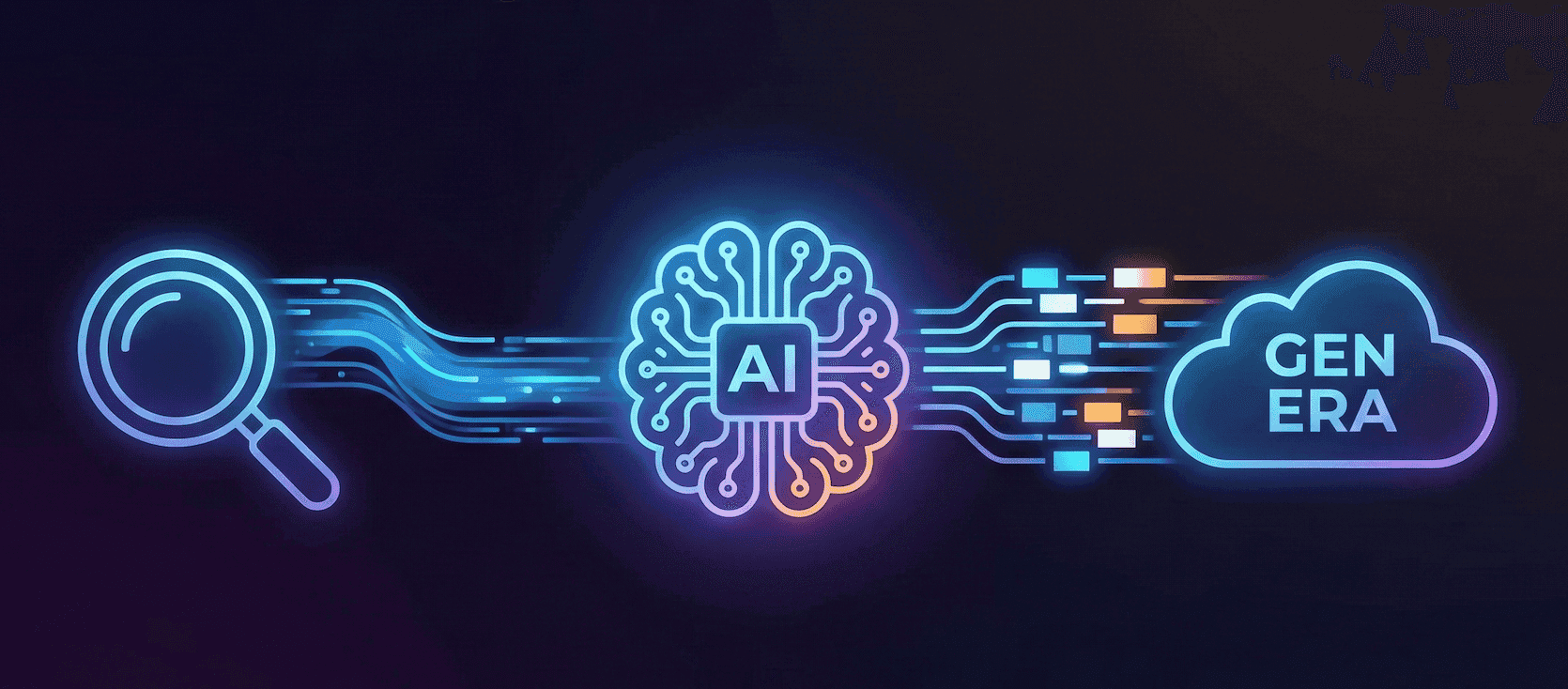
The "Great Decoupling" of Search
The digital marketing landscape is currently undergoing its most significant infrastructure shift since the introduction of mobile indexing. For two decades, the "search contract" was simple: a user queried Google, Google provided a list of blue links, and the user clicked through to a website.
In 2025, that contract has been broken. Search engines have evolved into "Answer Engines" that synthesize information from across the web into a single, cohesive response. While global search volume remains high, the click-through volume to websites is declining for informational queries.
This phenomenon is known as the "Great Decoupling." Traffic is no longer guaranteed by ranking; it is earned by citation.
The Problem: The "Visibility Gap" in AI Search
Traditional SEO prioritizes keywords, backlinks, and page speed to drive users to a destination. However, the introduction of AI Overviews (AIO) has fundamentally altered user behavior.
Data from Seer Interactive indicates a critical trend: when an AI Overview appears above the traditional results, the click-through rate (CTR) for organic links can drop by as much as 68%.
This creates a "Visibility Gap." If a user receives a satisfactory answer directly from the AI, they have no incentive to visit your website—unless the AI explicitly cites your brand as the source of that data. To solve this, businesses must pivot from traditional SEO to Generative Engine Optimization (GEO).
Understanding Retrieval-Augmented Generation (RAG)
To optimize for AI, one must understand how these models "read." Unlike a human who reads linearly from top to bottom, AI models use a process called Retrieval-Augmented Generation (RAG).
Retrieval: The AI scans the web for "chunks" of text that appear relevant to the query.
Augmentation: It ranks these chunks based on information density and authority.
Generation: It synthesizes the top-ranked chunks into a new answer.
If your content is buried in long paragraphs or fluff, the RAG process will skip it. To be included in the final answer, content must be structured specifically for machine retrieval.
Step 1: The "Answer-First" Framework
A landmark study from Princeton University analyzed which factors most influence an AI’s decision to cite a source. The findings were definitive: websites can increase their visibility in AI responses by 40% simply by utilizing "Answer-First" formatting.
This requires a strict structural overhaul of how content is written:
The 60-Word "Answer Block"
Every major H2 section of a blog post should begin with a direct, factual summary of 40 to 60 words. This block acts as a "pre-packaged" quote for the AI.
Incorrect: “There are many factors to consider when scaling ads, including budget and tracking...” (Too vague).
Correct: “Scaling Google Ads requires a consistent 20% weekly budget increase, verified by proper GTM tracking to prevent data loss during the scaling phase.” (High density, specific).
Semantic Questioning
Headlines must mirror the natural language users type into prompts. Instead of keywords like "Yoga Benefits," use semantic questions like "How does Hatha Yoga affect cortisol levels in high-stress professionals?" This ensures a direct match between the user’s intent and your content’s structure.
Statistical Density
The Princeton study noted that "Statistics Addition" is a primary signal for authority. AI models are trained to value data over opinion. Leveraging specific metrics—such as a $3M in managed ad spend—acts as a "trust signal" that distinguishes expert content from generic, AI-generated filler.
Step 2: Technical Verification Through Schema
While "Answer-First" content provides the raw data, Schema Markup provides the proof of ownership. In the era of mass-produced AI content, search engines have introduced a strict "verification layer" to determine who is a real expert and who is a hallucination.
Think of Schema as a Digital Nutrition Label embedded in your website's code. A human reader sees the blog post, but the AI reader scans this label to verify the ingredients (facts) and the manufacturer (author).
The "Person" Entity
To separate your brand from generic content farms, we implement Person Schema nested within the article code. This is not merely an author byline; it is a structured data set that explicitly tells the AI:
Identity: "The author is Martin Grozev."
Verification: "This person is the same entity found on this LinkedIn profile."
Authority: "This person has a documented history of managing $3M in ad spend."
By linking the content to a verifiable external source (like LinkedIn), we establish E-E-A-T (Experience, Expertise, Authoritativeness, and Trustworthiness) at the code level. The AI is far more likely to cite a statistic when it can trace the source back to a verified human entity.
The "Knowledge Graph" Connection
We further strengthen this by using Organization Schema with sameAs properties. This helps Google’s Knowledge Graph understand that "Du Marketing" is a legitimate business entity. When a user asks an AI to "compare top marketing agencies," the AI retrieves entities from this Knowledge Graph. Without this schema, your brand is simply a string of text; with it, your brand is a recognized database entry.
Step 3: The New Standard — llms.txt
As we move into late 2025, a new technical standard has emerged for "AI-First" websites: the llms.txt file.
Modern websites are often difficult for AI crawlers (like GPTBot or ClaudeBot) to read. They are cluttered with navigation menus, pop-ups, and tracking pixels that dilute the core message. The llms.txt file is a plain-text document placed at the root of your domain (e.g., yourdomain.com/llms.txt) that acts as a "VIP Entrance" for machines.
Function: It provides a clean, bulleted map of your most important services, case studies, and pricing models.
Benefit: Instead of the AI struggling to scrape your "About" page, it reads the
llms.txtfile to instantly understand your value proposition. This ensures that when the AI summarizes your business, it uses your approved facts, not a random guess.
The most efficient way to monetize this strategy is to sync your Google Ads data with your GEO Content. This creates a defensive "moat" around your ad spend.
Step 4: The Search-Sync Advantage (ROI Protection)
The Strategy:
The Ad Signal: You identify high-intent keywords where you are spending money (e.g., "Best B2B Lead Gen Strategies").
The Content Bridge: You create a specific "Answer-First" blog post that addresses that exact query.
The Trust Loop: When a user sees your ad, they often ask an AI for a second opinion. Because your blog post is optimized for GEO, the AI cites you as the expert answer.
The 3 Financial Benefits:
1. Zero-Cost Validation: You stop losing customers to competitors during the research phase. When a user checks your reputation on let’s say ChatGPT, your brand is the one being recommended, effectively "insulating" your paid traffic.
2. Lower CPA (Cost Per Acquisition): Data shows that users who see a brand in an ad and get a recommendation from an AI convert 3x faster. You pay for the click once, but the "AI verification" closes the deal.
3. Defensive Branding: If you don't own the AI answer for your own ad keywords, a competitor will. This strategy ensures you aren't paying €10/click just to send users to a competitor's "Best of" list.
The "AI-Ready" Technical Checklist
To ensure a website is fully optimized for the 2026 search landscape, it must pass this five-point audit:
Directness: Does every H2 section lead with a factual, 40-60 word summary?
Schema Identification: Is every post tagged with nested Person Schema linking to a verified LinkedIn profile?
llms.txt File: Is there a machine-readable map at the root of the site?
Bot Permissions: Is the
robots.txtfile configured to explicitly allow access to AI agents likeGPTBotandOAI-SearchBot?Search-Sync Alignment: Do you have an "Answer-First" blog post published for every high-cost keyword in your Google Ads account?
Conclusion: The End of the Keyword Era
The shift from "Search" to "Answer" is not a feature update; it is a fundamental infrastructure change. For twenty years, businesses have competed on keywords—renting attention through ads or earning it through volume.
In 2026, that currency is being devalued.
The brands that survive the "Great Decoupling" will not be the ones with the loudest blogs or the biggest ad budgets. They will be the ones with the cleanest data. When you structure your content for machines (GEO) and verify your identity with code (Schema), you stop fighting for a "click" and start securing your place in the Knowledge Graph.
This is the new dividing line in digital marketing: You are either an anonymous string of text that the AI summarizes and forgets, or you are a verifiable Entity that the AI quotes and recommends.
The infrastructure you build today determines whether your brand becomes a citation—or a footnote.