Your B2B Paid Search Strategy: From Clicks to Revenue

Most advice on B2B paid search is stuck on the wrong goal. It treats success as a spreadsheet full of cheap demo requests, ebook downloads, and contact form fills. Founders love that dashboard for about two weeks. Then sales says half the leads were students, consultants, competitors, or people who wanted a template and vanished.
That’s the trap. A B2B paid search strategy that optimizes for lead volume can look healthy while revenue stays flat. The actual job isn’t getting more conversions in Google Ads. It’s building a system that tells you which clicks turned into qualified pipeline and closed-won deals.
This matters more than ever because B2B buyers don’t move in straight lines. They search repeatedly, compare vendors, involve other stakeholders, disappear, return, and only then talk to sales. If your tracking ends at a thank-you page, you’re flying blind. If your CRM and ad platforms don’t talk to each other, you’re paying to learn the wrong lesson.
A lot of dashboards are lying. If you want a sharper lens on what matters, this breakdown of the marketing metrics that actually matter) is worth reading alongside your campaign reports.
Table of Contents
Stop Chasing Leads and Start Driving Revenue
Lead volume is one of the fastest ways to fool a CEO.
In B2B paid search, a form fill is only useful if it turns into qualified pipeline and closed revenue. We see the same failure pattern in startup accounts over and over. Google Ads is set to optimize toward demo requests, contact forms, or ebook downloads. Sales qualification happens in the CRM. Opportunities get created later. Closed-won revenue sits in a separate report. The ad platform never sees that downstream outcome, so it keeps buying more of the clicks that generate cheap conversions instead of actual customers.
That is how teams end up defending strong CPL while revenue stalls.
The fix is simple to describe and harder to implement. We need to connect click data to CRM stages the ad platforms can use for optimization. That means syncing offline conversions back into Google Ads based on milestones that matter to the business, not just to marketing. If a keyword creates fewer leads but more sales accepted opportunities, pipeline, and won deals, that keyword is doing better work.
Practical rule: If the ad platform cannot see pipeline quality, it will optimize for low-friction conversions.
This changes how we judge performance across the account. Lower conversion rate can be a good sign if tighter messaging filters out students, job seekers, consultants, and tiny accounts. Higher CPL can be a good trade if those leads create real opportunities. A landing page that cuts form volume by 30 percent may still improve revenue efficiency if sales stops wasting time on bad-fit inbound.
The companies that get this right stop treating paid search like a lead vending machine. They treat it like a revenue input with feedback loops. That requires a tighter measurement model than the average dashboard, which is why we track stage-to-stage progression and focus on the marketing metrics that actually matter instead of celebrating raw conversion totals.
Paid search becomes much easier to scale once four questions have clear answers:
Which searches create qualified pipeline
Which campaigns produce opportunities, not just contacts
Which ads attract accounts that can buy
Which clicks turn into closed-won revenue
If we can answer those, budget decisions get sharper, bidding gets smarter, and the board conversation improves. If we cannot, we are still paying for activity and hoping revenue shows up later.
The Strategic Blueprint Before You Pay for a Click
Paid search usually fails long before launch. The problem is not ad copy or bid strategy. It is weak commercial planning, disconnected tracking, and a campaign brief that never answers who can buy, why they buy, and how that click will be tied back to revenue in the CRM.
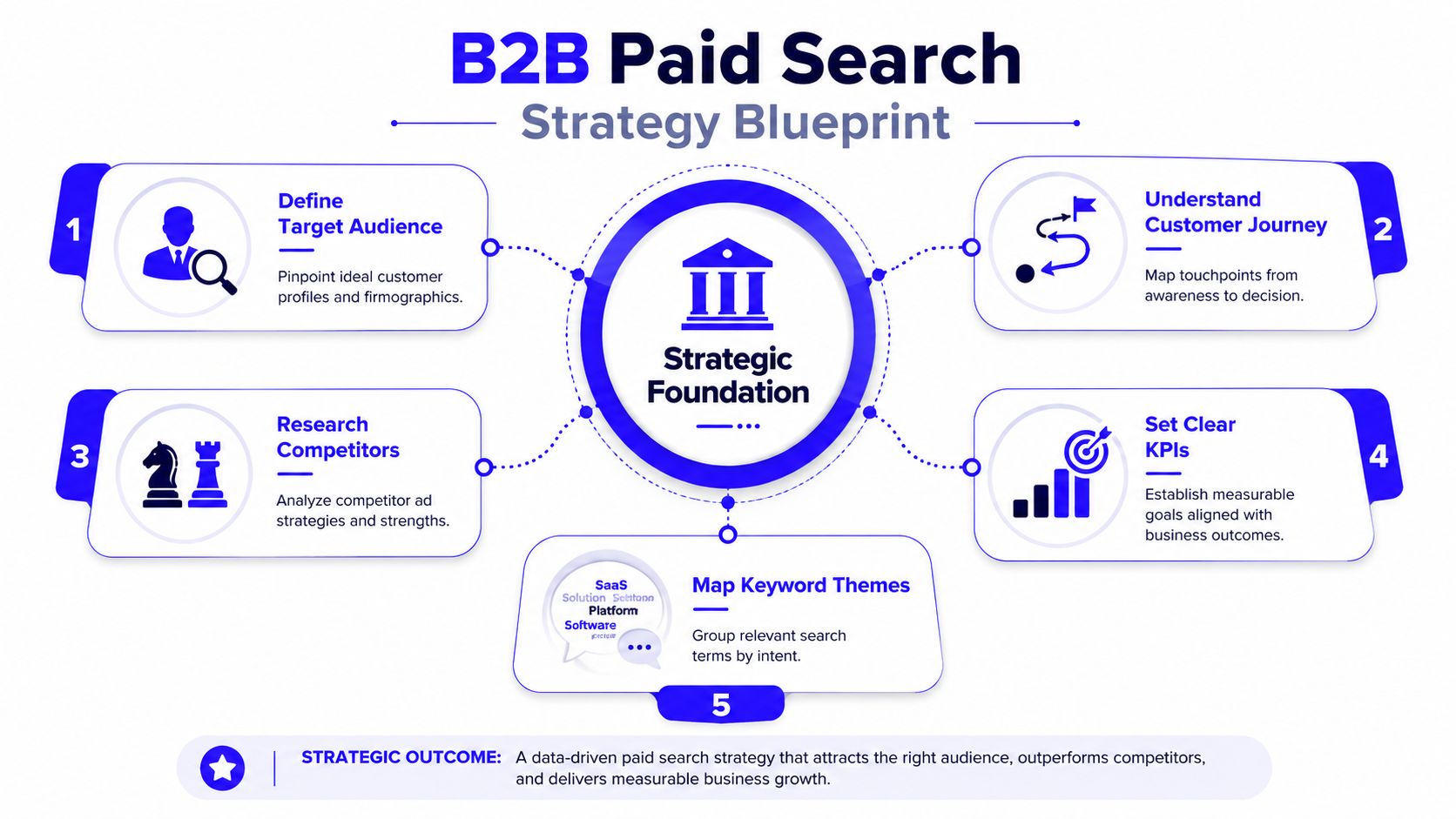
A useful blueprint does three jobs before spend starts. It defines the buying context, sets the search coverage by intent, and decides what conversion signals will be pushed back into the ad platform. If we skip that work, Google optimizes for form fills, sales complains about quality, and leadership still cannot see which campaigns produced pipeline or closed-won revenue.
Define the buyer before you define the budget
An ICP for paid search has to be specific enough to filter traffic, shape messaging, and improve downstream conversion quality. “Mid-market SaaS” is too broad to do any of that.
We need to know:
What triggered the search. Compliance pressure, tool sprawl, failed onboarding, broken reporting, headcount growth, procurement pressure.
Who starts the process. Founder, operations lead, finance owner, IT admin, RevOps manager.
What could block the deal. Security reviews, integration risk, unclear implementation scope, missing executive support, budget limits.
What makes the account worth pursuing. Contract value, sales cycle fit, expansion potential, implementation readiness.
That level of clarity changes the account fast. It changes the keywords we allow, the exclusions we add, the landing page proof points we lead with, and the form fields we ask for. It also gives us the raw material for predictive lead scoring that stops feeding your sales team junk, which matters if we want ad platforms trained on qualified pipeline instead of cheap conversions.
A broad term like “payroll software” can still have value. It just needs stronger controls, tighter copy, and a clear plan for qualification. A narrower term like “enterprise payroll software for healthcare” often costs more per click, but it usually saves money later in sales time, demo quality, and win rate.
Map searches to buying stages
Search intent is not one bucket. The same market searches differently at each step, and each step deserves different expectations.
A practical search map looks like this:
Buyer stage | Search pattern | What the searcher is signaling |
|---|---|---|
Problem aware | “how to reduce churn in SaaS” | They feel the pain but may not know the category |
Solution aware | “customer success platform for B2B SaaS” | They are evaluating solution types |
Vendor aware | “best customer success software pricing” | They are comparing vendors and likely building a shortlist |
Brand aware | “Brand X alternatives” or “Brand Y demo” | They are close to action |
The mistake is treating all four stages as equal on day one. Early-stage startups usually get better results by starting where intent is easier to read and qualification is easier to enforce. That usually means solution-aware, vendor-aware, and selected competitor terms first.
Problem-aware searches can work. They often create more noise, longer sales cycles, and weaker self-qualification. We use them when the sales team can handle education, the economics support a longer path to revenue, and offline conversion tracking is already stable enough to tell us whether those clicks ever become opportunities.
Choose the channel for the job
Channel choice is an economics decision.
Google Search is still the default for capturing active demand. Microsoft Ads often deserves a test sooner than teams expect, especially in B2B categories where CPCs are inflated on Google and the audience skews toward office-based buyers. LinkedIn works best as a supporting layer when persona targeting matters more than immediate search intent, especially for retargeting, account-list amplification, and message sequencing around high-value accounts.
The right mix depends on what we are trying to learn. If the priority is demand capture, search goes first. If the priority is account coverage for a named list, paid social can support it. If the priority is revenue attribution, we avoid adding channels faster than we can measure them.
That last point matters more than channel theory. A startup with one clean search program tied to CRM stages will usually make better budget decisions than a startup spreading spend across three platforms with no reliable closed-won feedback loop. Before the first click, decide which lifecycle stages count as optimization signals, how they will sync back into Google Ads, and who owns the handoff between marketing ops and sales ops. Without that, the account can generate activity for months and still tell you very little about revenue.
Architecting Campaigns That Capture High-Value Intent
Campaign architecture is where decent strategy either becomes profitable or collapses into waste. The biggest mistake is organizing campaigns around whatever came out of a keyword tool, then stuffing broad match terms, generic ads, and a catch-all landing page into the same account.
That structure creates noisy search term reports, fuzzy ad relevance, and conversion data you can’t trust.

Build around intent themes, not messy keyword buckets
The cleanest setup for B2B is usually intent-first. That means campaign themes such as competitor alternatives, category plus industry, integration-driven searches, pricing-driven searches, and pain-point searches.
Each theme gets its own logic:
Competitor campaigns need comparison language and clear differentiation.
Industry campaigns need vertical proof and language that signals fit.
Integration campaigns should name the systems buyers already use.
Pricing campaigns should pre-qualify with budget signals rather than hide from them.
This is also where we separate learning agendas. If one campaign targets “SOC 2 compliant project management software” and another targets “project management software,” they should not be judged as if they serve the same buyer. They don’t.
Use long-tail keywords to pre-qualify the click
Many startup accounts finally get efficient by focusing on the right keywords. Long-tail keywords with four or more words can produce conversion rates of 10% to 15%, often 3x higher than generic terms, according to Keywordtool.io’s discussion of long-tail keywords. The same source notes that campaigns allocating 40% to 50% of spend to these higher-intent terms often report 4:1 ROAS improvement.
That tracks with what practitioners see every day. Generic terms attract curiosity. Long-tail terms attract buyers with context.
A useful workflow looks like this:
Start with buyer language, not SEO vanity terms. Pull phrasing from sales calls, Gong snippets, CRM notes, and customer questions.
Expand with tools such as Ahrefs, SEMrush, and KeywordTool.io. Look for modifiers like industry, compliance, team size, integration, migration, and pricing.
Launch exact-match and tightly controlled phrase-match sets first. Don’t dump everything into broad match and hope the algorithm understands your market.
Review search terms aggressively. Search term review is where intent quality is won or lost.
If your sales team keeps saying “these leads don’t fit,” odds are your keyword strategy is still too generic. That’s why this guide on predictive lead scoring and cleaning up bad lead flow pairs well with search term analysis.
Ad copy should filter, not flatter
A lot of B2B ad copy tries to sound impressive. That’s backwards. Search ads should qualify the visitor before the click.
Use copy that signals fit:
Mention the audience. “For finance teams,” “for healthcare operations,” “for multi-location franchises.”
Name the use case. “Automate onboarding workflows,” “track pipeline by rep and region.”
Reference operational details. Integrations, implementation model, pricing approach, security language.
Set expectations. If you serve larger teams, say it. If onboarding is guided, say it. If the product isn’t for tiny businesses, imply that politely.
Better ad copy doesn’t just increase clicks. It reduces bad clicks.
Negative keywords need a taxonomy, not a random list
Most accounts have the usual negatives like free, jobs, and training. That’s not enough for B2B.
You need intent-based negative themes. Think in clusters:
Negative theme | Example searches you usually don’t want |
|---|---|
Learning intent | tutorial, definition, example, guide |
Student intent | course, certification, syllabus |
Technical research with no buying signal | pdf, diagram, template |
DIY intent | open source, github, build your own |
Career intent | jobs, salary, interview |
The point isn’t to block every top-of-funnel query. The point is to stop paying for traffic that has no path to revenue. This is especially important in solution categories where educational and buyer intent overlap.
Good campaign architecture feels narrow on purpose. That’s usually a sign you’re finally targeting adults with budgets instead of everyone with a keyboard.
Building the Revenue Attribution Pipeline
Lead tracking is where B2B paid search teams start. Revenue tracking is where paid search earns budget.
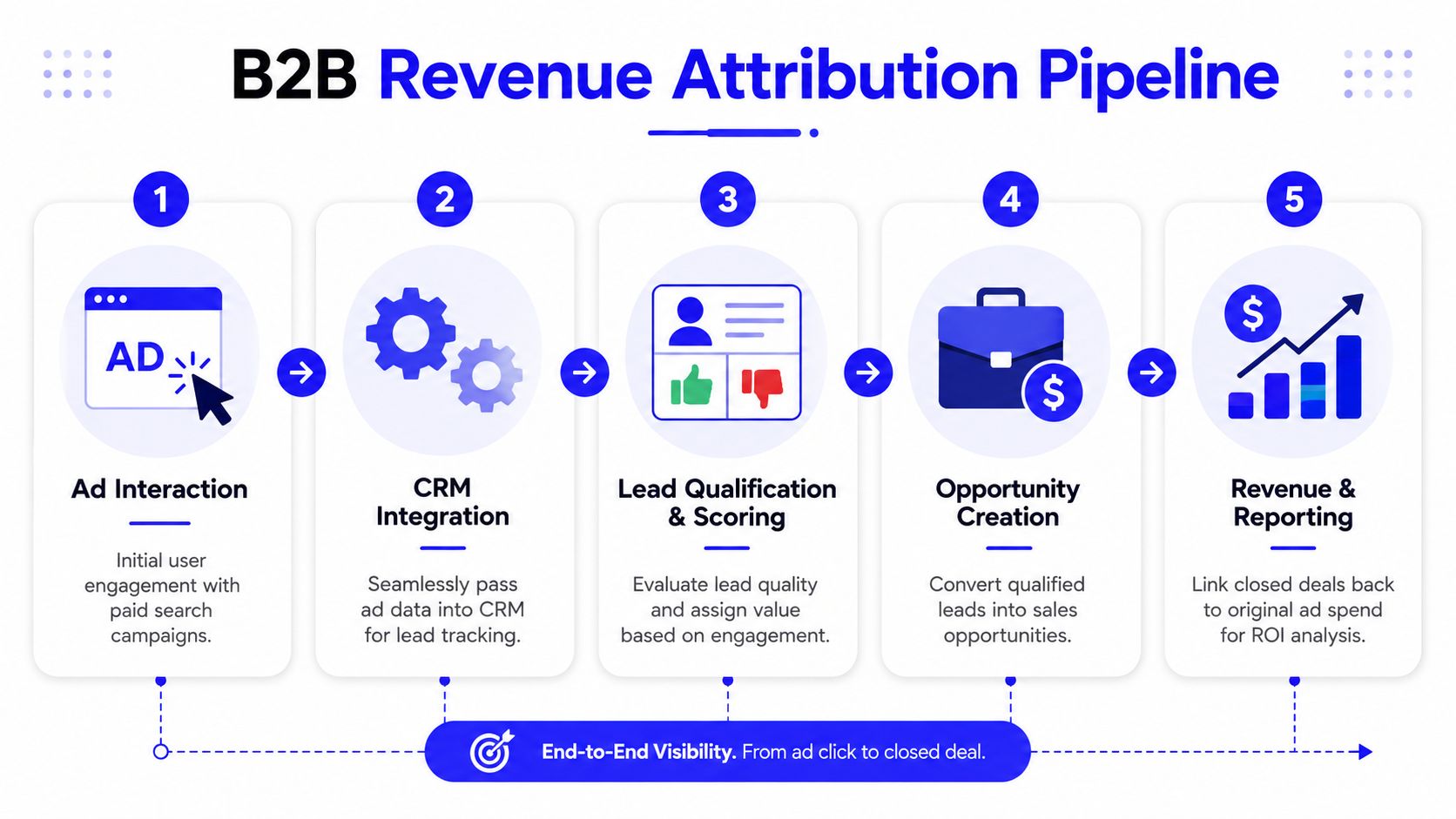
The gap between those two is usually a broken handoff. Google Ads records a form fill. The CRM records a contact. Sales creates an opportunity three weeks later. Finance recognizes revenue two months after that. If those records do not share click data and consistent stage definitions, the ad platforms optimize toward activity, not pipeline.
Why thank-you page tracking breaks in B2B
A thank-you page conversion answers one question. Did someone submit a form?
It does not answer the questions that matter to a CEO or board. Was the account a fit? Did sales accept it? Did it become pipeline? Did it close?
B2B buying cycles are long, multi-person, and full of delays between the click and the outcome. That makes early conversion signals useful, but weak as optimization targets on their own. We still track form fills. We just do not mistake them for proof of revenue.
A practical setup for startup teams
Startup teams do not need a warehouse project to close this attribution gap. They need a clean path from click ID to CRM stage to offline conversion import.
The first requirement is field capture. When someone arrives from Google Ads or Microsoft Ads, the landing page needs to preserve the click identifier, usually gclid or msclkid, along with UTM data. Those values need to pass through the form and land on the contact, lead, or company record in the CRM. GTM, hidden fields, and form testing usually handle this. The hard part is not implementation. It is making sure the values survive every CMS edit, form swap, and routing workflow.
Then map the process in a way the team can maintain:
Ad click
The visitor lands with UTMs and a click ID.
The site stores those parameters long enough for the form submission to capture them.
CRM record creation
HubSpot, Salesforce, Pipedrive, or another CRM creates the record.
Source data is written to fields the sales and ops teams can audit later.
Sales qualification
A rep or SDR reviews the lead against clear criteria.
The stage change reflects real qualification, not an automated status update based on form completion.
Opportunity creation
The opportunity or deal record inherits the original click data, or stays linked to the lead/contact that holds it.
This is the point where paid search starts connecting to pipeline instead of top-of-funnel volume.
Offline conversion sync
SQL, opportunity, and closed won events are sent back to Google Ads or Microsoft Ads.
If revenue values are available, import them with consistent rules. If they are not, use a value model tied to historical close rates and ACV bands.
Later in the section, this walkthrough is useful as a visual companion:
If the CRM stage cannot be tied back to the original click ID, the account is being optimized on assumptions.
Which CRM stages should go back into ad platforms
Sending every CRM update back to the ad platforms creates noise. Sending only closed won starves the system. The right answer is usually a staged approach.
For many startups, three imported milestones are enough:
Qualified lead after sales confirms fit
Opportunity created once there is a real deal path
Closed won once revenue is booked
Each stage serves a different job. Qualified lead gives the platform faster feedback. Opportunity created is often the best balance between speed and quality. Closed won is the cleanest signal, but it arrives late and in lower volume. We usually optimize toward the deepest stage that still gives enough conversion volume to train bidding.
Stage quality matters as much as stage selection. If one rep marks any demo request as qualified and another applies strict ICP filters, the ad account learns from inconsistent inputs. Fix that before touching bidding strategy. This review of CRM tracking blunders that kill ROAS) covers the cleanup work that often improves paid search performance faster than another round of ad tests.
The process failures that wreck attribution
Attribution usually fails in operations, not theory.
The recurring problems are familiar:
Broken field capture. Forms submit, but hidden fields miss click IDs on some pages or devices.
Stage drift. Sales and marketing use the same stage names to mean different things.
Late imports. Offline conversions are pushed back days or weeks after the stage change, which slows optimization.
Weak QA. Someone tests the flow once, then assumes it still works after a redesign or CRM workflow change.
Shallow optimization targets. Campaigns are tuned to MQLs or form fills because they are easy to measure, even when they rarely turn into revenue.
The fix is disciplined verification. Run test submissions through the full path. Confirm the click ID is captured. Confirm it appears in the CRM. Advance the test record through the right stages. Confirm the offline conversion lands in the ad platform with the expected name, timestamp, and value. Repeat that check after every form update, routing change, CRM field edit, and site release.
That is the pipeline investors care about. Spend in, revenue out.
Mastering Bids, Budgets, and the Optimization Cadence
Too many teams treat bidding, budgets, and landing pages as separate tasks. They’re one control loop. Bid too aggressively on weak traffic and you flood the funnel with bad leads. Cap budgets without understanding demand and you starve good campaigns. Fix neither while leaving weak landing pages untouched, and the account never stabilizes.
That’s why optimization in B2B has to be system-level.
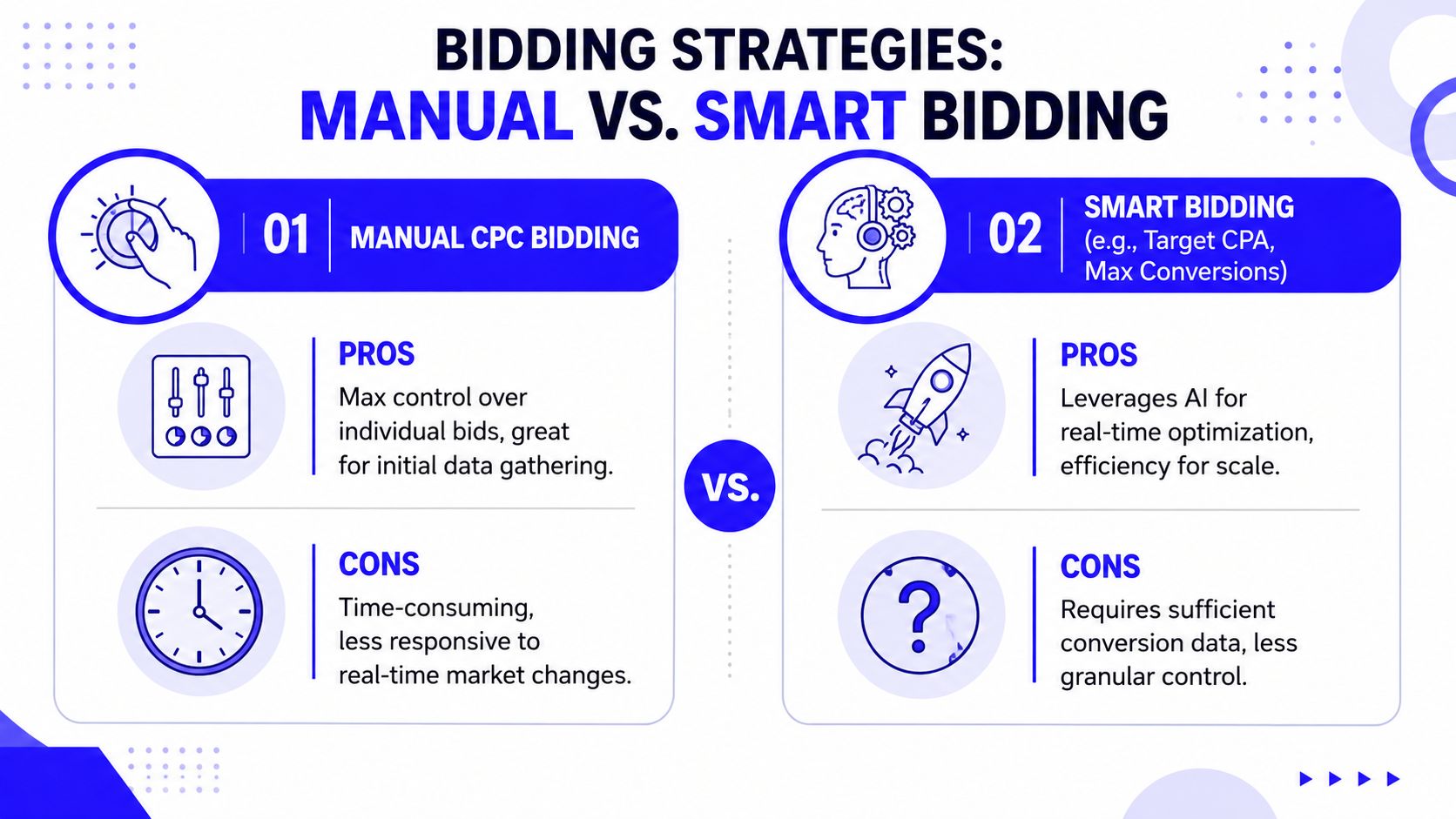
Manual first, automation second
Smart bidding is powerful. It’s also dangerous when the account doesn’t have enough signal quality.
Google Ads guidance says automated bidding models need at least 30 conversions in the last 30 days to perform reliably, and campaigns that first use manual bidding to cross that threshold see 25% more stable conversion rates than campaigns that automate too early, based on the benchmark summarized with Google Ads automated bidding guidance. For B2B, that matters because lead volume is often lower and sales cycles are longer.
So the sequence should usually look like this:
Stage | Best fit | Why |
|---|---|---|
Early launch | Manual CPC | You need clean data and tight control |
Post-threshold | Maximize Conversions or Target CPA | The platform finally has enough history to learn |
Mature revenue model | Revenue-aware bidding | Only after offline stages are trustworthy |
The common mistake is flipping on automation because it sounds advanced. It isn’t advanced if the underlying data is junk.
One hard rule: Never hand the wheel to automation before you trust the conversion signal.
Budgeting is a signal management problem
Budgeting in B2B isn’t just finance. It determines what the algorithm can learn.
If budgets are too thin across too many campaigns, nothing gathers enough data to mature. If one broad campaign absorbs everything, it learns from the easiest clicks, not the best ones. Budget concentration matters.
We usually make budgeting decisions with three questions:
Which campaigns target the clearest purchase intent
Which themes produce qualified opportunities in the CRM
Which campaigns are still in learning mode and need controlled spend
This is why fragmented accounts underperform. Six half-funded experiments are often worse than two tightly managed campaigns with enough room to gather signal.
Landing pages are part of bidding performance
Paid search teams love to blame keywords for what landing pages break.
If the ad promises industry fit, the page needs to show it. If the keyword implies integration urgency, the page should confirm supported systems fast. If the audience is high-consideration B2B, the page should reduce risk with proof points, implementation clarity, and sane form friction.
A useful landing page review checks for:
Message match between search term, ad, and headline
Fast qualification through industry, use case, or team-size cues
Credibility elements such as customer logos, product screenshots, and implementation detail
Form design that captures enough context without creating pointless resistance
Weak pages distort bidding decisions because they make good traffic look bad.
A weekly cadence that keeps campaigns honest
Optimization shouldn’t be constant fiddling. It needs rhythm.
A practical weekly cadence looks like this:
Review search terms and add negatives based on intent quality.
Check CRM outcomes by campaign and keyword theme, not just platform conversions.
Adjust bids or targets carefully, especially after stage-quality changes.
Inspect landing page behavior for drop-off patterns and message mismatch.
Document changes so you know what specifically caused movement later.
That cadence keeps you from making panicked changes based on incomplete data. In B2B, patience matters, but passive management kills accounts. The right pace sits between those extremes.
Your Continuous Optimization Playbook
B2B paid search wins or loses in the handoff between the ad platform and the CRM. If that handoff is weak, optimization turns into guesswork. Teams keep funding campaigns that generate form fills but never turn into pipeline, while the keywords that influence real deals stay underfunded because the platform never sees the outcome.
We treat optimization as revenue operations with media buying attached. The job is to keep tightening the connection between click, qualified pipeline, and closed-won revenue so bidding decisions reflect what the business values.
That changes what gets reviewed.
Here’s the playbook we’d hand to a startup team running paid search with real pipeline accountability:
Audit signal quality every week. Check whether click IDs are passing correctly, whether leads are matching to contacts and accounts in the CRM, and whether offline stages are being sent back to Google Ads without gaps or delays.
Optimize to stage progression, not raw lead volume. Review performance by campaign, keyword theme, and landing page against sales accepted leads, opportunities, and closed-won revenue where volume allows.
Set bid strategy around actual feedback loops. If deal cycles are long, use earlier offline milestones like qualified opportunity instead of waiting on revenue. If close rates are stable and volume is healthy, import closed-won values and let bidding learn from revenue.
Cut waste where CRM data proves it. Pause search terms and themes that keep producing low-fit accounts, no-shows, or stalled deals, even if the platform reports cheap conversions.
Reallocate budget to revenue density. Put more spend behind segments that produce higher-value opportunities, faster progression, or stronger win rates, not just lower cost per lead.
Document every meaningful change. If bids, budgets, landing pages, or qualification rules shift, log it. Otherwise the team ends up arguing over performance moves nobody can explain two weeks later.
The reporting should match that discipline. A useful monthly view for leadership includes spend, pipeline created, opportunity rate, win rate, closed-won revenue, and time lag by campaign theme. That last piece matters. Plenty of B2B programs look weak inside a 30-day window and strong inside a 90-day one. If the board reviews paid search on platform conversions alone, the channel gets judged by the wrong clock.
We also separate optimization decisions by data maturity. New campaigns get judged on search term quality, CTR, CPC, and qualified lead rate because there is not enough downstream data yet. Established campaigns should earn budget based on pipeline and revenue contribution. Mixing those stages causes bad calls. Teams kill promising campaigns too early, then keep mature campaigns alive because the top-of-funnel numbers still look clean.
The goal is simple. Make the ad platform learn from sales outcomes, make the CRM expose which intent closes, and make budget allocation follow revenue instead of lead counts.
If you want a hands-on operator to build the tracking, CRM sync, campaign structure, and reporting loop behind your paid search program, Du Marketing does exactly that for startups. The focus isn’t more dashboard noise. It’s connecting acquisition to pipeline and revenue with one integrated system.