Affiliate Program Management: A Startup's Playbook

You launched an affiliate program because it looked efficient. A few partners signed up, links went live, and clicks started appearing in the dashboard. Then the mess began.
One affiliate claimed they drove a deal your sales team says came from branded search. Another sent a batch of leads that looked good at signup but went nowhere in the pipeline. Finance asked what commissions are owed. Sales wanted to know which partners bring real opportunities, not form fills. Nobody had one answer because the tracking stopped at the click.
That's the common startup version of affiliate program management. Not a passive channel. An attribution problem wearing a partnership costume.
Table of Contents
Your Guide to Affiliate Program Management
Affiliate program management gets sold as easy money. Add software, recruit a few partners, pay commissions, and let the channel run. That version exists mostly in pitch decks.
In practice, startups run into three problems fast. First, they recruit partners before they know what a good partner looks like. Second, they track clicks and signups but not closed revenue. Third, they confuse partner volume with partner quality. That's how a channel that should be performance-driven turns into a dispute factory.
The channel is large enough that this isn't a side project anymore. Digital Applied's 2026 affiliate marketing data says global affiliate marketing spend reached an estimated $19.4 billion in 2026, nearly doubling from $9.6 billion in 2020. That scale is exactly why sloppy operations get expensive.
Practical rule: If you can't connect an affiliate click to a contact, an opportunity, and revenue in your CRM, you don't have affiliate program management. You have a referral guessing game.
The workable approach is operational. Build the strategy first. Wire the tracking so finance and sales can trust it. Recruit fewer partners, but better ones. Then manage the program like a revenue system, not a sign-up form.
Laying the Foundation Your Affiliate Program Strategy
Most affiliate programs fail before launch because the owner starts with payout ideas instead of partner-market fit. Start with the market. Then define partner types. Then decide how money moves.
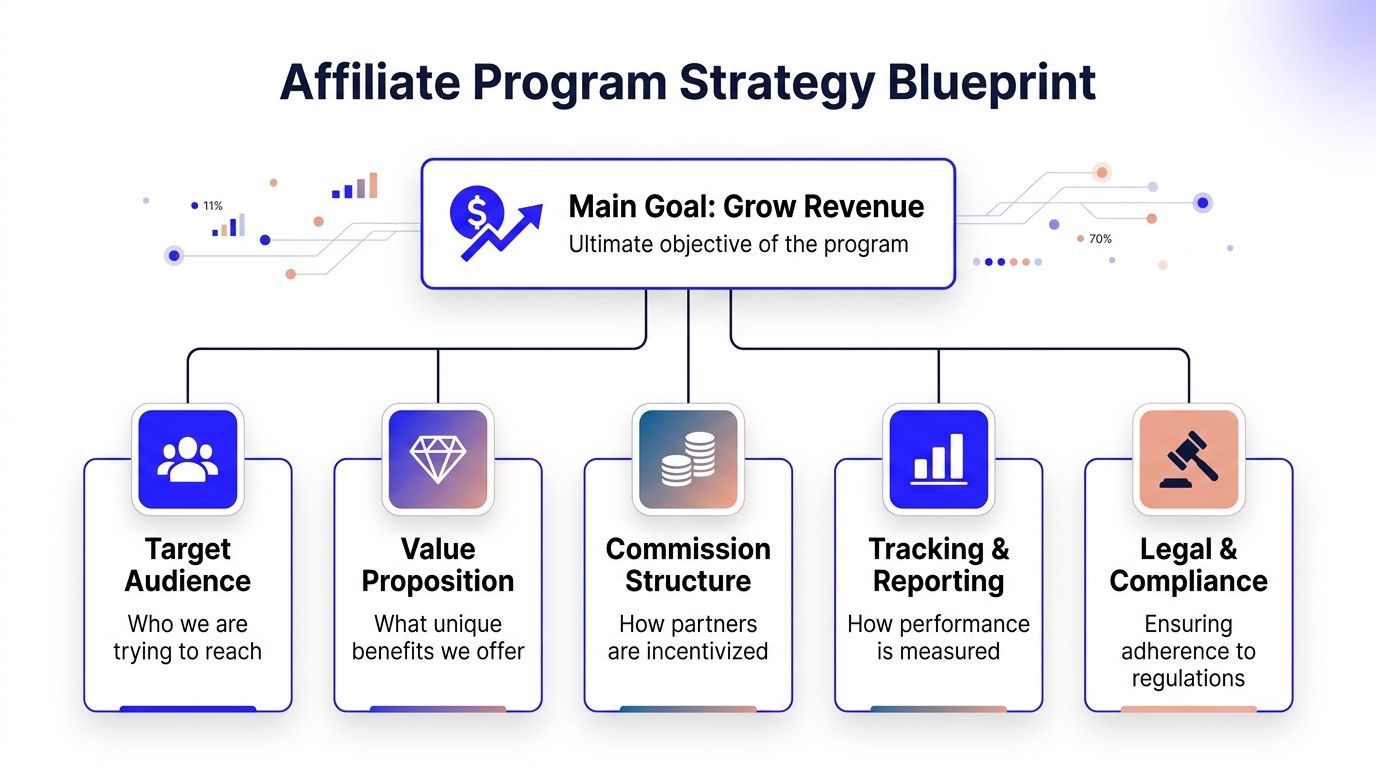
Start with the market, not your assumptions
Review competing programs the same way you'd audit paid landing pages. Look at who they recruit, what actions they pay on, how strict their rules are, and what assets they provide. For B2B and SaaS, pay attention to whether competitors reward trials, demos, qualified opportunities, or closed customers. That tells you where they trust attribution and where they don't.
Use a simple comparison grid:
Program element | What to inspect | Why it matters |
|---|---|---|
Partner type | Review sites, consultants, creators, agencies, communities | Shows who already influences buying decisions |
Conversion event | Lead, trial, demo, purchase, closed deal | Reveals attribution maturity |
Incentive style | Flat CPA, revenue share, hybrid, tiered | Signals risk tolerance |
Program rules | Brand bidding, coupon use, traffic restrictions | Prevents channel conflict later |
Partner assets | Landing pages, copy blocks, banners, comparison sheets | Affects activation speed |
The benchmark isn't there so you can copy it. It's there so you don't launch a commission structure that either attracts junk traffic or scares away serious partners.
Define an Ideal Partner Profile
Most startups write “creators, influencers, and publishers welcome” and call that strategy. That's not specific enough to recruit well or to reject the wrong applications.
An Ideal Partner Profile should mirror your best customer paths. If your best deals come from comparison research, your strongest partners may be review sites, consultants, and niche educators. If your product closes through outbound-assisted demos, partners who can frame use cases and pre-qualify intent will beat high-traffic publishers every time.
Useful filters include:
Audience fit: Does the partner speak to the same problem your best customers are trying to solve?
Content format: Are they good at tutorials, comparisons, implementation guides, webinars, or email recommendations?
Traffic intent: Do visitors arrive to learn, compare, or buy?
Commercial behavior: Do they push everything, or do they select products with care?
Operational fit: Can they follow tracking rules, disclosures, and content guidelines?
The strongest affiliate partner often isn't the loudest publisher. It's the one whose audience already trusts their buying advice.
For early-stage SaaS, I'd rather work with a consultant who sends a handful of high-intent introductions than a broad publisher who floods the CRM with weak demo requests. Partner selection decides downstream sales efficiency.
Choose a commission model finance can live with
Commission design is where many programs become unstable. The wrong model creates friction between marketing, sales, and finance because each team is measuring a different outcome.
Use the model that matches your sales motion:
CPA: Best when the conversion event is immediate, clearly defined, and low-dispute.
Revenue share: Useful when customer value unfolds over time and you can reliably connect affiliate ID to revenue events.
Hybrid: Good for SaaS when you want a small reward for a tracked action and a larger reward when revenue is confirmed.
Tiered payouts: Effective once you know which partners produce clean volume and strong downstream quality.
Keep the trade-offs explicit.
Model | What works | What breaks |
|---|---|---|
CPA | Simple partner pitch, easy to forecast | Can attract low-quality lead generation |
Revenue share | Aligns with long-term value | Harder to administer without CRM sync |
Hybrid | Balances activation and quality | Requires clean attribution logic |
Tiered | Rewards proven partners | Creates noise if tiers are based on vanity metrics |
Document one more thing before launch. Why would a good partner choose your program instead of another one? Faster approval, cleaner reporting, better landing pages, exclusive assets, or a product that converts well are all valid answers. “We pay commissions” is not a differentiator.
Building the Machine Tech Tracking and Attribution
Affiliate tracking that ends inside an affiliate dashboard is good enough for hobby programs. It's not good enough for a startup with a sales team, a CRM, and a finance function that wants clean books.
New Media affiliate marketing statistics note that affiliate channels influence 16% of all US e-commerce transactions, and mobile affiliate spending is growing 49% year-over-year. That's a strong reminder that cross-device attribution isn't optional when real revenue is at stake.
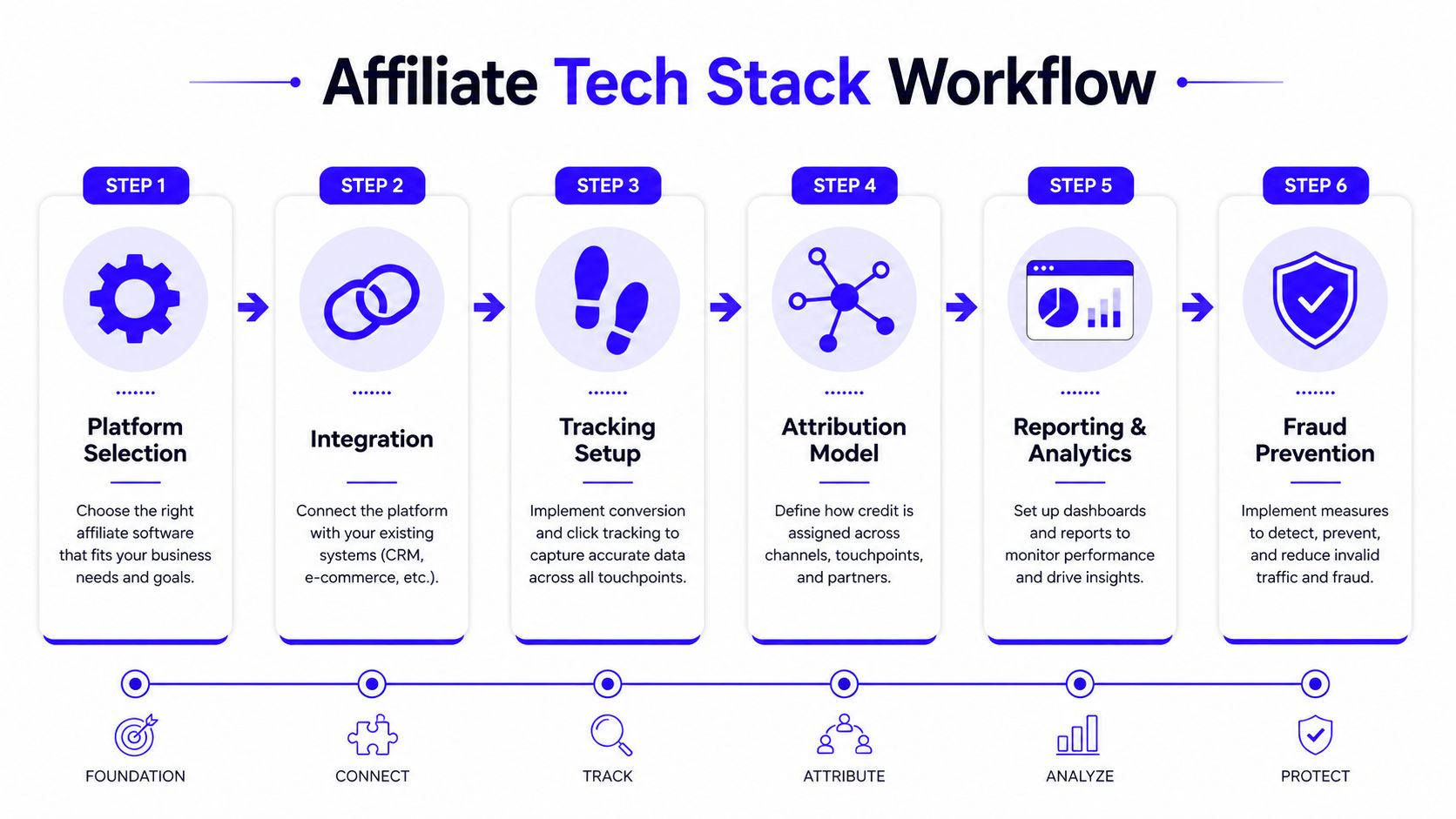
Map the data path before you buy software
Start with the data journey, not the software demo. The question isn't “Which affiliate platform is popular?” The question is “How does a partner click become a commissionable revenue record?”
A practical startup data path looks like this:
Affiliate click recorded with affiliate ID, sub ID, landing page, timestamp, and campaign parameters.
First-party session capture through GTM and landing page logic.
Lead or signup event sent into GA4 and your CRM.
Affiliate identifiers stored on the contact, company, and if needed the opportunity.
Opportunity stages update as sales works the lead.
Closed revenue fed back to the affiliate source record for payout and ROI reporting.
If your affiliate software can't pass consistent identifiers into your CRM, keep looking. If it can track conversions but not revenue reconciliation, expect payout disputes later.
Use client-side tracking, then harden it with server-side events
GTM gives you flexibility. Use it to standardize affiliate parameters, capture click data, and fire conversion events into GA4. Don't let every landing page or form tool invent its own logic. Standardization matters more than cleverness.
On the client side, define what you'll persist and for how long. Usually that means affiliate ID, source detail, landing page, and the original entry timestamp, all written into first-party storage and then passed into forms or app sign-up events.
Then harden the setup with server-side tracking. For many teams, that means a combination of server-side event forwarding and platform APIs such as Meta CAPI where relevant. For B2B, it can also mean your own endpoint that receives validated lead and opportunity events from the product or backend. Client-side-only tracking breaks more often than teams think because browsers, consent conditions, and cross-device journeys all create gaps.
A few implementation rules save a lot of pain:
Keep one canonical affiliate ID field: Don't let different tools create multiple versions.
Stamp the first touch and latest affiliate touch separately: They answer different questions.
Pass IDs into hidden fields carefully: Then verify they arrive in the CRM.
Name events consistently: “Demo booked” and “request_demo” should not be two different business events.
Log failures: If form submissions drop affiliate parameters, you want to know quickly.
If your broader attribution setup is already messy, this breakdown of CRM tracking blunders that kill ROAS) is worth reading before you pile affiliate logic on top.
Build affiliate tracking the same way you'd build paid media attribution. With persistence, validation, and reconciliation.
Push affiliate data into the CRM
This is the part most guides skip. It's also the part that turns affiliate program management from a marketing task into a revenue system.
For HubSpot or Pipedrive, create explicit fields for affiliate source data. Don't hide it in notes or generic UTM properties. The sales team should be able to see, at a glance, whether a lead came from an affiliate, which partner drove it, and what content or campaign context existed at the time of conversion.
At minimum, store:
CRM field | Purpose |
|---|---|
Affiliate ID | Canonical partner reference |
Affiliate name | Human-readable reporting |
Sub ID or placement | Tracks content source or campaign variant |
Original affiliate landing page | Supports QA and content analysis |
First affiliate touch date | Establishes sequence |
Last affiliate touch date | Helps reconcile multi-touch journeys |
Commission status | Draft, approved, held, rejected |
Revenue value | Enables ROI by partner |
Then connect opportunity updates back to the attribution record. If a lead becomes sales qualified, enters proposal, or closes won, that state should be available for reporting and payout decisions. For SaaS, if expansion or churn matter to payout logic, feed those states back too.
This is also where partner quality gets exposed. A partner that looks strong on clicks and form fills can look weak once you inspect stage progression, sales acceptance, and closed revenue.
Build for audits, not screenshots
If finance asks why a commission was paid, “the platform said so” is not an audit trail. Keep records that can be checked.
A clean audit workflow includes:
Raw click logs tied to affiliate identifiers
Captured lead records in the CRM
Opportunity linkage from contact to deal
Revenue confirmation from your sales pipeline or billing source
Commission status notes that explain holds, reversals, or approvals
Use Looker Studio, your CRM reports, or both for visibility. But keep the source-of-truth logic documented outside the dashboard. Dashboards summarize. They don't adjudicate disputes.
Launch and Recruit Finding and Activating Your First Partners
The first wave of partners shapes your program's reputation. Recruit sloppy, and you'll spend months cleaning up bad traffic, vague expectations, and coupon behavior you never wanted. Recruit carefully, and the early cohort becomes the template for how the program works.

Recruit like you're hiring specialists
Good affiliate recruiting looks more like business development than list blasting. Start with a shortlist built from real fit signals: niche relevance, content quality, audience intent, disclosure habits, and evidence that the partner can explain your category clearly.
That last part matters more than many teams think. A partner who educates well can pre-qualify leads before they ever hit your sales team. That reduces friction all the way down the funnel, much like a well-defined marketing qualified lead process improves handoff quality between marketing and sales.
Use a practical screening pass before outreach:
Read their content: Check whether they review products thoughtfully or just stuff pages with links.
Inspect commercial alignment: Look at the tools and vendors they already recommend.
Check audience overlap: Ask whether their readers sound like your customers.
Review operational maturity: Disclosures, contact details, media kit, and publishing consistency all matter.
Look for product storytelling: Can they explain implementation, outcomes, and limitations?
Mass outreach usually fails because it treats all partners like interchangeable traffic sources. They aren't.
Activation beats approval
An approved partner who never publishes is dead inventory. Make activation simple enough that a motivated partner can go live quickly without emailing you six times.
A solid partner kit usually includes:
Asset | Why it helps |
|---|---|
Unique tracking link | Prevents setup mistakes |
Messaging guide | Keeps positioning accurate |
Approved logos and visuals | Avoids brand distortion |
Landing page recommendations | Improves intent match |
FAQ | Cuts repetitive support |
Disclosure guidance | Reduces compliance risk |
Contact route for support | Speeds fixes and launches |
I prefer self-serve onboarding for the long tail and hands-on support for the promising middle and top tier. That split keeps the program scalable without turning partner management into a full-time inbox job.
A partner who asks sharp questions before launch often becomes more valuable than one who signs up instantly and disappears.
Spend human time where it changes outcomes
The invisible part of affiliate program management is relationship work. Not glad-handing. Actual operational relationship work. Reviewing draft content, helping a partner choose the right landing page, resolving attribution disputes, coordinating promotions, and giving feedback when their traffic doesn't match your customer profile.
That work doesn't always show up in dashboards, which is why teams underinvest in it. But Lise Slimane's note on the invisible work of affiliate management makes the point clearly: successful programs dedicate 60–70% of human management time to a small cohort of high-potential, motivated partners.
That means you shouldn't treat every affiliate equally. Use automation for the long tail. Use people for the partners who can materially move revenue.
A workable cadence looks like this:
Long tail: Automated approval paths, FAQ, asset library, basic compliance checks
Mid-tier partners: Periodic performance review, content feedback, landing page recommendations
Top-potential partners: Dedicated outreach, co-planning, custom offers, issue resolution, joint testing
Most startups get this backward. They spend hours answering low-impact questions from low-intent affiliates because those requests are immediate, while the best partners wait too long for meaningful support.
Managing for Growth Compliance Fraud and Optimization
Once the program is live, your job changes. You're no longer setting it up. You're protecting margin, validating quality, and deciding which partners deserve more access.

Protect the program before it scales
An affiliate agreement should remove ambiguity before money is involved. Define traffic restrictions, disclosure requirements, brand bidding rules, coupon policies, prohibited tactics, payout timing, reversal conditions, and what documentation you can request if activity looks suspicious.
Keep the document readable. Long legal text nobody understands doesn't prevent disputes. Clear terms do.
Three areas deserve special attention:
Disclosure compliance: Partners need explicit rules for promotional transparency.
Attribution conflicts: State how you handle overlaps with paid search, direct traffic, email, and sales-assisted conversions.
Consent-aware tracking: Your tracking setup has to respect consent logic and still preserve useful measurement, which is why teams working through Consent Mode v2 implementation issues should resolve that before scaling affiliate traffic.
If you're vague on these points, the program will invent its own rules through exceptions, and exceptions are expensive.
Validate quality after the conversion, not before it
Bad affiliate management overweights volume metrics because they're easy to see. Good affiliate management checks what happens after the lead lands in the CRM.
That's the blind spot most generic guides leave untouched. All Inclusive Marketing's strategic guide to affiliate program management highlights a critical gap: teams often fail to validate partner quality beyond volume, even though quality traffic outperforms high-volume, low-relevance traffic.
Here's a better review framework:
Review layer | What to inspect | What it tells you |
|---|---|---|
Traffic pattern | Landing page fit, device mix, time clustering | Helps spot manipulation or mismatch |
Lead quality | Sales acceptance, enrichment quality, duplicate rate | Filters weak intent |
Pipeline movement | Stage progression by partner | Shows actual business value |
Revenue outcome | Closed-won amount and payout alignment | Confirms economic contribution |
Retention signals | Post-conversion health where available | Exposes shallow acquisition |
For practical fraud detection, don't rely only on the affiliate platform's flags. Compare click timing to form timing. Look for unnatural clustering. Review whether leads from a partner repeatedly fail sales validation. Check whether “new” customers already existed in the CRM. Inspect referral patterns that suggest cookie stuffing, forced redirects, or traffic laundering through irrelevant pages.
High click volume with weak CRM outcomes is not a scaling opportunity. It's a diagnostic signal.
For startups, server-side logs and CRM status changes are usually more useful than surface-level dashboard alerts. They let you compare claimed attribution with what happened in the business.
Optimize from revenue signals
Once the protection layer is in place, optimization gets much easier because you're no longer chasing vanity metrics. You can reward what matters.
Useful levers include:
Tiered commissions for proven quality: Increase incentives for partners whose traffic converts cleanly into accepted pipeline and revenue.
Exclusive landing pages: Match partner messaging to a tighter intent path.
Custom coupon or offer logic: Helpful for controlled testing, but only if you define attribution rules clearly.
Seasonal or launch-specific promotions: Give partners a reason to refresh coverage.
Content gap support: Supply comparison data, use cases, onboarding walkthroughs, and objection handling.
A simple dashboard should answer a handful of hard questions. Which partners drive accepted leads? Which drive real opportunities? Which create the most commission liability without meaningful revenue? Which need more support because the intent is good but conversion friction is high?
A short video can help your team think more clearly about performance infrastructure before they overcomplicate reporting:
Use that reporting to hold monthly partner reviews, even if the “review” is just you and a spreadsheet at first. The discipline matters more than the presentation layer.
Remove partners who cost more than they contribute
Some affiliates shouldn't be coached. They should be removed.
That includes partners who ignore disclosure rules, generate persistent attribution disputes, send irrelevant traffic, resist compliance checks, or repeatedly produce leads that fail basic qualification. Keeping them around because they generate activity is how program health insidiously weakens.
Handle removals like an operator, not like a frustrated marketer:
Document the issue.
Compare behavior against written terms.
Pause commissions or traffic if needed.
Communicate the reason clearly.
Preserve the records.
The point isn't to build the biggest affiliate roster. It's to build a reliable one.
Turning Management into a Sustainable Growth System
Affiliate program management works when it stops being treated like a marketing side quest and starts operating like a controlled acquisition system.
The durable version has three connected parts. First, a partner strategy that defines who belongs in the program and who doesn't. Second, a tracking setup that carries affiliate data into the CRM and ties it to revenue. Third, an operating rhythm that protects the program while helping the right partners grow.
That structure changes decision-making. Recruitment gets sharper because you can see which partner traits predict revenue instead of just lead volume. Commission decisions get easier because finance can verify them. Sales trusts the channel more because affiliate-sourced leads are no longer invisible once they enter the pipeline.
The biggest mistake is trying to automate your way out of management. Automation is useful for links, assets, approvals, notifications, and baseline reporting. It doesn't replace judgment. Someone still has to decide which partners deserve attention, which traffic patterns look wrong, and which payout rules reflect reality.
The healthiest affiliate programs aren't the busiest. They're the ones where attribution, partner incentives, and revenue reporting agree with each other.
If you're building this from scratch, keep the first version boring. Clean fields. Clear rules. Narrow partner selection. Visible CRM linkage. Then improve from evidence. That's how affiliate program management becomes dependable enough to scale.
If your startup needs help building affiliate tracking that connects first click to CRM revenue, Du Marketing does the operational work other teams skip. That includes GTM, GA4, server-side tracking, CRM sync, landing pages, reporting, and the audit-ready attribution layer that makes affiliate program management measurable instead of debatable.