Marketing Qualified Leads: Build a Real Pipeline

The meeting usually sounds the same. Sales says the leads are junk. Marketing says the campaign hit the target. Everyone leaves with a dashboard, a headache, and zero agreement on what should happen next.
That’s where marketing qualified leads are often misunderstood, being treated as a marketing badge instead of an operational contract. In practice, an MQL only matters if sales accepts it, your stack can track it, and the handoff happens with enough context to turn activity into pipeline.
A lot of companies still optimize for volume because volume is easy to show. But volume is also where teams fool themselves. While 90% of marketers track MQL volume, 60% of those leads never convert to revenue, and sales teams reject up to 70% of MQLs due to poor quality or lack of purchase intent, according to Thomasnet’s overview of marketing qualified leads. If your content engine is producing names that sales won’t touch, you don’t have demand generation. You have administrative overhead.
The better approach looks more like systems design than campaign planning. Your content, forms, UTMs, GTM events, GA4 properties, CRM fields, scoring rules, and sales workflow all need to agree on one thing: what behavior counts as meaningful buying intent. That’s also why teams revisiting old lead gen playbooks are reworking content and measurement for the current search environment, not just publishing more assets, as seen in this practical take on modernizing content for the generative era.
Table of Contents
The Never-Ending Battle for Better Leads
Every startup hits the same wall eventually. Paid campaigns are running. Content is shipping. Demo forms are coming in. Then sales opens the CRM and says, “None of these people are ready.”
That tension usually gets framed as a people problem. It isn’t. It’s a systems problem. Marketing is rewarded for generating responses. Sales is rewarded for closing revenue. If nobody defines the line between “interesting contact” and “real opportunity,” both teams invent their own version of reality.
An MQL is supposed to fix that. Not as a vague stage name, but as a shared rule. Marketing says, “When a lead matches these fit criteria and shows these intent signals, we will mark it as qualified.” Sales says, “When that threshold is met and the record includes the right context, we will work it.”
Practical rule: If sales can reject an MQL without explaining why, your MQL definition isn’t a contract. It’s a suggestion.
The blind spot is obvious once you look for it. Teams celebrate lead counts because those are visible early. They ignore what happens after handoff because that’s where friction starts. The result is a funnel that looks healthy at the top and leaks everywhere else.
A useful MQL system does three things:
Defines qualification clearly: Job title, company type, market, use case, and buying behavior all have to be explicit.
Tracks qualification consistently: Your analytics and CRM need to capture the same signals, not conflicting versions.
Creates accountability both ways: Marketing owns lead quality. Sales owns follow-up and rejection reasons.
When teams do this well, the sales meeting changes tone. The argument stops being “these leads are bad” versus “we hit our numbers.” The conversation becomes operational: which channels create qualified demand, which behaviors predict readiness, and which handoff rules need tightening.
That’s the primary job of marketing qualified leads. They create a standard that both teams can enforce.
Decoding the Lead Lifecycle From Stranger to Customer
A lot of jargon in B2B marketing becomes easier if you stop treating the funnel like a spreadsheet and start treating it like a real interaction.
Consider a restaurant scenario. A stranger walking past the window is awareness. A person who stops and reads the menu is interest. Someone who sits down and asks about the specials is engaged. An MQL is the diner who says, “I’m seriously considering this place.” An SQL is the diner asking, “Can I order now?” A customer is obvious. They’ve paid and stayed.
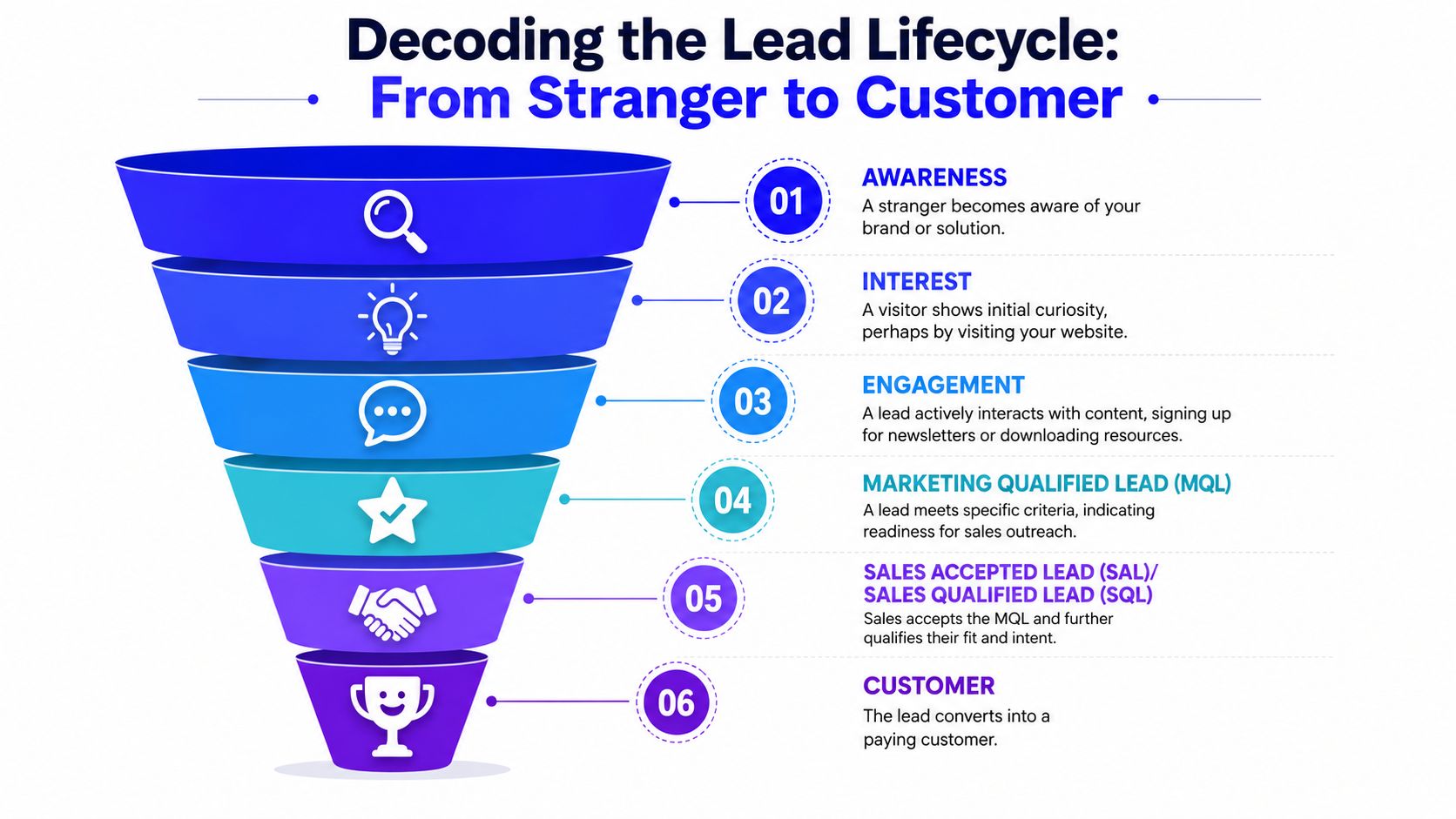
A simple way to think about lead stages
Most startups overcomplicate stage names and underdefine stage changes. The names matter less than the trigger.
Here’s the plain-English version:
Lead: A person or company has entered your world. Maybe they filled out a form, subscribed to email, or registered for a webinar.
Engaged lead: They’ve done more than a one-off click. They’re interacting with your site, content, or emails in a way that suggests ongoing interest.
Marketing qualified lead: They meet your baseline for fit and intent. They’re not just curious. They’re relevant and worth active nurturing or routing.
Sales accepted lead or SQL: Sales reviews the lead and agrees there’s enough evidence to begin direct outreach.
Customer: They buy.
That middle shift matters most. An MQL isn’t “someone who downloaded a guide.” That behavior might matter, but only in context. A student downloading an enterprise SaaS guide isn’t an MQL. A decision-maker from a target account who reads solution pages, returns to the site, and requests a comparison resource might be.
Where MQLs end and SQLs begin
The cleanest distinction is readiness for human sales time.
Marketing qualified leads are still in evaluation mode. They’re problem-aware and engaged. They may need nurture, retargeting, email sequences, or one more strong signal before a rep should step in.
SQLs are different. They’ve crossed from education into active buying behavior. They want specifics. Pricing, implementation, timelines, procurement, integrations, security reviews. That’s sales territory.
A lead stage should answer one practical question: who acts next?
There’s one more category worth separating in SaaS. Product qualified leads, or PQLs. These are users whose product behavior suggests a strong chance of conversion. Free trial usage, repeat logins, or adoption of a core feature often tells you more than a content download ever will. MQLs come from marketing interaction. PQLs come from product interaction. If you run a freemium or trial-led model, don’t blend them into one bucket. They solve different problems.
When the lifecycle is clear, teams stop arguing over labels. They start making better routing decisions.
Designing Your MQL Criteria with the Fit vs Intent Matrix
Most MQL definitions fail because they lean too hard on one side of the equation. Marketing sees engagement and gets excited. Sales sees bad-fit accounts and gets annoyed. Both are reacting to incomplete information.
The easiest fix is a Fit vs Intent matrix.
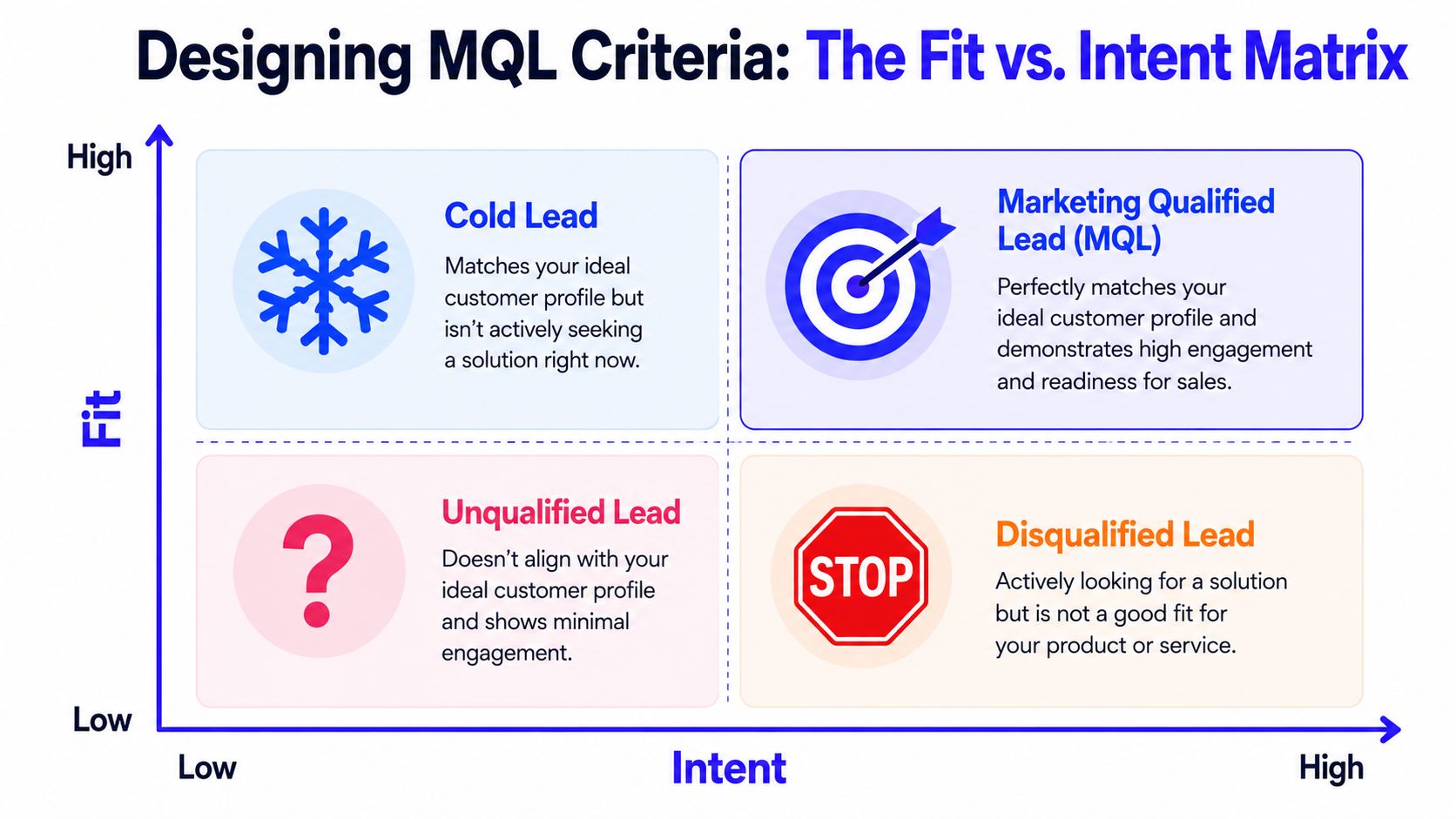
Fit keeps sales from chasing the wrong accounts
Fit answers, “Should we want this account at all?”
For a B2B SaaS startup, fit usually includes things like:
Company profile: Industry, business model, geography, and whether the company matches your ICP.
Role relevance: The contact should influence or own the problem you solve. A casual researcher is not the same as a budget holder or process owner.
Operational match: Team size, tech stack, and use case need to align with what your product handles well.
Low-fit leads can look busy in your dashboard. They visit pages, click emails, and sometimes even ask for demos. But they still waste time if your product can’t serve them well. Sales feels this immediately, which is why reps often distrust top-of-funnel enthusiasm.
Intent tells you who wants to buy now
Intent answers, “Why should we care right now?”
Not all actions deserve equal weight. A blog visit is weak. A pricing page visit is stronger. A comparison-page visit, demo request, or repeat return to a bottom-of-funnel page usually signals more urgency.
The mistake is rewarding “easy engagement.” Blog reads, basic newsletter signups, and top-of-funnel content consumption can be useful for nurture, but they often inflate MQL counts without proving readiness. That’s one reason intent-based definitions are more reliable in practice than generic engagement checklists.
This short video gives a useful visual way to think about qualification logic before you formalize it in your CRM.
A helpful pattern is to classify behaviors like this:
Signal type | Examples | Practical meaning |
|---|---|---|
Weak intent | Blog read, general newsletter signup, single homepage visit | Interesting, but not sales-ready |
Moderate intent | Webinar registration, repeat visits, resource download tied to a problem | Good for nurture and scoring |
Strong intent | Pricing page, comparison page, demo request, contact form with specific problem | Likely worth sales review |
There’s also a channel-quality clue many teams underuse. Leads from Organic Search convert to MQL status at 41% and then to SQLs at 51%, while Paid Search leads convert to MQLs at 26% and to SQLs at 26%, according to GTM 80/20’s MQL statistics roundup. That doesn’t mean paid search is bad. It means source can signal different starting levels of intent.
If a lead arrives through a high-trust, high-intent path, give that source more weight than a cold click with thin engagement.
A workable matrix gives you four buckets: low-fit low-intent leads to ignore or park, high-fit low-intent leads to nurture, low-fit high-intent leads to disqualify politely, and high-fit high-intent leads to route as marketing qualified leads. That’s the bucket sales wants.
Building Your First Lead Scoring Model in an Afternoon
Lead scoring sounds complicated until you stop pretending it needs to be perfect on day one. It doesn’t. You need a simple model that sales can understand, marketing can maintain, and your CRM can automate without breaking.
Start with a rough model, not a perfect one
The job of a first scoring model is triage. That’s it. It should help you separate “interesting” from “worth a rep’s time.”
Start with two categories:
Fit points for who the lead is
Intent points for what the lead does
Then add a few negative signals. Students, competitors, irrelevant company types, personal email domains for enterprise products, or support requests masquerading as demos often need score deductions or direct routing to another queue.
Behavior-based scoring matters because it catches motion, not just identity. Companies that use marketing automation to enable behavioral lead scoring see a 451% increase in qualified leads. Companies combining explicit data and implicit behavior reach MQL-to-SQL conversion rates of 39-40%, compared with 12-21% for teams using basic criteria, according to Salesgenie’s marketing qualified lead statistics.
That aligns with what practitioners see in tools like HubSpot every day. Static lists age badly. Behavior updates fast.
If your current model only scores form fills and job titles, this guide on predictive lead scoring that stops feeding sales junk is a good companion to rethink the setup.
A simple scoring table you can adapt
You don’t need fifty rules. Start with a handful your team already trusts.
Category | Attribute / Action | Points |
|---|---|---|
Fit | Target industry | +10 |
Fit | Relevant job title or function | +10 |
Fit | Company matches ideal size/use case | +10 |
Fit | Personal email for a B2B demo flow | -10 |
Fit | Obvious non-customer type | -20 |
Intent | Downloaded a practical mid-funnel resource | +5 |
Intent | Attended a webinar or registered for a live session | +10 |
Intent | Visited product or solution pages repeatedly | +10 |
Intent | Visited pricing, comparison, or demo page | +20 |
Intent | Requested a demo or contacted sales | +30 |
A few implementation rules keep this sane:
Use point ranges, not false precision: Nobody knows whether a webinar should be worth 11 or 13 points. Pick a clean value and move on.
Score meaningful pages separately: In GA4 and HubSpot, treat pricing, integrations, comparisons, and demo flows differently from blog traffic.
Decay stale engagement: If someone looked active months ago and disappeared, don’t let the score stay inflated forever.
Keep the threshold negotiable: The score cut-off is a working agreement, not a sacred number.
Field note: The best lead scoring model is usually the one your sales team trusts enough to use, not the one with the fanciest math.
In an early-stage startup, simple beats elegant. Once you’ve logged enough accepted and rejected MQLs, refine the weights. Until then, speed matters more than sophistication.
Connecting the Tech Stack From Click to CRM
A lead score in a slide deck is harmless. A lead score in a broken stack is dangerous.
If your GA4 events, GTM triggers, form fields, and CRM properties don’t line up, you’ll mark leads as qualified for the wrong reasons or lose the source data that explains why they qualified. That’s how teams end up saying “organic is great” while half the records in the CRM say “direct traffic.”
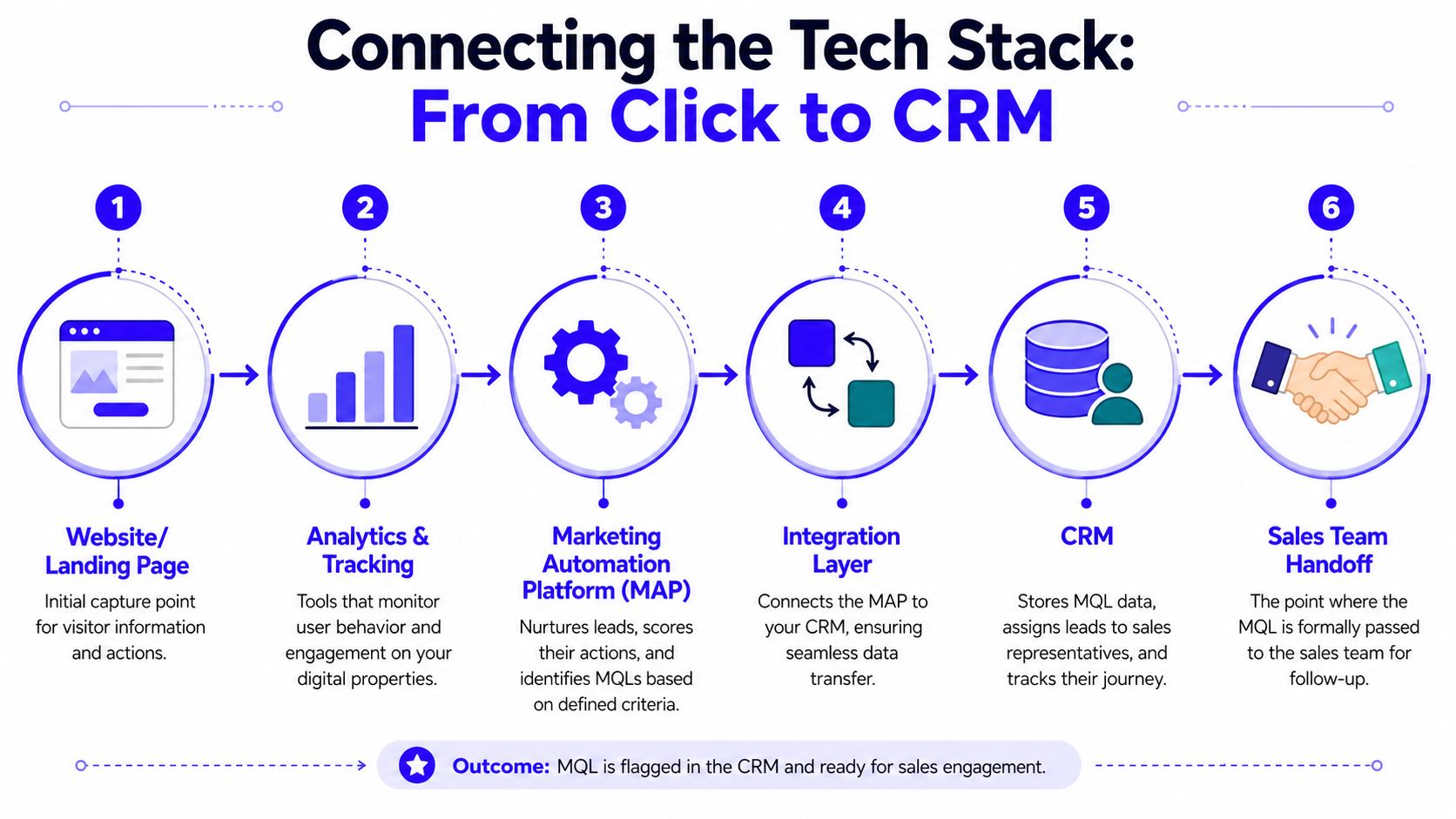
What each tool should actually do
A startup stack doesn’t need to be huge. It needs to be coherent.
Google Tag Manager should handle event firing cleanly. Form submissions, demo button clicks, pricing page views, comparison-page views, and key engagement events should be standardized there.
GA4 should answer behavioral questions. Which sessions included high-intent pageviews? Which channels brought users who engaged with product pages? Which landing pages precede qualified form fills?
Your CRM, often HubSpot or Pipedrive in startup environments, should be the operational source of truth. That’s where lead records, scores, owner assignment, lifecycle stage, and sales outcomes live.
Marketing automation sits in the middle. It listens for behavior, updates properties, adjusts scores, and flips the MQL flag when threshold logic is met.
The minimum viable data flow
The clean version of this flow looks like this:
A user clicks an ad, search result, email, or partner link carrying UTMs.
The landing page stores those attribution details.
GTM records key events and passes them into GA4.
Hidden form fields capture source context at the moment of conversion.
The form pushes data into HubSpot or Pipedrive with original source and recent engagement attached.
A workflow updates score, marks MQL, and routes the record to sales.
That hidden-field step matters more than is often acknowledged. If the lead form only captures name, email, and company, then sales gets a contact with no acquisition story. A rep should be able to open the record and see campaign source, landing page, last meaningful conversion action, and pages viewed before submission.
Here’s the practical checklist I use when auditing this setup:
UTM discipline: Every campaign needs consistent naming. If one team uses
paid-socialand another usespaidsocial, reporting gets messy fast.Event naming hygiene: GTM and GA4 should use readable, durable event names. Don’t create a new event every time someone changes button text.
CRM property mapping: Original source, latest source, campaign fields, lifecycle stage, and lead score properties need clear ownership.
Workflow logic: “If score rises above threshold and fit criteria are present, mark as MQL and assign owner.”
QA across the whole path: Test with real submissions. Don’t assume the sync works because the form submitted once.
Broken attribution doesn’t just hurt reporting. It changes who sales calls and who gets ignored.
If your CRM data is noisy, marketing and sales alignment won’t last because every review meeting turns into a debate about whether the numbers are real. That’s why teams often need to fix tracking before they tune campaigns. This breakdown of CRM tracking blunders that kill ROAS and break the loop) is relevant if your handoff looks fine on paper but falls apart in actual records.
The goal isn’t fancy architecture. The goal is a trustworthy chain from first click to qualified record.
The MQL Handoff Playbook and Critical KPIs
A lead becoming an MQL is not the finish line. It’s the moment accountability starts.
Many programs often fail at this stage. Marketing defines qualification, pushes records into the CRM, and considers the job done. Sales sees incomplete context, waits too long, or rejects leads in a free-text note nobody reviews. Then everyone wonders why “good leads” don’t become pipeline.

What sales needs at the moment of handoff
If you want sales to act quickly, don’t send mystery leads.
A handoff record should include:
Who the lead is: Name, company, role, and any relevant fit details.
Why they qualified: Score breakdown or at least the trigger events that crossed the threshold.
Where they came from: Channel, campaign, landing page, and first-touch or recent-touch context.
What they engaged with: Key pages visited, forms submitted, webinars attended, or assets requested.
What happens next: Owner assignment, status, and follow-up expectation.
The SLA matters too. Some teams use a same-day expectation. Some use a within-one-business-day rule. The exact timing depends on sales coverage and deal size, but the principle is simple: if marketing says a lead is qualified, sales can’t let it rot in the CRM.
The flip side is just as important. Sales needs a structured rejection path. Not “bad lead.” That tells nobody anything. Use rejection categories such as poor fit, no budget, student/researcher, competitor, duplicate, or no real intent. Those tags let marketing tune targeting, forms, scoring, and nurture sequences.
Operator’s rule: Every rejected MQL should teach the system something. If it doesn’t, the rejection process is broken.
A quick weekly review between marketing and sales usually surfaces the truth fast. Which MQLs got accepted. Which got rejected. Which channels created real conversations. Which assets attracted the wrong audience. No theatrics required.
The KPIs worth defending in a weekly meeting
Most lead dashboards are bloated. They track opens, clicks, raw leads, and assorted vanity metrics, then bury the numbers that matter.
For a practical MQL program, I’d focus on a short list:
KPI | Why it matters |
|---|---|
MQL conversion rate | Shows how many leads meet your qualification standard |
MQL to SAL or SQL rate | Tests whether sales agrees with marketing’s threshold |
Sales accepted rate | Reveals handoff trust and lead quality |
Sales cycle length for MQLs | Helps spot whether “qualified” leads move efficiently |
Revenue from MQLs | Connects the program to closed business |
Notice what’s missing. Raw MQL volume on its own. That number is easy to inflate and easy to misread.
The strongest MQL programs treat the metric as a quality checkpoint inside a revenue system. If sales acceptance is low, your criteria are loose. If MQLs convert to SQLs but stall later, your qualification may be too broad or your sales process may be weak. If one channel produces fewer MQLs but better downstream movement, it probably deserves more budget than the noisy channel winning the top-of-funnel spreadsheet.
That’s the mindset shift founders and startup teams need. Marketing qualified leads are not a trophy for marketing. They’re an agreement, a routing rule, and a test of whether your growth stack is connected to revenue.
If your startup needs help turning marketing qualified leads into an actual operating system, Du Marketing builds the whole loop: acquisition, SEO, CRM automation, GTM and GA4 tracking, attribution, and sales-ready reporting. It’s a practical fit for teams that want one operator connecting clicks, lead scoring, and pipeline without juggling multiple freelancers or agencies.