Content Distribution Strategy: A Startup's Blueprint

Most advice on content distribution strategy is built for teams with too many channels, too many meetings, and too little accountability. It tells founders to post everywhere, repurpose endlessly, and celebrate “reach” as if reach pays payroll.
It doesn’t.
A startup needs a distribution system that can answer one rude but necessary question: which content touched pipeline, influenced deals, and earned another round of investment in the channel? If you can’t answer that, you don’t have a strategy. You have activity.
The irony is that content marketing is bigger than ever, yet distribution remains the choke point. The industry has reached $107.5 billion, and 60% of marketers say distribution is their biggest challenge, while companies that optimize distribution see 30% higher engagement, according to WhisperTranscribe’s content distribution analysis. This is the core issue. Startups aren’t losing because they failed to publish. They’re losing because nobody built the route from content to revenue.
Table of Contents
Stop Creating Content Nobody Sees
The worst content advice for startups is “just be consistent.” Consistent where? For whom? Tied to what outcome? A founder can publish for months and still learn nothing if every post floats around disconnected from CRM data.
That’s the single-operator attribution gap. One person writes the blog, slices the post into social snippets, sends the newsletter, maybe boosts a few posts, then gets asked what any of it produced. Without clean attribution, the honest answer is usually a shrug dressed up as a dashboard.
Practical rule: If a content asset can’t be tied to a stage in the buyer journey and a destination in your CRM, it’s not ready for distribution.
The old “build it and they will come” model is dead. Digital platforms made distribution cheaper to do, but not easier to do well. A lot of founders confuse access with effectiveness. You can publish in ten places before lunch and still fail because the message, channel, and tracking weren’t aligned.
That’s why the startup version of a content distribution strategy has to be lean and ruthless. Fewer channels. Better hooks. Standardized tracking. Clear CTAs. Measured republishing. No heroics.
What works is boring in the best way. You pick a narrow audience, identify the content that already moves buyers, distribute it where those buyers pay attention, and track every meaningful touch back to opportunity creation and closed revenue.
What doesn’t work is the startup cosplay version of media company marketing. Daily posting with no attribution. Generic “thought leadership” with no next step. Random paid spend on content nobody validated on owned channels first.
A startup doesn’t need more content. It needs content that gets seen, clicked, remembered, and logged against pipeline.
Map Your Audience and Your Arsenal
The best distribution plans start with a map, not a calendar. If you don’t know where buyers spend time or which assets already pull their weight, channel selection becomes guesswork in a nicer outfit.
The operating model that consistently holds up is Analyze, Map, Execute. Neglecting the Map step, meaning alignment between content and buyer journey stage, causes a 35% drop in engagement rates based on the verified methodology provided in the brief. That drop makes sense. Wrong message, wrong timing, wrong context.
Start with behavior, not personas
Most personas are fiction with better formatting. “Marketing Mary” doesn’t help you distribute anything. You need observable behavior.
Open LinkedIn Analytics, Facebook Insights, X or Twitter Analytics if you still use it, GA4, your email platform, and your CRM. Then ask practical questions:
Where do prospects click from: Look at referral paths, social assists, and high-intent landing pages.
Where do they linger: Check pages with meaningful engagement, not just visits.
Where do they raise their hand: Track demo requests, trial starts, newsletter replies, and contact form submissions by source.
Where do sales conversations begin: Pull first-touch and assisted-touch data from HubSpot or Pipedrive.
Then pressure-test the numbers with direct conversations. Ask recent prospects where they learn, what they ignore, and which formats they trust. Founders often discover that buyers don’t want more content. They want fewer pieces with more specificity.
A simple audience map might look like this:
Buyer behavior | Likely watering hole | Content format that fits |
|---|---|---|
Researching category problems | Search engines, niche blogs | Deep blog posts, how-to guides |
Comparing vendors | Founder LinkedIn, email | Proof-driven posts, newsletter analysis |
Asking peers for validation | Industry forums, Reddit, groups | Opinionated snippets, discussion posts |
Re-engaging before a decision | Email, remarketing audiences | Case-led follow-ups, product explainers |
Audit the content you already have
Most startups already have usable material. It’s just buried in old blog posts, sales decks, webinar recordings, founder notes, onboarding emails, and support docs.
The Analyze step means checking GA4, server-side event data where available, and CRM sync to find assets with strong commercial signals. The verified process calls for identifying top-performing assets with more than 25% conversion uplift before distribution decisions are made. In practice, that means you stop promoting content because you like it and start promoting content because buyers act on it.
Use a simple review lens:
Traffic quality
Which assets bring visitors who do something useful after landing?Pipeline relevance
Which assets show up in journeys that later become opportunities?Stage fit
Is the asset best for awareness, consideration, or decision?Repurposing potential
Can one asset become a carousel, email section, sales follow-up, or short video?
Good distribution starts with old assets that still have teeth.
Once you’ve scored your content, create a live sheet with four fields only: asset name, buyer stage, primary channel, and CRM goal. Keep it tight. Startups don’t need a giant taxonomy project. They need a shortlist of assets worth pushing.
Choose Your Channels with the 80/20 Rule
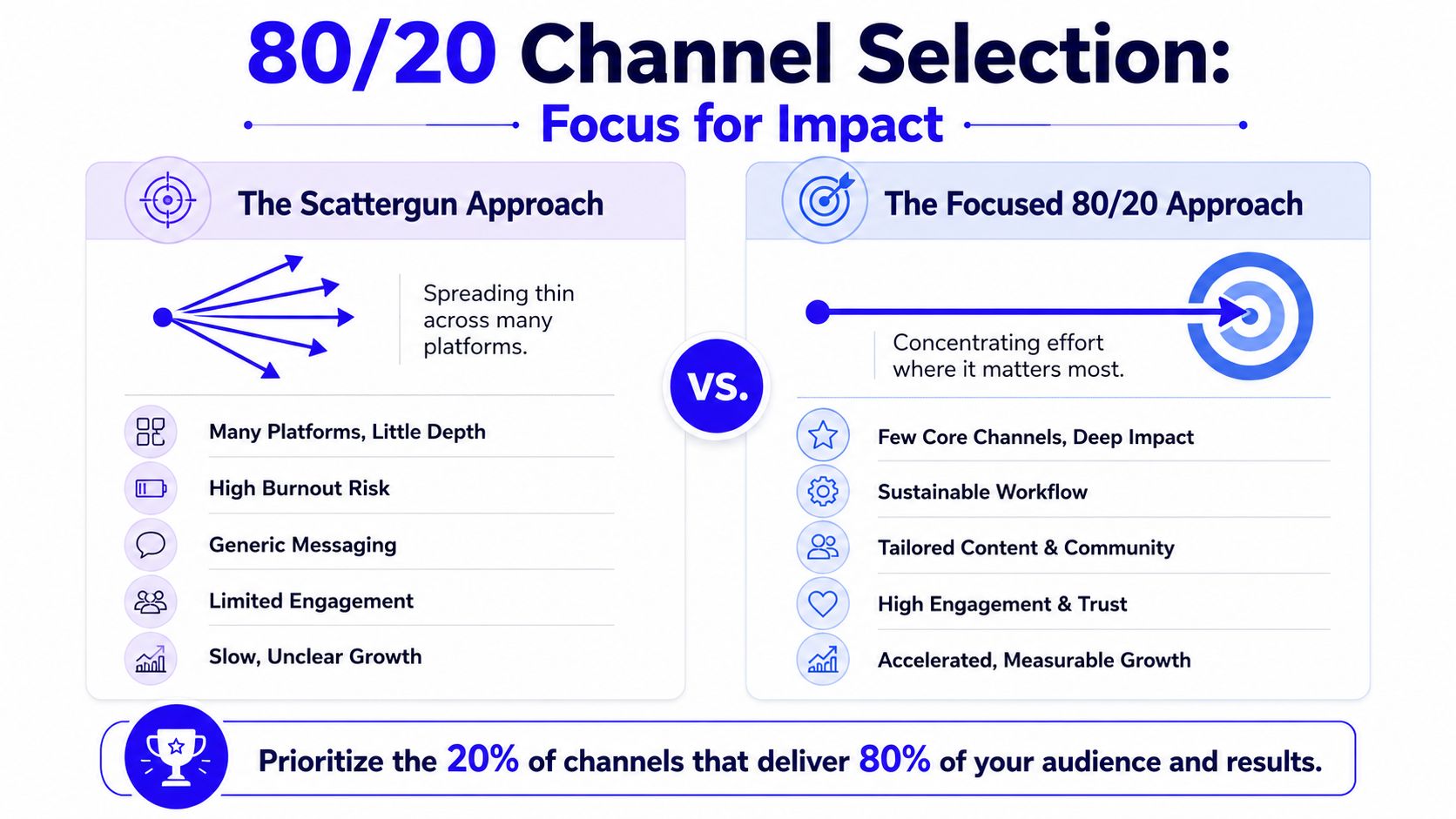
A startup can’t win a channel-decathlon. Trying to maintain a blog, newsletter, YouTube, LinkedIn, Instagram, X, Reddit, communities, webinars, and paid social all at once is how good content turns into tired content.
The smarter move is concentration. The verified methodology recommends a distribution mix where 80% of effort targets owned channels and 20% targets paid channels. That ratio works because it forces discipline. Owned channels build memory and trust. Paid channels scale what already proved itself.
Owned channels do the heavy lifting
For most early-stage startups, owned means three things: your site, your email list, and one primary social presence that someone on the team can maintain without resentment. Often that’s the founder’s LinkedIn profile in B2B, because it combines reach, trust, and speed.
Why this matters is simple. You control the message, landing experience, CTA, and follow-up path. That’s a much better setup for attribution than spraying links into channels you barely control.
The cadence data also points in a contrarian direction. Startups using a slow, high-signal cadence, such as one deep post per week plus three targeted shares on owned channels, outperform high-volume strategies by 40% in lead conversion according to the verified data in the brief. That tracks with reality. More posting often creates more noise, not more demand.
A practical owned stack for a small team looks like this:
Blog as the source asset: Publish one substantial post aimed at a real buyer problem.
Email as the retention engine: Send the post to subscribers with one sharp angle, not a generic roundup.
Founder social as distribution surface: Publish a native take that earns attention before asking for the click.
If organic search is getting messier, that doesn’t weaken this approach. It makes channel focus more important. The shift is well illustrated in this breakdown of zero-click search behavior, where visibility increasingly depends on how well you package and distribute ideas beyond a simple “publish and rank” model.
Paid works best as an amplifier
Paid distribution gets expensive when used as a substitute for message-market fit. A weak asset with a media budget is still a weak asset.
Use paid after an owned-channel signal tells you the content has traction. Then treat paid as a test bed for amplification, not as a rescue mission.
That means:
Promote proven assets: Back the post, guide, or snippet that already generates quality engagement.
Match channel to intent: Search can capture active demand. Social can amplify a strong hook to a defined audience.
Preserve attribution: If UTMs are sloppy, the lesson from the campaign will be sloppy too.
The 80/20 rule isn’t about purity. It’s about not wasting your best operator hours on channels that haven’t earned them.
Execute with a Startup-Ready Cadence
A good content distribution strategy shouldn’t feel like running a media company from a laptop at midnight. It should feel like a repeatable operating rhythm.
The leanest useful cadence is straightforward. One substantial asset each week. A small set of supporting derivatives. A newsletter mention. A republish or refresh cycle for assets that still matter but have cooled off. The verified framework also recommends 3 to 5 social posts per main asset and a republishing cycle every 60 to 90 days for pieces with declining engagement but strong underlying value.
Start with the repurposing flow, then add complexity only when the first version runs cleanly.

Turn one asset into a week of distribution
Say your core asset is a blog post on reducing sales cycle friction in a SaaS onboarding flow.
On publish day, the job isn’t finished. It’s just becoming useful.
Here’s a startup-ready version of the week:
Monday
Publish the full post on the site with clean internal links, a clear CTA, and standardized UTM-ready URLs prepared for distribution.Tuesday
Turn the strongest argument into a LinkedIn carousel or text post. Don’t summarize everything. Lead with one tension point.Wednesday
Pull three shorter snippets from the article. One can be a contrarian take, one a tactical checklist, one a buyer mistake.Thursday
Add the post to the weekly newsletter with a short editor’s note explaining why it matters now.Friday
Share a visual excerpt or short video commentary pulled from the same piece. Then watch replies and route the good ones into sales or nurture workflows.
This video captures the mindset shift well, especially for teams trying to modernize content beyond simple publishing.
The strongest repurposing doesn’t copy and paste. It reframes. A blog post teaches in sequence. A LinkedIn post opens with tension. A newsletter connects the idea to a problem your list already cares about. That’s why teams doing this well build for context first.
For another angle on adapting source material into formats built for current discovery behavior, this piece on modernizing content for the generative era is worth reading.
Build the tasks into the calendar
Distribution fails when it lives in a separate to-do list called “promote later.” It needs to be baked into the editorial plan from the start.
Publish day is not the finish line. It’s the first scheduled distribution event.
A usable content calendar for a startup should include the asset, target stage, CTA, derivative formats, owner, and publish dates for each derivative. That eliminates channel siloing, one of the most common reasons good content never gets fully distributed.
Keep the cadence humane. The verified guidance points to a quality-first rhythm, typically one high-quality blog post and one newsletter weekly. That’s enough for a small team if the pieces are built to travel.
Measure What Matters Connect Content to Cash
Most content distribution strategies fall apart because they stop at clicks, impressions, and engagement screenshots. Nice for morale. Useless for budget allocation.
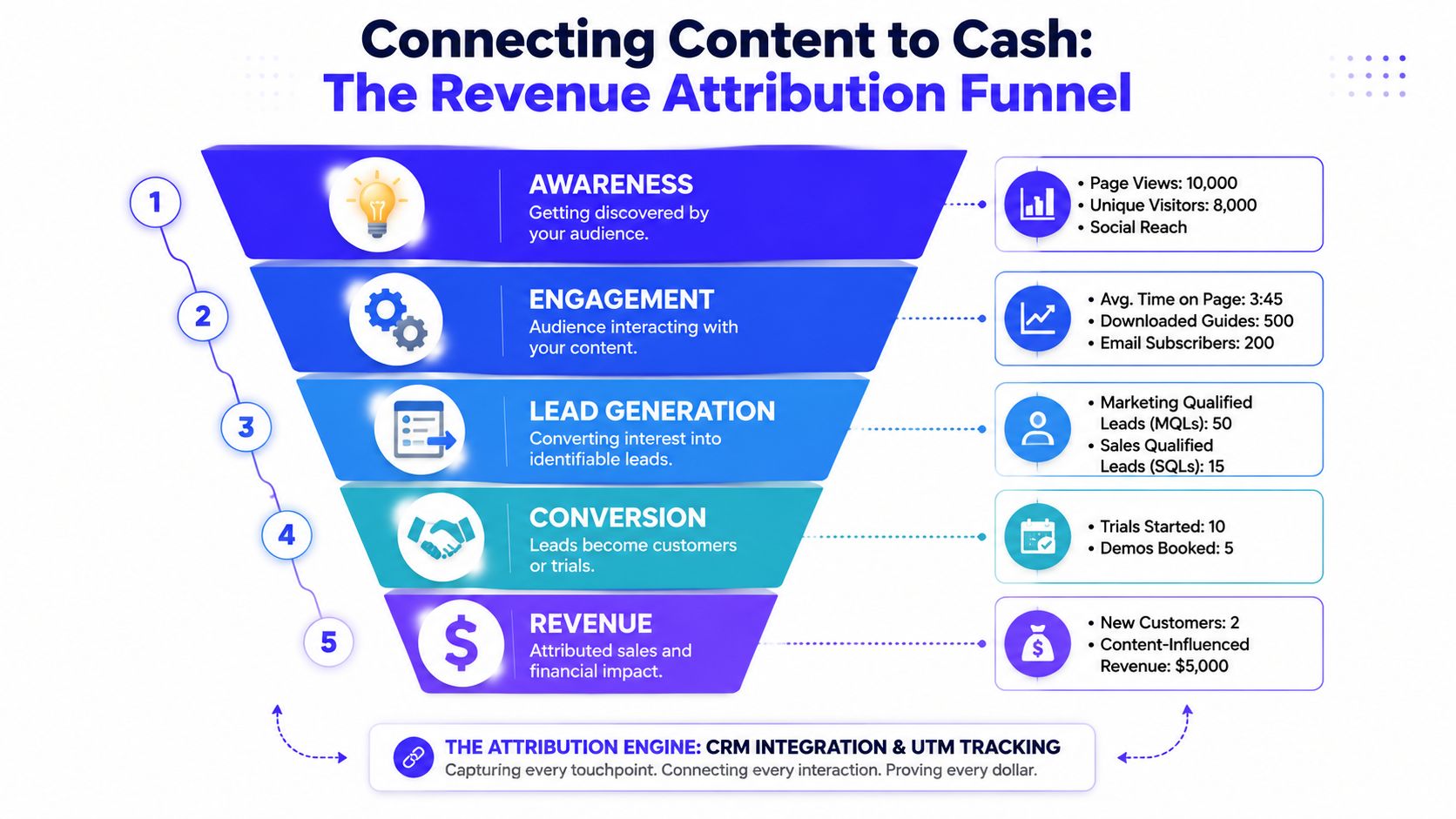
If you want to know whether content deserves more investment, you need an attribution setup that follows a user from first touch to CRM record to revenue event. The verified data is blunt here. Teams using an integrated stack of GA4, server-side CAPI, and CRM sync achieve a 6:1 average ROAS, compared with 2:1 ROAS when relying only on browser-based tracking. The same verified dataset also notes that attribution blindness can drive a 40% increase in waste when decision-grade data is missing.
What the stack actually does
A lot of founders hear “tracking infrastructure” and assume they need a data engineer. You don’t. You need a sane stack and strict naming discipline.
The core pieces are:
Component | Job | Why it matters |
|---|---|---|
UTM conventions | Standardize campaign, source, medium, and asset naming | Prevents reporting chaos |
Google Tag Manager | Manages event implementation | Lets you update tracking without rebuilding pages |
GA4 | Captures user behavior and journeys | Shows which content starts and assists meaningful actions |
Server-side or Meta CAPI | Improves signal quality beyond browser-only tracking | Reduces data loss |
CRM sync | Connects leads, opportunities, and closed revenue | Turns content influence into commercial evidence |
Offline conversion uploads | Sends revenue-stage outcomes back into ad platforms | Helps optimize for actual business results |
That stack matters because content rarely converts in one session. Someone clicks a founder post, reads a blog article, leaves, comes back from email, books a demo later, then closes weeks after that. Browser-only tracking misses pieces of that path. CRM-linked tracking recovers enough of it to make smart decisions.
If the campaign name in your UTM doesn’t match the naming in your CRM and reporting layer, you’re creating future arguments instead of future insight.
If your dashboard is full of surface metrics and empty of commercial outcomes, fix the plumbing before making channel decisions. This guide to the marketing metrics that actually matter) is a useful reminder that dashboards often look polished while hiding the decisions you need to make.
A simple attribution path
Take a basic example.
A buyer sees a LinkedIn post that promotes a guide. The link includes standardized UTMs that identify source, medium, campaign, and asset. They read the article, sign up for the newsletter a few days later, then click a follow-up email to request a demo. The form pushes into HubSpot or Pipedrive with the source data preserved. Sales works the opportunity. The deal closes. Revenue is now associated with a contact journey that includes the original content asset.
That’s the difference between “this post got engagement” and “this post influenced pipeline.”
The stack only works if naming is clean and every handoff is deliberate:
Link tagging stays consistent
Every distributed asset needs the same naming logic.Events reflect business actions
Scroll depth is optional. Demo booked, qualified lead created, and opportunity advanced are not.CRM fields stay usable
Don’t dump traffic sources into a messy free-text field and hope for clarity later.Revenue feedback closes the loop
When possible, send downstream conversion data back into ad platforms and reporting.
What to review every week
Weekly reviews should be short and mildly unforgiving.
Check:
Which assets touched qualified pipeline: Not all leads deserve equal attention.
Which channels created clean attribution paths: If a channel produces ambiguous journeys, clean the setup before scaling it.
Where users drop between engagement and conversion: Heatmaps and on-page behavior tools can help diagnose friction qualitatively.
Which old assets deserve a refresh: Good content often needs better packaging, not replacement.
The goal isn’t perfect attribution. It’s attribution good enough to fund the next decision with confidence.
Your First 90 Days of Smart Distribution
Most content plans fail because they start with publishing instead of instrumentation. A startup can avoid that trap by building the machine in the right order.
The key idea is simple. Integrated attribution, which connects content views to closed revenue in a CRM, is the top differentiator for scalable startups, yet 78% of generic content distribution guides ignore that linkage, based on the verified data provided for this article. So the first quarter should focus less on volume and more on traceability.
Days 1 to 30 build the foundation
Get the tracking stack into working shape first.
Set up GA4, GTM, server-side or CAPI connections where appropriate, and CRM sync with HubSpot or Pipedrive. Standardize UTM naming before another link goes out. Then audit your existing content and tag each asset by buyer stage, likely channel, and business goal.
At the same time, identify your top audience watering holes. Keep it tight. One search surface, one email program, one primary social channel is enough for most small teams.
Days 31 to 60 publish and distribute
Choose one strong problem your buyers care about and create a substantial source asset around it. Then run the startup-ready cadence. Publish the piece, create a handful of derivatives, distribute them across owned channels, and make sure every path routes to a meaningful CTA.
Don’t add more channels during this phase. Better to learn from one clean cycle than drown in partial execution across six platforms.
A startup grows faster from one reliable distribution loop than from a dozen half-maintained channels.
Days 61 to 90 optimize like an operator
By now, you should have clean enough data to judge signal quality. Review which asset generated the best engagement with commercial intent, not empty reach. Refresh underperforming packaging if the underlying topic is strong. Test a small paid amplification effort only on content that already proved itself on owned channels.
Then build a simple reporting view in Looker Studio or your tool of choice that shows the path from content asset to lead, opportunity, and revenue. Once that view exists, content stops being an article factory and starts acting like a pipeline input.
That’s the shift most startups need. Less content theater. More distribution discipline.
If you want a single operator to build and run that system for you, Du Marketing helps startups connect paid media, SEO, content, email/CRM, and attribution into one measurable growth engine. The focus is practical execution, transparent reporting, and proving what content and channels move pipeline.