Content Marketing for Startups: A Founder's Playbook

Most startup content advice starts with the wrong instruction: publish more.
That sounds sensible until you look at what founders need. They don’t need a busy blog. They need a system that turns expertise into pipeline, feeds the CRM, improves paid efficiency, and keeps compounding after each campaign ends. A startup that treats content as a side project usually gets vanity traffic, random posts, and a Slack channel full of links nobody can tie to revenue.
That’s backwards. Content marketing for startups works when it behaves like infrastructure. It should support SEO, give sales better follow-up assets, create remarketing audiences, and capture intent you can track from first click to opportunity. That’s why content keeps winning budget. 83% of marketers say content marketing is the most effective method for demand generation across the buying journey, ahead of organic SEO, paid advertising, and paid search according to Salesgenie’s roundup of content marketing statistics.
The mistake isn’t believing in content. The mistake is running it as an isolated channel.
Table of Contents
Why Most Content Marketing for Startups Fails
The publish and pray trap
Most startup content fails because nobody decides what the content is supposed to do before it gets made.
A founder hires a freelancer, picks a few keywords from Ahrefs or Semrush, publishes a handful of posts, shares them on LinkedIn once, and waits for magic. When nothing meaningful happens, content gets labeled slow, fluffy, or impossible to measure. The underlying problem is simpler. The content never had a job.
I see the same pattern over and over. Articles sit in the blog with no conversion path, no CRM fields, no internal links, no sales enablement use, and no paid amplification plan. They were created to exist, not to move a prospect from interest to action.
Practical rule: If a piece of content doesn’t connect to a business objective, a funnel stage, and a next step, it isn’t an asset. It’s an expense.
The popular advice makes this worse. “Be consistent” is harmless on its own, but consistency in the wrong direction just produces more waste. Publishing weekly won’t save weak positioning. A beautiful article won’t help if it targets readers who will never buy. And traffic won’t impress anyone if your CRM can’t tell you whether those visitors became pipeline.
What a content operating system looks like
Startups need a content operating system, not a content calendar.
That means every asset gets planned across four layers:
Audience fit. Who is this for, and are they close enough to your real buyer profile to matter?
Intent match. Is the user trying to learn, compare, validate, or buy?
Distribution path. Where will this be seen beyond your blog?
Measurement plan. What action should happen next, and where will you record it?
When those four layers line up, content stops acting like a brand exercise and starts acting like growth infrastructure. One article can rank in search, feed email nurture, support outbound follow-up, build a retargeting pool, and help a paid search landing page convert better because the buyer already trusts the message.
Here’s what usually does not work for startups:
Broad thought leadership first. Founders love big vision pieces. Buyers usually need specific answers.
Top-of-funnel only plans. Education matters, but pipeline appears when you cover comparison, implementation, objections, and buyer risk.
Handing content to one person without systems. A solo marketer can do great work. They can’t do chaos forever.
Separating content from sales. If your sales team never uses your articles, guides, or videos, your content strategy is underbuilt.
A better operating model is blunt. Start with buyer questions. Build assets around recurring intent. Attach each asset to a conversion path. Feed performance data back into the next sprint.
That’s how startups make content pull its weight.
Laying the Foundation with Audience and Intent Mapping
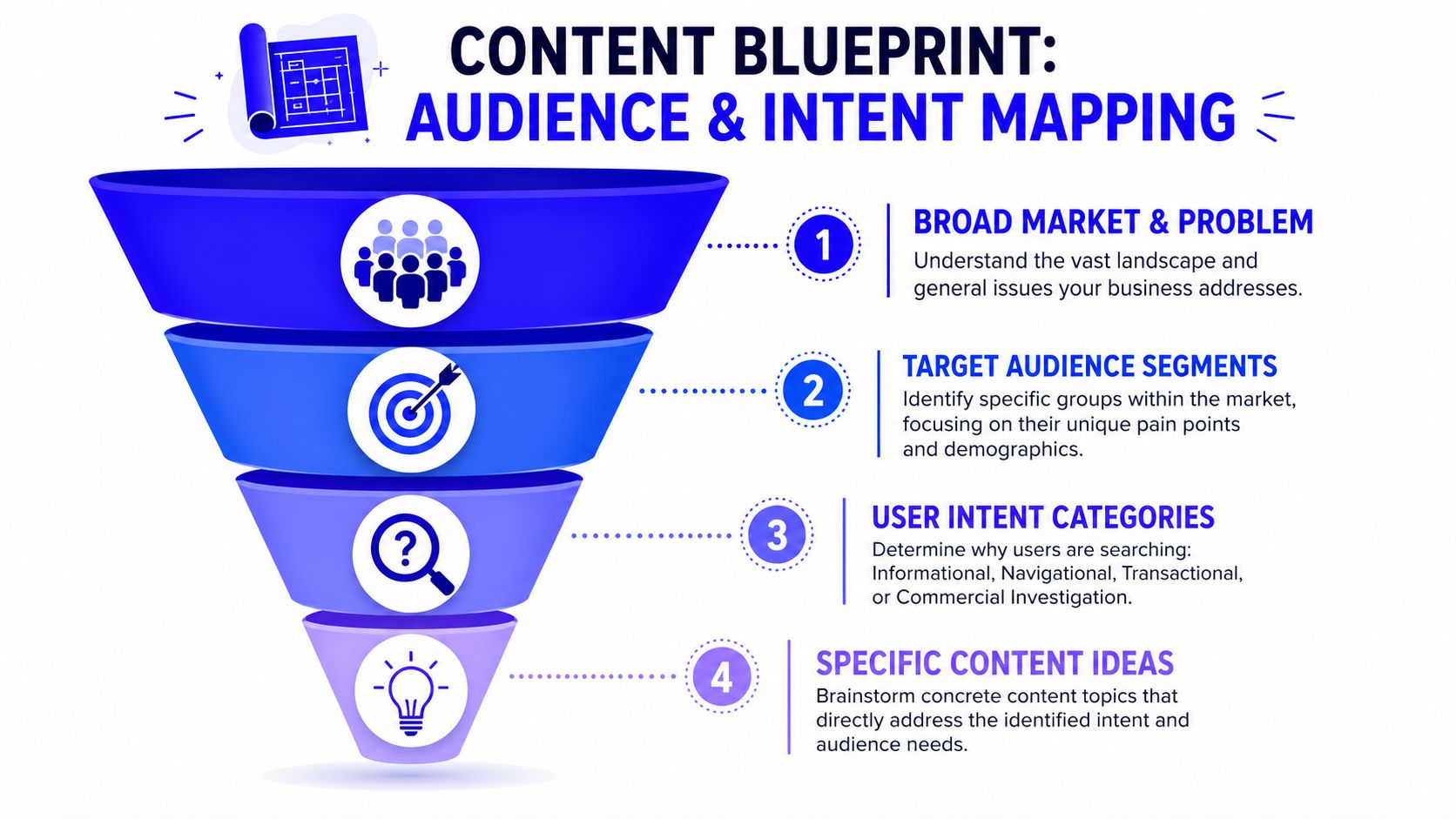
The fastest way to waste a quarter is to create content for “startup founders,” “marketers,” or “small businesses.” Those are audiences in the same way “people with laptops” is an audience.
You need a working ICP. Not a poster for a workshop. Something your writer, paid media buyer, and founder can all use without translating it.
Start with an ICP you can actually use
An actionable ICP has four parts:
Company fit
Industry, business model, stage, sales motion, and team shape. A seed-stage B2B SaaS company selling through demos behaves differently from a consumer app with self-serve onboarding.Buyer role
The person who feels the pain, the person who approves spend, and the person who will live with the result. In many startups, those aren’t the same person.Pain trigger
What forces them to care now? A broken process, rising acquisition costs, poor reporting, low lead quality, or pressure from investors all create very different content angles.Buying friction
What slows the deal? Procurement, migration fear, implementation complexity, lack of internal resources, or unclear ROI.
Once you have that, turn it into a simple map. One row per segment. One column for pains. One for likely searches. One for the proof they need before they’ll act.
Map intent to funnel movement
Search intent is where startup content strategy usually gets sharper fast.
A practical setup looks like this:
Intent type | What the buyer wants | Content that fits | Best next step |
|---|---|---|---|
Informational | Understand a problem | How-to posts, explainers, templates | Email capture or related article |
Commercial | Compare options | Alternatives pages, comparison posts, use-case guides | Demo, consult, case-led nurture |
Transactional | Take action now | Product page, service page, pricing explainer | Form fill, purchase, booking |
There’s also navigational behavior, but that usually matters once people already know your brand.
The mistake is forcing every topic into a conversion play. If someone searches a basic educational query, they usually don’t want a hard pitch. Give them the clearest answer, then offer the next logical step. On the other hand, if someone is comparing categories, vendors, or implementation approaches, you should be much more direct.
Most startup funnels leak because the content matches the keyword but ignores the moment. Intent beats topic every time.
A clean map often looks like this:
Problem aware. “Why is our CAC rising?” or “How to track lead source in HubSpot.” These deserve practical educational content.
Solution aware. “SEO agency vs freelancer” or “best CRM attribution setup.” These need comparison and trade-off content.
Decision ready. “Book demo,” “pricing,” “implementation process.” These need clarity, proof, and low friction.
If you’re selling to both B2B and B2C audiences, split the map early. The language, buying cycle, and conversion path differ too much to fake a shared strategy. Startups get into trouble when they cram unlike buyers into one editorial plan because it feels efficient.
It isn’t. It muddies the message and weakens conversion paths on every channel.
Building Your SEO-Led Content Engine
SEO for startups usually breaks for one reason: the roadmap is a pile of disconnected keywords.
That’s not a strategy. That’s a spreadsheet with ambition.
Build around topics, not loose keywords
A stronger model is the topic cluster. You choose a core subject that matters to your buyer and build one deep pillar piece around it. Then you surround it with narrower supporting pieces that answer related questions, handle objections, and cover adjacent use cases.

For a startup selling CRM or RevOps services, a cluster might look like this:
A pillar guide on CRM attribution
Supporting posts on UTM governance, hidden fields, offline conversion uploads, lead source cleanup, and GA4 event mapping
Commercial pages for audits, implementation, or migration help
This structure does two useful things. It helps search engines understand topical depth, and it gives humans an obvious path to keep reading. If you want a sharper strategic lens on that shift, this piece on SEO moats and why assets beat keywords) captures the mindset well.
Make the calendar small enough to survive contact with reality
Most startup content calendars fail because they’re built like a media company roadmap and staffed like a side project.
Start smaller. Pick one pillar topic tied closely to revenue. Then build a cluster around it with a realistic production cadence. A founder-led team usually does better with fewer strong assets than a flood of decent ones that never get updated, distributed, or linked properly.
A useful planning stack is simple:
Search Console for early query signals
Ahrefs, Semrush, or LowFruits for topic expansion
Google Docs or Notion for briefs
Asana, Trello, or ClickUp for workflow
GA4 and your CRM for outcome data
The important part isn’t the stack. It’s the brief. Every article brief should include target intent, primary angle, internal links to include, CTA, proof points available, and what sales objection it addresses.
Here’s a compact way to choose cluster topics:
Start with questions your buyers ask in calls.
Check whether those questions also show up in search behavior.
Prioritize topics where your startup has a clear point of view or implementation edge.
Build the internal linking structure before publishing, not weeks later.
This video gives a useful visual overview of how content and search structure work together:
The mechanics that still matter
Founders don’t need a lecture on SEO theory. They need the mechanics that still move results:
Search-first titles. Clear beats clever. A headline that signals exact relevance usually outperforms a witty one.
Tight intros. Answer the query early. Don’t spend five paragraphs warming up.
Useful subheads. Structure should mirror the way buyers think.
Internal linking. Link to related pages with intent, not randomly.
Conversion paths. Add one next step that matches the article’s intent.
Refresh cycles. Update winners. Don’t just chase net-new content.
Your first SEO win usually doesn’t come from publishing more. It comes from creating a better-connected set of pages around one buyer-critical topic.
Distribution for Zero-Audience Startups
Publishing without distribution is just organized optimism.
A startup with no audience can’t afford to wait for discovery. It has to manufacture reach from day one using a repeatable workflow across owned, earned, and paid channels.
Use a publish and amplify workflow
The practical sequence looks like this:
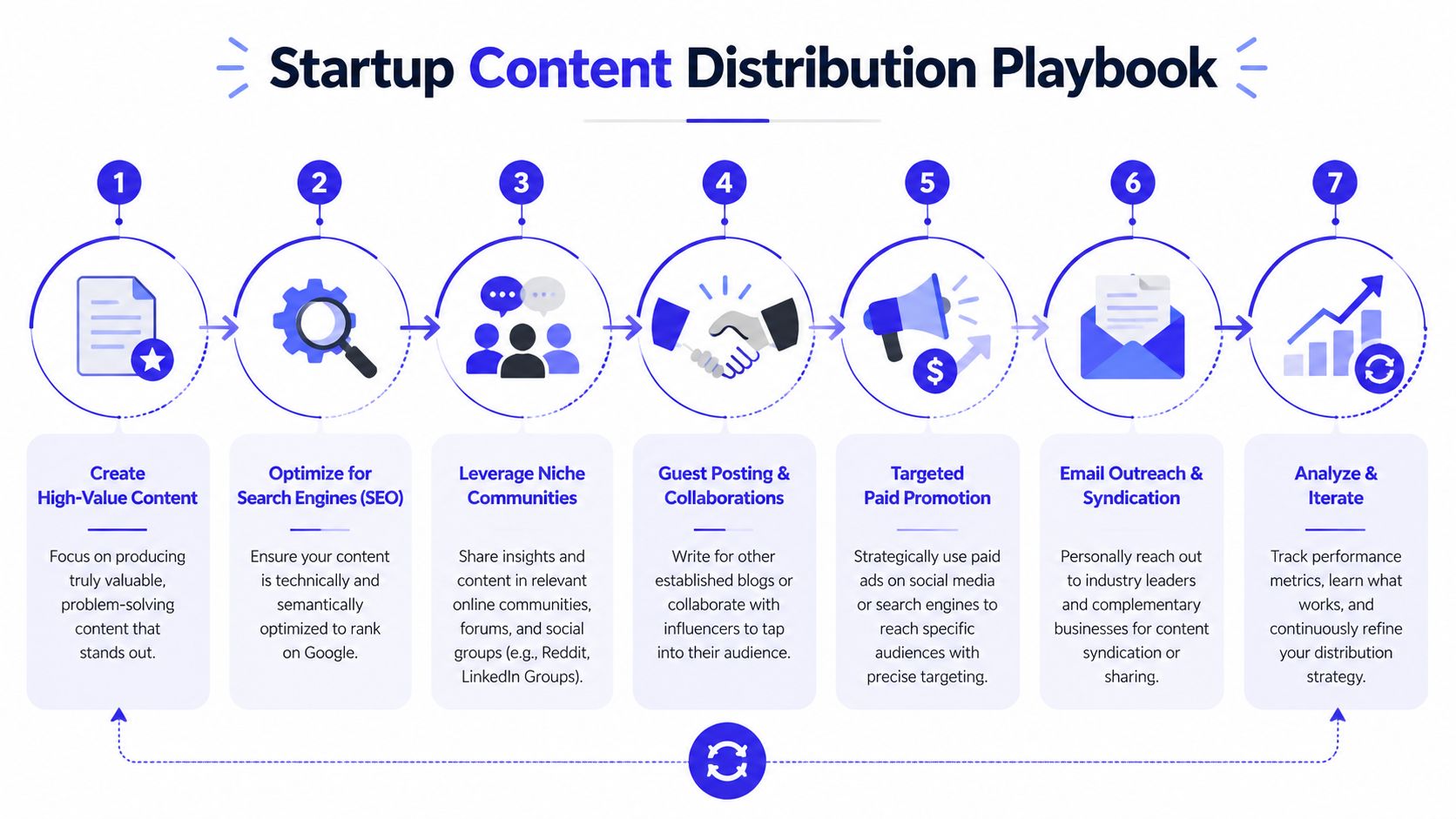
Publish the core asset on your site first, with internal links and a clear CTA already in place.
Extract channel-specific angles for LinkedIn posts, founder notes, short email sends, Reddit comments, community replies, and sales follow-up snippets.
Seed the asset manually in niche communities where the topic already has demand. That means relevant Slack groups, subreddits, Discord communities, or industry newsletters. Not spam blasts.
Enable the sales team with a short summary and a sentence on when to send the asset.
Retarget engaged visitors if the topic maps to commercial or decision-stage interest.
The biggest distribution mistake is posting the link everywhere with the same caption. Each channel has its own social contract. Reddit wants substance. LinkedIn wants a point of view. Email wants context. Sales wants relevance to a live conversation.
Repurpose before you create something new
Startups often create too much from scratch and repurpose too little.
One strong pillar can become:
A founder LinkedIn post with a contrarian take
A carousel for Instagram or LinkedIn
Three to five short clips for video channels
An email to existing leads
A one-page checklist for sales follow-up
Ad creative for retargeting or paid social tests
Short-form video becomes hard to ignore. For every $1,000 invested in short-form video, direct sales attributed reached $8,900 in 2025, an 8.9x return, according to Taboola’s content marketing statistics roundup. That doesn’t mean every startup should become a video studio. It means repackaging useful ideas into formats buyers will consume can pay off fast.
A zero-audience startup shouldn’t ask, “What should we publish next?” It should ask, “How many useful formats can we extract from the best thing we already made?”
Use paid like a spotlight, not a crutch
Paid amplification works best when it sharpens existing content, not when it tries to rescue weak content.
For startups, that usually means:
Boosting proven posts to narrowly defined audiences on LinkedIn or Meta
Running search ads against bottom-of-funnel pages and comparison content
Retargeting readers who visited high-intent articles but didn’t convert
Testing hooks with paid social before turning them into bigger content bets
The wrong move is pouring spend into broad educational posts with no clear next step. If the content can’t hold attention, build trust, and create movement on its own, paid traffic just helps it fail faster.
Proving ROI with GA4 and CRM Attribution
Content without attribution is a hobby.
That sounds harsh, but founders need that level of clarity. If content brings in traffic and nobody can connect it to leads, opportunities, or revenue, it will lose budget the moment paid search or outbound has a stronger story.
Content without attribution is a hobby
A lot of startups still track content with pageviews, average engagement time, and maybe a form completion total in GA4. Those metrics are useful diagnostics. They are not enough to defend spend.
What matters is whether content influenced pipeline. Did the blog post drive a demo request? Did the guide assist an opportunity before closed-won? Did a comparison page produce leads with higher sales acceptance? Did readers from one topic cluster move faster through the funnel than others?
Those questions require two systems to talk to each other:
GA4 and Google Tag Manager for session-level behavior and event tracking
A CRM like HubSpot or Pipedrive for lead source, lifecycle stage, opportunity creation, and revenue outcome
If those systems are disconnected, your reporting ends at “someone read an article.”
A startup-friendly attribution setup
You do not need an enterprise RevOps department to fix this. You need disciplined plumbing.
Use this setup:
Define conversion events in GA4
Track meaningful actions only. Demo requests, contact submissions, resource downloads, trial starts, booked calls. Skip vanity event clutter.Standardize UTM rules
Every campaign and every distribution touchpoint should use the same source, medium, campaign, and content conventions. If one team writes “linkedin” and another writes “LinkedIn-paid,” reporting gets messy fast.Capture first-touch and latest-touch fields in the CRM
Hidden form fields, JavaScript capture, or middleware can carry UTMs into HubSpot or Pipedrive. Store the original source separately from the latest source.Map content assets to forms and pages
A download form on a blog post should tell you which content asset drove the submission, not just that “organic” happened.Tie opportunities back to origin and influence
Once a lead becomes a deal, you want visibility into both the first content touch and the later touches that helped conversion.
A lot of teams break this loop with sloppy field logic, duplicate contacts, or channel overwrites. This overview of common CRM tracking mistakes that kill ROAS) is a good checklist for avoiding those failures.
What founders should review every month
Don’t ask for a giant attribution report. Ask for a decision report.
A founder-friendly monthly review should answer:
Question | What to inspect |
|---|---|
Which content assets created qualified leads? | Leads by landing page, source, and content theme |
Which assets influenced pipeline later? | Assisted conversions and CRM touch history |
Which traffic sources were low quality? | Bounce patterns, poor lead progression, weak sales feedback |
Which topics deserve more investment? | Strong conversion paths, higher lead quality, repeated sales use |
Then make choices. Expand the clusters that produce qualified conversations. Rewrite or cut the content that attracts the wrong people. Improve CTAs where engagement is high but conversion is weak. Build more sales collateral around assets that reps keep sending manually.
If your reporting stops at traffic, content looks soft. If your reporting reaches opportunity and revenue, content starts competing for serious budget.
Building Your Content Team Without Breaking the Bank
Founders usually ask the wrong hiring question. They ask, “Who can do content?”
The better question is, “Which operating gaps do we need covered right now?” Strategy, writing, SEO, design, editing, distribution, analytics, and CRM coordination rarely sit comfortably in one cheap hire.
In-house junior marketer
This option works when you need someone embedded in the product, close to the founders, and available every day for rapid iteration.
The upside is speed of communication and growing institutional knowledge. The downside is obvious. Junior hires often need support across positioning, SEO, analytics, and editorial judgment. They can become a content coordinator instead of a content operator.
Best fit:
Early team with strong founder involvement
Narrow product scope
Willingness to coach and review work closely
Red flags:
Expecting one person to own strategy, writing, design, SEO, and attribution alone
No clear editorial direction
No access to customer calls or sales feedback
Specialist freelancers
Freelancers make sense when you know exactly what you need and can manage the moving parts.
A strong freelance writer can produce excellent work. A technical SEO specialist can clean up structure and internal linking. A designer can turn dense ideas into usable visuals. The catch is orchestration. Founders often become accidental project managers across multiple contractors with different timelines and standards.
This route works best if you already have:
Clear briefs
A documented voice and positioning
One person responsible for final QA
A workflow for publishing, distribution, and measurement
It breaks when freelancers operate from vague Slack messages and rough topic ideas.
Fractional consultant or small agency
This is often the best bridge for startups that need strategy and execution discipline but aren’t ready for a full internal team.
A good fractional lead or small agency should create the operating model, define priorities, coordinate specialists when needed, and keep content tied to pipeline goals. You get senior judgment without building a full department too early.
Here’s a quick comparison:
Model | Strengths | Weaknesses | Best for |
|---|---|---|---|
In-house junior marketer | Availability, context, speed with founders | Needs guidance, limited range | Early teams with hands-on leadership |
Specialist freelancers | Flexible skills, targeted help | Coordination burden, uneven strategy | Teams with strong internal direction |
Fractional consultant or small agency | Strategic oversight, integrated execution | Requires careful vetting | Startups needing systems before scale |
When vetting any option, ask for process, not just samples. How do they brief content? How do they decide topics? How do they connect content to CRM outcomes? How do they handle revision, distribution, and reporting? Good answers sound operational. Weak answers sound like inspiration.
Your First 90-Day Content Marketing Sprint
Most startups don’t need a twelve-month content masterplan. They need a useful first sprint.
The first ninety days should build the system, launch a focused cluster, prove that attribution works, and create enough feedback to choose the next bet with confidence. If you’re adapting your content for the current search environment, this piece on modernizing content for the generative era is a good companion to the sprint below.
Weeks 1 through 4
Start with research and setup. Interview customers, review sales calls, collect objection language, and build a usable ICP and intent map. At the same time, audit your site structure, define one pillar topic, and set up the first reporting layer in GA4 and your CRM.
Then create the production system. Build templates for briefs, metadata, internal linking, CTAs, and social repurposing. Keep it boring. Boring systems scale.
Weeks 5 through 8
Publish the pillar asset and the first supporting pieces. Make sure each post has a clear next step, a proper internal link path, and a distribution plan before it goes live.
Use founder-led distribution early. Post original commentary on LinkedIn, send relevant pieces in sales follow-ups, share in communities where the topic is already active, and cut the best ideas into short-form assets for reuse.
Weeks 9 through 12
Now you look for signal, not certainty.
Review which pages attracted the right visitors, which CTAs produced real leads, and which topics got picked up in calls, email replies, or sales usage. Tighten weak pages, expand promising subtopics, and decide what the next cluster should be.
Here’s the sprint in one view:
Phase | Weeks | Key Actions |
|---|---|---|
Foundation | 1 to 4 | ICP interviews, intent mapping, topic selection, analytics and CRM setup, workflow templates |
Launch | 5 to 8 | Publish pillar and cluster content, build internal links, deploy CTAs, start organic and sales distribution |
Optimization | 9 to 12 | Review attribution, refine pages, repurpose winners, expand the next cluster based on real buyer signal |
A good ninety-day sprint should leave you with more than published content. You should have a working operating rhythm, cleaner reporting, and a shortlist of topics that deserve serious investment.
If you want help building that system without juggling separate freelancers for SEO, paid, CRM, and attribution, Du Marketing offers startup-focused growth execution that connects content, ads, lifecycle, and tracking into one measurable operating model.