8 Powerful Examples of Retargeting Ads for 2026

Don't let warm traffic go cold. Retargeting ads generate a tenfold increase in engagement and an average 0.7% CTR versus roughly 0.07% for non-retargeted display ads. That gap is why smart teams treat retargeting as infrastructure, not a nice-to-have campaign.
Most visitors won't convert on the first session. They browse, compare, get distracted, open a Slack message, and disappear. Strong retargeting brings them back with context. Not random reminders. Specific messages tied to what they viewed, how far they got, and what objection is probably blocking the next step.
These examples of retargeting ads aren't just creative inspiration. They're strategic teardowns with the mechanics behind them, including event tracking, audience windows, frequency control, CRM sync, and attribution. If you want to rebuild a working retargeting system from first click to closed conversion, start here.
Table of Contents
6. Page-Specific Retargeting with Conversion-Intent Messaging
7. Sequential Messaging Campaigns Frequency-Gated Creative Progression
1. Dynamic Product Retargeting Ads
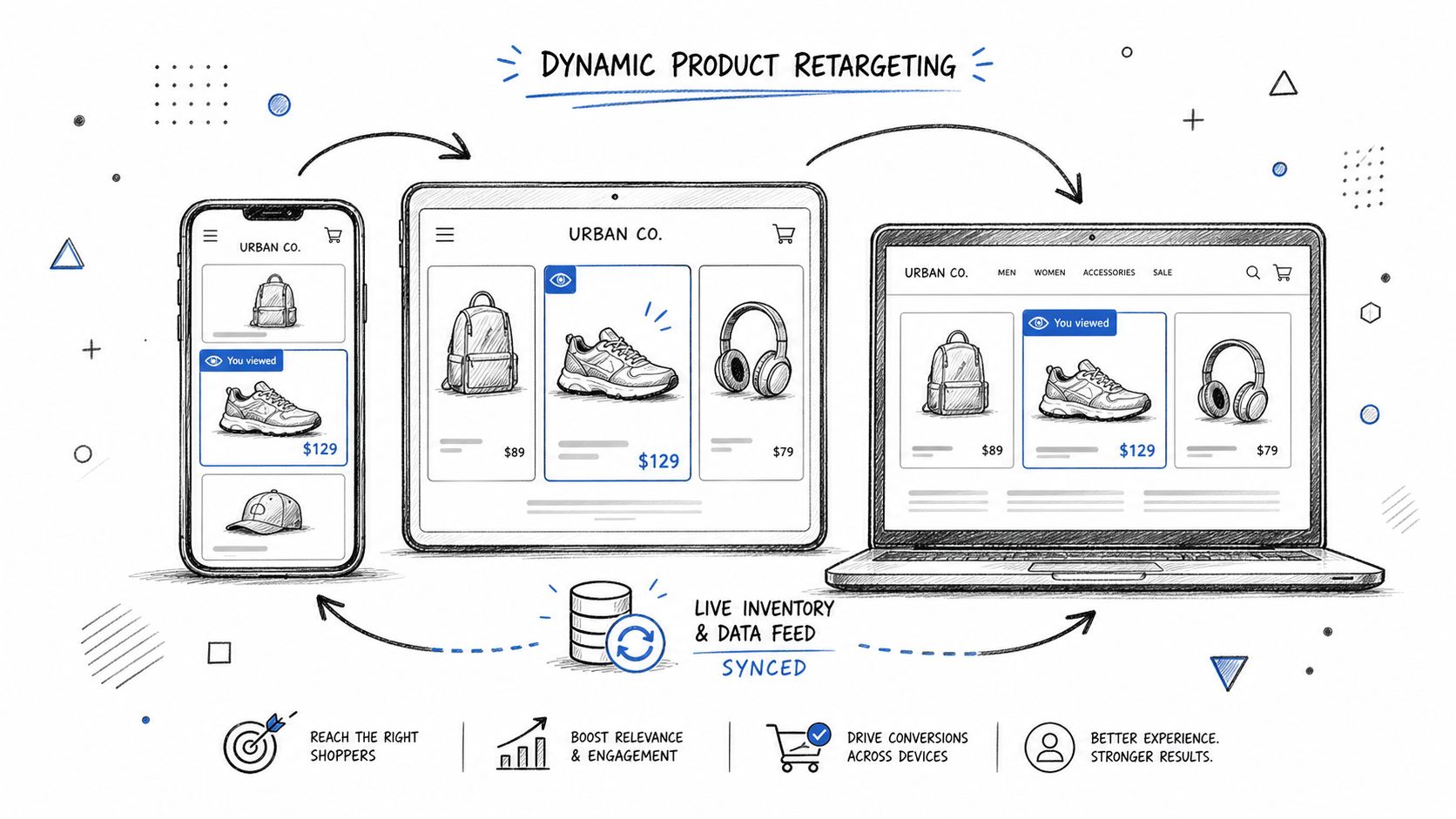
Dynamic product ads are the workhorse of ecommerce retargeting. A shopper views black running shoes on a Shopify store, leaves, then sees those exact shoes again on Instagram, Facebook, Google Display, or YouTube. The ad doesn't feel generic because it isn't. It's generated from the catalog and tied to the visitor's on-site behavior.
This format works best when the product feed is clean and the event tracking is boringly accurate. If your view_item, add_to_cart, and purchase events are inconsistent, the creative can still look polished while the campaign serves the wrong products to the wrong people.
Why this format keeps winning
DemandSage notes that users in the 1 to 7 day retargeting window show the highest conversion rates of 10% to 15%, especially hot traffic like cart abandoners. That's why dynamic ads are strongest when they follow recent product views, recent cart activity, or repeat category visits.
A few real examples:
A Shopify apparel brand retargets cart abandoners with Meta Dynamic Ads showing the exact size and color last viewed.
A furniture store uses Google Ads remarketing to bring back users who visited a product page twice but never added to cart.
A SaaS company with tiered plans uses a dynamic-style variant, retargeting feature-demo visitors with the closest pricing tier and use-case creative.
Practical rule: Don't retarget your whole catalog. Retarget the last meaningful intent signal.
Back-end setup that makes it work
The ad itself is only the surface layer. Its actual influence comes from the setup.
Track product behavior cleanly: Use GA4 enhanced ecommerce with GTM, or native Shopify events if they're mapped correctly.
Segment by recency: Split audiences into recent viewers, recent cart abandoners, and older browsers so messaging can change as intent cools.
Measure at product level: Push product IDs into your ad platforms and analytics stack so you can see which SKUs pull conversions, not just which campaign looks good in aggregate.
Protect the audience: Exclude recent purchasers so you don't keep showing the same item after the sale.
What usually fails is lazy creative. If every ad says “Still thinking about it?” the campaign plateaus fast. Better versions answer the likely objection. Shipping concern, price concern, trust concern, or comparison concern.
2. Cart Abandonment Email + Display Ad Sequence
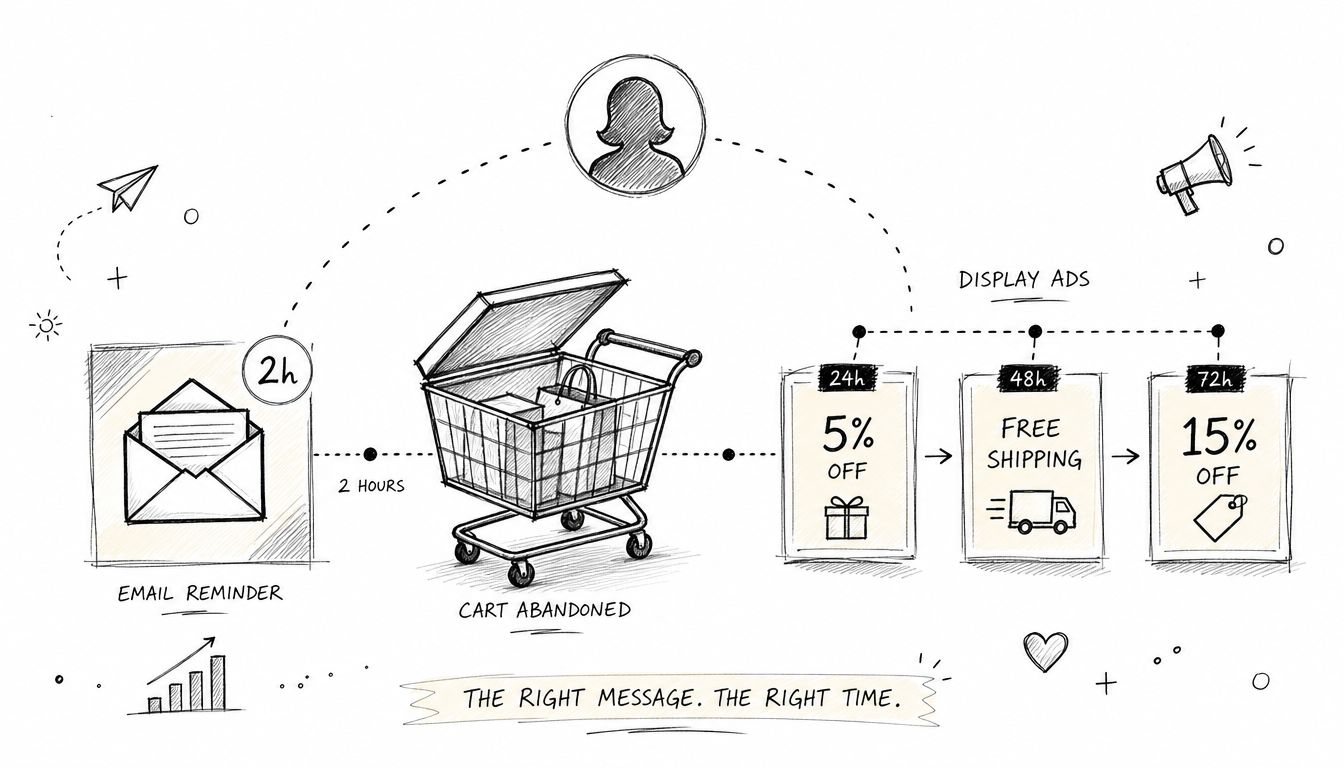
A single abandoned-cart email is better than silence. A coordinated email plus display sequence is better than hope. This is one of the best examples of retargeting ads because it treats abandonment like a decision journey, not a one-off reminder.
The pattern is familiar in D2C. Someone adds a product to cart, leaves, gets an email first, then sees display ads over the next several days. B2B versions work too. A buyer starts a demo request, exits before submitting, then enters a sequence across HubSpot, Google Ads, and Meta.
The sequence that feels helpful, not desperate
Postano reported a 364% increase in clickthrough conversions and a 278% lift in conversion rate within 60 days by targeting users who had recently shown product interest. The detail I like most is operational, not flashy. They segmented users by action depth and used dynamic creative to show the exact abandoned product.
That's the lesson. Don't send the same message to:
someone who bounced from cart after seeing shipping,
someone who viewed one product page,
someone who came back three times and still didn't buy.
Most cart recovery campaigns fail because the media team and the CRM team run separate plays against the same user.
What breaks attribution in this setup
If you run email and display together, attribution gets messy fast. Email clicks steal credit. View-through display credit inflates. GA4 undercounts. Meta overclaims. None of that means the sequence isn't working. It means your plumbing needs work.
Here's the clean version:
Pass cart value into the CRM: High-value abandoners deserve different creative and different urgency.
Delay the first display ad slightly: Let the email land before paid impressions pile on.
Sync cart events server-side: Meta CAPI or equivalent server-side event forwarding helps when browser tracking drops.
Upload downstream conversions: If someone returns through email but converts later through brand search, offline conversion uploads help stitch the path back together.
The worst version of this campaign launches every touch at once. Email, Meta, Google Display, SMS. That doesn't create urgency. It creates suspicion.
3. Lead Magnet Download Nurture Ads
Lead magnet retargeting is where B2B teams either build pipeline or burn budget on people who only wanted a free PDF. Someone downloads a template, webinar replay, or market guide. They're interested, but not ready. If you jump straight to “Book a demo,” you'll lose a big chunk of them.
The better move is a nurture arc. A further-education company can retarget webinar attendees with student outcomes and course structure. A fintech startup can follow account-registration starters with short product-tour clips and implementation proof. A SaaS company can show free-trial signups who never activated the exact workflow they skipped.
Where most B2B nurture retargeting fails
A useful LinkedIn teardown points out that 73% of B2B buyers require 5+ touchpoints before conversion. It also highlights a real gap: most retargeting examples are still obsessed with B2C discount ads, while long-cycle B2B buyers often need emotional confidence-building before they need another feature list.
That tracks with what works in-market. Pricing-page lurkers usually don't need louder product claims. They need reassurance. Comparison visuals, customer proof, implementation clarity, and buyer-specific messaging.
For teams tightening handoff logic, this guide to marketing qualified leads is useful because it forces you to define when a lead should stay in nurture and when sales should take over.
How to wire this into your CRM
The campaign only gets smart when the CRM feeds the ad platform back.
Build separate audiences by asset type: A pricing calculator download deserves different follow-up than a top-of-funnel ebook.
Push lead score downstream: Once a contact becomes sales-ready, stop showing them low-intent nurture ads.
Tag nurture stage in UTMs: Keep naming conventions consistent so reporting doesn't collapse into “paid social assisted something.”
Use offline conversions: Closed-won data beats form-fill counts every time.
What doesn't work is recycling one case study ad forever. B2B buyers stall when every retargeting touch says the same thing in a different template.
4. Video View Retargeting YouTube and Meta
Video retargeting filters curiosity from actual interest. Someone who watched a few seconds of a broad awareness ad isn't the same as someone who stayed through a product walkthrough, customer story, or feature demo. That second group is where follow-up ads can get sharp.
A strong pattern is simple. Run a product or category video on YouTube, build audiences from viewers based on watch depth, then retarget those viewers on Meta or Google with narrower offers. D2C brands often move from lifestyle video to product detail. B2B teams usually move from explainer to proof.
Watch behavior is a qualification signal
Historical retargeting benchmarks compiled by DemandSage show that UGC-style videos and testimonials generate 2.3 times higher CTR than standard imagery. That matters because many teams still retarget video viewers with static ads that feel disconnected from the content that earned attention in the first place.
If the first touch was a founder video or customer testimonial, the follow-up should keep that tone. An enterprise SaaS brand might retarget viewers of an eight-minute walkthrough with an ROI-focused customer story. A D2C skincare brand might follow a tutorial viewer with a carousel featuring the exact products used in the routine.
To pressure-test Meta campaigns at scale without wrecking efficiency, I'd also look at this framework for scaling Meta ads without killing ROAS.
Here's a useful example of the kind of video asset that can feed a retargeting audience:
How to avoid wasting video audiences
The common mistake is treating all viewers the same.
Separate by watch depth: A viewer who completed most of the video should see stronger conversion messaging than someone who barely engaged.
Keep event naming consistent: If GTM, GA4, and the ad platform all define video actions differently, your audiences become unreliable.
Retarget across platforms carefully: Cross-platform syncing can be powerful, but only if you're matching the same intent signal.
Retargeting video viewers works best when the second ad answers the question the first video created.
5. Cross-Platform Lookalike + Behavioral Retargeting
Cross-platform expansion usually fails for a simple reason. Teams scale the audience before they prove which behavior predicts revenue.
The better approach starts with first-party signals that correlate with sales, then uses platform modeling to find similar people, and finally tightens delivery with recent behavior. That is how this tactic sits between pure retargeting and prospecting. It gives you room to grow without cutting the thread between the first click, the CRM record, and the conversion event you care about.
A B2B SaaS team might seed Meta and Google with closed-won customers or late-stage opportunities pushed from HubSpot. An ecommerce brand might use repeat purchasers or high-AOV buyers, then filter downstream messaging based on product views, category depth, or add-to-cart activity. The trade-off is reach versus signal quality. Broader seeds create volume. Tighter seeds usually create better conversion rates and cleaner learning.
Where this setup earns its keep
Use it when direct retargeting alone cannot support spend, but broad cold targeting burns budget.
I have seen this work best when the seed audience comes from a system of record, not just the ad platform. If lifecycle stage changes in the CRM sync back into Meta, Google, or LinkedIn on a daily schedule, you can build lookalikes from people who became customers, not from every lead who filled out a top-of-funnel form. That one decision changes the quality of expansion.
Analysts at WordStream found that retargeted visitors are more likely to convert than new visitors, which is why behavioral overlays matter once you expand beyond your owned audience (WordStream retargeting benchmarks). A lookalike built from strong seed data gets you in front of similar users. Behavioral retargeting decides which of those users have shown enough intent to deserve stronger offers.
Build the audience in layers
The strongest campaigns use three layers, each with a clear job:
Seed layer: Use high-quality source audiences such as repeat buyers, SQLs, closed-won accounts, or users who reached a meaningful product milestone.
Expansion layer: Build lookalikes or similar audiences separately by value tier. Do not throw all buyers, leads, and casual visitors into one model.
Behavior layer: Retarget only the expanded users who watched key videos, viewed product pages, returned to the site, or started checkout or demo flow steps.
That structure keeps the campaign honest. You are not asking a platform to find "more traffic." You are asking it to find people who resemble proven customers, then earn the right to see conversion-focused ads through observed behavior.
The back-end setup determines whether this scales
Many accounts experience problems at this point.
If GA4, the ad platform pixel, and the CRM all name events differently, your audience logic starts drifting within a few weeks. "Qualified lead" in the CRM becomes "form submit" in the ad account. "Purchase" includes canceled orders in one system and net sales in another. Then the lookalike seed gets polluted, attribution gets noisy, and budget shifts toward the wrong segments.
A workable setup usually includes:
Consistent event naming across GTM, GA4, and ad platforms
Offline conversion or CRM stage sync for lead quality feedback
Audience refresh windows based on sales cycle length, not arbitrary 30-day defaults
Exclusions for existing customers, low-intent visitors, and stale engagers
The practical lesson is simple. Expansion only works if the feedback loop is clean.
A strong example
A subscription brand can build one lookalike from repeat buyers and another from subscribers who stayed past month three. Then it can retarget only the people from those expanded audiences who viewed the pricing page or engaged with a product explainer. The first audience finds likely buyers. The second behavioral filter cuts out weak matches.
A B2B team can do the same with pipeline stages. Seed from SQLs or closed-won opportunities, sync those stages from the CRM, and retarget ad engagers with proof-heavy creative such as case studies, ROI snapshots, or implementation timelines. That sequence works because each step reflects a stronger buying signal than the last.
What fails is using lookalikes as a shortcut. Similarity modeling cannot fix weak positioning, poor offer fit, or broken tracking.
6. Page-Specific Retargeting with Conversion-Intent Messaging
Pricing-page visitors convert at a very different rate from blog readers, and your retargeting should reflect that. Page-specific campaigns work because they treat page depth as a buying signal, then pair the follow-up message to the objection that likely stalled the conversion.
That sounds simple. The execution is where teams either waste budget or get real lift.
A visitor who spent time on pricing usually is not asking, “What is this product?” They are asking, “Is this worth the cost, how hard is implementation, and what happens if we switch?” A comparison-page visitor often needs proof and risk reduction. A feature-page visitor may need to see the workflow in context. If the ad just says “come back,” it ignores the decision they were already trying to make.
Match the page to the objection
Strong page-based retargeting starts with message mapping, not page mapping. The page tells you where the person was. The objection tells you what to say next.
Useful pairings look like this:
Pricing page visit to ROI calculator, cost breakdown, or implementation timeline ad
Feature page visit to workflow demo or role-specific use case
Comparison page visit to competitor switch checklist, migration FAQ, or proof point
Blog reader visit to webinar, checklist, or practical template
Checkout abandoner visit to shipping reassurance, return policy, or limited-stock message
The trade-off is narrower audience size. Once you split by page intent, each segment gets smaller, so creative has to be tighter and the offer has to do more work. That is usually a good trade if the page reflects real purchase intent.
The back-end setup matters as much as the creative
Page-specific retargeting breaks fast when tracking is loose. URL-based audiences sound easy until pricing-page visitors also get lumped into generic all-visitor pools, comparison pages sit on a different subdomain, or your CRM marks a lead as qualified but the ad platform still treats them as an open prospect.
A setup that holds up in practice usually includes:
Clean page groups: Pricing, features, comparison, blog, demo start, checkout
Audience rules in GA4 or the ad platform: Based on page path, page title, or custom events when URLs are inconsistent
Exclusions tied to the funnel: Existing customers, closed opportunities, recent converters, and support logins should stay out
CRM or offline conversion sync: So high-intent visitors who already booked, bought, or moved to sales do not keep seeing acquisition ads
Message-matched landing pages: Pricing retargeting should land on pricing support content, not the homepage
This is the operational difference between a nice-looking ad and a campaign that can scale without muddy attribution.
A practical example
Say a SaaS company has three high-intent page groups: pricing, integrations, and competitor comparison. Pricing visitors get ads with ROI framing and implementation clarity. Integration-page visitors get ads showing setup steps, supported systems, and time-to-live. Competitor-comparison visitors get customer proof, migration support, and risk-reversal messaging.
All three groups are “warm,” but they are not warm in the same way. Treating them as one audience usually lowers relevance and makes reporting less useful. Segmenting them gives you cleaner readouts on which objections are blocking conversion, which creative themes move pipeline, and where sales-assisted follow-up should step in.
The easiest mistake to make is audience overlap. If high-intent visitors also sit inside broad retargeting campaigns with generic creative, delivery gets messy and you lose the signal you were trying to isolate in the first place.
7. Sequential Messaging Campaigns Frequency-Gated Creative Progression
Sequential retargeting works because buyers rarely convert after seeing one message repeated ten times. A well-built sequence raises response by matching the next ad to the next question in the buying process.
That sounds simple. The hard part is execution.
The strongest sequences are built from audience age, engagement depth, and conversion state. A first-time pricing-page visitor should not get the same creative as someone who watched a product demo, clicked a case study, and came back three days later. Good sequencing turns those signals into ordered messaging. Day 1 to 3 might focus on the problem. Day 4 to 7 can shift to product fit. After that, proof and a direct CTA usually carry more weight.
This is also where back-end setup matters more than the ad copy. Sequence logic breaks fast if UTMs are messy, pixel events fire twice, or the CRM does not push lead-stage changes back into ad platforms. Teams that have CRM tracking gaps that quietly waste retargeting spend) usually blame creative fatigue when the underlying issue is bad audience movement.
A practical B2B sequence often looks like this:
Stage 1: Education. Serve category pain points, missed-revenue angles, or process inefficiencies to recent visitors and light engagers.
Stage 2: Product context. Show how the product works, what it replaces, and where implementation friction is lower than expected.
Stage 3: Proof. Introduce customer evidence, quantified outcomes, or role-specific wins.
Stage 4: Action. Ask for the demo, trial, consultation, or quote once the user has seen enough to make that ask credible.
Frequency gates keep this from turning into noise. Set impression thresholds or time windows so users do not jump from awareness creative to hard-conversion asks too early. In practice, I want stage progression tied to both recency and exposure. Someone who saw one impression yesterday is not in the same state as someone who saw six impressions across five days and clicked twice.
Reporting should follow the same structure. Break out performance by sequence stage, not just by campaign total. If proof-stage ads are doing the conversion work, that usually points to a trust problem, not a traffic problem. If stage-one education gets clicks but nobody progresses, the message may be attracting curiosity without real buying intent.
One more rule matters here. Stop the sequence as soon as a user takes the next meaningful step. If someone books a demo, starts a trial, or becomes sales-qualified, generic progression ads should end immediately and a tighter follow-up flow should take over. That is how sequential retargeting stays persuasive instead of wasteful.
8. CRM-Driven Account-Based Retargeting ABM
Only a small slice of B2B demand is worth paying to re-engage. ABM retargeting works because it filters for the accounts that can close, then matches creative to account tier, contact role, and pipeline stage instead of treating every visitor like the same lead.
That changes the job of retargeting. The goal is not to follow anonymous traffic around the internet with generic reminder ads. The goal is to keep the right buying committee moving once intent shows up in your CRM, your site activity, or your sales process.
A consulting firm, for example, can upload a named-account list to LinkedIn, then serve one message to CFOs, another to operations leaders, and a third to the internal champion who downloaded a case study last week. An enterprise SaaS team can go further and split by opportunity stage. Early-stage accounts get category education. Late-stage accounts get security, implementation, and ROI proof built to remove procurement friction.
Why ABM retargeting outperforms broad B2B reminder ads
Broad B2B retargeting usually wastes spend on weak-fit visitors, old traffic, and contacts with no influence on the deal. ABM retargeting improves that by narrowing the audience before the first impression is bought.
The trade-off is setup complexity. Match rates are imperfect. Buying committees are messy. Sales stages drift. If CRM fields are stale, the campaign logic breaks fast. A high-intent account can end up seeing top-of-funnel creative, while a disqualified account keeps getting served expensive impressions.
That is why the back end matters as much as the ad itself. Watchfinder's six-month remarketing case study is a useful example of what tight audience logic can do. Their campaign delivered a 1,300% return on investment, a 34% reduction in CPA, a 13% increase in average order size, and roughly 10% more purchases month-to-month from retargeting alone. Different sales motion, same principle. Better segmentation and cleaner feedback loops usually beat broader reach.
What the data flow should look like
ABM retargeting depends on a clean handoff between CRM, ad platform audiences, and conversion reporting. If lifecycle stage is wrong, if duplicate accounts sit under different company names, or if closed-won revenue never gets pushed back into the platform, optimization starts steering on bad inputs.
I see the same failure pattern often. Marketing uploads a target list once, sales updates opportunity stages in the CRM, nobody syncs the changes back to ad platforms, and the campaign keeps spending against accounts that should have been excluded or deprioritized. If that loop sounds familiar, this guide to CRM tracking blunders killing your ROAS and how to fix the loop) is worth reading.
A strong setup usually includes:
Tiered account lists: Separate top-tier accounts, active opportunities, recycled pipeline, and expansion targets.
Frequent audience syncing: Keep matched audiences current so closed-lost, closed-won, and disqualified accounts stop seeing acquisition ads.
Offline conversion feedback: Send sales-qualified, opportunity-created, and revenue events back into the ad platform where the channel supports it.
Role-based creative: Finance cares about payback period. Ops cares about rollout risk. End users care about workflow friction.
Suppression logic: Exclude existing customers, open support escalations, and accounts already in active sales conversations when the message would conflict.
Done well, ABM retargeting connects first click, account qualification, sales progression, and closed revenue in one system. That is what makes it useful. Not the ad format, but the fact that targeting, messaging, and attribution are all tied to the same account record.
8-Point Retargeting Ads Comparison
Strategy | 🔄 Implementation Complexity | ⚡ Resource Requirements | ⭐ Expected Outcomes / Quality | 📊 Ideal Use Cases | 💡 Key Advantages / Tips |
|---|---|---|---|---|---|
Dynamic Product Retargeting Ads | Medium–High: product feed, GA4 & CAPI setup, cross-device tracking | Moderate–High: feed engineering, automation, creative templates | High: strong CTR/CR uplift; SKU-level ROI insights | E‑commerce, large catalogs, SaaS with many SKUs | Scales with catalog; keep feed clean; frequency caps; track by SKU |
Cart Abandonment Email + Display Ad Sequence | High: coordinate CRM, email triggers, display sequencing | High: email platform, GTM/GA4/CAPI, creative & ad spend | Very High: 40–60% better than single-channel recovery | D2C apparel, subscriptions, B2B demo/cart abandoners | Delay display 12–24h after email; segment by cart value; use server-side sync |
Lead Magnet Download Nurture Ads | Medium: GA4 audiences + CRM lead scoring integration | Moderate: content (ebooks/webinars), CRM automation, video assets | Moderate–High: lower CAC; measurable pipeline progression | B2B SaaS, education, fintech nurturing non‑qualified leads | Segment by magnet type; sync lead score to pause ads; progressive profiling |
Video View Retargeting (YouTube/Meta) | Medium: video event tracking, platform linking (YouTube ↔ Google Ads) | Moderate–High: video production, promotion budget | High intent: engaged audiences (3–5x engagement) but conversion varies | B2B SaaS demos, brand storytelling, product walkthroughs | Build audiences by % watched; test follow-up ad formats; use UTMs for video attribution |
Cross-Platform Lookalike + Behavioral Retargeting | Medium: GA4 export, CRM seeds, platform connections | Moderate: CRM segmentation, monitoring, A/B tests | High for scale: expands reach 10–50x; conversion may dilute at large sizes | Scaling acquisition for D2C & B2B when seed audiences exist | Use high-quality seeds; test 1/3/5% tiers; refresh seeds monthly |
Page-Specific Retargeting with Conversion-Intent Messaging | Medium: map page types, create GA4 page-level audiences | Moderate: creative variants per page type, tagging & QA | High: 2–3x conversions vs generic retargeting (intent-aligned) | SaaS pricing/feature pages, e‑commerce checkout & comparison pages | Define intent hierarchy; bid multipliers per page type; align post-click pages |
Sequential Messaging Campaigns (Frequency-Gated) | High: impression-level sequencing, time-decay & frequency rules | High: 4–6 creative variations, sequencing tools, tighter management | High: reduces fatigue; builds narrative → better conversion attribution | Longer consideration journeys (B2B SaaS, Fintech, D2C campaigns) | Mirror customer journey; A/B test sequences; track conversions by impression number |
CRM-Driven Account-Based Retargeting (ABM) | High: CRM hygiene, account mapping, matched-audience uploads | High: account lists, personalization assets, LinkedIn/Google spend | Very High for targeted accounts: 5–10x better than generic retargeting | Enterprise B2B, high-ACV sales motions | Tier accounts; upload monthly; use merge tags for personalization; map offline conversions |
Start Retargeting Your First Three Steps
The fastest way to mess up retargeting is to start with creative before you've fixed tracking. The fastest way to waste budget is to build giant “all visitors” audiences and hope the algorithm sorts it out. If you want these examples of retargeting ads to produce revenue instead of screenshots, start smaller and wire the system properly.
First, nail tracking with GA4 and GTM. That means your page views, key events, ecommerce actions, and form submissions should fire consistently and map cleanly into your ad platforms. If you're using Meta, server-side CAPI is worth the setup. If you're using Google Ads with CRM-led conversion points, offline conversion uploads matter more than commonly understood. Without those pieces, you won't know whether retargeting is creating demand, harvesting existing demand, or just claiming credit after the fact.
Second, start with the highest-intent audience you already have. For ecommerce, that's usually cart abandoners, recent product viewers, or checkout starters. For SaaS and B2B, it's often pricing-page visitors, demo-start abandoners, or people who engaged extensively with a product walkthrough. Broad visitor retargeting has its place, but it's usually where teams go when they haven't made the harder decision about audience priority.
Third, build one simple sequential campaign. Don't launch eight variants across four platforms on day one. Pick one audience. Pick one conversion event. Create a short message progression that matches likely objections. For example, start with reminder plus relevance, then move to trust, then move to offer. Watch how often users convert after each stage. That tells you whether the problem is awareness, confidence, or urgency.
Retargeting works because it's contextual. Someone already knows you. The job isn't to shout louder. It's to continue the conversation with the right message at the right point in the buying cycle. That's why the back-end setup matters so much. Audience windows, exclusions, CRM sync, product feeds, UTMs, and attribution logic aren't technical chores. They are the strategy.
Start with clean data. Then run one high-intent audience. Then layer in sequence logic. That's enough to recover lost demand, tighten CAC, and give the rest of your acquisition system a much better chance to perform.
If you want help building retargeting that connects ad clicks to actual pipeline and revenue, Du Marketing can do that end to end. Du Marketing plans, implements, and optimizes paid media, lifecycle, landing pages, and tracking as one system, with GA4, GTM, CRM sync, offline conversions, and live reporting wired in from the start.