Master Your Growth Marketing Strategy: Startup Roadmap 2026

You've got campaigns running, a few blog posts published, maybe a founder doing LinkedIn outreach between investor calls, and a CRM that's technically alive but spiritually unwell. Leads appear. Some disappear. Revenue happens, but nobody can say which part of marketing deserves credit.
That's the normal startup mess.
One week Meta looks promising. The next week branded search spikes and everyone claims victory. Sales says the best deals came from referrals. Marketing points at Google Ads. Product says the free trial is doing the heavy lifting. Meanwhile, your budget keeps moving and your confidence keeps dropping because you don't have a growth marketing strategy. You have motion.
The expensive part isn't just wasted ad spend. It's wasted attention. Founders keep revisiting the same questions because the system never answers them. Should you invest in SEO or paid? Should you build lifecycle email now or later? Are those demo requests qualified, or did a broad campaign merely stuff the CRM with noise?
A real growth engine fixes that. It gives every channel a job, ties every touchpoint to a measurable outcome, and turns scattered activity into one operating system. Small teams need this more than enterprise teams do, because there isn't spare headcount to absorb chaos.
Table of Contents
Your Startup Is Leaking Money and You Don't Know Where
A founder launches Google Ads because intent feels strong. They boost a few LinkedIn posts because investors said thought leadership matters. They publish two blog articles because “SEO takes time,” so better start now. They add HubSpot or Pipedrive, import a lead list, and promise themselves they'll clean it up later.
Later never comes.
Now the startup has three dashboards, four opinions, and no single answer to a basic question: what's producing customers, not just activity? The ad platform says conversions are happening. GA4 says traffic is up. The CRM shows open deals. None of those views line up cleanly enough to trust with real budget decisions.
That's where money leaks. Not in one dramatic mistake, but in dozens of small ones. Campaigns optimize for the wrong action. Sales closes leads that marketing can't trace back to a source. Organic content attracts visitors who never hit a tracked conversion event. Email gets bolted on after the funnel is already messy, so lifecycle becomes guesswork.
What the leak usually looks like
Paid runs without revenue signals: Campaigns chase clicks or form fills, but nobody imports qualified pipeline or closed revenue back into the ad platforms.
SEO lives in a separate universe: Content gets published with no CRM path, no retargeting audience plan, and no clear conversion architecture.
CRM becomes a graveyard: Leads enter, stages drift, source fields break, and nobody trusts reports enough to act on them.
Founders make channel decisions from anecdotes: The loudest team member wins the argument because the data can't.
A startup doesn't need more tactics first. It needs fewer blind spots.
The fix isn't glamorous. It's a system. One that starts with tracking, routes leads through a sane CRM structure, gives each channel a specific role, and reports on outcomes a founder can use. Once that exists, marketing stops feeling like a casino and starts behaving like an operating function.
What Is a Growth Marketing Strategy Really
A founder hires a freelancer for paid search, another for content, and someone else to set up HubSpot. Three months later, traffic is up, forms are coming in, and nobody can answer a basic question: which work is creating qualified pipeline, and which work is just creating activity.
A growth marketing strategy solves that problem by turning separate tools and channels into one operating system.
For a solo operator or a small team, that matters more than having a long list of tactics. The job is not to run paid, publish content, send emails, and hope the numbers sort themselves out. The job is to decide what each channel is supposed to do, connect every handoff to tracking and CRM fields, and make budget decisions from outcomes that survive past the first conversion.
Strategy starts with system design
In practice, a real growth strategy answers four operational questions before it answers creative ones:
What job does each channel own
Which conversion events matter enough to track
How does lead data enter and stay clean inside the CRM
How does the team connect top-of-funnel activity to pipeline, revenue, and retention
That last point is where weak setups break. A paid campaign can produce leads. SEO can drive useful traffic. Email can recover and nurture demand. But if source data is inconsistent, lifecycle stages are sloppy, or sales outcomes never make it back into reporting, the founder still cannot tell what to scale.
That is why growth strategy is closer to systems design than campaign planning.
The real difference between tactics and strategy
A tactics-first setup usually looks busy. Ads launch fast. Blog posts go live. Automated emails fire. The problem is that each piece is judged in its own dashboard, with its own success metric, and with no shared definition of what counts as progress.
A strategy-first setup uses one measurement logic across the funnel.
Approach | What it looks like | What usually happens |
|---|---|---|
Tactics collection | Separate freelancers, separate tools, separate KPIs | More output, weak attribution, slow improvement |
Channel-first marketing | One team owns traffic, another owns CRM later | Handoffs break, source data drifts, reporting gets argued over |
Integrated growth system | Shared tracking plan, enforced CRM fields, channel roles tied to revenue stages | Faster learning, cleaner budget calls, fewer blind spots |
For small teams, this is usually simpler with one accountable operator. Fewer handoffs means fewer broken UTMs, fewer duplicate lifecycle rules, and fewer reporting debates at the exact moment a founder needs a budget answer.
For founders comparing scattered freelancers against a more integrated operating model, these performance marketing strategies that actually scale) explain why continuity beats channel volume.
Growth strategy includes what happens after the lead
A lot of marketing work still ends at the form fill. Real growth work does not.
It follows the lead into qualification, sales contact, pipeline creation, purchase, and expansion. It also checks whether those downstream outcomes can be traced back to channel, campaign, and message. Without that loop, teams keep funding lead sources that look cheap at the top and fail unnoticed at the bottom.
The practical rule is simple: if reporting stops before the CRM, the strategy is incomplete.
Good growth strategy is rarely flashy. It makes cause and effect visible, keeps channel decisions tied to the same funnel, and gives a founder a clear answer to one question. What should we do more of next month, and why?
The Core Pillars of Your Startup Growth Engine
A founder hires one marketer, turns on ads, publishes a few posts, connects a form to the CRM, and expects growth to stack neatly. What usually happens is messier. Paid campaigns generate leads sales does not want. Content brings traffic that never reaches the CRM. Email runs on a separate list with no tie back to source or revenue.
The pillars are easy to name. The hard part is wiring them into one operating system. For a small team, that system usually has three working parts: paid acquisition, organic growth, and lifecycle conversion. Product-led growth can strengthen the model, but only if product events feed the same reporting and CRM rules the rest of marketing uses.
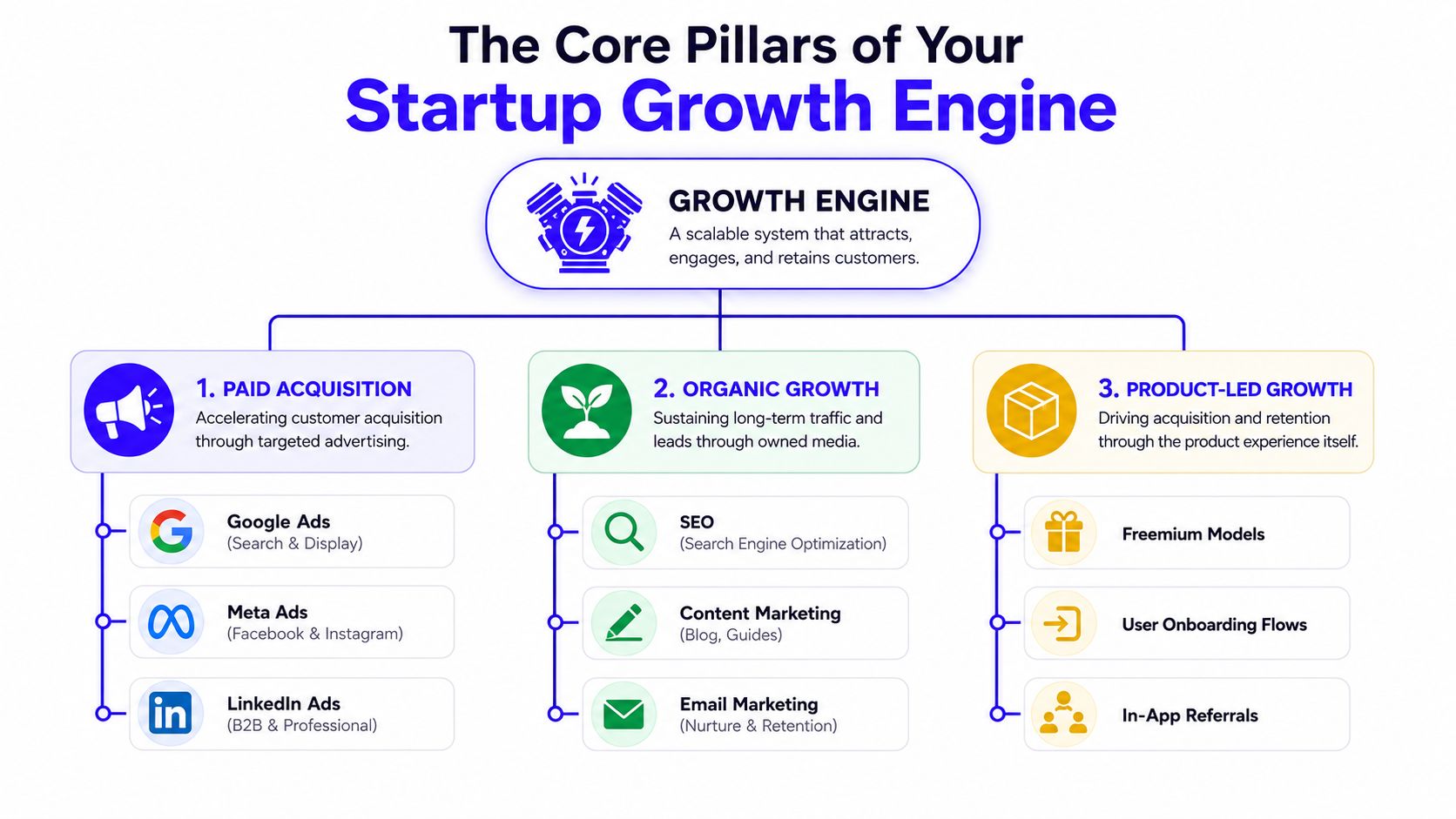
Treating those pillars as separate workstreams creates fake progress. The better setup is a loop. Paid finds demand and pressure-tests offers. Organic captures intent that would otherwise cost you every month. Email and CRM convert interest into pipeline, then send conversion feedback back to the channels that created it.
Channel mix is where small teams usually drift off course. Social gets attention because it is visible and easy to keep shipping. Search and lifecycle work are less visible, but they usually produce cleaner intent and better follow-through. A practical startup mix uses social selectively for distribution and creative testing, then puts real effort into search capture and conversion paths that continue after the first visit.
Paid acquisition as a feedback loop
Paid should answer questions fast. It is a testing system before it is a scaling system.
Google Ads shows which searches carry buying intent. Meta helps test positioning, offers, and audience angles at speed. LinkedIn can produce strong B2B leads, but only when the audience is narrow and the landing page matches the promise in the ad. If none of that data makes it into the CRM, paid turns into a traffic report instead of a growth channel.
Use paid to get decisions you can apply elsewhere:
Which message brings in qualified responses
Which audience segment creates real opportunities
Which offer produces pipeline instead of form fills
Which landing page angle sales can close
The payoff is not just cheaper acquisition. It is sharper messaging across the whole engine.
SEO and content as the compounding asset
SEO usually starts slower and ages better. Good content keeps producing after the campaign that inspired it is long gone. It also gives paid stronger retargeting audiences and gives sales assets they can send when prospects stall.
That does not mean publishing endlessly. A small team needs a focused content map tied to commercial intent:
Bottom-funnel pages: Solution pages, comparison pages, use-case pages
Middle-funnel assets: Guides, templates, buyer education
Support content: Articles that answer objections sales hears every week
Content has to do a job inside the system. For startups, that usually means pushing the visitor toward a demo, a trial, or email capture tied to a defined nurture sequence. If the blog attracts visits but does not create the next step, it is publishing activity without growth mechanics.
If you want tighter alignment between acquisition and sales readiness, this guide to marketing qualified leads is useful because it forces channel planning to match the standards used in pipeline review.
Email and CRM as the conversion layer
Email and CRM decide whether acquisition turns into revenue or just noise.
Visitors arrive with different levels of intent. Some need proof. Some need education. Some are ready for a sales conversation if the follow-up is fast and informed by the original source, campaign, and page path. Email and CRM handle that variation, but only if fields, stages, and handoff rules are set up consistently.
That is the part founders often miss. Email is not a standalone nurture tool. CRM is not just a sales database. In a working growth engine, both systems tell you which traffic sources produce qualified leads, which campaigns stall after the first call, and which messages create expansion potential later.
Pillar | Primary job | What it should feed |
|---|---|---|
Paid acquisition | Fast testing and demand capture | Keyword, audience, and offer insights |
SEO and content | Compounding traffic and trust | Retargeting pools, lead capture, sales enablement |
Email and CRM | Nurture, qualification, retention | Pipeline visibility, lifecycle automation |
When these pillars share the same tracking logic and CRM destination, each one makes the others better. Paid reveals language to use in content. Content lowers paid pressure on expensive terms. CRM shows which sources deserve more budget and which should be cut. That is what turns a pile of tactics into a growth engine.
The Unskippable Foundation Your Tech and Tracking Stack
Most startups postpone tracking because it feels technical, unglamorous, and easy to “sort out later.” That's a mistake. If you launch campaigns before the plumbing works, you don't just lose data. You train the whole company to make decisions from partial truth.
This is the foundation the rest of your growth marketing strategy sits on.
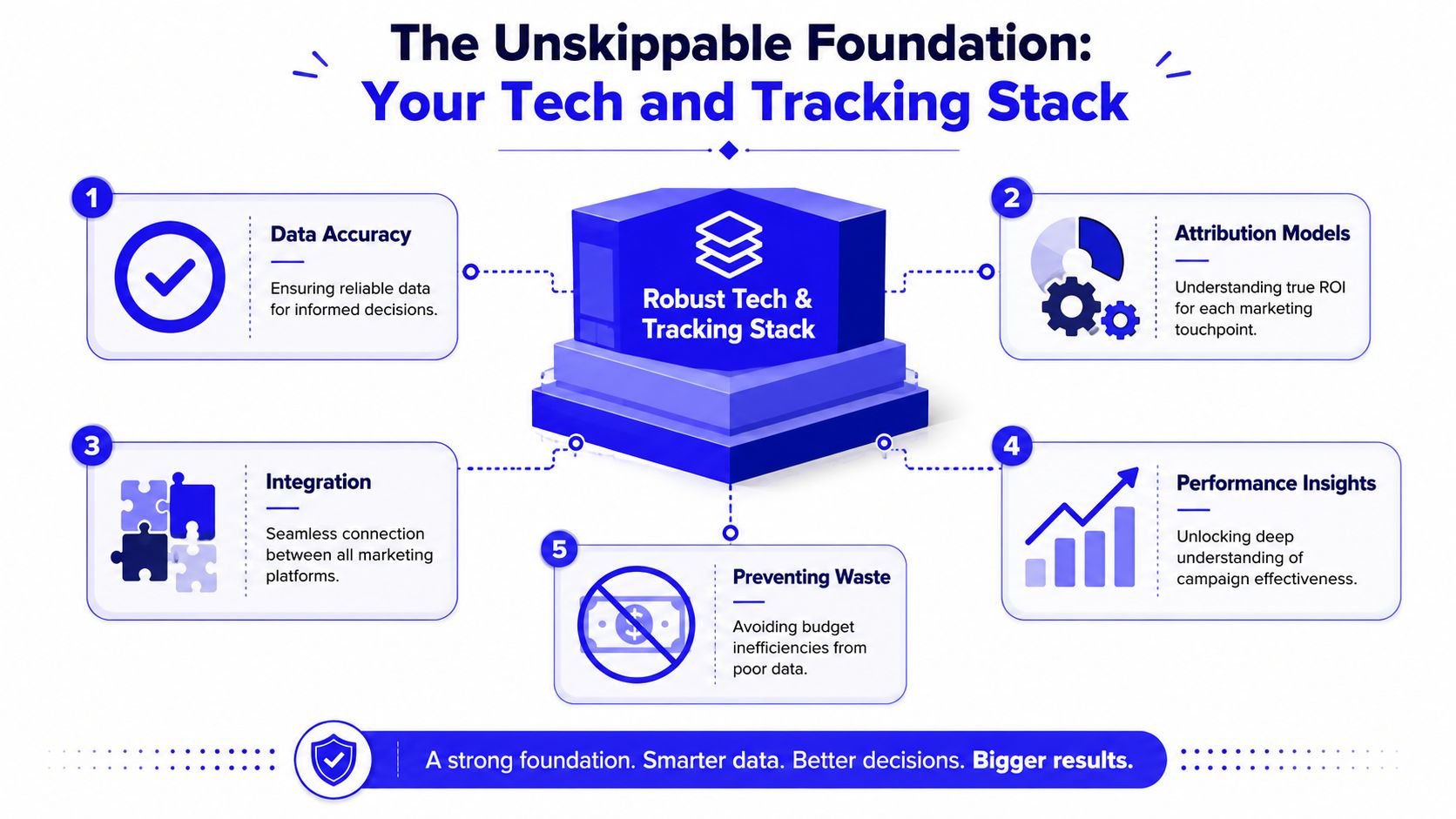
Think of the stack as your startup's nervous system. Ads generate stimuli. Your site and product collect behavior. GTM routes event logic. GA4 records and organizes. Server-side signals and platform APIs help recover cleaner attribution. The CRM tells you whether a conversion was valuable.
Without that chain, every channel overclaims.
What each tool actually does
Founders often hear these tool names tossed around like everyone was born understanding them. Here's the plain-English version:
Google Tag Manager: The control panel for site tracking. It lets you deploy tags and event logic without hard-coding every update into the site.
GA4: Your behavioral analytics layer. It shows how users move through pages, events, sources, and conversion paths.
Server-side CAPI and ad platform integrations: These help pass cleaner conversion signals back to Meta and other platforms when browser-only tracking misses part of the picture.
CRM like HubSpot or Pipedrive: The place where leads become pipeline, sales activity, and revenue status.
UTM standards and automation layers: The discipline that keeps source data readable once leads enter forms, meetings, and downstream workflows.
The stack matters because attribution based on last click is too weak for serious budget decisions. Expert-level growth marketing requires moving beyond last-click attribution to incrementality testing, and teams should calculate a break-even ROAS from 1 divided by profit margin instead of chasing a generic benchmark, according to TVScientific's analysis of growth marketing strategy.
Why attribution breaks in small teams
Small teams usually don't fail because they picked the wrong software. They fail because nobody defined the operating rules.
The common breakdowns look like this:
Form events exist, but CRM fields don't map cleanly
UTMs are inconsistent, so campaign names splinter in reports
Offline conversions never go back to ad platforms
Sales updates opportunity stages manually and inconsistently
“Qualified lead” means one thing to marketing and another to sales
That's why a startup can have plenty of dashboards and still not know what worked.
A useful walkthrough on this problem is these CRM tracking blunders that kill ROAS), because the issue is rarely one missing tag. It's a broken loop from click to revenue.
Here's a simple comparison:
Setup | What you can see | What you still miss |
|---|---|---|
Ad platform only | Clicks, platform conversions | Lead quality, deal value, retention |
Ads plus GA4 | Traffic paths and web conversions | Closed revenue and CRM truth |
Ads plus GA4 plus CRM sync | Acquisition to revenue chain | A much clearer basis for scaling |
A short visual helps if you need to explain the stack internally.
What good setup looks like in practice
Good setup feels boring after it's done. That's how you know it's working.
A click arrives with structured UTMs. The visitor hits a landing page aligned to the campaign promise. Form fills fire correctly through GTM into GA4. The lead enters the CRM with source data intact. Sales qualifies or disqualifies with consistent stage logic. Offline conversion uploads send value signals back to the ad platform. Reporting pulls from one shared naming system.
If your team can't trace a closed deal back to its original acquisition path, you're still operating on estimates.
This isn't an advanced layer for later-stage companies. It's the minimum viable infrastructure for any startup that wants to scale without lying to itself.
The 13-Step Startup Growth Onboarding Pipeline
Startups freeze when “build a growth engine” sounds like a giant transformation project. It's easier when you reduce it to an ordered pipeline. Each step solves one dependency so the next step doesn't rest on broken assumptions.
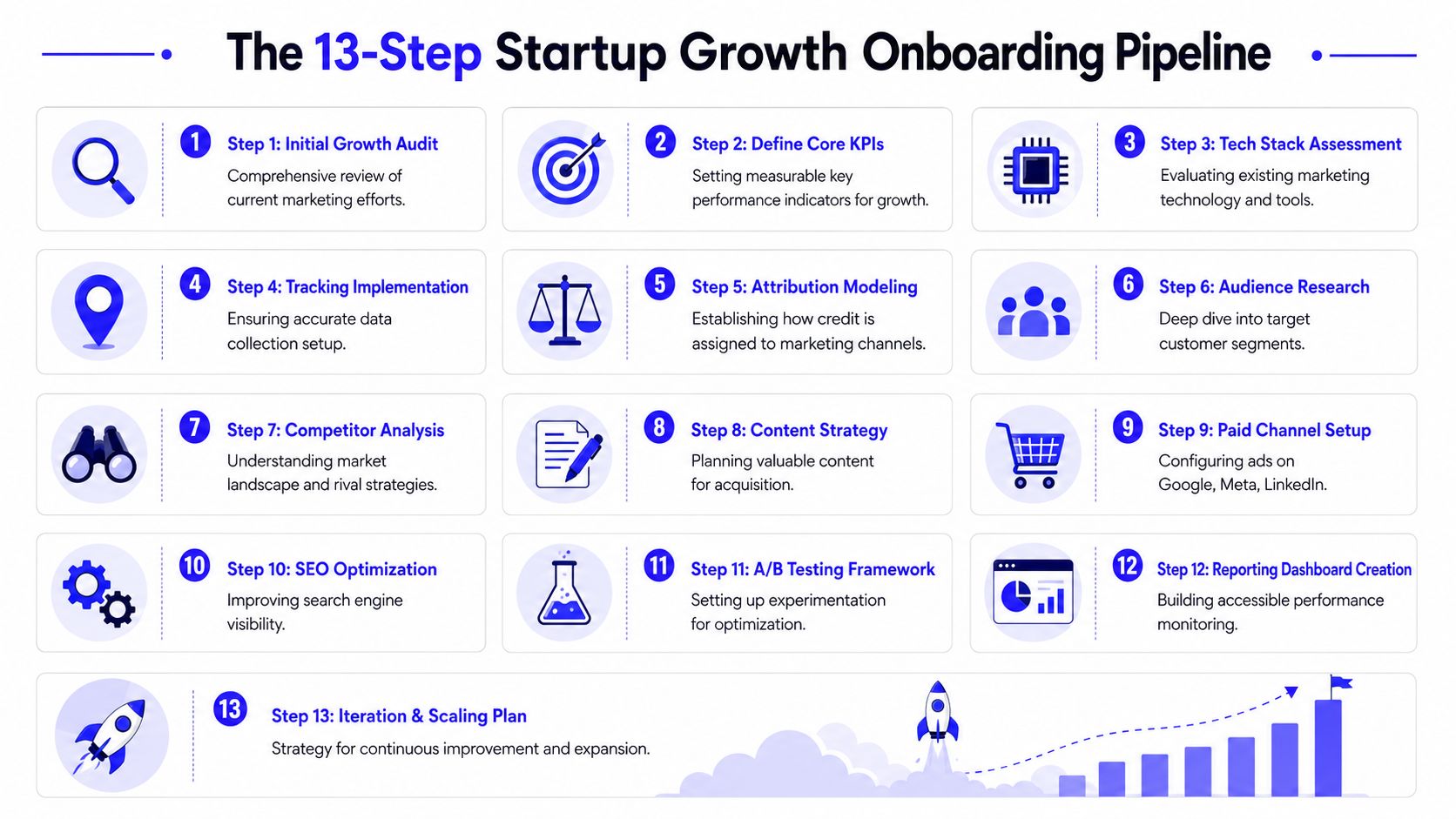
The sequence matters. Don't launch campaigns first and promise to fix reporting later. That's how startups spend the first quarter paying tuition to ad platforms.
The setup phase
Audit the current mess
Pull every active input into one view. Ad accounts, GA4, CRM, landing pages, current UTMs, existing automations, and sales stages. The point is not blame. The point is locating the breaks.Define the business KPIs
Pick the numbers that matter commercially, not cosmetically. Qualified pipeline, closed revenue, sales-qualified leads, trial-to-paid, and break-even efficiency thresholds.Assess the tech stack
Confirm what exists and what's trustworthy. GTM, GA4, Meta CAPI, Google Ads conversion tracking, CRM sync, and dashboard access all need an owner.Implement core tracking
Get forms, calls-to-action, booking events, trial starts, and key product events tracked properly. Make naming conventions boring and consistent.Set attribution logic
Decide how you'll read influence, not just direct last touch. Keep the model understandable enough that founders and sales will use it.
The market and messaging phase
Research the audience
Use call notes, sales objections, search behavior, and customer interviews. Don't settle for a slide deck persona with a fake first name.Map the competition
Look at offers, landing page structures, ad angles, and content gaps. The useful question isn't “What are they doing?” It's “Where are they weak?”Build the content plan
Create pages and assets around actual purchase paths. Some content should capture demand. Some should educate. Some should remove objections.Set up paid channels
Launch only the channels your team can maintain. Most startups don't need every platform. They need one search layer, one paid social layer, and clean exclusions.Optimize for SEO foundations
Clean page intent, metadata, internal linking, on-page structure, and conversion paths. Organic growth only compounds when the site can convert the visits it earns.
The launch and optimization phase
Install an A/B testing rhythm
Don't test random colors and call it growth. Test message-to-market fit, offer framing, landing page structure, form friction, and qualification logic.Build the reporting dashboard
Founder-ready reporting should show channel spend, conversion flow, lead quality, pipeline, and revenue view in one place.Create the scaling plan
Define what gets more budget, what gets cut, and what conditions trigger expansion into another channel or segment.
This is also where product-led growth either becomes a force multiplier or gets wasted. PLG-driven companies achieve 3x higher trial-to-paid conversion rates when onboarding, email/CRM, and feature usage are tightly aligned, yet 78% of startups fail to connect product metrics to marketing campaigns, according to Simon-Kucher's guide to building a real growth marketing engine.
That point matters because the pipeline shouldn't stop at acquisition. If someone starts a trial, key product events should influence CRM segmentation and lifecycle messaging. Otherwise, the startup ends up treating active evaluators and passive signups exactly the same.
Build the onboarding pipeline so marketing, product, and sales can all read the same customer journey.
A lot of startup waste comes from doing the right tasks in the wrong order. This sequence prevents that.
Common Pitfalls and the Solo Marketer's Playbook
The single-operator setup is common for startups because it's practical. One person owns strategy, execution, reporting, and cleanup. The upside is speed. The downside is that bad priorities become expensive fast.
Most solo marketers don't fail from laziness. They fail from fragmentation.
What wastes the most time
The first trap is spreading across too many channels. One person cannot run Google Ads, Meta, LinkedIn, SEO, organic social, webinar ops, affiliate tests, and a newsletter with any depth. The startup ends up with broad presence and weak results.
The second trap is optimizing for easy metrics. Click-through rate, traffic, form volume, and follower growth are seductive because they move quickly. Revenue usually doesn't.
The third trap is choosing the wrong campaign objective. This one hurts because it feels like a small settings choice when it's really a core profit lever. Meta sales campaigns yield an average ROAS of 4.87x, while traffic campaigns yield 0.52x, a 9x performance difference, according to Rule1's ROAS benchmark analysis.
That should change how a small team thinks about campaign setup. If you're buying low-intent clicks to make dashboards look busy, you're teaching the algorithm to find cheap visitors instead of valuable customers.
What a solo operator should do instead
A better playbook is narrower and less exciting on the surface.
Pick one capture channel and one nurture system: For many startups that means Google Ads plus SEO, or Meta plus email/CRM, depending on demand type.
Set one primary conversion goal per campaign: Don't ask one campaign to drive awareness, leads, and purchases at the same time.
Protect maintenance time: Tracking QA, CRM cleanup, naming discipline, and dashboard checks need scheduled time or they deteriorate.
Use sales feedback as a filter: If leads don't convert downstream, acquisition success is fake success.
Keep content close to objections: Write the pages sales wishes existed, not the articles social media told you to publish.
Here's the simple version:
Bad habit | Better move |
|---|---|
Running many channels lightly | Run fewer channels with full-funnel intent |
Buying traffic | Optimize for revenue events or qualified lead signals |
Ignoring CRM hygiene | Treat CRM fields and stages as part of campaign performance |
Checking dashboards daily without context | Review trends with sales outcomes attached |
The solo marketer's edge isn't volume. It's continuity. One person can see the whole system if the system is designed to be seen.
A small team wins by achieving outsized results, not by imitating a large marketing department. The more connected your setup is, the fewer moving parts you need to manage.
Measuring What Matters and Reporting for Growth in 2026
Founders don't need prettier dashboards. They need decision-grade reporting.
That means a dashboard should answer four questions fast. What are we spending? What is each channel producing? Which leads are becoming pipeline or revenue? Where should the next dollar go?
The market keeps getting noisier, and the paid side isn't slowing down. Global social ad spend is projected to surpass $276.72 billion in 2025, up 10.9% year over year, according to Sprinklr's social media marketing statistics. In that environment, weak attribution doesn't just create confusion. It creates expensive confidence.
The dashboard a founder actually needs
A useful growth dashboard blends channel data with CRM outcomes. Looker Studio is a common reporting layer because it can present ad data, GA4 behavior, and CRM outputs in one place, but the tool matters less than the reporting logic.
The dashboard should include:
Spend by channel and campaign
Primary conversion volume
Qualified lead or opportunity count
Pipeline and closed revenue by source
Trend view by week or month
Breakdowns by landing page, audience, or offer where useful
What you should remove is just as important:
Vanity totals without business context
Duplicated attribution views no one can explain
Dozens of KPIs that nobody uses
Platform screenshots passed off as strategic reporting
How reporting changes budget decisions
Good reporting doesn't exist to impress investors in a board slide. It exists to make trade-offs visible.
Maybe paid search produces fewer leads, but sales closes them faster. Maybe content drives fewer direct conversions, but heavily assists demo bookings later. Maybe one campaign creates cheap form fills that never become opportunities. The point of reporting is not to crown a winner every week. The point is to connect spend to commercial reality with enough clarity to act.
A strong reporting cadence usually does three things:
Shows trend, not noise
Weekly snapshots can mislead. Monthly and rolling views reveal signal better.Ties top-of-funnel to downstream quality
A lead is only useful if it progresses.Supports reallocation, not just observation
Reports should trigger decisions. Pause, scale, revise, or rebuild.
A growth marketing strategy becomes real when reporting changes behavior, not when reporting looks sophisticated.
When the system is working, marketing stops arguing for its existence. The numbers don't need dramatic interpretation. They tell you where to push, where to stop, and what to fix next.
If you want that kind of integrated system without juggling multiple freelancers or agency layers, Du Marketing helps startups build and run paid acquisition, SEO, email/CRM, and attribution as one connected growth engine with direct operator access and transparent reporting.