How to Perform Keyword Research for Revenue Growth in 2026

If you've ever opened your analytics dashboard, seen traffic climbing, and still felt no pressure from sales or sign-ups, the problem probably isn't “more content.” It's that the content is aimed at the wrong searchers, or at the wrong stage of the buying journey.
That's the trap startups fall into. A team publishes around broad, high-volume phrases because they look impressive on a report, then wonders why the pipeline doesn't move. Keyword research only works when it connects search demand to business intent, not when it just fills a spreadsheet. Salesforce recommends using keywords with an average monthly search volume of 100 searches or greater as a practical demand signal, while also checking intent and competition before you target them, which is a much better filter than chasing vanity traffic alone (Salesforce keyword research guidance).
Table of Contents
Beyond Traffic Why Most Keyword Research Fails
A lot of startup SEO dies in the same way. Someone picks a broad term, builds a blog calendar around it, and celebrates when clicks show up. Then the demo inbox stays quiet because the visitors were looking for definitions, not vendors.
That isn't a traffic problem. It's a search intent problem.
A founder selling CRM software does not need ten posts around “what is CRM” if buyers are searching for comparisons, pricing, setup guidance, and migration help. Informational queries can still matter, but they earn their place by feeding the funnel, not by pretending to be revenue pages. A small list of high-intent keywords is more valuable than a giant list of popular ones that never touch a buying decision.
Practical rule: if a keyword sounds useful but you can't connect it to a page, offer, or next step, it's usually a distraction.
What a bad keyword list looks like
Bad lists are packed with terms that look defensible in isolation. They miss the core job, which is to help a startup decide what to publish, what to ignore, and what to map to the product.
That's why keyword research has changed from a list-building exercise into a planning exercise. HubSpot's guidance reflects that shift by recommending keyword ideas be grouped by topic and intent, then assigned to pages in a keyword map rather than treated as isolated terms, and Similarweb's page-based approach of assigning one to five target keywords per asset makes the same point from a practical angle (HubSpot keyword research guide).
For startups, that shift matters because resources are tight. You don't need every keyword. You need the right few that align with a page, a searcher, and a business outcome.
Finding Your Seed Keywords and Hidden Gems
The best seed keywords usually aren't hiding in a third-party tool. They're already sitting in your own data, your own calls, and your own website.
Start with Google Search Console. Look for queries where you already get impressions but not clicks, because those terms tell you Google already sees a connection between your page and a searcher's need. Then check internal site search, if your site has it, because people often tell you exactly what they want when they search inside your product or content library. SE Ranking also points to Google Search Console queries, GA4 site-search terms, and pages titled around “You searched for [your keyword]” as sources of valuable search queries that generic keyword lists miss (SE Ranking advanced keyword research).

Mine first-party data before opening a tool
The order matters. If you open Semrush or Google Keyword Planner first, it's easy to let tool suggestions define the strategy. If you start with first-party data, you're building around real phrasing from prospects and users.
Pull the language from sales calls and support tickets. Don't rewrite it into marketing copy. The exact words people use are often more useful than the polished version your team would prefer. A prospect saying “how do I migrate from Pipedrive” is more actionable than a vague theme like “CRM migration.” A support thread asking about “HubSpot pipeline stages” tells you what users are trying to do, not just what category they belong to.
Start with the questions that repeatedly show up in sales, support, onboarding, and internal search. Those are the phrases most likely to signal intent you can serve.
Turn raw phrases into seed topics
Once you've collected those phrases, group them into obvious buckets. Separate product names, use cases, pain points, and comparison language. Then create seed keywords from each group.
For a startup selling analytics or attribution software, that list might include terms around campaign tracking, conversion sync, UTM hygiene, CRM reporting, and attribution setup. For an ecommerce brand, the seeds may come from product-specific problems, comparison terms, and pre-purchase questions. The point isn't to finalize keywords yet. The point is to build a starter set that reflects real customer language before you widen the search.
If your internal data is thin, add input from the people closest to buyers. Sales hears objections. Support hears confusion. Founders hear the blunt version of the market. Those are all seed sources, and they're often better than guessing from a keyword tool.
Reverse-Engineering Your Competitors' Playbook
Competitor research works best when you treat it like intelligence, not imitation. The goal isn't to copy their content calendar. The goal is to see which search problems they've already proven matter, then find the gaps they left open.
Pick three to five competitors. Include direct competitors, plus one or two indirect ones that solve the same customer problem in a different way. A SaaS startup can learn as much from a comparison blog, marketplace listing, or help center page as it can from a rival homepage. If you want a broader growth lens for that kind of analysis, this growth marketing examples guide is a useful companion reference.
Look for what they rank for, not just what they publish
Some competitor pages are obvious winners because they sit on high-value keywords with clear buying intent. Others offer a distinct kind of utility because they speak to the exact questions buyers ask before they convert. That's where the opportunity usually lives.
You're looking for three things. First, the content formats they rely on most. Second, the phrases they repeat across multiple pages. Third, the pages that feel outdated, thin, or mismatched to intent. Those are often the easiest opportunities for a better page to outrank them or pull attention away from them.
A comparison page can tell you more than a traffic monster blog post. If a competitor has a weak “tool A vs tool B” page, that's a signal that buyers in your category are already shopping. If they have a dated setup guide, that's a signal that implementation pain is part of the buying decision.
Spot content gaps with buyer intent in mind
A content gap isn't just a keyword they rank for and you don't. It's a keyword tied to a serious question that they answer poorly.
That difference matters. A startup doesn't have the luxury of publishing everything. You want the topics where competitors are vulnerable and the buyer is close enough to action that the page can influence a decision. If the current result pages look shallow, generic, or outdated, that's usually better than going after a crowded keyword with strong incumbents and no opening.
Use a simple test. If a competitor's page would frustrate a buyer who is trying to choose, compare, or implement, you've likely found a gap worth targeting. If it's just a broad awareness article with no purchase path, leave it unless it can support a cluster you're actively building.
Decoding Intent Volume and Difficulty
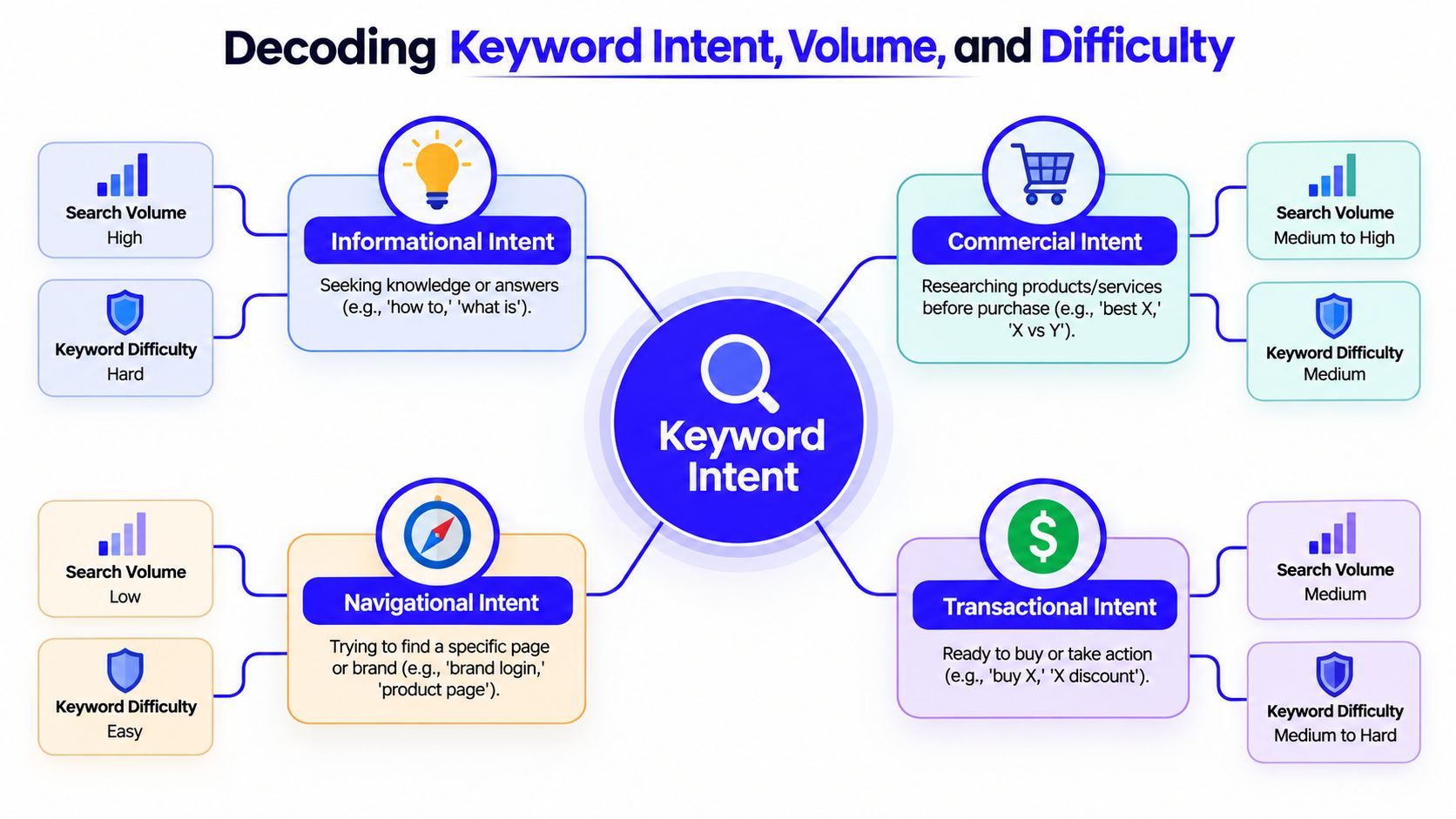
Search volume, keyword difficulty, and intent often get discussed like separate filters. In practice, they have to work together. A keyword can have solid demand and still be useless if the searcher wants something you don't offer, or if the SERP is full of content that's impossible for you to beat right now.
The cleanest way to think about intent is to sort keywords into informational, commercial, transactional, and navigational buckets. “What is CRM” is informational. “HubSpot vs Pipedrive” is commercial. “Pipedrive pricing” is transactional. “HubSpot login” is navigational. Those categories matter because the page type should match the intent, not the other way around.
Match the page type to the searcher's job
A startup wastes time when it tries to force one article to do everything. Informational queries want explanation. Commercial queries want comparisons. Transactional queries want proof and a next step. If you ignore that, the page may still rank, but it won't convert.
That's why the same product can deserve different assets for different intent. A CRM startup might need a “what is CRM” article to establish context, a “best CRM for startups” page to catch evaluative searches, and a pricing page that answers transaction-ready visitors. Those pages work together, but they're not interchangeable.
Practical rule: if the searcher is comparing vendors, don't send them to a feature explainer. If they're trying to buy, don't bury them in a glossary.
Use volume as a demand signal, not a command
Search volume is useful because it helps you avoid writing for invisible demand. Salesforce's 100 searches or greater guideline is a practical threshold for checking whether a keyword is worth evaluating, especially once you're comparing it against relevance and competition (Salesforce keyword research guidance).
Still, volume alone can mislead you. A broader keyword can pull in plenty of visits and almost no buyers. A tighter, lower-volume phrase can bring fewer visitors and better leads. For startups, the lower-volume term is often the better business bet if it points closer to the product.
That's also why it helps to start with lower-difficulty, higher-intent terms when the site is still building authority. A new domain usually has a better chance with focused, transactional queries than with broad head terms. The sequence should be simple. Find the seed. Check the intent. Verify the search demand. Then look at how hard the current SERP is to break into.
Treat difficulty as a feasibility check
Difficulty is not a moral score, it's a resource check. Can your current site, with its current authority and content quality, realistically compete here? If not, that keyword might still belong in your strategy, but not this quarter.
That's where the startup mindset helps. You're not trying to win every term at once. You're trying to win the terms that can create momentum, topical depth, and revenue signal. Once those pages start performing, you can climb toward more competitive territory with more confidence.
A Simple Framework for Prioritizing Keywords
A long list of decent keywords is still a problem if you can't decide what to build first. Gut feel isn't enough once the list gets past a handful of options, because the team will always gravitate toward the topic someone likes best, not the one most likely to produce business value.
A cleaner approach is to score every keyword on three dimensions, Business Value, Search Intent Strength, and Ranking Ease. Give each one a score from 1 to 5, then total them. That makes the decision visible instead of political.
Keyword | Business Value (1-5) | Search Intent Strength (1-5) | Ranking Ease (1-5) | Total Score |
|---|---|---|---|---|
Score business value first
Business value asks one question, how closely does this keyword align with what you sell? A keyword tied to your core product, a clear use case, or a serious pain point should score high. A keyword that only creates loose awareness should score lower unless it supports a bigger cluster.
Startups often overestimate top-of-funnel content. A helpful article can be a valid asset, but if it sits too far from the product and never feeds a meaningful next step, it shouldn't outrank a term that maps directly to revenue intent.
Let intent strength separate good from great
Intent strength is about conversion likelihood. A searcher comparing tools or checking pricing is closer to action than someone asking for a definition. A page that captures that behavior deserves to rise in the queue.
The easiest way to keep this honest is to inspect the SERP. If the top results are mostly comparison pages, pricing pages, and decision content, that keyword probably has stronger commercial intent than a generic educational result would suggest. If the SERP is full of encyclopedia-style pages, the keyword may be valuable for authority but weak for direct response.
Use ranking ease to keep the plan realistic
Ranking ease forces a conversation about what your current site can win. A tiny startup doesn't need to pretend it can outrun entrenched incumbents for every phrase. It needs a sequence that builds wins quickly, then stacks authority over time.
If two keywords look equally useful, the easier one usually goes first. That's not because the harder one is bad. It's because your first job is to create movement. Once a few pages start earning visibility, the rest of the plan gets easier to justify internally.
From List to Live Content Your Action Plan
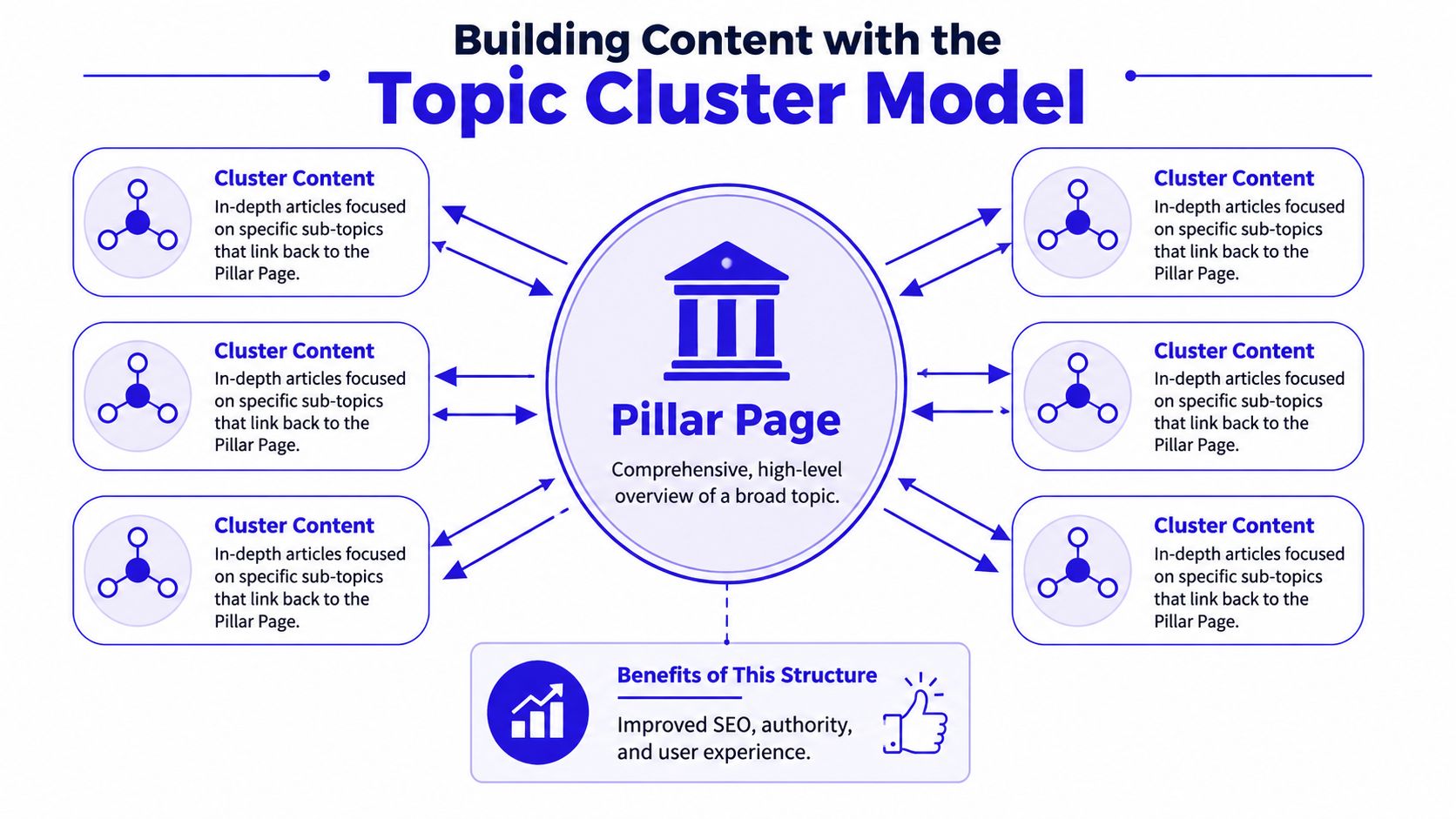
Once the keywords are scored, stop thinking about them as rows in a sheet. Turn them into a content system. That means grouping related terms into topic clusters, assigning each cluster a page type, and deciding what gets published first.
A pillar page covers the broad topic. Cluster content handles the specific subtopics. For a SaaS company, a pillar around project management could support cluster pages on workload planning, team collaboration, time tracking, integrations, and process templates. The structure helps search engines understand topical depth, and it helps readers move through related questions without starting over each time.
Map keywords to page types
Not every keyword should become a blog post. Some belong on landing pages, comparison pages, feature pages, or integration pages. The right format matters as much as the keyword itself.
Use the commercial and transactional terms to define revenue-facing pages first. Use informational terms to support the cluster and build authority around the main theme. HubSpot's recommendation to organize keyword ideas by topic and intent, and Similarweb's guidance to keep pages focused on one to five target keywords per asset, both support this page-based approach (HubSpot keyword research guide).
If you want the research to turn into an operating rhythm, connect the keyword map to a content calendar. That's where a startup stops “doing SEO” and starts building an asset pipeline. This content marketing for startups guide is a good reference point for organizing that workflow.
Build the content around the buying journey, not around the keyword list. The keyword list is just the input.
Close the loop after publication
Publishing is not the end of the process. Track which pages earn visibility, which pages attract clicks, and which pages support sign-ups, demos, or sales conversations. The point is to feed the next research round with better data than the last one.
That feedback loop is where startup SEO gets efficient. The pages that perform reveal which intents are worth doubling down on. The pages that stall show you where the mapping was wrong, the competition was stronger, or the content format missed the searcher's expectation. Either way, you get a smarter plan for the next sprint.
If you want a keyword research process that's built for revenue, not vanity traffic, Du Marketing can help you turn raw search data into a lean content plan, map it to the right pages, and connect it to measurable growth. Reach out at Du Marketing and start with the keywords that are most likely to pay off.