Landing Page Conversion Optimization a Startup Playbook

You launched the campaign. Clicks are coming in from Google Ads, LinkedIn, or Meta. The dashboard says traffic exists, but the form fills, demo requests, or purchases feel stuck in mud. So the team starts doing what teams always do when a landing page underperforms. They rewrite the headline, change the button color, move the form up, add another testimonial, and hope something magical happens.
Usually, nothing magical happens.
That's because landing page conversion optimization isn't a design clean-up project. It's a systems job. The page sits in the middle of a chain that starts with the ad or email, continues through on-page intent matching, and ends inside your CRM where a lead either becomes real pipeline or dies. Most startups don't have a landing page problem in isolation. They have a broken handoff problem.
Table of Contents
Your Landing Page Is Leaking Money Heres Why
A founder usually notices the problem in a very specific way. Ads look healthy enough. Cost per click isn't terrifying. The page looks polished. Yet leads are weak, sales calls are thin, and nobody can explain why the spend feels heavier every month.
That's the trap. A nice-looking page can still be a leaky one.
The benchmark gap is often underestimated. The average landing page conversion rate across industries is about 6.6%, while 10% or higher is generally considered strong, according to Involve's landing page statistics roundup. The same source notes that pages with a single primary CTA average 13.5% conversion, while pages with five or more links convert about 10.5%. Attention gets diluted fast.

The page usually isn't the only problem
Teams love to blame the button, the hero image, or the copy length. Sometimes those are the issue. More often, the leak starts earlier. The ad promises one thing. The landing page opens with another. The form asks for too much too soon. Then the CRM tags the lead incorrectly, sales follows up late, and everyone concludes “the traffic was bad.”
It may not have been bad traffic. It may have been a bad sequence.
A lot of startup CRO advice treats the landing page like a stand-alone asset. That's outdated. Your page is a junction between acquisition, message, trust, and measurement. If those pieces don't line up, a prettier layout won't save you.
Practical rule: If your ad, landing page, thank-you flow, and CRM field mapping were built by different people with different assumptions, your conversion rate is probably paying the price.
Founders usually feel this before they can diagnose it
The symptoms are familiar:
Traffic exists: Sessions arrive, but pipeline doesn't move with them.
Sales complains about quality: Form fills come through, but they don't match the buyer you thought you targeted.
Paid media gets blamed: The campaign gets cut before anyone checks whether the page and post-submit flow were built for the same intent.
Teams chase trivia: Button colors get debated while message mismatch, speed, and form friction stay untouched.
This is also why strong SEO or paid acquisition alone won't fix a broken page. If search platforms and AI surfaces are already absorbing more of the user journey, every visit that still reaches your page matters more. That makes post-click performance even more important, especially in the zero-click search reality many teams now face.
Landing page conversion optimization works when you stop treating it like a page edit and start treating it like funnel surgery.
Conduct a Brutally Honest Diagnostic Audit
Teams often start optimizing too early. They open the page, spot a few things they dislike, and begin changing copy. That feels productive. It usually isn't.
A proper audit starts with evidence. You need analytics for what happened, behavior tools for where people got stuck, and CRM data for whether those “conversions” were worth anything after the form was submitted.

Start with the baseline and the traffic split
First, define the exact conversion you care about. That sounds obvious, but plenty of pages are judged on total form fills when the business primarily cares about qualified demos, activated trials, or opportunities created in HubSpot or Pipedrive.
Then split your data by source. Don't blend paid search, paid social, organic, branded traffic, partner traffic, and email into one number. A page can look “fine” in aggregate while one traffic source performs terribly.
Use a simple audit sequence:
Pull the page-level baseline: Look at visits, conversions, and the specific action the page is supposed to drive.
Break performance by channel: GA4 can show whether paid traffic behaves differently from organic or email traffic.
Review heatmaps and session recordings: Hotjar, Lucky Orange, or Microsoft Clarity can show rage clicks, dead clicks, and abandonment points.
Check mobile separately: Lots of pages look acceptable on desktop and clumsy on phones.
Compare lead quality in the CRM: If one source submits forms but never turns into qualified pipeline, that's not a win.
Alexander Jarvis notes that a rigorous process starts by establishing a baseline conversion rate and then auditing ad-to-page continuity using a “story mindset” where the ad is the introduction and the page continues that same narrative. He also stresses A/B testing one variable at a time and segmenting analysis by visitor source in his piece on landing page conversion rate in SaaS.
Audit the message match, not just the page
A lot of B2B pages break at this point.
The headline may technically include the same keyword as the ad, but it still misses the buyer's stage. An awareness-stage visitor clicks an ad because they want clarity, education, or a way to frame the problem. The landing page greets them with a hard-close “book a demo now” pitch. That's not alignment. That's a lunge.
According to Mailjet's landing page optimization article, 68% of B2B landing pages fail to convert ad traffic because headlines match the ad's keyword but not the user's buying stage, leading to a 40% drop-off in the first 3 seconds.
If the ad says “reduce reporting chaos” and the page says “enterprise analytics platform for modern finance teams,” the language may be related, but the intent isn't.
A blunt message-match audit checks four things:
Promise match: Does the first screen continue the exact promise from the ad or email?
Stage match: Is the CTA appropriate for the visitor's likely buying stage?
Offer match: Did the user click for a guide, a trial, a consultation, or a comparison page?
Tone match: A conversational ad followed by stiff corporate copy creates friction fast.
Look past the form submission
A submitted form is not the finish line. It's a handoff.
You need to inspect what happens after conversion. Does the thank-you page reinforce the next step? Does the CRM capture campaign source and creative context? Does sales know which message brought the lead in? If attribution breaks after the form, your optimization loop breaks with it.
Here's the shortest version of a useful diagnostic standard:
On-page data tells you what people did
Behavior tools tell you where they struggled
Ad context tells you what they expected
CRM data tells you whether the conversion mattered
Without all four, teams end up optimizing for activity instead of business value.
Build a Prioritized Hypothesis Backlog
Once the audit is done, teams often create chaos. They dump observations into Slack, open six test tickets, and start rewriting half the page. That's not a backlog. That's a stress response.
A useful backlog turns observations into decisions. Every item should explain what you saw, what change you believe will help, and which audience the change is for. If you can't write that cleanly, you're not ready to test it.
Write hypotheses like an operator
Use a format that forces clarity:
Based on [observed behavior or data], we believe that [specific change] for [specific audience] will result in [expected outcome].
Examples:
Based on repeated abandonment at the form, we believe shortening the form for paid social visitors will improve completion quality.
Based on weak engagement above the fold, we believe rewriting the headline to mirror the ad promise for non-brand paid search visitors will increase first-step actions.
Based on CRM feedback that leads from one campaign are underqualified, we believe tightening the offer language for decision-stage traffic will improve lead quality.
The key is specificity. “Test new CTA” is vague. “Replace ‘Submit' with a CTA that names the outcome for demo-intent traffic” is useful.
Use P I E without turning it into bureaucracy
You don't need a giant experimentation department. A spreadsheet is enough if it forces prioritization. The classic P.I.E. model works well:
Potential: How much upside does this page or issue seem to have?
Importance: How valuable is the traffic or conversion point involved?
Ease: How quickly can the team ship the change with low complexity?
Here's a simple working template.
Hypothesis Statement | Potential (1-10) | Importance (1-10) | Ease (1-10) | PIE Score | Status |
|---|---|---|---|---|---|
Rewrite hero headline to match paid search ad promise for non-brand traffic | 9 | 9 | 7 | 25 | Ready |
Reduce form fields on demo page for mobile visitors | 8 | 8 | 8 | 24 | In progress |
Replace generic testimonial block with industry-specific proof for campaign-specific traffic | 8 | 7 | 6 | 21 | Planned |
Remove secondary navigation links from lead gen page | 7 | 8 | 9 | 24 | Ready |
Rework CTA copy to reflect offer outcome instead of generic submit language | 6 | 7 | 9 | 22 | Testing |
A few prioritization rules save a lot of pain:
Start where intent is already high: Decision-stage pages often produce faster learning than broad awareness traffic.
Favor changes tied to observed friction: Session recordings beat opinions.
Don't over-reward clever ideas: A simple message match fix often beats a fancy redesign.
Keep “big redesign” items separate: They're usually too messy to learn from quickly.
Operator's bias: If an idea needs five teams, three weeks, and a custom component, it probably doesn't belong at the top of the backlog.
A backlog should reduce randomness. If it doesn't help you say “not yet” to weak ideas, it's just decorative project management.
Design Experiments That Deliver Clear Answers
Bad testing creates expensive confidence. The page changes, the graph wiggles, and everyone declares victory without knowing what caused the change.
That's why the best experiments are usually smaller and more boring than people expect.
Most startups test too many things at once
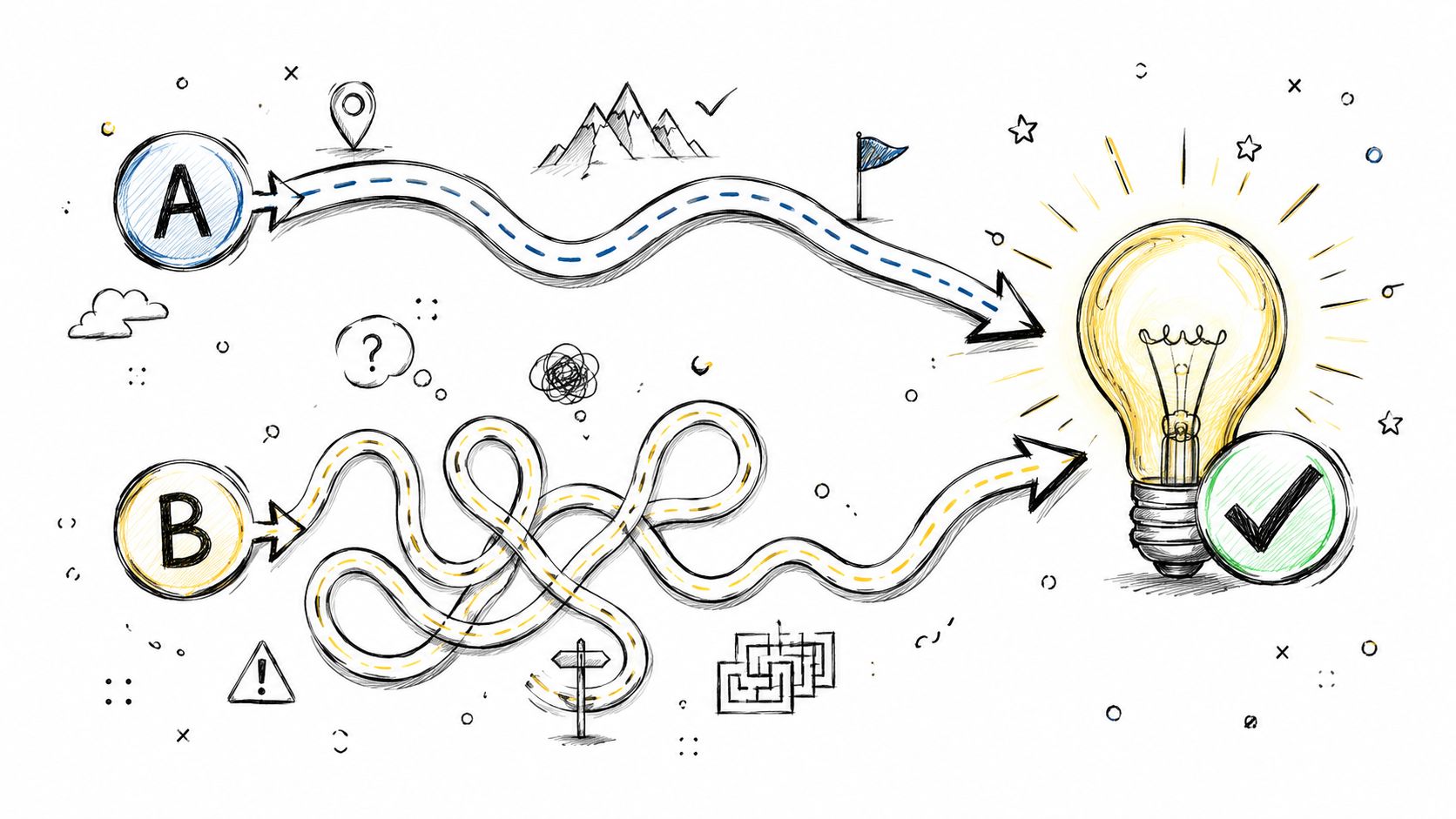
One of the most useful rules in landing page conversion optimization is simple. Change one variable at a time. Headline, CTA wording, form length, testimonial block, hero layout. Pick one.
That principle matters because you're not trying to decorate the page. You're trying to answer a business question.
Here's the difference:
Weak test: New headline, new CTA, shorter form, new image, and different proof section all at once.
Useful test: Keep the page constant and test only the hero message for paid search traffic from one campaign group.
A/B tests are usually enough. A/B/n can help when you have a few clear alternatives for one element, but they get messy fast. Multivariate tests sound impressive and often produce muddled learning unless traffic volume and experimentation discipline are already strong.
The point is not to “test everything.” The point is to remove uncertainty around the biggest decision.
Test contextual trust, not generic social proof
A lot of startup pages include trust elements that should work in theory but don't land in context. A visitor from a fintech campaign sees testimonials from ecommerce brands. A B2B buyer clicks a compliance-focused ad and lands on a page full of vague startup logos. The page has proof, but the proof doesn't feel like it belongs to them.
That's where contextual trust matters.
According to CXL's landing page optimization article, personalized landing pages for specific ad campaigns boost conversions by 32% compared to static pages, yet 85% of startups still use one-size-fits-all pages.
That stat explains a lot of underperforming campaigns.
A better trust test might compare:
Test Version | Trust Signal | Best Use Case |
|---|---|---|
Control | Generic testimonials and broad logos | Mixed or low-segmentation traffic |
Variant A | Industry-specific testimonials | Vertical campaigns like fintech, education, or healthcare |
Variant B | Source-matched proof | Visitors from a specific ad set or offer |
Variant C | Stage-matched proof | Awareness visitors see credibility and clarity, decision visitors see outcome-focused proof |
Generic social proof says, “Other people trust us.” Contextual trust says, “People like you trusted us in situations like yours.”
That's a very different psychological job.
Good experiments also respect the visitor source. If traffic comes from a comparison keyword, test proof that reduces perceived risk. If traffic comes from a pain-point ad, test copy that confirms the pain before pitching the product. If traffic comes from retargeting, don't waste the first screen reintroducing basics they already know.
The best landing page conversion optimization programs don't run more tests. They run cleaner ones.
Implement High-Impact Copy and Technical Fixes
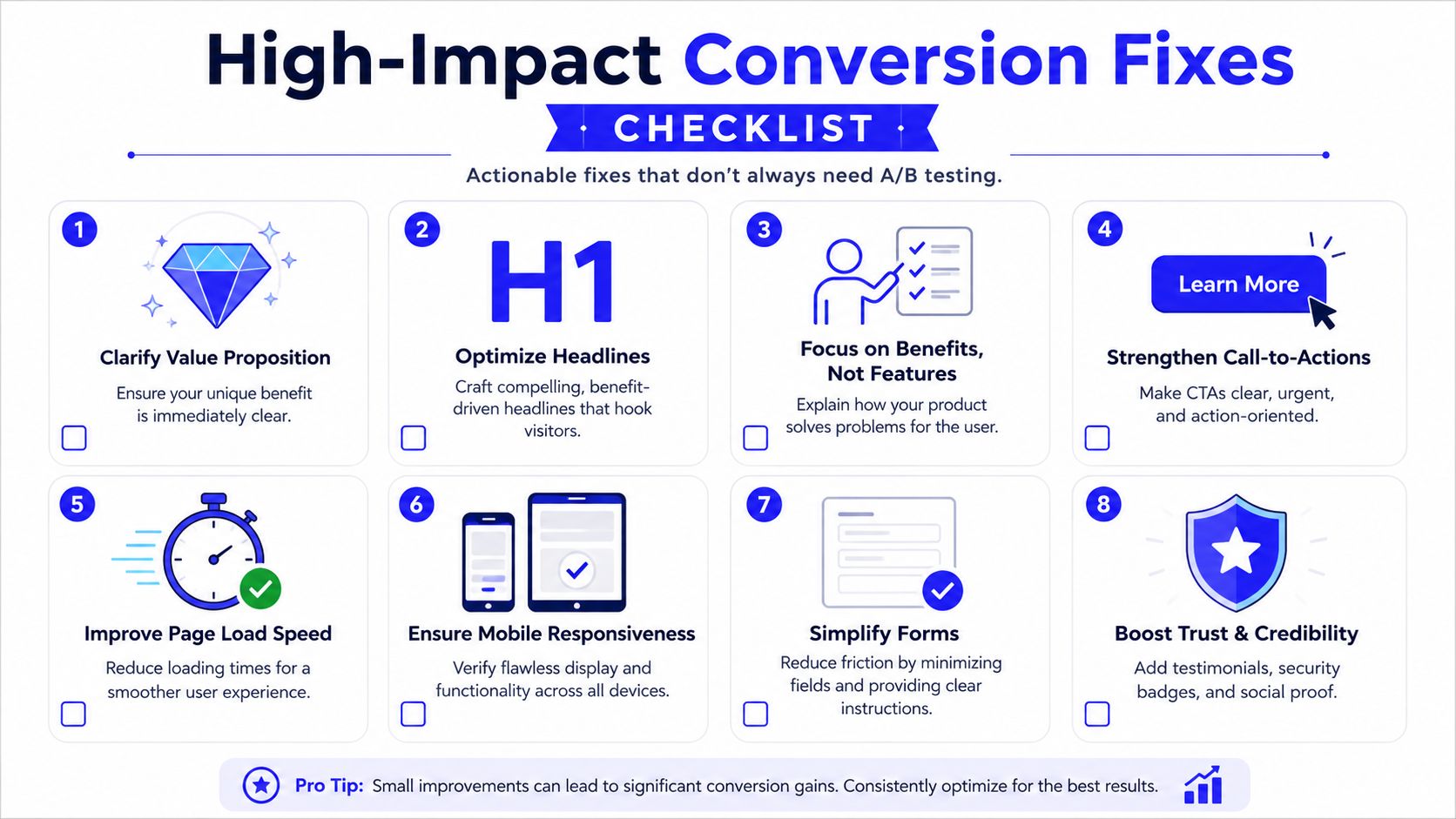
Some fixes don't need a philosophical debate or a month-long experiment queue. If the page is obviously confusing, overloaded, or slow, fix it.
The most common conversion killers are still the old ones. Too many actions. Too much friction. Too much waiting.
Fix the words people trip over
Start at the top of the page. The headline should tell the visitor what they get, who it's for, or what problem gets solved. If it sounds like internal brand poetry, it's probably underperforming.
A fast copy audit checks this:
Headline clarity: Can a first-time visitor understand the core value without scrolling?
Benefit language: Does the page explain outcomes, not just product features?
CTA specificity: Does the button describe the next step in plain language?
Offer consistency: Does the page deliver what the ad or email promised?
If a startup page says “Transform your workflow with intelligent orchestration,” that may impress the team that wrote it. It won't help a buyer decide whether this is for reporting, hiring, onboarding, compliance, or something else entirely.
This is also where one-action discipline matters. SamCart notes in its guide to conversion rate optimization for landing pages that common pitfalls include multi-action landing pages, excessive form fields, and slow page load times, and that lazy-loading for images and CDNs can reduce load time by up to 40%.
Reduce form friction before asking for more intent
Forms often reveal what a company wants, not what a visitor is ready to give.
If you're asking for phone number, company size, job title, revenue range, use case, timeline, and preferred meeting date on the first touch, you're making the visitor do sales qualification work before they trust you enough to bother.
A practical form review looks like this:
Must-have fields: Keep only what the next step requires.
Nice-to-have fields: Move them to later lifecycle stages or enrichment.
Field order: Ask easier questions first.
Mobile entry: Make the form painless on a phone.
There's also a strategic trade-off here. A longer form can improve lead quality in some cases, but many teams reach for that too early. If the page hasn't earned the ask, form length becomes a tax on curiosity.
A related content issue is clutter. If the page supports one campaign, remove irrelevant navigation and side quests. Internal links, footer distractions, and “learn more” detours often siphon intent away from the primary action. That same logic applies to content teams adapting old pages for changing search and AI behavior, especially when modernizing content for the generative era demands clearer purpose and cleaner page structure.
Before the next checklist, this short walkthrough is worth a look:
Handle speed and mobile like revenue issues
Technical performance gets pushed into a separate bucket called “web stuff.” That's a mistake. If the page loads slowly, shifts while rendering, or feels awkward on mobile, the user experiences that as distrust and friction, not as a technical footnote.
A fast non-developer checklist:
Compress heavy images: Large visual files degrade mobile experience.
Use lazy-loading where appropriate: Especially for below-the-fold assets.
Check with and without ad scripts: Tracking tools sometimes add more weight than teams realize.
Review mobile above the fold: CTA visibility and headline readability matter immediately.
Use a CDN if the setup allows it: Speed improvements here often come from infrastructure, not just design.
Reality check: A page doesn't need to be perfect. It needs to be clear, fast enough, and easy to act on.
Copy and technical fixes are the floor, not the ceiling. If the floor is weak, every experiment on top of it gets harder to trust.
Master Your Measurement and Iteration Cadence
Most CRO programs break after the test ends. Someone reports that conversion rate moved, a winner gets pushed live, and then the learning vanishes into a slide deck no one opens again.
That's not a program. That's a one-off event.
The reason landing page conversion optimization compounds is simple. The team keeps a rhythm. They review what changed, what it meant, and whether the front-end conversion translated into actual business value later in the funnel.
Tie front-end conversions to CRM outcomes
A form fill is only a proxy. The business cares about qualified leads, opportunities, sales conversations, activated users, or closed revenue.
That means your measurement loop has to connect:
Visitor source
Landing page variant
Conversion event
CRM record
Pipeline outcome
If the UTM structure is inconsistent, if offline conversions never make it back to ad platforms, or if CRM lifecycle stages are messy, your landing page data will mislead you. You'll think one page wins because it generated more submissions, even though another page produced fewer but far better leads.
The upside is meaningful. Involve reports that businesses that strategically optimize landing pages can more than double conversion rates, moving from roughly 2.35% to 5.31% or higher, with top-performing pages exceeding 10%. Those gains matter a lot more when the back-end measurement is clean enough to show which conversions delivered real value.
If your attribution chain is shaky, it's worth fixing the basics before scaling spend. A lot of teams lose the thread between campaign click and CRM outcome through avoidable process gaps, which is exactly what breaks when CRM tracking blunders kill your ROAS loop).
Run CRO on a rhythm, not on emotion
A stable cadence beats a burst of random activity.
A practical operating rhythm looks like this:
Cadence | What to Review | What to Decide |
|---|---|---|
Weekly | Live experiments, page anomalies, CRM lead quality notes | Keep running, stop, or ship change |
Monthly | Backlog grooming, source-level performance, recurring friction patterns | Prioritize next batch of tests and fixes |
Quarterly | Offer alignment, page architecture, tracking quality, campaign-to-page mapping | Rework bigger structural issues |
A few habits make this sustainable:
Log every test clearly: Hypothesis, audience, variant, result, and business takeaway.
Record losses too: Failed tests often teach more than winners.
Separate insight from action: “Visitors didn't trust the page” is an interpretation. “Visitors repeatedly abandoned before the form after reading the pricing block” is an observation.
Review sales feedback alongside analytics: Reps often hear objections the page never answered.
The best operators don't chase novelty. They tighten the loop. They use the page, the ad account, and the CRM as one system.
That's when landing page conversion optimization stops being a collection of tricks and starts behaving like a growth engine.
Du Marketing helps startups build that system end to end, from paid traffic and SEO to landing pages, CRM workflows, and attribution. If you want a single operator who can diagnose the leaks, implement the fixes, and connect conversions to real pipeline, explore Du Marketing.