Marketing and Sales Alignment: Startup Success Guide 2026

Your startup probably already has a version of this argument.
Marketing says the campaigns are working because leads are coming in. Sales says those leads are useless because nobody serious books a call. The founder sits in the middle, refreshing HubSpot or Pipedrive and wondering why “activity” never seems to turn into revenue.
That fight usually gets treated like a communication problem. In startups, it's usually a systems problem. If one person or one very small team owns acquisition, qualification, follow-up logic, and reporting together, you can build marketing and sales alignment before silos ever show up. That's a fundamental startup advantage. You don't need a cross-functional task force. You need one operating model that treats buyer intent, pipeline movement, and revenue as the same machine.
Table of Contents
Why Most Sales and Marketing Teams Fight And How Yours Wont
The usual blame game starts when each side thinks it did its job. Marketing generated form fills. Sales followed up on a few and decided the list was weak. Nobody is lying. They're just optimizing for different outcomes.
According to TechnologyAdvice on sales and marketing alignment, the primary failure point is misaligned goals, specifically lead volume versus revenue, and only 41% of companies rate their alignment as “very good.” That number tends to reflect larger organizations with more handoffs and more opportunities for friction.
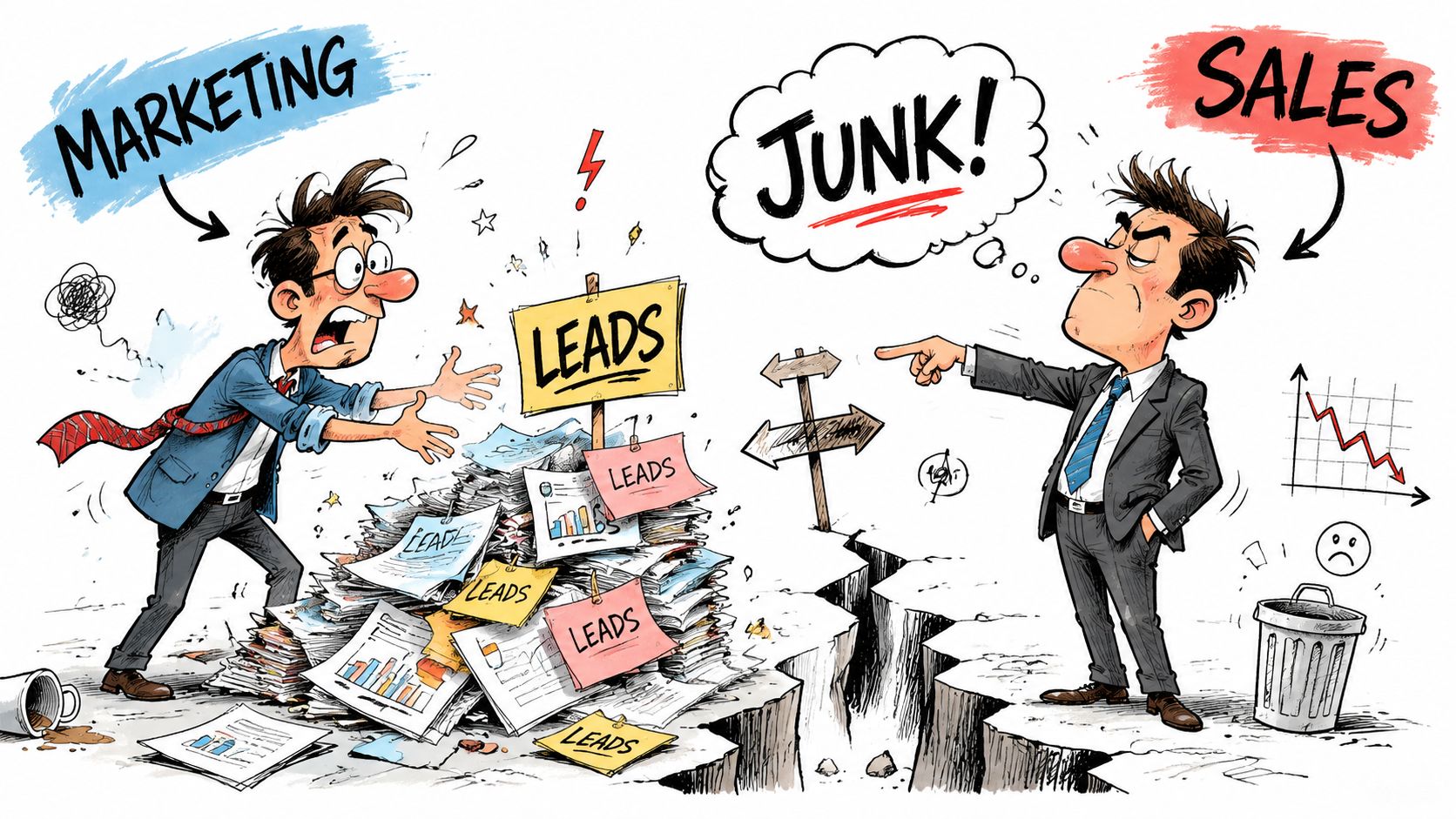
The real problem is the scoreboard
If marketing gets rewarded for lead count, it will chase cheap conversion paths. If sales gets rewarded only for closed deals, it will ignore early-stage interest that needs nurturing. You end up with a fake handoff. One side tosses names over the fence. The other side rejects them after the fact.
That setup creates predictable mess:
Lead definitions drift: “Qualified” means one thing in ads, another in the CRM, and something else in a founder's head.
Follow-up becomes random: Demo requests get instant replies, but webinar signups sit untouched.
Reporting gets political: Every dashboard is designed to prove one team worked hard rather than show what produced pipeline.
Practical rule: If marketing and sales are measured by different success criteria, they aren't aligned. They're negotiating.
The startup advantage is pre-alignment
Most alignment advice assumes you already have separate departments, separate incentives, and separate tools. Startups don't need to copy that model. In the early stage, the cleaner move is to keep acquisition and conversion inside one unified revenue engine.
That can mean one founder. It can mean one growth lead running paid acquisition, lifecycle, CRM hygiene, and reporting. It can mean a tiny team where nobody says, “That's not my part.”
In practice, pre-alignment looks like this:
One person owns the full funnel view. They can see ad intent, landing page behavior, form data, CRM status, and call outcomes without waiting for another department.
One definition of quality exists. A lead is good if it fits the ICP and moves toward revenue. Not because it hit an arbitrary score.
One feedback loop runs weekly. Campaigns don't stay live because click-through rate looks healthy. They stay live if they create pipeline with the right accounts.
Startups don't win by adding process. They win by refusing to build the wrong process in the first place.
If you're small, don't imitate enterprise alignment theater. Build your operating model so the conflict never has room to grow.
Defining Your Joint North Star with a Shared ICP and OKRs
Alignment is frequently sought after launch. That's backward. Alignment starts before the first campaign, when you decide who you're trying to reach and what “working” means.
B2B companies with tightly aligned sales and marketing functions generate 208% more revenue from marketing efforts, with correlation to 36% higher client retention and 15% higher profitability, according to The Starr Conspiracy alignment benchmarks. That's why the first serious alignment task isn't dashboard design. It's agreeing on the customer and the target outcome.
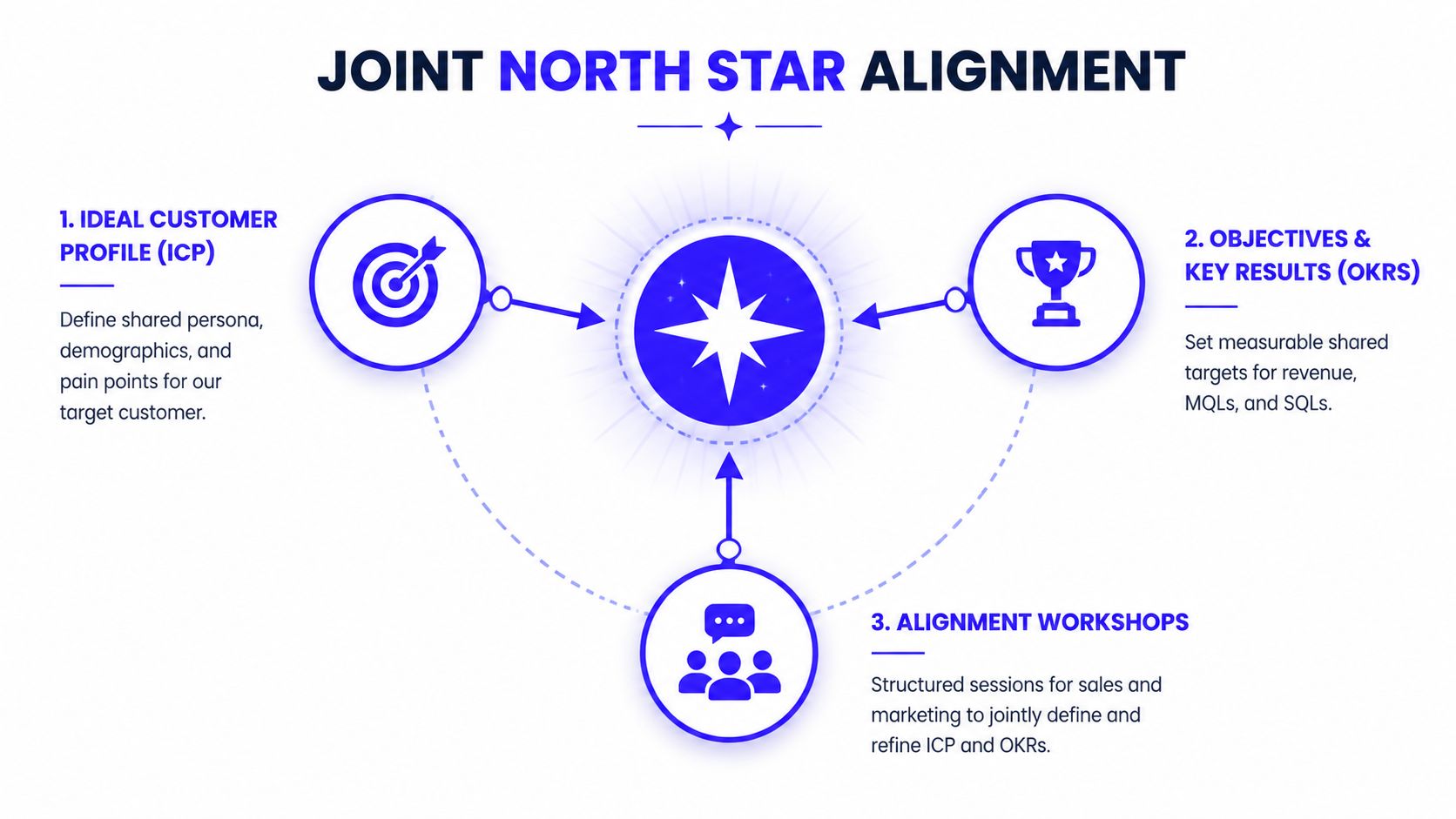
Build the ICP in one room
A shared Ideal Customer Profile should be built by whoever touches demand generation, qualification, demos, onboarding, and renewals. In a startup, that's often a founder plus the person running growth. Keep it practical. Skip the glossy persona slide.
Start with five fields inside a working doc or CRM property map:
Company fit: Industry, team size, geography, business model.
Buying trigger: What happened that makes them look now. New funding, hiring push, compliance need, tool migration, pipeline gap.
Pain pattern: The repeated operational pain your product solves.
Decision shape: Who feels the pain, who signs, who blocks, who champions.
Disqualification markers: Tiny team with no budget, wrong use case, consultant shopping, student research, competitor curiosity.
Then pressure-test it against reality. Pull the last set of closed-won and closed-lost deals. Look at sales notes, call recordings, demo request text, and landing page paths. Your ICP isn't a branding exercise. It's a filter for spend and attention.
A weak ICP sounds like this: “B2B SaaS companies that want growth.”
A usable ICP sounds like this: “VC-backed B2B SaaS teams with a sales-assisted motion, using HubSpot or Pipedrive, where founders need clearer attribution and faster lead follow-up.”
Turn the ICP into operating goals
Once the ICP is clear, convert it into shared OKRs. Many teams sabotage themselves at this stage by splitting metrics too early. Marketing gets MQLs. Sales gets revenue. Everyone smiles in the planning meeting and starts fighting by month two.
Shared OKRs should point at outcomes both sides influence. Good examples include:
Pipeline creation from ICP-fit accounts
Marketing-sourced revenue contribution
Lead response compliance by stage
MQL-to-SAL conversion quality
Opportunity progression speed
Bad goals sound busy. Good goals create decisions.
If a target can be “hit” while revenue quality gets worse, it's the wrong target.
A simple startup version looks like this:
Area | Weak goal | Better shared goal |
|---|---|---|
Top of funnel | Increase leads | Increase ICP-fit inquiries that progress to sales acceptance |
Qualification | Improve lead quality | Improve MQL-to-SAL conversion through tighter targeting and form intent signals |
Pipeline | Book more demos | Increase pipeline created from accounts that match the ICP |
Revenue | Close more deals | Improve revenue contribution from channels that consistently produce qualified opportunities |
Keep the list short. If your team is tiny, two or three shared OKRs are enough. The point isn't to measure everything. The point is to force the same commercial logic across campaigns, follow-up, and reporting.
Creating Your Sales and Marketing Service Level Agreement
A shared ICP tells you who matters. A Service Level Agreement decides what happens next. Without it, every hot lead depends on memory, mood, and whether someone checked Slack at the right moment.
An effective hand-off process, where sales contacts a high percentage of ad clickers, can boost pipeline conversions by 65% compared to cold outreach, and aligned teams are 67% better at closing deals and see 38% higher sales win rates, according to Influ2's sales and marketing alignment statistics.
What a startup SLA actually needs
Your SLA doesn't need legal language. It needs operational clarity. One page is enough if it answers the right questions.
First, define the stages. Don't let “lead,” “MQL,” “SQL,” and “opportunity” float around as vibes. Put definitions inside the CRM so they can be selected, filtered, and reported.
Second, define response rules by intent. A demo request should not sit in the same queue as a newsletter signup. Treat every form as a statement of urgency.
Third, define recycling rules. Sales shouldn't bury decent leads just because timing is off. Marketing shouldn't keep nurturing people who already said “wrong fit.” A startup wins when every non-ready lead has a next action.
Here's the minimum viable SLA logic:
High-intent actions: Demo request, pricing request, contact sales. These route instantly to sales with a required follow-up window.
Mid-intent actions: Webinar registration, comparison guide, case-study request. These get fast human follow-up or a short qualification sequence.
Low-intent actions: Newsletter, broad educational content, top-of-funnel ebook. These stay in nurture until behavior changes.
One useful cleanup step is tightening what you mean by an MQL. If your current MQL definition is “filled any form,” your SLA is already broken. A more useful reference point is this guide to what marketing qualified leads should actually mean.
A handoff is not “marketing generated a lead.” A handoff is “someone with fit and intent entered a stage with a clear owner and a clock.”
Sample Startup SLA Template
Use this as a starting point, then adapt it to your motion.
Commitment | Marketing Responsibility | Sales Responsibility | Shared Metric |
|---|---|---|---|
Define lead stages | Maintain form mapping, lead source rules, and qualification criteria in the CRM | Accept or reject leads using agreed stage definitions | Stage accuracy in CRM |
Route high-intent leads | Send demo, pricing, and contact requests to the correct owner immediately | Follow up within the agreed response window and log outcome | Response compliance |
Validate lead quality | Review campaign, keyword, audience, and landing page quality weekly | Mark reasons for rejection clearly and consistently | MQL-to-SAL conversion rate |
Recycle non-ready leads | Build nurture paths by objection, timing, and persona | Return leads with clear next-step labels instead of silent loss | Recycled lead reactivation |
Close the loop | Sync campaign data, source fields, and lifecycle stages | Update deal status, amount, and disposition notes | Opportunity and revenue attribution |
A few startup rules make this work better than a giant playbook ever will:
Keep ownership visible: Every lead record should show current owner, source, stage, and last action.
Reject with reason: “Bad lead” is not a reason. “Student,” “outside ICP,” “no budget,” and “competitor” are reasons.
Review the misses: The most useful SLA meeting is often a quick review of leads nobody handled correctly.
If your team is one founder and one operator, still write the SLA. You're not documenting it for bureaucracy. You're documenting it so growth doesn't break when volume picks up.
The Unbreakable Tech Stack for End-to-End Attribution
Most startup tracking setups fail in a boring way. The ad platform shows conversions. GA4 shows something slightly different. The CRM shows a third version of reality. Then everyone starts using whichever number supports their argument.
That's why the stack has to be built around one principle: the CRM is the commercial source of truth, and everything else feeds it clean context.
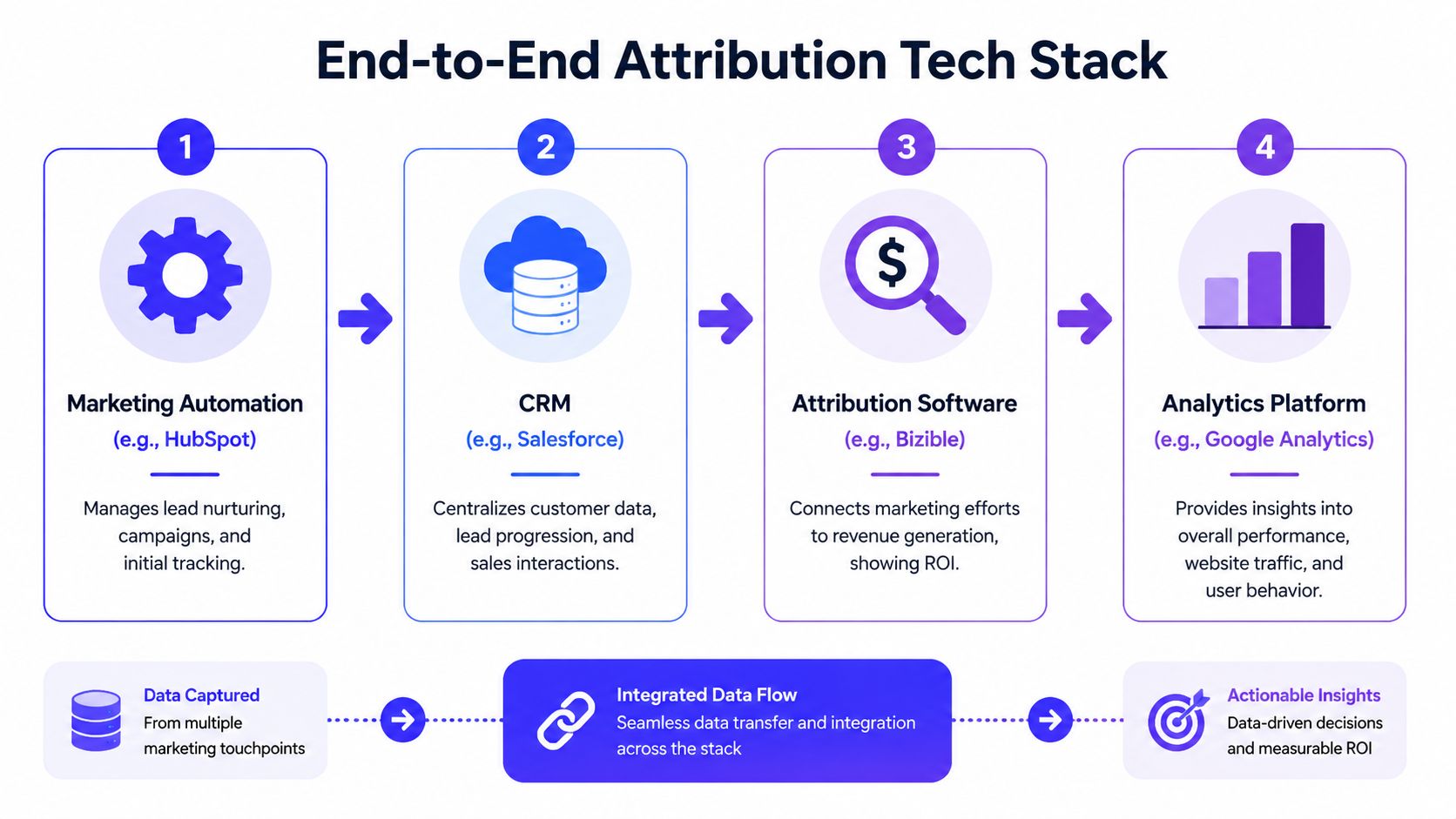
Use the CRM as the source of truth
For startups, HubSpot and Pipedrive are plenty if you configure them properly. They shouldn't function as digital address books. They should hold lifecycle stage, owner, original source context, latest source context, qualification notes, pipeline status, and deal outcomes.
Your basic stack can stay lean:
CRM: HubSpot or Pipedrive
Tag management: Google Tag Manager
Analytics: GA4
Paid media signal reinforcement: Meta Conversions API where relevant
Automation layer: Native workflows or Zapier for field sync and alerts
Dashboarding: Looker Studio if you need a clean operational view
The setup only works if field design comes first. Before installing another script, decide which properties matter. Typical essentials include UTM source, medium, campaign, landing page path, form name, first conversion action, lifecycle stage, sales owner, and opportunity status.
A useful walkthrough on common setup failures is this post on CRM tracking blunders that break your ROAS loop).
Pass attribution data all the way through
A lot of “attribution” dies at the form. The click happened. The user converted. Then the source data never reaches the CRM cleanly, or sales overwrites fields manually, or lead records duplicate and split the history.
The fix is less glamorous than people expect:
Standardize UTMs. Decide naming rules once. Don't let one campaign use paid-social and another use paidsocial.
Capture hidden fields in forms. Pass UTM values, landing page, and referring page into contact records.
Sync lifecycle updates. When a lead becomes sales accepted or an opportunity, that status should update without spreadsheet gymnastics.
Feed offline outcomes back where possible. When deals move forward or close, tie that information back to campaign analysis.
This is also where a simple video explainer can help teams stop treating tracking like dark magic.
Reporting only works if the loop closes
A poor hand-off process is a major pitfall, and only 11% of companies have mastered an effective one, according to Outfunnel's guide to sales and marketing alignment. Their recommended fix is the right one for startups too: a unified CRM with marketing automation and closed-loop reporting, including tracking metrics like MQL-to-SAL conversion rates.
That means every campaign review should answer questions like these:
Which sources create accepted leads, not just submissions
Which landing pages attract the right ICP
Which campaigns stall after form fill
Which objections show up repeatedly in sales notes
Which channels create opportunities that progress
Tracking is useful when it changes budget and follow-up decisions. If it only decorates a dashboard, it's overhead.
You don't need a data warehouse to get this right. You need clean field architecture, disciplined naming, and one place where pipeline truth lives.
From Vanity Metrics to Revenue Reporting That Matters
Impressions are fine. Click-through rate can be useful. Cost per lead has a role. None of those metrics should run your company.
The problem with vanity metrics isn't that they're fake. It's that they are too easy to celebrate in isolation. A campaign can produce cheap leads and still create expensive chaos for sales. That's how misalignment hides in plain sight.
Organizations with strong sales and marketing alignment achieve 19% faster overall growth and 15% higher profitability, driven by 38% improved win rates and 36% higher customer retention, according to GTM80/20's alignment statistics roundup. Those are revenue-efficiency outcomes, not “our engagement is up” outcomes.
The dashboard trap
A weak dashboard usually has three symptoms.
It overweights top-of-funnel data: sessions, clicks, reach, downloads.
It hides sales progression: accepted leads, opportunity creation, stage movement, close outcomes.
It reports backward: what happened last month, with no direct decisions attached.
A useful dashboard makes someone uncomfortable in a productive way. It shows where spend is attracting the wrong audience. It shows where sales is slow to follow up. It shows where one offer fills forms but never creates opportunities.
If your report can't explain pipeline movement, it's a marketing activity report. It isn't a revenue report.
For startup operators, a better reading list lives closer to these questions:
What entered pipeline this week
Which sources created opportunities
Where are leads getting stuck
How much revenue came from marketing-sourced deals
Which channels deserve more budget, less budget, or a rewrite
If you want a sharper filter for this, this breakdown of marketing metrics that actually matter) is worth comparing against your current dashboard.
Two meetings worth keeping
The first is the Weekly Ops Review. Keep it tight. Look at in-flight campaigns, lead quality notes, SLA misses, stage progression, and any source that's producing the wrong kind of demand. It lets you pause wasted spend fast.
The second is the Monthly Revenue Meeting. This one rolls up channel performance into pipeline and closed revenue context. Founders should care about this meeting because it ties commercial effort to actual business movement.
A simple structure works:
Meeting | Main focus | Questions to answer |
|---|---|---|
Weekly Ops Review | Execution and corrections | What changed in lead quality, follow-up, or stage progression this week? |
Monthly Revenue Meeting | Pipeline and revenue impact | Which channels and campaigns influenced accepted leads, opportunities, and closed business? |
The trick is to leave every meeting with decisions. Change audience targeting. Tighten form friction. Rewrite qualification criteria. Reassign owner rules. Reporting should create actions, not applause.
Your 90-Day Marketing and Sales Alignment Checklist
The startup version of marketing and sales alignment isn't a transformation project. It's a short build sprint. If you keep ownership tight and resist overengineering, you can put the whole operating model in place fast.
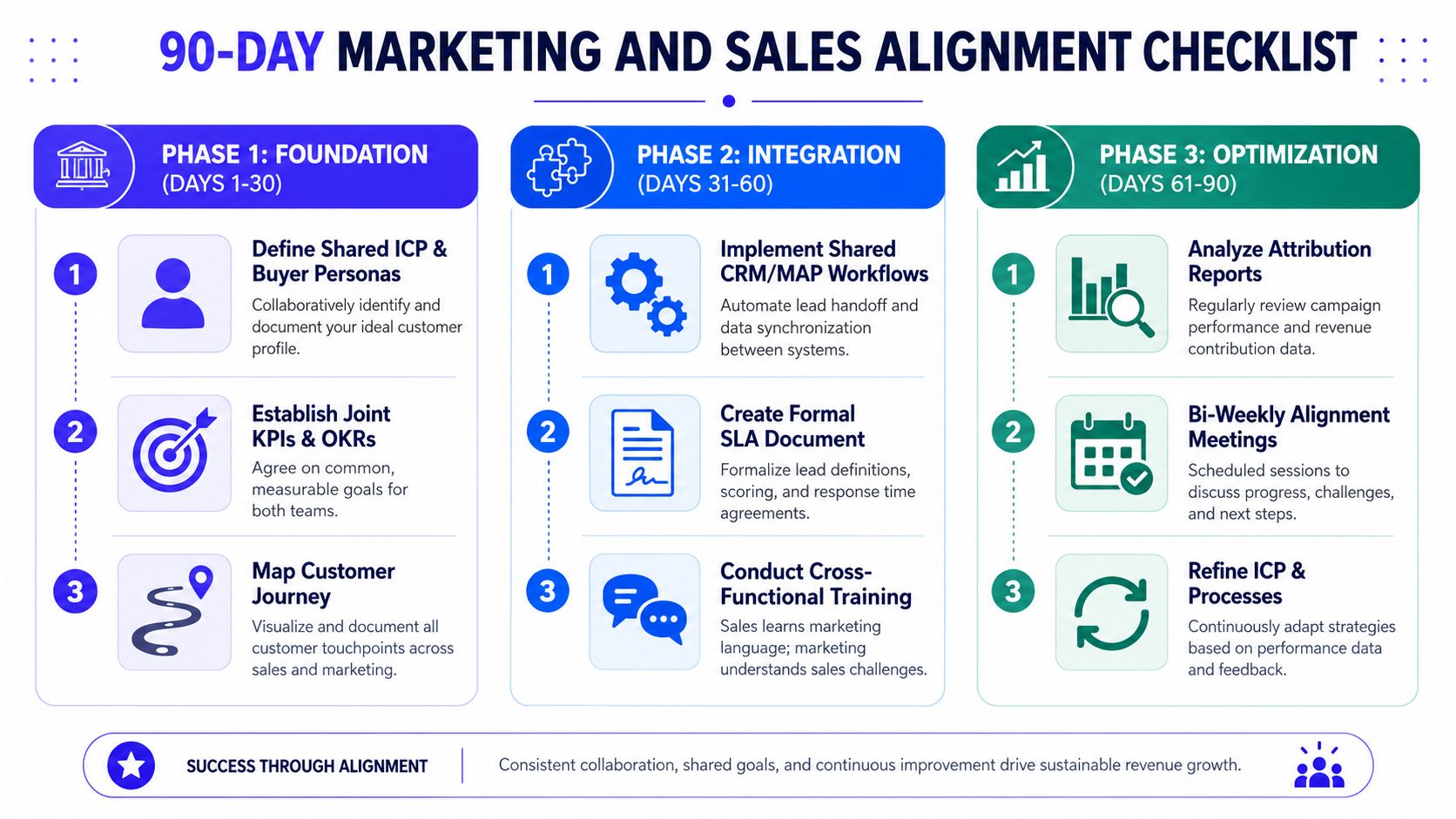
Days 1 to 30 Foundation
Start by forcing clarity.
Define the ICP: Review recent deals, lost reasons, buyer notes, and common triggers. Write down fit, pain, timing, and disqualifiers.
Set shared OKRs: Drop vanity targets. Keep goals tied to pipeline quality, accepted leads, and revenue contribution.
Map the buyer journey: List every path into the business, from demo request to content download to referral intro.
Create stage definitions: Put MQL, SAL, SQL, opportunity, and recycle status inside the CRM with plain-English rules.
This phase should end with fewer opinions floating around. The team should be able to look at one lead and agree on what it is.
Days 31 to 60 Implementation
Now install the operating rules.
Use this stretch to wire up forms, ownership, notifications, and source tracking. Build the SLA inside the CRM, not in a forgotten doc. A field that no workflow uses is decoration.
Two mini-playbooks help a lot here:
Demo request playbook
Route immediately to the correct owner.
Send a confirmation email with a clear next step.
Require outcome logging after first contact attempt.
If no response, move into a short follow-up sequence with visible status.
Content download playbook
Check ICP fit and source context.
Put the lead into nurture if intent is still soft.
Trigger human outreach only when behavior signals deepen.
Recycle into sales when engagement and fit line up.
Small teams should automate routing and reminders, not judgment. The human decision still matters most at qualification.
Days 61 to 90 Optimization
This phase is where pre-alignment starts paying off. You're no longer guessing which campaigns “feel good.” You can see where the funnel holds and where it leaks.
Focus on three habits:
Review attribution weekly: Look for accepted leads and opportunities by source, not just conversions.
Tune the SLA from evidence: If a stage causes confusion, rewrite the definition. If response rules are unrealistic, fix them.
Refine the ICP: Add exclusion rules, sharpen messaging, and cut channels that attract noise.
By day ninety, you should have a real revenue operating system. Not a perfect one. A usable one. That's enough to scale.
If you want that system built by one hands-on operator instead of spread across freelancers, agencies, and internal guesswork, Du Marketing helps startups run acquisition, CRM, lifecycle, and attribution as one connected revenue engine.