Optimize Search Ads: Drive Revenue in 2026

Most advice on how to optimize search ads is obsessed with surface-level activity. Change a bid. Test a headline. Add broad match. Pause a keyword. That work matters, but it’s often done in accounts that can’t even tell you which clicks turned into pipeline, which leads became customers, or which search terms never had buying intent in the first place.
That isn’t optimization. That’s motion without accountability.
The underlying problem usually sits underneath the campaigns. Tracking is incomplete. CRM attribution is broken. Search terms are full of job seekers, researchers, and DIY traffic. Teams celebrate conversions that sales never wanted. Then they wonder why spend keeps rising while revenue feels fuzzy. If you want to optimize search ads in a way finance, founders, and sales will genuinely trust, you need a revenue system, not a pile of ad tweaks.
Table of Contents
Stop Tinkering and Start Optimizing
Search ads do not fail because teams make too few changes. They fail because teams keep changing bids, match types, and ad copy before they can trace a click to pipeline and closed revenue.
That approach creates activity, not control.
If your account cannot tie ad spend to qualified opportunities through GA4, server-side tracking, offline conversion imports, and CRM sync, you are still optimizing for lead-shaped noise. Google’s own documentation on importing offline conversions into Google Ads makes the point plainly. Revenue feedback has to return to the platform if you want bidding and budget decisions to reflect sales outcomes instead of cheap form fills.
The shift is operational, not philosophical. Treat search as a revenue capture system with attribution attached. Every change should answer a hard question: will this improve the path from query to qualified pipeline, won deals, or both?
Practical rule: If a change cannot be judged against sales quality, pipeline creation, or closed revenue, it does not belong at the top of the optimization queue.
CTR, conversion rate, CPA, and impression share still matter. They help diagnose where performance is breaking. They do not tell you which clicks become customers. For that, you need a measurement model built around business outcomes, not a dashboard full of platform metrics. If your team still reports success with blended lead counts and surface-level efficiency metrics, fix that first with a set of marketing metrics tied to real business outcomes).
I see the same pattern in startup accounts. Search terms pull in research traffic with no buying intent. Negative keyword lists are too thin to block it. Campaigns mix high-intent and low-intent queries, so budgets drift toward volume instead of revenue. Sales closes deals in the CRM, but that data never gets pushed back to Google Ads. Then the team keeps adjusting bids as if the bidding strategy is the problem.
It usually is not.
Foundational work starts earlier. Build attribution that survives a finance review. Separate traffic by intent so cost can be matched to deal quality. Use Intent-Killer negatives to block queries that look relevant in-platform but never produce pipeline in the CRM. Once that system is in place, optimization stops being guesswork and starts acting like capital allocation.
Your Pre-Flight Audit Checklist
Optimization starts with an audit, not another round of bid edits. If the account cannot tie a click to pipeline, every “win” inside Google Ads is provisional and every budget decision is half-blind.
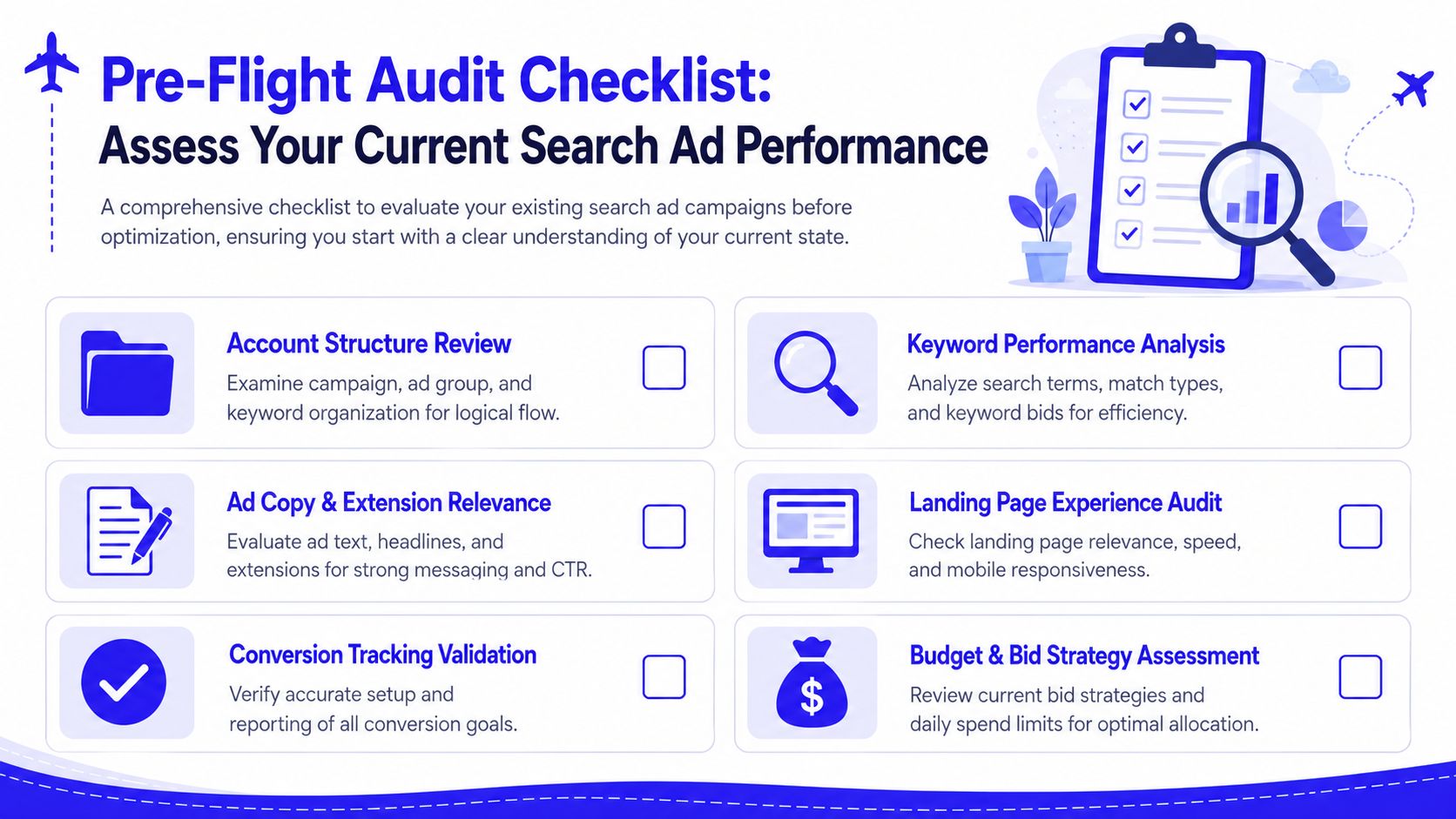
Start with tracking integrity
Start by checking whether the account measures outcomes the business can use. I do not mean “conversions” in the platform sense. I mean events that survive contact with sales, finance, and the CRM.
A form fill that never becomes a lead record has no value for bidding. A demo request that gets disqualified in two minutes should not carry the same weight as an opportunity that reaches pipeline. If those signals are blended, the algorithm will buy more of the cheaper one and call it efficiency.
Run the audit in this order:
Validate conversion definitions: Separate soft actions from revenue-linked actions. Content downloads, newsletter signups, pricing page visits, qualified leads, opportunities, and closed deals each need distinct treatment.
Trace the handoff: Follow one click from keyword to landing page to form to CRM record to pipeline stage. Breaks usually happen in hidden fields, UTM capture, offline conversion imports, or duplicate event firing.
Reconcile reporting: Compare Google Ads, GA4, and CRM counts by campaign and date range. Gaps usually point to tagging errors, attribution settings, duplicate conversions, or inconsistent campaign naming.
Check revenue fields: Make sure lead source, opportunity value, pipeline stage, and closed-won revenue can be pushed back to the ad platform or at least joined in reporting.
Audit optimization signals: Confirm which conversions are marked primary. I regularly find accounts optimizing toward “contact us” while leadership thinks the campaigns are being judged on revenue.
If your reporting still mixes lead volume with business outcomes, fix that before touching bids. This guide to marketing metrics tied to real business outcomes) is a useful reset.
Find the structural leaks
Once tracking is credible, inspect where spend is slipping away.
Use this checklist:
Audit area | What to look for | Why it matters |
|---|---|---|
Account structure | Campaigns and ad groups grouped by clear commercial intent | Mixed intent makes budget allocation sloppy and hides which queries create revenue |
Keyword coverage | Search terms, match types, bid logic, wasted queries | Broad, low-intent traffic inflates cost and weakens downstream lead quality |
Negative keyword strategy | Repeated research terms, job-seeker queries, support queries, free-tool intent | Intent-Killer negatives stop spend on clicks that look relevant but never become pipeline |
Ad relevance | Headlines, descriptions, assets, landing page alignment | Weak message match lowers click quality and drags down conversion rates after the click |
Budget control | Spend concentration, pacing, campaign overlap | Budget often pools into high-volume terms that sales would never prioritize |
Landing page fit | Message match, clarity, friction, mobile usability | Good intent still gets wasted if the page asks too much or answers too little |
Conversion path quality | Form friction, routing, CRM enrichment, speed to lead | Revenue loss often starts after the click, not before it |
One account issue rarely causes the miss. Startup accounts usually lose money through a stack of smaller failures: weak negatives, muddy conversion goals, broad match without guardrails, and no CRM feedback loop.
Pay close attention to search terms that attract the wrong kind of curiosity. Queries with words like “jobs,” “definition,” “template,” “free,” “course,” “support,” or “DIY” can look topically relevant and still produce zero pipeline. Those are Intent-Killer negatives. Add them early, review them weekly, and segment them by campaign so you do not block useful edge cases in high-intent ad groups.
Quality Score still matters here, but treat it as a symptom check, not the finish line. If relevance is weak between query, ad, and landing page, costs usually rise and impression quality declines. The fix is tighter intent control and better message match, not chasing the score itself.
Finish by reviewing the search terms report manually. Do not stop at terms that converted. Look for terms that should never have triggered an ad, terms that generate low-quality leads, and terms that sales keeps rejecting. That review is where wasted spend turns into attributable savings.
Build an Unshakeable Account Foundation
Search ads rarely break at the ad copy level first. They break in the account design, where mixed intent, weak routing, and sloppy measurement make profitable queries look average and bad queries look acceptable.
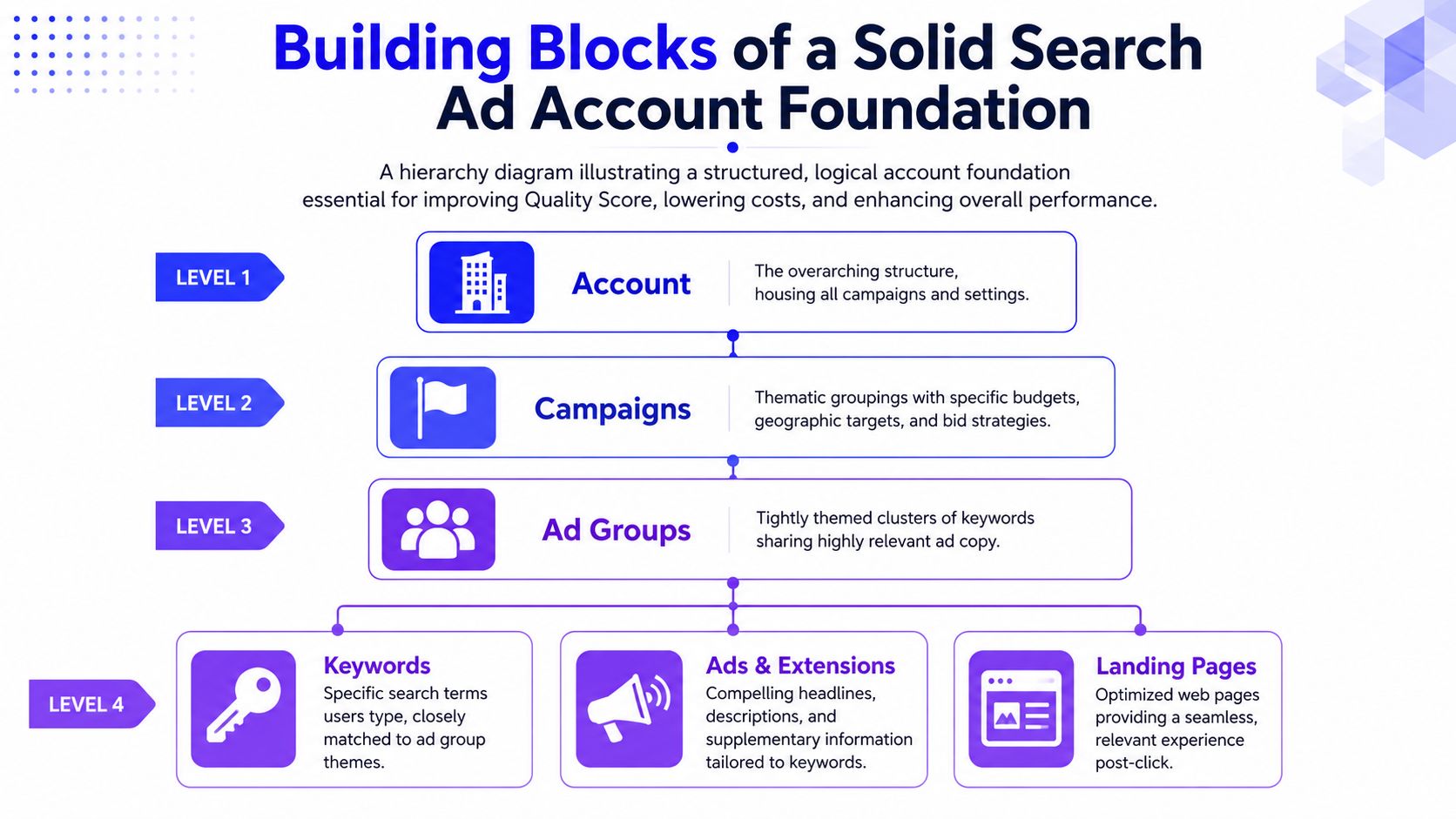
Structure decides what you can learn
A messy account does more than waste spend. It ruins attribution. If one campaign mixes branded searches, competitor terms, high-intent service queries, and research traffic, you cannot tell which clicks create pipeline and which ones only create activity.
Clean structure fixes that.
Set campaigns around business constraints that affect revenue. That usually means product line, geography, deal size, or sales motion. An SMB self-serve offer should not share budget logic with an enterprise demo campaign. Their conversion paths, close rates, and acceptable CAC are different.
Inside each campaign, build ad groups around a single intent cluster. Do not group keywords because they look similar. Group them because the same ad promise and the same landing page can satisfy all of them without compromise. Google’s guide to building high quality Search campaigns reinforces this point. Relevance improves when keywords, ads, and landing pages stay tightly aligned.
At the working level, the structure should look like this:
Campaign level: Separate by budget owner, geography, product, or sales model.
Ad group level: Group by one clear commercial intent.
Ad level: Mirror the query language and qualify the click.
Landing page level: Match the promise, remove distractions, and capture the next step cleanly.
If consent and measurement are already corrupting what you see in-platform, fix that before you scale. This guide to Consent Mode V2 recovery and tracking repair is the right starting point.
Intent-Killer negatives protect revenue, not just CTR
Negative keywords belong in the foundation, not in cleanup.
I treat negatives as account control infrastructure. They protect sales from junk leads, protect bidding models from bad conversion signals, and protect reporting from false optimism. A search term can look relevant to marketing and still be useless to revenue. Queries with modifiers like job, salary, training, template, free, definition, support, or DIY often fall into that bucket.
Google’s documentation on negative keywords covers the mechanics. The strategic part matters more. Build negatives in layers so intent stays separated:
Universal negatives: Traffic that never buys from you.
Campaign negatives: Terms that belong in another campaign and would create internal competition.
Qualification negatives: Modifiers that signal research, hiring, education, or unsupported use cases.
Sales-led negatives: Terms pulled from CRM loss reasons and disqualified lead patterns.
That last layer is where startup accounts usually miss money. If sales keeps rejecting leads from “free software,” “internship,” or “how to,” those terms should shape account rules, not just a Slack complaint.
Build for promotion paths, not keyword sprawl
Accounts get unstable when every keyword enters the same campaign with the same level of trust. Proven terms and unproven terms should not live under one budget strategy.
Start with a controlled set of commercial queries that map to revenue. Then create a promotion path. Search terms that generate qualified leads move into their own exact match keywords, their own ad groups, or even their own campaigns if they justify dedicated budget and landing page treatment. Lower-intent terms stay constrained until they prove they can create pipeline, not just form fills.
Google Ads explains the match type trade-offs in its keyword matching options documentation. The practical takeaway is simple. Broader reach can help discovery, but only if negatives, query reviews, and downstream lead quality checks are already in place.
I also separate foundation keywords into three buckets:
Revenue terms: Queries tied to closed-won patterns, high-quality SQLs, or strong demo-to-opportunity rates.
Exploration terms: Relevant queries you are testing with tight controls.
Research terms: Queries that may inform content or audience insight but do not deserve aggressive spend.
That structure makes budget decisions easier because every keyword has a job. It also makes attribution cleaner. You can see which intent buckets create meetings, opportunities, and revenue, then shift spend with confidence instead of chasing top-of-funnel volume.
A stable account is built to answer one hard question clearly: which searches bring in customers you want, and which ones should never get a click in the first place?
Crafting Ads People Actually Want to Click
A high CTR can still hide a bad ad account.
I see this problem all the time in startup accounts. The ads get clicks because the copy is broad, polished, and easy to say yes to. Sales then reviews the leads, shrugs, and calls them junk. If the ad invites low-intent traffic, you did not improve performance. You just bought more noise.
Good search ad copy should qualify, not just attract. It should make the right buyer feel understood and make the wrong searcher keep scrolling. That is how ad creative supports revenue attribution. Cleaner clicks produce cleaner lead stages, cleaner pipeline reporting, and better bidding signals later.
Build responsive ads like a message system
Responsive search ads work best when each asset has a job. Google’s responsive search ads documentation explains how headlines and descriptions are mixed and matched across auctions, which is exactly why lazy variation hurts performance instead of helping it: Google Ads responsive search ads guide.
Do not fill headline slots with twenty versions of the same claim. Build a message bank relevant to the full decision:
Problem headlines: Name the pain behind the query.
Offer headlines: State what you sell and what happens next.
Credibility lines: Add proof, specialization, or implementation experience.
Qualification lines: Filter out poor-fit clicks.
Action lines: Ask for the next step in plain language.
That mix gives the platform room to assemble relevant ads without turning every combination into generic fluff.
Pinning also has a place. I use it when compliance matters, when a core qualifier must stay visible, or when a campaign targets a narrow offer that breaks if the message order changes. Pin too much, though, and you reduce testing range. Leave everything loose, and you risk showing weak combinations. The trade-off is simple. Control protects message quality. Flexibility helps discover better combinations.
Specific copy brings better clicks
Generic CTAs are expensive because they hide intent. “Learn More” gets curiosity clicks. “Book a Demo with a RevOps Specialist” sets a clearer expectation. That usually lowers wasted spend and raises the percentage of clicks that turn into qualified pipeline.
Here is what that looks like in practice:
Weak ad language | Better ad language |
|---|---|
Learn More | Book a Demo with a RevOps Specialist |
Solutions for Every Business | CRM Setup for B2B Sales Teams |
Trusted Service | HubSpot Migration with Revenue Tracking |
Get Started Today | See Keyword to Pipeline Attribution |
The better version does three things. It names the buyer. It names the offer. It hints at the business outcome.
That last part matters. Search ads should connect to revenue before the click happens. If your best customers care about tracking pipeline by source, say that. If they care about faster handoff from form fill to sales, say that. If your service excludes tiny accounts, say that too. Qualified demand is worth more than inflated volume.
Write ads that repel the wrong click. Lower click volume with stronger lead quality is often the better trade.
Match the ad to the searcher’s actual intent
The strongest ad accounts do not just mirror keywords. They respond to intent level.
A person searching “CRM consultant” needs a different message than someone searching “HubSpot revenue attribution setup.” The first query may need category clarity and buyer qualification. The second can handle tighter copy, stronger proof, and a direct commercial CTA because the user has already done part of the filtering for you.
Google’s ad strength recommendations are useful for coverage and variation, but revenue teams should judge ad quality by downstream results too: Google Ads asset best practices. If an ad raises clicks but lowers opportunity rate, the copy is too broad, too vague, or too appealing to the wrong audience.
One more point gets missed in a lot of ad copy advice. Your negatives and your ads should work together. If you are excluding research-heavy traffic with Intent-Killer negatives, the ad can be more direct and commercial. If your query mix still includes mixed intent, the copy needs harder qualifiers to protect spend. Good creative is part of traffic shaping, not decoration.
Test one meaningful variable at a time. Offer angle, CTA, qualifier, proof point. Keep the landing page and query set stable long enough to see what changed in lead quality, meeting rate, opportunity creation, and closed-won revenue. That is how you get past “this ad got more clicks” and into “this message produced more pipeline from the same budget.”
Advanced Bidding and Budgeting Tactics
Bid strategy is not the hard part. Bad inputs are.
Founders and paid search managers often spend hours debating manual CPC versus Smart Bidding while the core problem sits upstream: weak conversion signals, mixed-intent traffic, and budgets spread across campaigns that have never produced revenue. No bid strategy fixes that. Bidding only decides where the next dollar goes. If your account cannot tell Google which clicks turn into qualified pipeline, the platform will keep buying more of the wrong clicks.
Budget follows revenue, not hope
Start with budget partitioning that reflects business certainty. Keep the majority of spend in campaigns that already produce qualified pipeline or closed-won revenue. Carve out a smaller testing pool for new keyword groups, offer angles, landing pages, or audience constraints.
That separation matters because startup accounts usually fail in a predictable way. Proven campaigns get capped. Experimental campaigns keep spending because nobody defined a limit for learning. The result is flat pipeline, noisy reporting, and endless debate about performance.
Use the proven bucket for campaigns with a clear sales pattern:
Search terms show strong commercial intent
Leads consistently reach qualification
Opportunities get created at an acceptable cost
Closed revenue can be traced back to the campaign
Use the testing bucket for controlled bets:
New keyword themes
New geo segments
New offer or pricing angles
New landing page paths
New match type structures
Set a rule before the test starts. A campaign graduates only when it proves downstream value, not because it hit a decent CTR or cheap cost per lead.
Choose bid strategy based on signal quality
The right bidding model depends on how much truth your account can send back to the platform.
Situation | Better fit | Why |
|---|---|---|
Clean primary conversions and consistent lead quality | Smart Bidding | The system has enough reliable signal to optimize toward likely buyers |
Offline revenue or opportunity value is passed back into Google Ads | Value-based bidding | Bid decisions can reflect pipeline and revenue instead of raw form fills |
Lead gen account with uneven qualification rates by keyword | CPA bidding with tight guardrails | Cost control matters, but low-cost leads can still poison optimization |
New campaign or low-volume account | Manual CPC or Max Clicks with strict controls | Early data collection needs human review before automation gets trusted |
I switch to automation only after the account proves it can separate a good lead from a bad one. Until then, aggressive automation scales noise.
That trade-off is where many accounts go sideways. Automated bidding can outperform manual management, but only when conversion actions reflect business value. If your primary conversion is a generic form submission and half of those leads are junk, Target CPA will get very efficient at buying junk.
Bid up on winners. Cut losers faster.
Higher bids belong on search terms that repeatedly produce revenue within target acquisition cost. That sounds obvious, but plenty of accounts still increase bids on keywords with strong click-through rate and weak sales outcomes.
Use three questions before increasing a bid:
Does this keyword produce sales-qualified leads or opportunities?
Can the campaign absorb more spend without a drop in close rate?
Is impression share lost to rank costing profitable demand?
If the answer is no, keep the bid where it is or cut it. More volume is useful only when the extra volume looks like the customers you already want.
The inverse matters just as much. Reduce bids or cap budgets on terms that generate activity without commercial progress. That includes broad queries that look relevant on the surface but attract research traffic, job seekers, students, or small accounts your sales team will never close. Those are the same leaks that show up later as CRM attribution problems. If your funnel reporting still breaks after the lead is created, fix the tracking gap before trusting automated optimization. This guide on CRM tracking blunders that kill ROAS) covers the handoff issues that distort bidding decisions.
Budget concentration beats account sprawl
One of the fastest wins in a messy account is budget concentration. Fewer campaigns. Clearer intent buckets. Enough spend behind each campaign to produce a readable result.
Small budgets spread across too many campaigns create fake diversification. In practice, they create underpowered learning, delayed decisions, and campaigns that never gather enough data to prove anything. Put money behind the terms and structures that already map to revenue. Keep experiments constrained until they earn more budget.
That is how bidding and budgeting stop being platform settings and start acting like revenue controls.
Connecting Clicks to Cash with Full-Funnel Tracking
Search ads do not fail because clicks are hard to buy. They fail because revenue disappears the moment the lead leaves the ad platform.
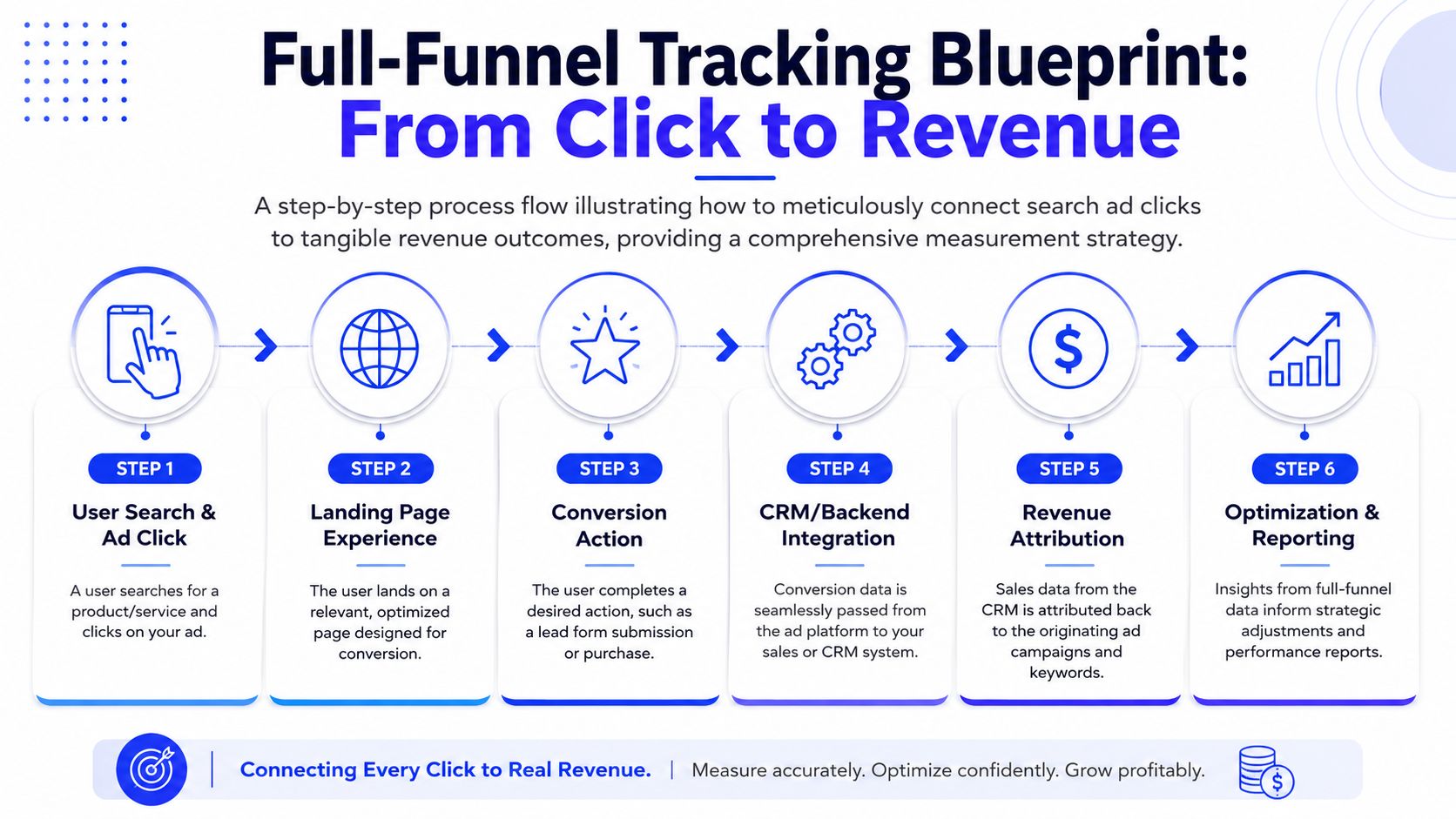
Your attribution stack needs to survive scrutiny
A startup can show strong platform conversions and still miss target because the account is optimizing toward form fills that sales would never close. The fix is a tracking system that carries the original click ID and intent signal all the way into the CRM, then sends sales outcomes back to the ad platform.
The stack is straightforward. GA4 for on-site behavior. Server-side tracking to reduce browser loss. Platform APIs and offline conversion imports to pass back qualified pipeline and revenue. CRM sync to connect leads, opportunities, and closed-won deals under the same record.
A clean setup does five jobs well:
Capture the click: Store source, medium, campaign, ad group, keyword, query where possible, and click IDs at landing.
Track the action: Record meaningful conversion events such as demo requests, qualified calls, or booked meetings instead of every button press.
Pass the data forward: Push those records into the CRM with stable identifiers so lead records can be matched later.
Record sales outcomes: Update lifecycle stages, opportunity creation, pipeline value, and closed revenue inside the CRM.
Send value back: Import offline conversions or revenue values into Google Ads so bidding can optimize toward actual business outcomes.
That is the difference between platform-reported success and revenue you can defend in a board meeting.
This section’s blueprint is easier to visualize first:
Close the loop back into ad platforms
Once that loop is in place, weak optimization habits become obvious. A keyword that generates cheap leads but never creates pipeline should lose budget. A campaign with a higher CPA but strong sales acceptance rate often deserves more spend. Without full-funnel tracking, those decisions get reversed.
This is also where intent filtering stops being a cleanup task and starts acting like revenue protection. Negative keywords should block traffic from people who will not buy, such as job seekers, students, support requests, competitors doing research, and low-fit accounts outside your sales motion. I treat these as Intent-Killer negatives because they remove queries that inflate lead volume while dragging down close rate.
Once CRM outcomes are feeding back into the account, campaign management gets sharper fast:
Sales-qualified leads beat raw lead counts: bidding stops chasing junk submissions.
Keyword themes can be judged by pipeline and closed revenue: search term analysis becomes commercially useful.
Budget reviews get simpler: founders and finance teams can see what produced revenue, not just activity.
Automation gets better signals: smart bidding has a better target than shallow conversion events.
If the ad-to-CRM handoff is breaking, start with these CRM tracking blunders that kill ROAS before trusting any automated bidding recommendation.
When attribution is broken, the lowest-cost lead often gets rewarded. That is how low-intent traffic gets promoted and revenue-producing campaigns get cut.
Full-funnel tracking gives you operational control. You stop guessing which clicks mattered and start measuring which queries, ads, and campaigns turned into closed-won revenue.
Your Recurring Optimization Rhythm
Search accounts do not fail because nobody touched them. They fail because teams touch the wrong things at the wrong frequency.
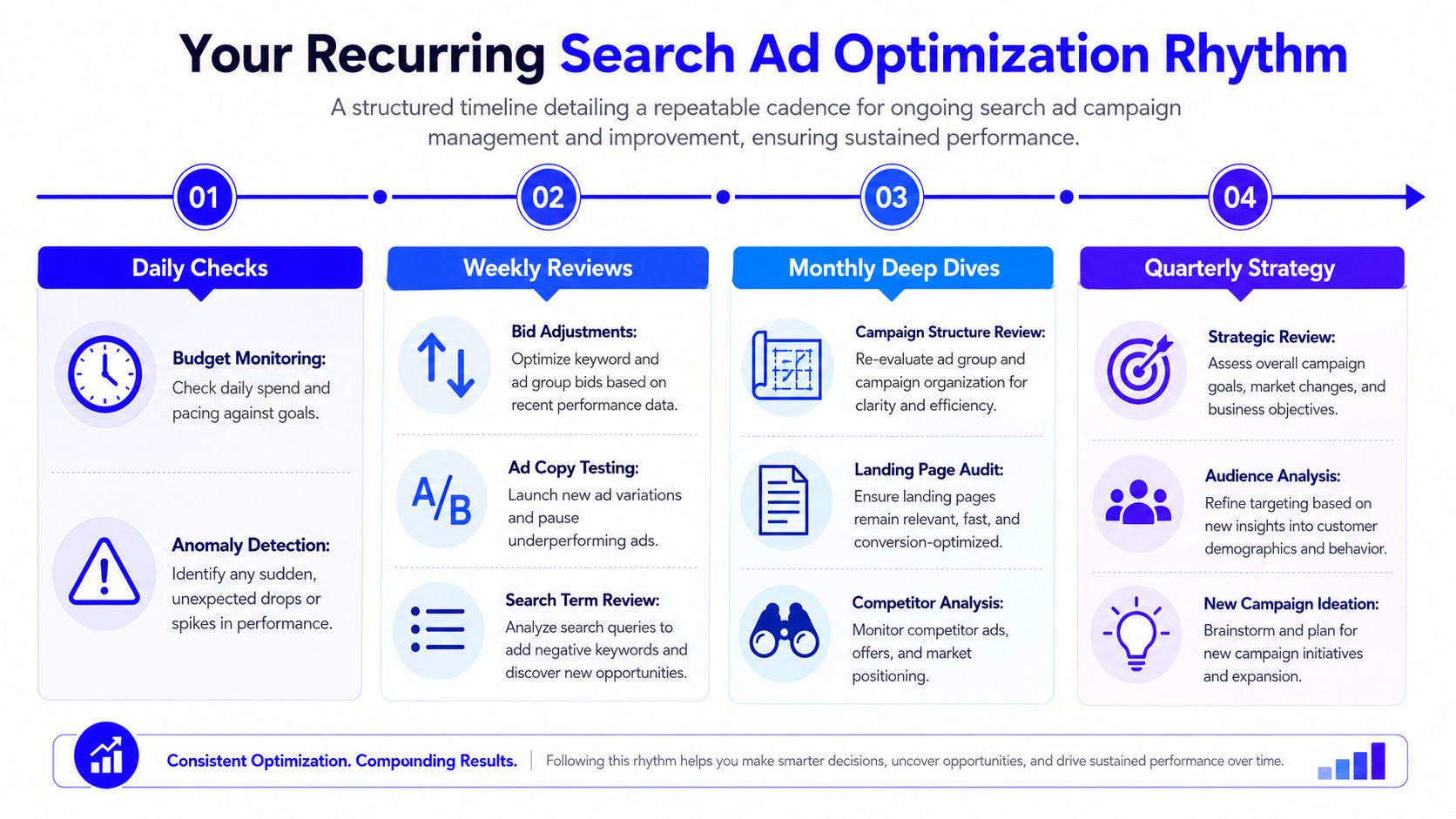
A real optimization rhythm is an operating system for revenue attribution. Daily checks catch broken tracking, spend drift, and traffic quality issues before they pollute the data. Weekly reviews decide which queries, ads, and audience slices deserve more budget. Monthly and quarterly reviews answer the only question that matters: which campaigns produced pipeline and closed revenue, and which ones only looked busy inside Google Ads?
Daily checks catch damage early
Daily work should stay narrow. Do not rewrite campaigns every morning.
Check spend pacing, impression delivery, CPC movement, lead volume, and conversion tracking status. If impressions drop hard, look for budget caps, disapprovals, bid strategy constraints, or a broken feed into your CRM. If CTR falls, inspect ad relevance and search term quality. If lead volume rises while qualified pipeline stays flat, that is not a win. It usually means low-intent queries slipped through or forms are attracting the wrong buyers.
Watch for attribution failures too. A disconnected thank-you page, duplicate conversion firing, or offline conversions failing to import can push bidding toward junk traffic within days.
Weekly reviews are where money is won or wasted
Weekly optimization is where a search program starts acting like a revenue channel instead of a lead vending machine.
Review search terms with CRM outcomes beside them. Add Intent-Killer negatives for searches that generate clicks and form fills but never turn into sales conversations. Compare ad variants on qualified conversion rate, not just CTR. Inspect device, geo, audience, and hour-of-day performance with downstream revenue attached. Raise bids and budgets where closed-won rates support it. Cut or isolate themes that burn spend without producing pipeline.
One metric I like here is impression-to-qualified-conversion rate. It is a simple way to see whether visibility is turning into commercially useful action, not just traffic. In practice, this helps spot campaigns that look healthy on click metrics but fail once you judge them against SQLs, opportunities, or revenue.
A practical weekly rhythm looks like this:
Daily: Check spend pacing, delivery anomalies, CPC spikes, tracking health, and lead quality signals.
Weekly: Review search terms against CRM stages, add negatives, assess ad tests, and adjust bids or budgets based on qualified outcomes.
Monthly: Evaluate campaign structure, landing page fit, sales feedback, and revenue by campaign, keyword theme, and query class.
Quarterly: Revisit attribution rules, conversion definitions, target setting, and account structure based on closed-won data.
Monthly and quarterly reviews keep the account honest
Monthly reviews should force budget decisions. Which campaigns sourced pipeline? Which keyword clusters closed deals faster? Which segments produced leads that sales ignored? Those answers should decide where spend goes next.
Quarterly reviews are for structural fixes. Rework campaign segmentation, conversion priorities, offline import quality, and reporting views if they are hiding revenue truth. This is also the right time to audit whether your negative keyword strategy still reflects the business. New product lines, pricing changes, and sales motion shifts can all change what counts as high intent.
Teams that keep this cadence stop chasing cheap conversions and start managing search as an attributable revenue engine.
If you want a hands-on operator to audit your ad account, fix your attribution, and connect paid search to real pipeline and closed revenue, Du Marketing does exactly that across Google Ads, CRM tracking, landing pages, and reporting.