What Is Media Strategy: Your 2026 Guide to Growth

Most advice about media strategy starts in the wrong place. It starts with channels.
You'll hear, “Be on LinkedIn.” “Test Meta.” “Launch Google Search.” That's not strategy. That's a shopping list with a caffeine problem.
For startups, essential work happens earlier. Before budget. Before creatives. Before anyone argues about whether YouTube is top of funnel or whether branded search is “cheating.” Media strategy is the layer that decides what business outcome matters, which audience matters most, what message earns attention, and how you'll prove any of it worked with attribution you can audit.
If that layer is weak, a polished media plan just helps you waste money more efficiently.
Table of Contents
Your Media Plan Is Not Your Media Strategy
The most common mistake in startup marketing is simple. Teams confuse execution with direction.
A media plan answers operational questions. Which channels will we run? What's the budget this month? When do campaigns launch? Who owns creative? Those questions matter, but they come after the strategic ones.
Media strategy answers the harder questions first. What outcome are we trying to create in the business? Which audience is worth reaching now, not someday? What belief needs to change for a buyer to act? How will we connect spend to pipeline or revenue instead of celebrating click volume like it pays payroll?
That gap is bigger than most founders realize. Emerging data from 2025 to 2026 shows that 68% of early-stage SaaS startups underestimate the strategic layer of media, leading to misaligned campaigns and poor ROAS despite complex channel mixes, according to Habitat M's analysis of why the media plan isn't the strategy.
A startup can have well-built campaigns and still have no strategy. That happens when the team knows where ads run, but not why those ads should exist.
Here's the practical distinction:
Strategy decides the game: market priority, buyer priority, message priority, and proof.
Planning decides deployment: budget split, flight dates, channel cadence, and asset production.
Buying executes placement: bids, inventory, audiences, and media spend.
Founders often skip straight to the middle. They ask for channel recommendations before defining the commercial problem. That's how you end up paying LinkedIn prices for a product that still has homepage messaging from three pivots ago.
If you remember one thing, remember this. A plan organizes activity. A strategy makes activity coherent.
So What Is Media Strategy Really
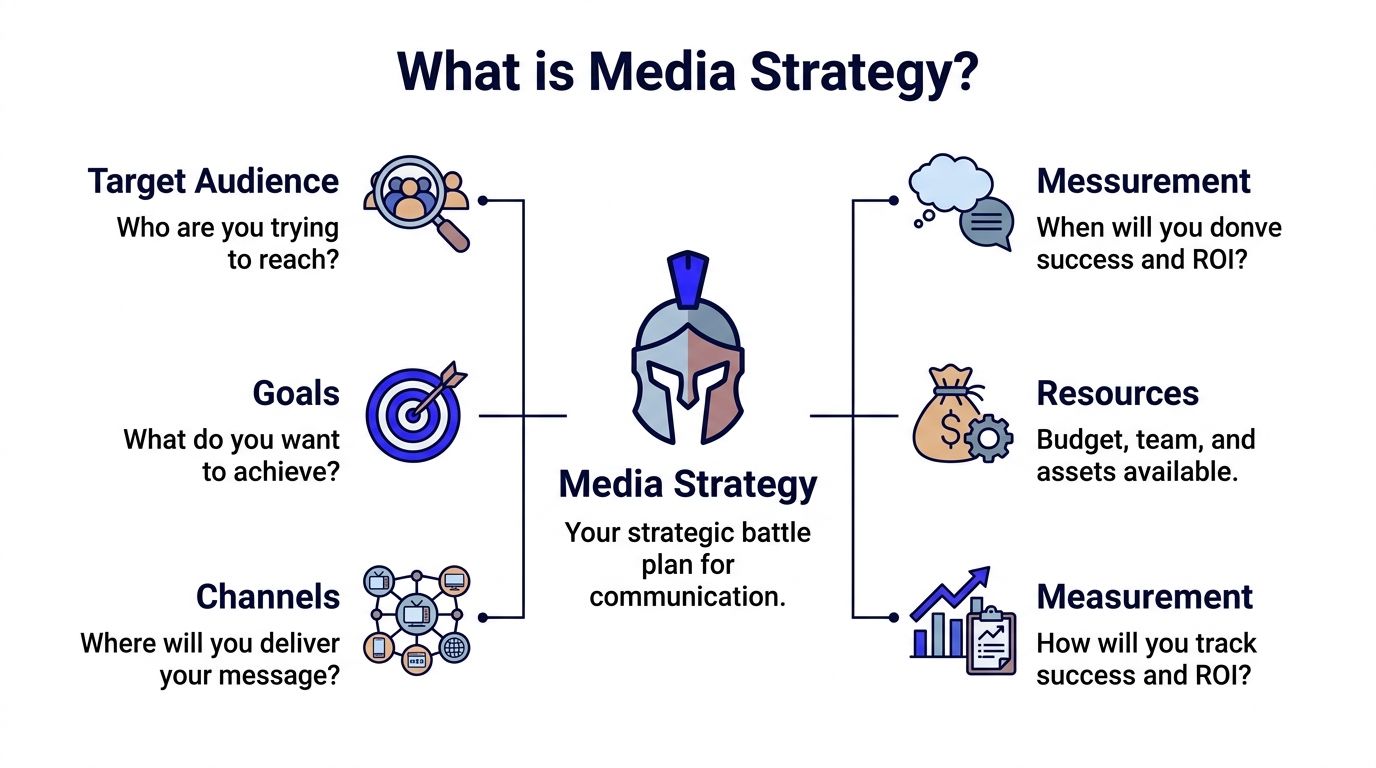
What is media strategy? It's the operating logic behind your communication system. It connects a business goal to a specific audience, message, channel mix, timing, and measurement model so every dollar has a job.
The easiest analogy is military, because it's blunt and useful. Strategy is the campaign map. It defines the objective, terrain, resources, sequence, and win condition. Tactics are the troop movements. A startup that picks channels before it sets strategy is like sending soldiers somewhere because the road looked busy.
That's why media strategy has expanded far beyond buying ads. It used to be possible to think in isolated channels. Buy print. Run radio. Negotiate TV. Today that approach falls apart because buyers don't move in neat lines. They search, ignore, compare, click, subscribe, revisit, ask peers, and convert later through a different device or team member.
The three media types that have to work together
A modern strategy usually blends paid, owned, and earned media.
Paid media: Google Ads, Meta, LinkedIn Sponsored Content, YouTube pre-roll, display, sponsored placements.
Owned media: your site, landing pages, blog, email list, CRM nurture, webinars, product pages.
Earned media: press mentions, founder appearances, customer referrals, reviews, community discussion, word of mouth.
The important part isn't memorizing the categories. It's understanding how they support each other.
Paid media creates controlled reach. Owned media carries the narrative and captures demand. Earned media adds credibility that money alone can't buy. When one of those is missing, the whole system gets less efficient. Ads drive traffic to weak pages. Great content gets buried because no one distributes it. Press spikes attention, but there's no lifecycle path after the click.
That integrated model isn't just cleaner in theory. A balanced media strategy that integrates paid, owned, and earned media increases campaign ROI by 30 to 45% compared with single-channel campaigns, based on TVEyes' explanation of modern media strategy.
What a strategy actually decides
A real strategy forces choices.
It decides whether you're trying to create demand, capture existing demand, or do both with different messages. It decides whether your landing page is for education or conversion. It decides whether your best buyers need proof from a case-led email sequence, a founder-led LinkedIn narrative, or a high-intent search campaign.
Practical rule: If your team can explain the channel mix but can't explain the buyer journey, you have media activity, not media strategy.
The payoff is focus. Instead of asking, “Which channels should we add?” you start asking better questions. Which message has earned the right to scale? Which audience deserves budget now? Which touches create movement in the pipeline, and which ones just make dashboards look busy?
That's what media strategy really is. Not a list of platforms. A decision system.
The 5 Core Components of a Strong Strategy
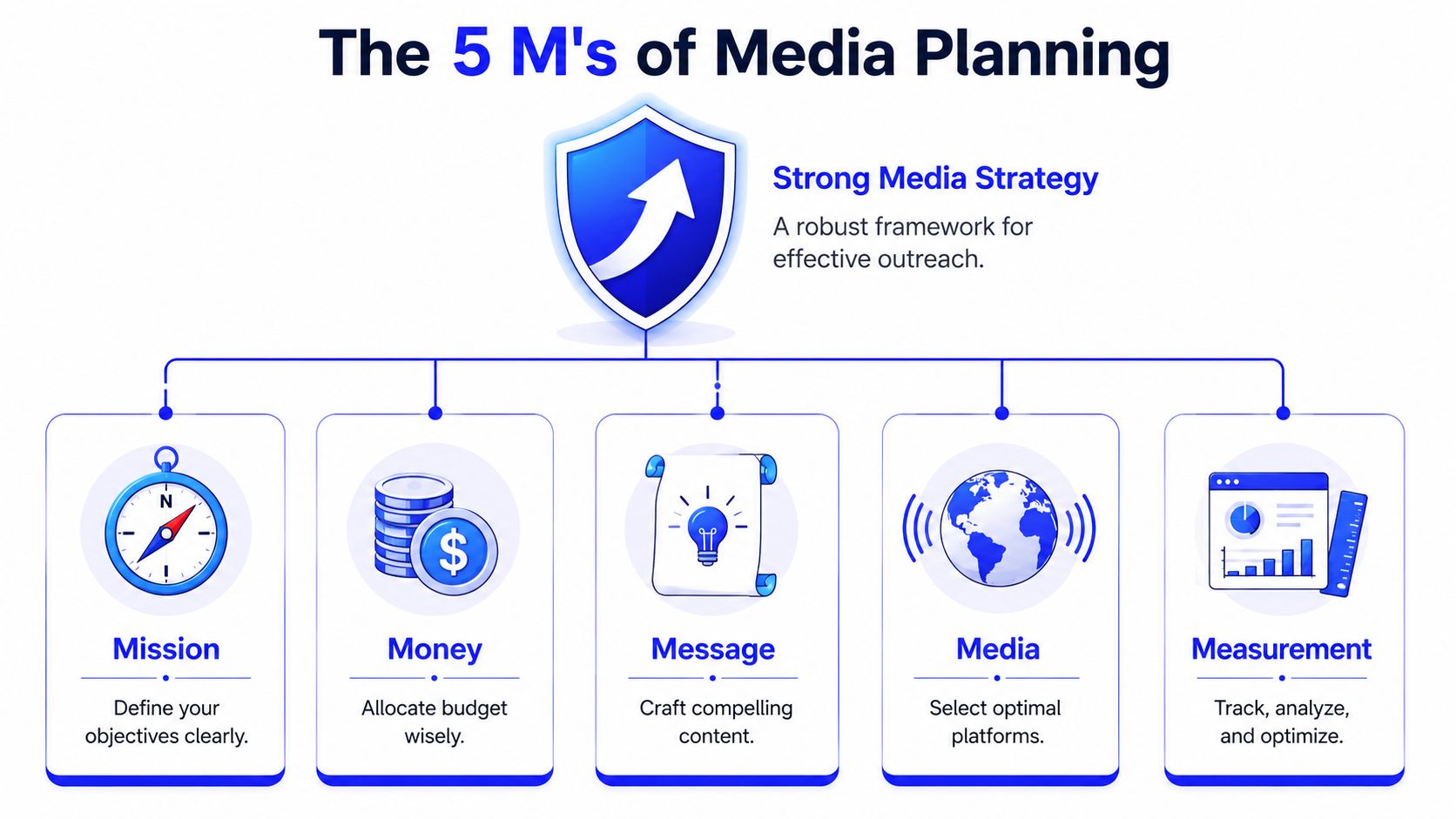
The cleanest framework I've seen still holds up. The 5 M's of media planning give founders a practical way to pressure-test strategy before spend hits the account.
Campaigns using this checklist achieve 20 to 35% higher ROAS by tying budget allocation, timing, and KPI tracking to audience research and business goals, according to Improvado's breakdown of the 5 M's of media planning.
Mission comes first
Mission is the objective. Not “grow awareness.” Not “do more content.” The actual commercial outcome.
For a startup, mission usually sounds like one of these:
Pipeline creation: generate qualified demos for a sales team that can close.
Revenue expansion: turn existing demand into more efficient acquisition.
Market entry: establish relevance in a category where nobody knows you yet.
Founders get tempted to stay vague because vague goals feel flexible. They're not. They make trade-offs impossible.
Ask one question: What business outcome should this strategy move in the next operating cycle?
Money needs rules
Money isn't just your monthly spend cap. It's your budget logic.
Strong strategy sets rules before pressure shows up. How much budget goes to testing versus proven channels? When do you increase spend? What result has to happen before creative production expands? What gets paused first when performance slips?
Startups get into trouble when budget behaves emotionally. One good week and they double spend. One bad week and they kill a channel that was doing the heavy lifting higher up the funnel.
A milestone-based budget works better than a blind retainer mindset. Release more budget when the system proves something, not when the team feels optimistic.
For founders thinking about scalable acquisition systems, these performance marketing strategies that actually scale) are useful because they force budget decisions to follow evidence.
Message has to do a job
Most startup messaging is either too broad or too internal. It explains the product the way the team talks about it, not the way buyers evaluate it.
Message in a media strategy should answer three things fast:
Question | What the message must do |
|---|---|
Why should this buyer care now | Surface urgency or relevance |
Why this option over alternatives | Clarify differentiation |
Why trust this claim | Provide proof, specificity, or credibility |
A message isn't a slogan. It's a conversion hypothesis.
Media is selection not instinct
Media is where a lot of teams start, which is exactly why it often goes wrong.
A strong strategy picks channels based on buyer behavior, message fit, and measurement feasibility. Search works differently from LinkedIn. YouTube works differently from email nurture. Founder-led organic content does a different job from retargeting.
The point isn't to “be everywhere.” It's to create coordinated coverage across the journey.
Measurement is part of strategy not reporting
Measurement is often treated as a dashboard issue. It's not. It's a design issue.
If your CRM stages are vague, your UTMs are inconsistent, and GA4 isn't aligned to actual conversion events, you can't judge media well. You can only argue about it.
The channel that looks cheapest in-platform often looks very different once you connect first click, lead quality, opportunity creation, and closed revenue.
Measurement belongs inside strategy because it determines what the team can learn, trust, and repeat.
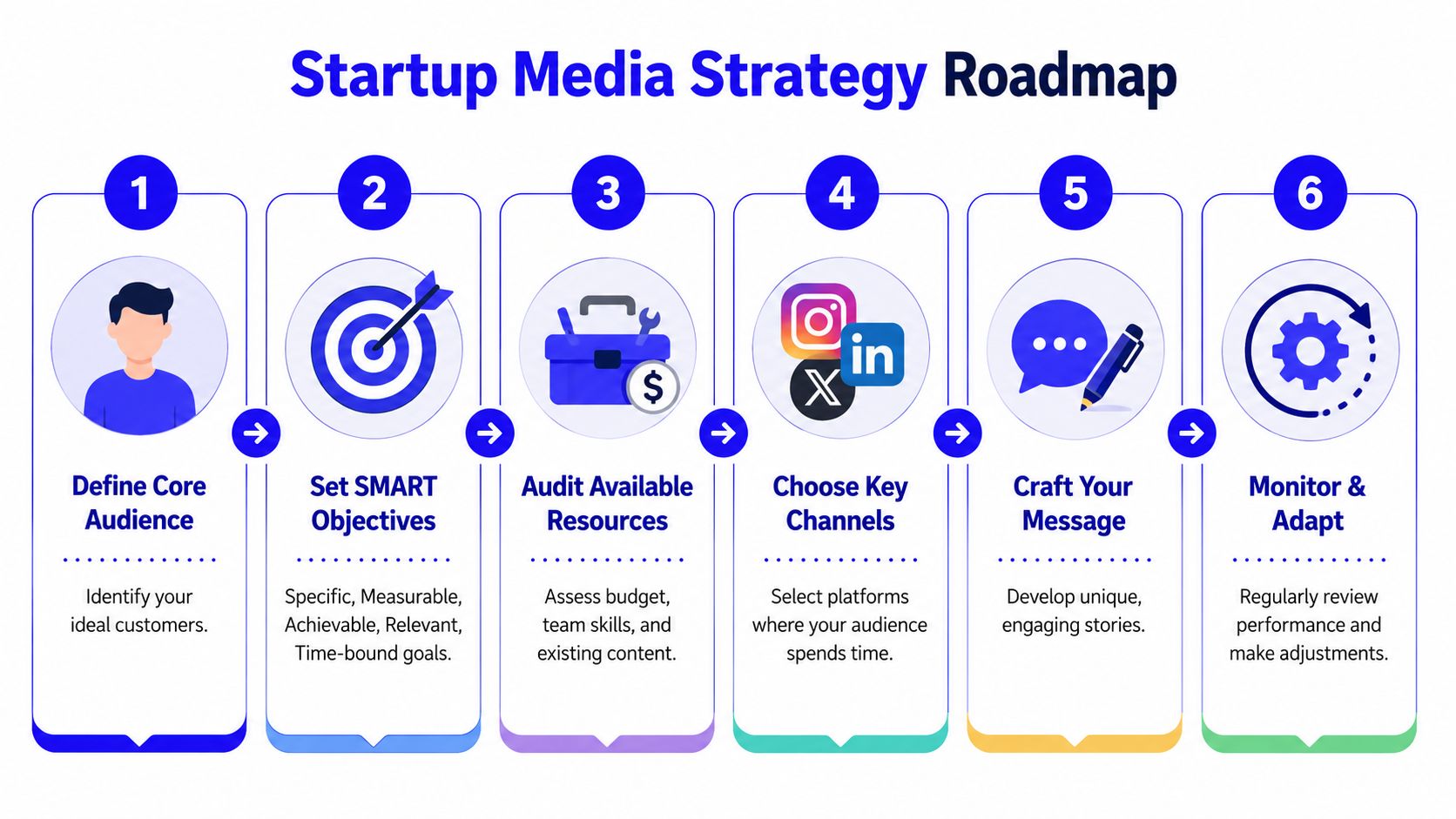
A Startup's Roadmap to Building a Media Strategy
Startups rarely lose because they picked the wrong channel first. They lose because they bought media before they built the operating system behind it.
Start with the business problem and the buying motion
Begin with the outcome the company needs, then work backward into media. A startup that needs enterprise demos this quarter needs a different system from one chasing free-trial volume or expansion revenue from existing accounts.
That sounds obvious. In practice, teams still jump straight to channel ideas.
The better sequence is tighter. Define the commercial goal. Define the buyer in terms the team can target, message to, and measure. Then decide what media has to do.
Use operational audience inputs, not persona wallpaper:
Buying context: Are they replacing a tool, reacting to a new mandate, or trying to fix an expensive bottleneck?
Pain threshold: What has to happen before this problem gets budget and attention?
Decision structure: Is one operator buying, or does legal, finance, and a department head all shape the deal?
Proof requirement: Do they need a benchmark, case study, product tour, ROI model, trial, or peer validation before they move?
From there, build message discipline. A startup usually needs one sharp promise, one credible proof point, and one call to action that matches buyer intent. Anything more and the landing page starts arguing with itself.
Distribution should reinforce that structure. It should not introduce a second strategy by accident. If you want a practical complement to this step, this guide to building a content distribution strategy helps map each message to the right format and channel role.
Here's a quick walkthrough that explains the mechanics in plain English:
Build the attribution layer before scaling
Early-stage teams often treat attribution as cleanup work for later. That decision gets expensive fast.
Before serious spend, set the measurement rules. Standardize UTMs. Configure GA4 around meaningful conversion events, not vanity actions. Set up Google Tag Manager cleanly. Map CRM source fields to campaign data. Account for offline conversion steps if revenue closes in sales, not on the website. Use naming conventions a new hire could audit without needing a decoder ring.
This is the overlooked strategic layer. Channel selection depends on it.
If attribution is sloppy, every review meeting turns into opinion trading. Paid media reports one story. Sales reports another. Finance trusts neither. The issue is not reporting hygiene. The issue is that the strategy was never built to produce audit-ready evidence.
Audit-ready attribution means someone new can inspect the setup and trace how a click became a lead, how that lead became an opportunity, and how that opportunity tied back to revenue.
That matters even more once multiple teams touch the journey. Marketing may optimize for form fills. Sales may care about meeting quality. Product may care about activation. Without shared definitions and clean handoffs, the startup sees activity but cannot defend what is working.
Pick channels based on role, signal quality, and learning speed
Once the business goal, buyer logic, and attribution setup are in place, channel decisions get much easier.
Treat channels as jobs inside a system. Search captures active intent. Paid social can create demand or retarget it. YouTube can educate before a buyer is ready to convert. Email and lifecycle touchpoints protect the value of the click you already paid for. The right mix depends on message fit, sales cycle length, creative capacity, and how quickly each channel can produce useful learning.
A practical startup rollout often looks like this:
Start with one high-intent channel
Search is common because it reveals what buyers are already trying to solve and gives fast signal on message-market fit.Add one scalable demand-generation channel
LinkedIn often fits B2B. Meta can work for many B2C and prosumer offers. YouTube earns a place when education does real conversion work.Support with owned assets
Build the landing pages, nurture flows, comparison pages, onboarding emails, and sales materials that keep paid traffic from stalling out.Review channels by their assigned role
Awareness channels should not be judged by the same timeline as bottom-funnel capture. Retargeting should not get credit for demand it did not create.Scale only after downstream validation
Keep funding the channels that move qualified leads, pipeline, activation, or revenue. Cut the ones that produce cheap clicks and weak business outcomes.
The order matters because each step reduces false positives. Startups do not need more channel activity. They need a system that connects business goals, buyer behavior, channel roles, and attribution the team can defend under scrutiny.
Measuring Your Strategy with the Right KPIs
Founders don't need more metrics. They need a hierarchy.
The easiest way to evaluate a media strategy is to separate KPIs into three layers. If you skip that structure, teams start comparing apples to seatbelts. Someone celebrates click-through rate. Someone else complains about CAC. Both might be right, and neither conversation helps.
A simple KPI hierarchy
Use this as a working template.
KPI Tier | Example Metric | What It Answers |
|---|---|---|
Business KPI | CAC, LTV, revenue, pipeline created | Is the business growing efficiently |
Channel KPI | ROAS, cost per lead, qualified demo rate | Which channels are contributing |
Diagnostic KPI | CTR, CPC, landing page conversion rate, email open trends | Why is this tactic underperforming or improving |
A useful rule is to read from top to bottom.
If business KPIs are healthy, don't panic because one ad has an ugly CTR. If business KPIs are weak, don't comfort yourself with strong impression volume. Channel KPIs help you locate the source. Diagnostic KPIs help you find the mechanism.
For founders who want a sharper filter for dashboard noise, these marketing metrics that actually matter) are a good sanity check.
Use the metrics in order
Most reporting fails because teams reverse the order.
They start with the easiest numbers to access, usually in-platform metrics. Then they build a story upward. That's how weak strategy hides behind pretty charts.
A better process looks like this:
Start with the business question: Did acquisition become more efficient? Did qualified pipeline improve?
Move to channel contribution: Which sources created meaningful movement, not just form fills?
Use diagnostics to troubleshoot: Was the offer weak, the audience off, the landing page unclear, or the follow-up broken?
Good measurement doesn't reward the loudest channel. It rewards the channel that helps the business create profitable customer movement.
This is also why attribution discipline matters so much. Without it, KPI review becomes theater. With it, founders can make hard calls faster, because the numbers connect to the operating reality of sales, lifecycle, and revenue.
Three Media Strategy Pitfalls That Sink Startups
Startups rarely lose on media because they picked the wrong channel first. They lose because they never built the system that tells them which channels deserve budget, how those channels work together, and whether revenue can be traced back cleanly when the board starts asking questions.

The shiny object chaser
Founders feel this one fast. A new platform gets attention, a competitor appears there, and the team rushes in without defining the job that channel needs to do.
That creates activity, not strategy. Reddit, TikTok, podcast ads, influencer partnerships, paid search, they can all work. The question is whether each one reaches a buying audience, supports the right message at the right stage, and can be measured in a way your team will trust six months later.
I usually pressure-test channel ideas with three filters:
Audience fit: does this channel reliably reach the people who can buy, influence, or accelerate the deal?
Strategic role: is it creating demand, capturing intent, nurturing consideration, or improving conversion?
Attribution readiness: can the startup track contribution cleanly across ad platforms, analytics, CRM, and pipeline reporting?
If a channel fails one of those tests, it is still an experiment. It is not part of the strategy yet.
The broken compass
Some startups spend real money before they standardize measurement. Then the arguments start. Meta reports one version of performance. GA4 reports another. The CRM has messy source fields, duplicate contacts, and half-complete lifecycle stages. Sales updates outcomes inconsistently, so closed revenue cannot be tied back to acquisition with confidence.
At that point, media strategy turns into politics. The loudest dashboard wins.
The fix starts before budget scales. Set one naming convention. Clean up UTMs. Define conversions the same way across platforms. Sync ad data, web analytics, and CRM records so the same lead does not appear as three different stories. Document the rules so reporting can survive staff changes, agency changes, and investor diligence.
Audit-ready attribution is not a reporting extra. It is the layer that keeps media decisions tied to business reality.
The silo trap
This is the startup version of organizational debt. Paid media chases lower CPL. Brand wants reach. Sales wants better-fit opportunities. Product marketing changes the positioning mid-quarter. Lifecycle inherits leads that were never qualified properly in the first place.
The buyer sees the result immediately. The ad promises one thing. The landing page emphasizes something else. The nurture sequence shifts the message again. Then sales opens the call with a different definition of the problem.
That disconnect usually starts upstream. Teams selected channels before they agreed on the customer journey, the message architecture, and the business outcome that matters. So every function optimizes its own local metric and the system gets weaker as spending rises.
A startup fix is simple to describe and harder to enforce:
Set one shared objective: qualified pipeline, revenue efficiency, sales-accepted opportunities, or another business outcome every team recognizes
Use one message architecture: the ad promise, landing page, email follow-up, and sales narrative should all come from the same strategic brief
Review one operating system: channel data, CRM stages, and revenue outcomes need to be reviewed together, not in separate team dashboards
Assign ownership for handoffs: someone has to own the transition from impression to click to lead to pipeline, or gaps will keep getting blamed on “the channel”
A startup can survive a mediocre campaign. It usually cannot survive a fragmented journey with messy attribution and teams optimizing in different directions.
Conclusion Your Strategy Is Your Growth Engine
Media strategy isn't a static document tucked into a Notion folder. It's the operating system that coordinates growth.
When it's done well, paid, owned, and earned media stop acting like separate departments with separate opinions. They become one system with shared goals, clean handoffs, and measurement you can trust. That's what lets a founder decide where to push, where to pause, and where to invest with conviction.
When it's done badly, marketing gets noisy. Channels compete for credit. Reporting turns into interpretation. Budget drifts toward whatever looked promising last week.
For a startup, that difference is huge. A real media strategy gives you focus before spend, coherence across channels, and attribution strong enough to survive scrutiny. That's not extra polish. It's what keeps growth from turning into expensive guesswork.
If you want help building that kind of system, Du Marketing works with startups that need paid media, SEO, lifecycle, landing pages, and attribution run as one connected growth engine, with transparent reporting and execution that's built to be audit-ready.