What Is Paid Media in Marketing: Grow Your Startup

You're probably here because paid media feels both obvious and suspicious.
Obvious, because every startup eventually asks, “Should we run ads?” Suspicious, because “just spend money on Google and Meta” is how founders end up with screenshots full of clicks and no clue whether any of them turned into pipeline, purchases, or useful learning.
That tension is a fundamental starting point for understanding what paid media is in marketing. It isn't just ad buying. It's a controllable distribution system. Used well, it lets you choose who sees your offer, when they see it, how much you're willing to spend, and what happens after the click. Used badly, it becomes a fast way to pay for confusion.
Table of Contents
Paid Media Is More Than Just Buying Ads
A lot of bad marketing advice treats paid media like a vending machine. Insert budget. Receive customers.
That's not how it works. Paid media is better understood as the most controllable growth lever most startups can access. You can set targeting rules, budgets, timing, placements, creative, landing pages, and measurement. Few channels give you that level of direct control.
That control is the point. According to Adobe's explanation of paid media, paid media is defined by its technical capacity for deterministic control over targeting, timing, and budget, allowing advertisers to build detailed buyer personas using behavioral data from CRM systems and website analytics to drive measurable business outcomes.
Why founders get burned
Founders usually don't fail because they picked the wrong ad platform. They fail because they treat paid media like an isolated tactic.
Common pattern:
They launch too early. No clear offer, weak landing page, fuzzy audience.
They optimize the wrong thing. They celebrate cheap clicks instead of qualified leads or sales.
They skip tracking. The campaign runs, forms come in, and nobody knows which keyword or ad produced revenue.
They expect instant certainty. They shut campaigns off before the data can teach them anything useful.
Practical rule: Paid media works best when it sits inside a system with strong messaging, clean tracking, and a clear next step after the click.
What it looks like when it works
A good paid media setup doesn't just buy attention. It does four jobs at once:
Captures existing demand from people already looking for a solution.
Creates demand by introducing your product to the right audience before they're actively searching.
Tests messages fast so you learn which angles resonate with people.
Feeds owned channels like email, CRM, and retargeting pools for follow-up.
That's why the useful question isn't “Should we run ads?”
It's “Can we build a paid media engine that informs SEO, strengthens email, improves attribution, and gives us a faster feedback loop than waiting for organic growth alone?”
Paid Owned and Earned Media Explained
Most marketing confusion clears up once you separate paid, owned, and earned media.
Think about a restaurant. Paid media is renting a billboard or buying ads in local search. Owned media is your restaurant, your menu, your website, your email list. Earned media is the glowing review, the friend recommendation, the food photo someone posts without you asking.
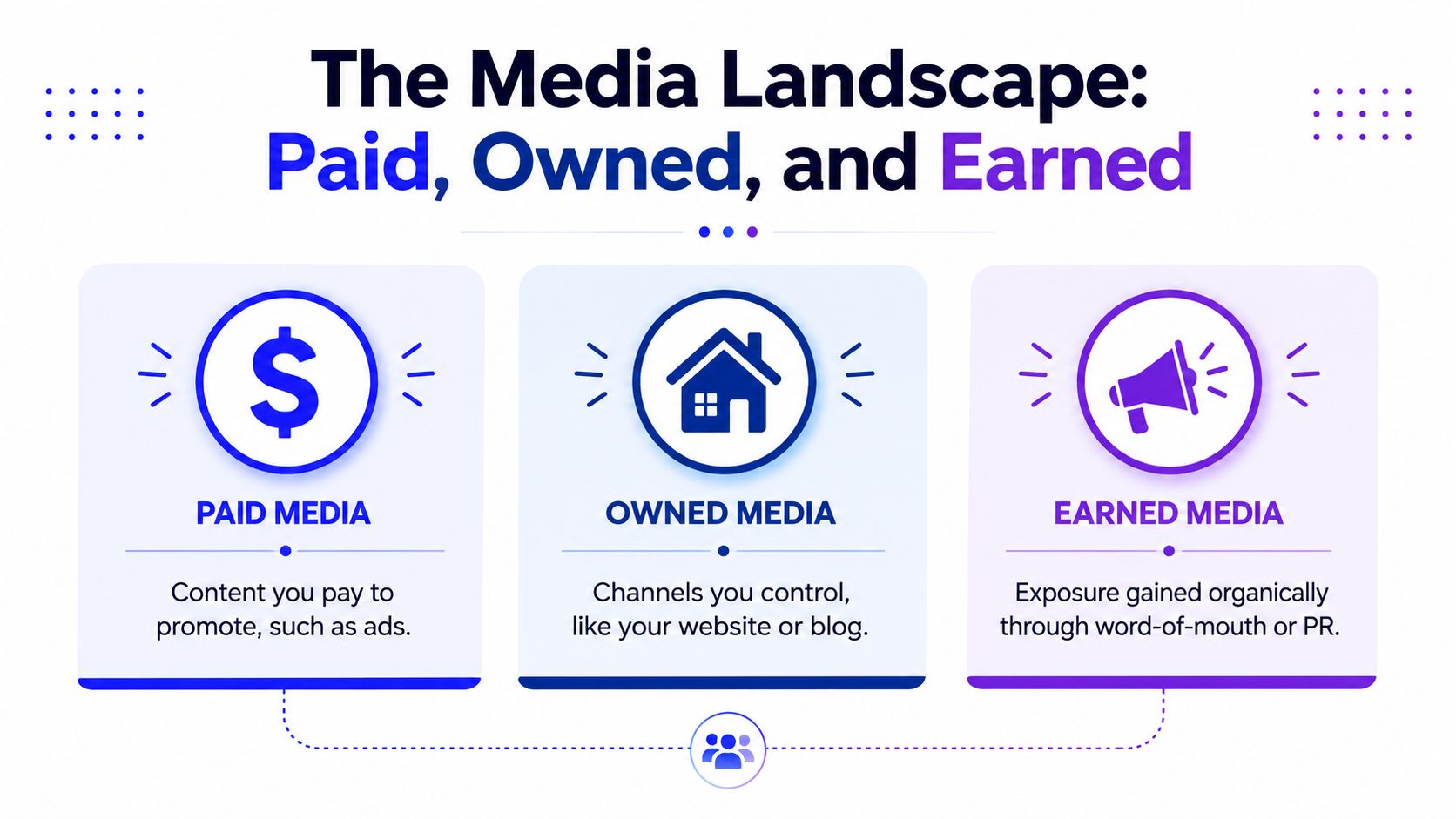
A simple way to think about the three
Here's the shortest useful version.
Attribute | Paid Media (Renting) | Owned Media (Owning) | Earned Media (Reputation) |
|---|---|---|---|
Core idea | You pay for distribution | You control the asset | Others talk about you |
Examples | Google Ads, Meta Ads, LinkedIn Ads, sponsored placements | Website, blog, landing pages, email list, CRM audience | Reviews, PR mentions, referrals, shares, word of mouth |
Speed | Fast | Slower to build | Unpredictable |
Control | High over targeting, budget, and timing | High over content and structure | Low |
Cost structure | Media spend plus execution | Time, tools, and production | Not directly purchased |
Best use | Reach, testing, demand capture, scaling | Education, conversion, nurture, retention | Trust, credibility, amplification |
Why paid media gets so much attention
Owned media matters because it compounds. Your site, content library, and email list are assets you keep. Earned media matters because buyers trust other people more than they trust your ad copy.
But paid media gets attention because it gives you control now. You don't need to wait for rankings, press coverage, or social momentum. You can launch a campaign, define an audience, test an offer, and start collecting signals.
That's also why startups misuse it. They assume control means certainty. It doesn't. It means you can deliberately shape the inputs.
Paid media is rented attention. Owned media is the place that attention should land. Earned media is what happens when the experience is good enough that other people carry the message for you.
If you're trying to answer “what is paid media in marketing” in one line, that's the practical answer: paid media is the part of your marketing system where you buy controlled distribution.
Navigating the Major Paid Media Channels
Channel choice sets the ceiling on paid performance.
A founder launches Google, Meta, and LinkedIn in the same month, sees clicks from all three, and still cannot tell which one deserves more budget. The problem usually is not effort. It is channel selection without a clear job for each platform.
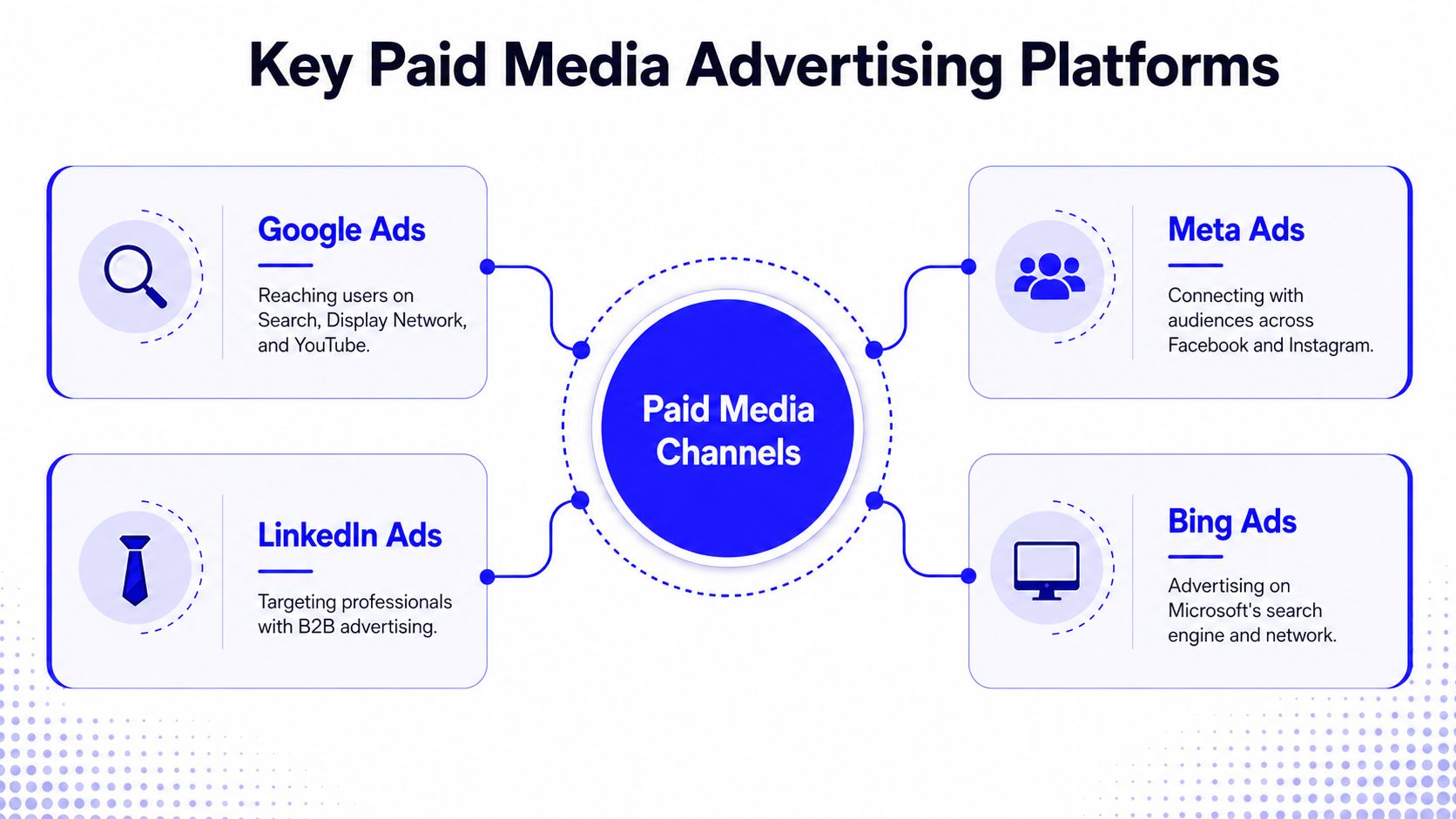
Paid media works best when each channel has a role inside the wider system. Search captures demand. Social creates and shapes it. Retargeting brings people back. Email and the site do the conversion and follow-up work. Analytics tells you whether the traffic is producing customers or just activity.
Google Ads when demand already exists
Google Ads is usually the cleanest place to start because intent is visible. Someone searches for a problem, a category, a competitor, or a specific feature. That gives you a direct line between what the buyer wants and what you put in front of them.
This channel rewards clarity. Tight keyword groups, useful ad copy, strong negatives, and a landing page that answers the query usually beat broad messaging. If you want a practical framework for structure and query control, this guide on how to optimize search ads covers the setup details that matter.
Use Google when:
People already search for your solution
Your offer is specific enough to match intent
Your landing page can convert traffic without a long education cycle
You need fast feedback on messaging, pricing, or positioning
Search has limits. If nobody is searching, search volume will not save you. If your conversion tracking is weak, Performance Max can spread spend across placements faster than you can diagnose waste.
Later in your channel mix, this video gives a useful overview of platform roles and trade-offs.
Meta Ads when you need to create demand
Meta sits higher in the funnel. People are not there to solve an urgent business problem the way they are on Google. They are scrolling, which means the creative has to stop attention, frame the problem fast, and give them a reason to care.
That makes Meta useful for products with a strong visual story, offers with a clear hook, founder-led brands, and retargeting programs that keep your product in view after a site visit. It can also be a strong testing ground for angles before you invest in larger creative production.
The trade-off is quality control. Meta can deliver cheap clicks and weak buying intent at the same time. If your site, email capture, and follow-up sequence are underbuilt, you can spend a lot to fill the top of the funnel and still feel like nothing is working.
LinkedIn Ads for narrow B2B targeting
LinkedIn earns its place when audience precision matters more than cheap traffic.
If you sell to heads of finance at SaaS companies, operations leaders in healthcare, or HR teams above a certain company size, LinkedIn gives you targeting that broader social platforms cannot match. That is why it often works best for demo requests, webinar registration, lead magnets, and account-based campaigns tied closely to sales follow-up.
It is rarely the right first channel for a startup with a weak offer or no sales process. Clicks cost more, and the platform exposes bad positioning fast. The upside is lower audience waste when your ICP is clear and your CRM process is ready to handle leads properly.
Bing Ads as an efficient extension
Bing Ads usually comes after Google, not before.
Once search campaigns are organized, with clean keyword mapping, negative keyword logic, tested landing pages, and working conversion tracking, Bing can add incremental reach without forcing the team to learn a completely different channel. For lean teams, that matters. Extending a search system is often easier than building a new paid social motion from scratch.
The upside is operational simplicity. The downside is volume. Bing can be a profitable addition, but it is rarely the engine that creates growth on its own.
Pick channels based on buyer intent, sales motion, and measurement readiness. The right platform is the one that fits your funnel and feeds the rest of your growth system.
The KPIs That Actually Drive Growth
Metrics only matter if they answer a business question. Founders don't need prettier dashboards. They need numbers that tell them whether growth is affordable, profitable, and repeatable.
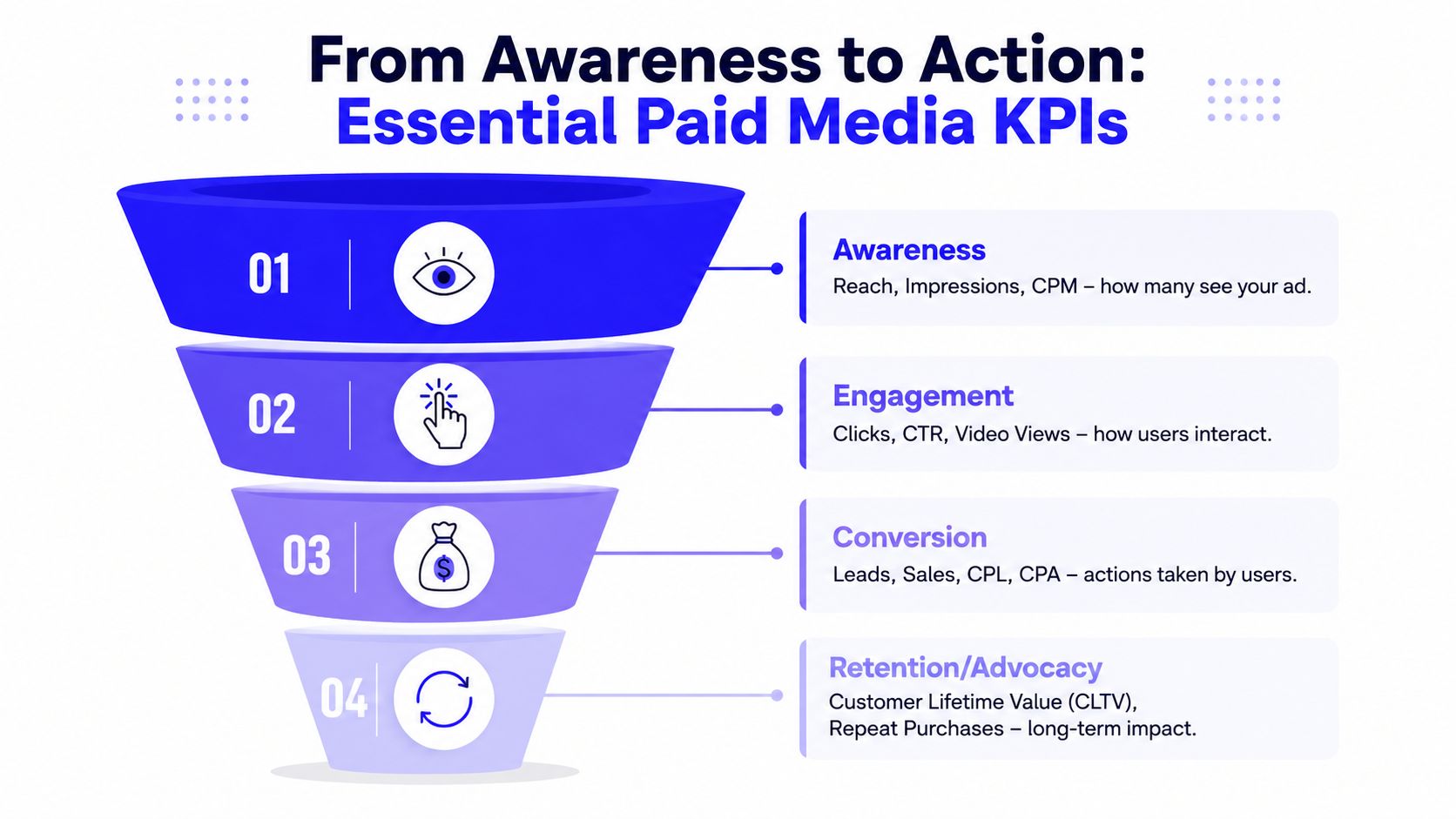
Start with the business question
A metric becomes useful when it answers one of these:
Business question | KPI that helps answer it | Why it matters |
|---|---|---|
Can we buy growth at a reasonable cost? | CPA or CPL | Tells you what a conversion costs |
Is this spend turning into revenue efficiently? | ROAS | Shows revenue returned from ad spend |
Is our message getting attention? | CTR | Signals whether targeting and creative connect |
Are we acquiring customers worth keeping? | LTV:CAC | Tests long-term sustainability |
CTR matters, but only in context. A high click-through rate on weak traffic can flatter a campaign that never produces qualified demand. CPA matters, but only if the underlying lead quality holds up in the CRM. ROAS matters, but only if your revenue data is trustworthy.
That's why I usually treat metrics in layers, not in isolation.
What founders should watch first
If the account is early-stage, start simple.
CTR checks message-market fit at the ad level. If nobody clicks, the problem is usually the offer, audience match, or creative.
CPA or CPL checks economic reality. If conversions cost more than the business can support, scale won't save you.
ROAS checks near-term efficiency. It's useful for ecommerce and other models with relatively direct revenue attribution.
LTV:CAC checks whether growth can survive beyond the first transaction. This matters most when repurchase, retention, or expansion revenue drives the business.
A founder-friendly rule: if your dashboard can't help you decide whether to increase budget, cut spend, revise creative, or fix the landing page, it's decoration.
For a sharper view of signal versus noise, this article on the marketing metrics that actually matter) is a useful companion.
The best KPI isn't the most advanced one. It's the one that changes what you do next.
One more practical note. Don't let top-of-funnel metrics dominate your thinking. Reach, impressions, and video views can be helpful diagnostics, but they don't answer the investor question, the board question, or the payroll question. Revenue quality does.
Connecting Clicks to Customers with Smart Tracking
A founder launches campaigns on Meta and Google, lead volume goes up, and the weekly report still cannot answer a basic question. Which spend produced qualified pipeline, and which spend just produced form fills.
That gap is usually a tracking problem, not a channel problem.
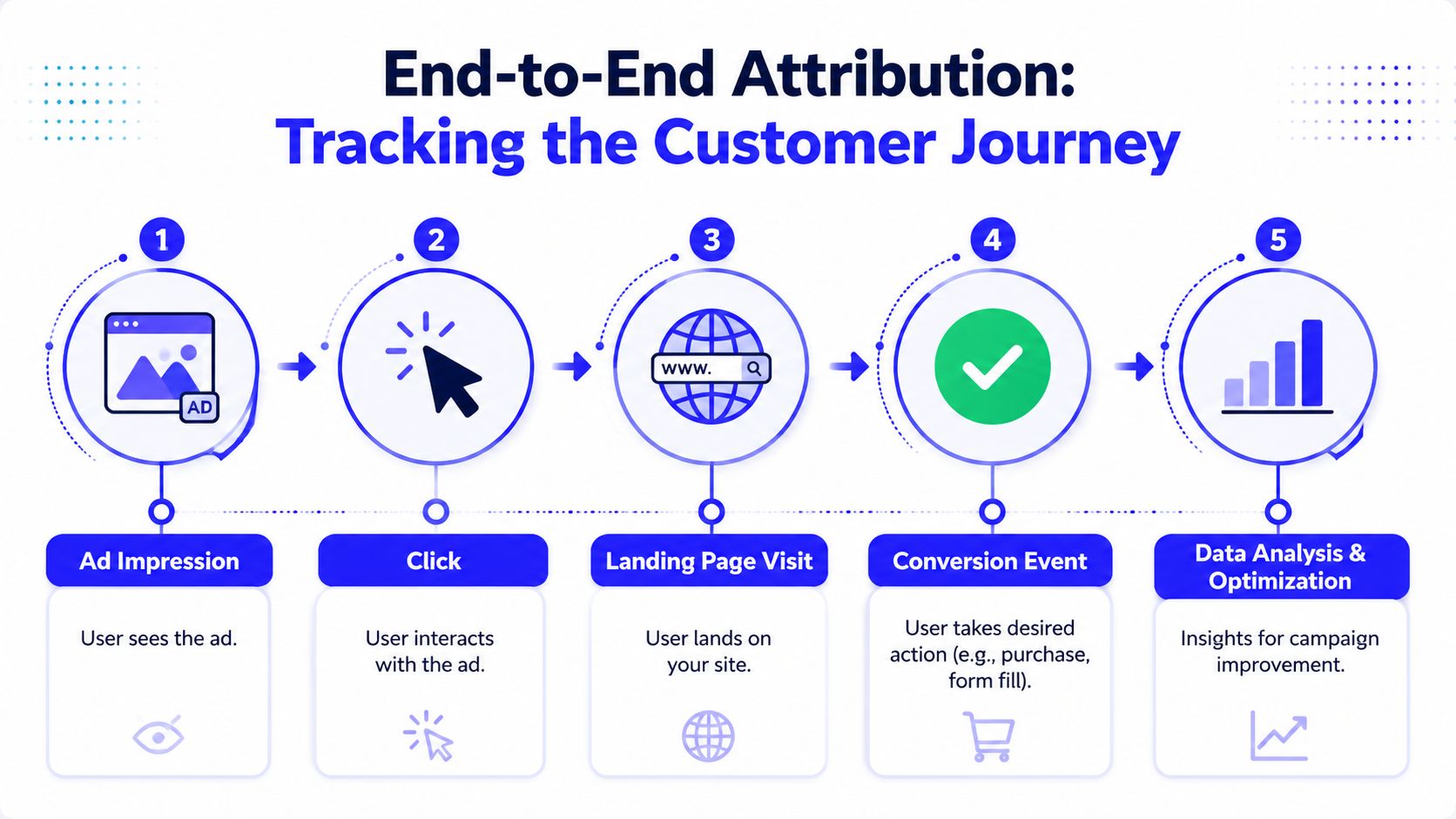
Paid media only becomes a controllable growth engine when clicks can be tied back to sales outcomes. Otherwise, the ad platforms grade their own homework, GA4 shows partial behavior, and the CRM sits in a separate system with the revenue data you actually care about. The job is to connect those pieces so SEO, email, sales, and paid all use the same source context.
What a usable tracking stack looks like
A usable setup has a few parts, and each one solves a different failure point.
UTM parameters label acquisition clearly. Every campaign needs consistent source, medium, campaign, content, and term naming so reports stay clean across platforms and time periods.
GA4 shows on-site behavior. It helps you see what happened after the click, including engaged sessions, key events, and drop-off points on the path to conversion.
Google Tag Manager gives you operational control. You can ship tracking changes faster, test tags, and reduce how often small measurement fixes wait on engineering.
Server-side tracking and CAPI improve signal quality. They help recover events that browser-side tracking misses and reduce data loss caused by privacy restrictions or ad blockers.
CRM sync closes the loop. Campaign data has to pass into HubSpot, Salesforce, or Pipedrive so you can tie leads, opportunities, and closed revenue back to the original spend.
As noted earlier, strong paid media operations depend on standardized naming, shared reporting, and attribution that holds up across channels. Without that, teams end up arguing over three different versions of performance instead of deciding what to change.
What usually breaks attribution
Attribution failures are rarely dramatic. They come from small setup mistakes that sit unnoticed while budget keeps spending.
Inconsistent naming
One campaign uses
paid_social, another usespaidsocial, and a third usesmeta_paid. Reporting fragments fast. Channel performance starts looking worse or better than reality because the same traffic is split across multiple buckets.Broken CRM handoff
A lead submits a form, but the UTM data never gets written into contact or deal fields. Marketing can report conversions. Sales can report meetings. Finance can report revenue. Nobody can connect them confidently.
Platform-only optimization
Meta and Google can report the conversions they can observe, but they do not know which leads became qualified pipeline unless you pass that data back. If you optimize only inside the ad platform, you often train campaigns toward cheap conversions instead of valuable customers.
No QA process
A form changes, a redirect strips UTMs, or a thank-you event stops firing. Nothing looks broken at a glance. Performance decisions get made on bad inputs for weeks.
I see this a lot with startups running paid search, paid social, and lifecycle email in parallel. Each channel looks fine in isolation. The system fails in the handoff between click, session, lead, and revenue.
If that sounds familiar, this guide to CRM tracking blunders that kill ROAS explains the failure points that usually break the loop.
Good attribution does not improve campaign performance on its own. It helps you stop funding the wrong campaigns, fix the right bottlenecks, and scale with more confidence.
Paid Media in Action A Startup Playbook
A founder usually sees the symptom first. Demo volume is flat, or revenue rises and falls with platform spend. The fix is rarely "buy more ads." Paid media works when it sits inside a system that turns clicks into qualified leads, customers, and repeat demand.
A B2B SaaS playbook for demo generation
A SaaS founder wants more demo requests from the right accounts. The target is operations leaders at mid-market companies, and the buying process takes time, multiple touches, and internal buy-in.
LinkedIn fits that job because the targeting can map to title, company size, and industry. But sending cold traffic straight to a demo form is usually too aggressive for this stage. A better move is to offer a useful mid-funnel asset tied to a clear pain point: a benchmark report, implementation checklist, ROI calculator, webinar, or short diagnostic.
Then the rest of the system has to do its job. The landing page captures the lead and matches the ad promise. The CRM records source, campaign, and creative using clean UTM conventions. Email nurture follows based on what the person downloaded or which page they viewed. Sales gets context instead of a nameless form fill.
That is where paid media starts compounding. Paid traffic gets the first response. SEO can support the same topic with high-intent content. Email keeps the conversation going until the account is ready for a meeting. Performance comes from how well those parts work together, not from LinkedIn alone.
A B2C ecommerce playbook for revenue growth
Now take an ecommerce brand with a broad catalog, uneven margins, and plenty of customers who do not buy on the first visit.
The channel mix usually breaks down by intent. Google Shopping and Search capture demand from people already comparing products or searching by category. Meta handles prospecting, product education, and retargeting. Email picks up after signup or purchase with cart recovery, browse abandonment, replenishment, and repeat-purchase flows.
The operator's job is to make those channels reinforce each other.
Search helps close demand that already exists. Social builds familiarity, tests new angles, and brings back visitors who left without buying. Email turns one session into a longer customer relationship. If analytics, campaign naming, and product-level revenue tracking are messy, the whole setup starts making bad decisions, especially when one product line can afford higher acquisition costs than another.
A simple founder view of the workflow:
Google captures high-intent demand. Product and category campaigns bring in shoppers close to purchase.
Meta creates and recovers demand. Prospecting introduces the brand. Retargeting gives warm traffic a reason to return.
Email extends the value of each click. Cart, browse, welcome, and post-purchase flows improve conversion and retention.
Analytics shows what is worth scaling. Revenue, margin, and customer behavior need to connect back to campaign decisions.
The ad platform is one part of the machine. Performance comes from how well the click connects to the page, the offer, the CRM, and the next message.
Building Your Integrated Growth System
The cleanest answer to what is paid media in marketing is this: it's the controllable distribution layer inside a larger growth system.
On its own, paid media can buy visibility. Integrated with SEO, landing pages, email, CRM, and analytics, it becomes a learning engine. You discover which audiences respond, which messages convert, which pages leak demand, and where revenue comes from. That insight improves more than ads. It sharpens the whole go-to-market motion.
Most startups struggle because execution gets split across too many hands. One freelancer runs ads. Another writes content. Someone in-house owns HubSpot. A developer touches tracking when they have time. Nobody owns the full path from first click to closed revenue.
That fragmentation is why paid media often looks worse than it is. The channel gets blamed for failures caused by weak systems around it.
If you want that system built and run as one connected operation, Du Marketing helps startups manage paid acquisition, SEO, email/CRM, and attribution under a single operator model. That means fewer handoffs, cleaner reporting, and a clearer link between ad spend and revenue.