Abandoned Cart Recovery: The Growth Operator's Playbook

70.19%. That's the average shopping cart abandonment rate in Baymard Institute's 2025 aggregation of 49 studies, which means roughly 7 in 10 shoppers who start checkout still don't finish it, and that's before you even get into the messier real-world variation seen in 2026 benchmarks such as 70.22% and 76.8% depending on methodology and source (Baymard aggregation referenced here). The uncomfortable part isn't the number itself. It's that many teams still treat abandoned cart recovery like a polite reminder email instead of a measurable lifecycle system.
That mindset leaves money on the table because typical recovery rates sit in the 3% to 5% range, while top performers get into 10% to 14% and some sources estimate up to 20% with strong programs (cart recovery benchmark roundup). If you're running a startup or a lean ecommerce operation, that gap matters more than another marginal ad tweak. The audience is already high-intent, already in-market, and already paying attention, which is why abandoned cart recovery is one of the most effective places to grow revenue without pushing acquisition spend higher.
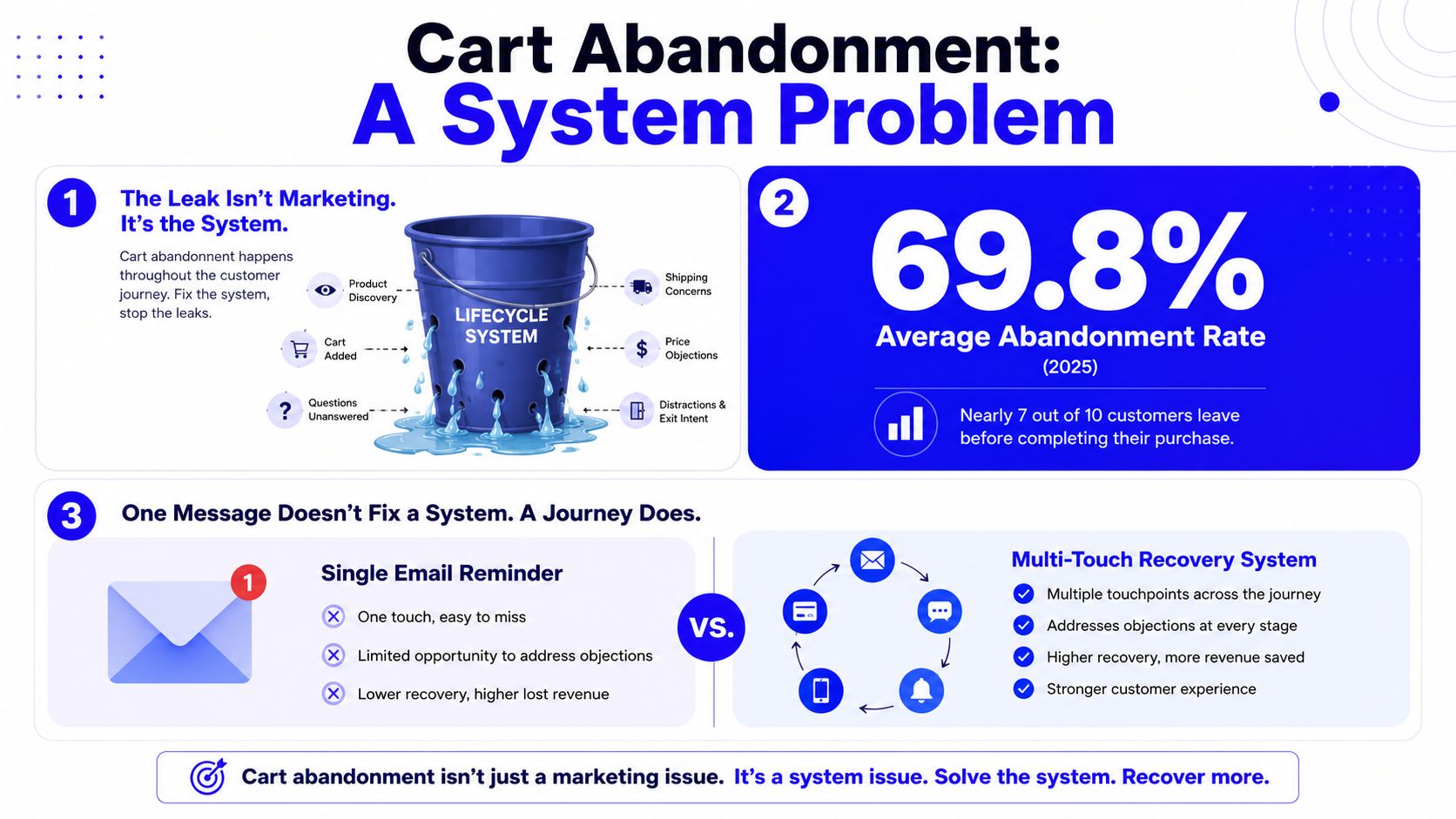
Table of Contents
Why Cart Abandonment Is a System Problem, Not an Email Problem
The first mistake is assuming the fix lives in the inbox. It doesn't. The abandonment problem starts upstream, at product pages, shipping estimates, account creation, payment forms, and the point where intent gets interrupted by friction, price shock, or distraction, then it finishes in a recovery system that either catches the shopper or lets them vanish.
The practical implication is simple. If your team only builds a single reminder email, you're optimizing one narrow touchpoint inside a much larger flow. Baymard's 70.19% benchmark, plus the 3% to 5% recovery range for typical programs and 10% to 14% for top performers, makes the strategic point clear, the revenue upside comes from orchestration, not from sending one more message (benchmark summary).
Practical rule: treat every abandoned cart as a lifecycle event, not a missed newsletter open.
A real recovery system has to coordinate data capture, message timing, channel selection, and measurement. That means the checkout event can't live in one silo, CRM contact history can't live in another, and ad-platform audiences can't be built from guesswork. If those pieces don't connect, you can't tell whether revenue came back because the message was timely, because the offer was stronger, or because the shopper would've converted anyway.
The easiest internal test is this, ask whether you can explain recovery performance without mentioning a subject line. If the answer is no, the system is underbuilt. And if the answer is yes, but only because you stitched together tracking, CRM sync, and channel attribution, then you're finally managing abandoned cart recovery like a growth operator instead of a flow-builder.
The same logic applies to your stack. If marketing data and product data don't talk to each other cleanly, recovery becomes a guessing game, which is exactly why teams that care about lifecycle revenue need a stronger data foundation, not just more copy variations. For a useful example of that broader integration mindset, see marketing data integration in practice.
Diagnosing Where Your Carts Leak
Before you write a recovery sequence, find the leak. A lot of teams jump straight to copy, then discover their real problem is that shoppers are dropping at shipping, payment, or account creation, not at the cart itself. That is a funnel diagnosis problem, and it belongs in your analytics stack before it belongs in your inbox.
Read the funnel by stage, not by vibes
GA4 is most useful when you stop treating it like a traffic report and start using it like a funnel recorder. Build the path around add_to_cart, begin_checkout, and purchase, then compare drop-off by device, source, product category, and geography. If the cart stage looks healthy but begin checkout collapses, your issue is likely checkout friction. If people reach payment and disappear, the problem is usually trust, complexity, or a payment option mismatch.
CRM stages help you separate shoppers who are lost from shoppers who just need a nudge. In B2B checkout funnels, that distinction matters even more because the “cart” may represent an opportunity, an invoice request, or a quote stage rather than a classic retail basket. A lead that stalls after checkout initiation is not the same as a casual browser, and your follow-up should reflect that difference.
If you can't name the stage where intent breaks, you're just sending reminders into fog.
Use a simple leakage table
Checkout Stage | Typical Drop-off Signal | Likely Root Cause |
|---|---|---|
Product page | High intent signals, no add_to_cart action | Weak offer clarity, pricing friction, low trust |
Cart page | Items added, no begin_checkout action | Surprise fees, indecision, distraction |
Shipping step | Checkout started, then exit | Delivery cost, policy confusion, timing mismatch |
Payment step | Form started, then abandoned | Payment friction, account creation, validation issues |
Account creation | Exit before checkout continues | Forced registration, too much friction |
That table is enough to keep you honest. If cart abandonment is shipping abandonment, a discount email will not fix it. If the drop happens at payment, you need to inspect UX, payment methods, and form friction, not just the recovery copy.
For tracking setup, event hygiene matters too. If the events are messy, the diagnosis is fake. A clean implementation starts with consistent checkout events, then gets cross-checked against CRM records and session behavior. If your stack is still in the “we think the event fired” phase, use the tracking discipline outlined in event tracking with Google Tag Manager before you trust any recovery insight.
Wiring the Tracking and Attribution Stack
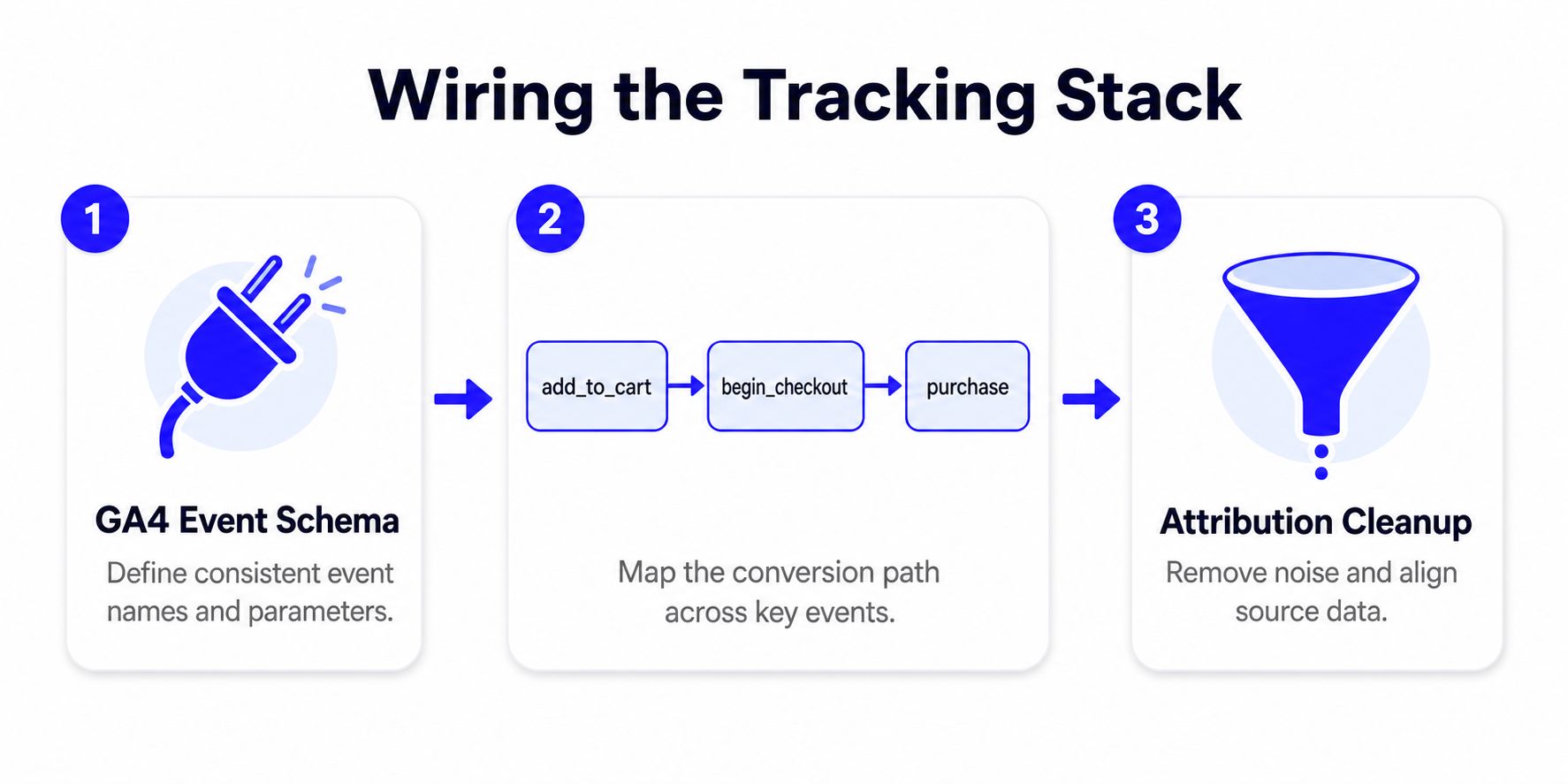
A recovery flow only becomes measurable when the tracking stack stops guessing. The minimum setup is intentionally plain, GA4 for behavior, server-side GTM where it matters, Meta CAPI and Google Ads enhanced conversions for match quality, and a CRM sync that links recovered orders back to contacts or opportunities. That is not overbuilding, it is what turns recovered revenue into something you can trust in reporting.
Send the right events, then keep them clean
The core events are simple, add_to_cart, begin_checkout, and purchase. Capture those consistently and you have the base layer for recovery audiences, funnel reporting, and revenue attribution. Miss one of them and the recovery flow can still function, but the reporting starts to blur quickly.
The core problem is not whether the events exist, it is whether they fire the same way every time. Duplicate purchase events, broken parameter values, and mismatched transaction IDs can make recovery revenue look better or worse than it is. QA has to stay in the workflow each time the checkout page changes, not only at launch.
A clean pipeline also depends on how the handoff is built behind the scenes. If your tracking and sync steps are improvised, the numbers drift as soon as traffic or checkout volume changes, which is why the implementation work described in data pipeline automation for marketers matters before anyone trusts the dashboard.
Keep attribution usable, not ornamental
UTM discipline is the other half of the plumbing. If recovery email, SMS, and retargeting use different naming patterns, you will not know which touch brought the shopper back. Standardize source, medium, campaign, and content naming before the first flow goes live, then keep it stable long enough to compare channel performance without rewriting history.
Consent mode v2 also belongs in the setup in 2026, because the recovery stack only works when measurement respects user choice. The practical question is what can be collected, what can be modeled, and what has to stay blocked. That is not just a legal checkbox, it is what keeps the data usable when audiences and ad platforms get noisier.
Operational takeaway: if the CRM cannot tell you whether a recovered order came from a contact, an opportunity, or a one-time shopper, the dashboard is lying by omission.
The useful check for an operator is simple. A recovered order should be traceable backward through the stack without manual detective work. If it is not, fix the plumbing before you celebrate any lift. A tidy implementation also makes the rest of the lifecycle easier, because recovery audiences, offline conversion uploads, and follow-up segmentation all become mechanically reliable instead of hand-waved.
Designing a Multi-Channel Recovery Sequence
Email is still the anchor channel because the benchmarks are strong, with open rates around 40% to 45%, conversion rates around 18% to 20%, and timing sensitivity that rewards fast follow-up (email benchmark roundup). But email-only recovery usually sits around 5% to 15%, while multi-channel programs that add SMS, push, or retargeting often reach 15% to 25% (multi-channel recovery playbook). That's the whole game, not just the message, but the sequence.
Use timing as a decision, not a template
The most useful operating rhythm is 1 hour → 24 hours → 48 to 72 hours (sequence benchmark). The first touch does most of the heavy lifting because intent is still hot. The later touches are there to recover people who were distracted, comparison shopping, or waiting for approval, not to repeat the same message with slightly different punctuation.
A first email should be direct and low-friction. It should remind, not over-sell. By the second and third touch, the message can handle objections, answer the most likely doubt, or offer a channel shift if the customer is more responsive by text. SMS belongs in the sequence when consent exists and the category moves quickly, while push and onsite banners make sense when you already have authenticated traffic or a logged-in customer base.
Match channel choice to the buyer's context
Fast-moving categories don't need a long narrative. They need a sharp nudge, a clear path back, and a reason to act now. Slower categories can support a more considered sequence, especially when the decision involves higher price sensitivity, more comparison, or a longer internal approval loop.
Retargeting should earn its place, not be sprayed everywhere by default. It works best as a backstop when the cart reminder didn't land, or when you want to stay present across devices without asking the shopper to reopen email. The best sequences feel coordinated, not repetitive, because each channel plays a different role in the same recovery motion.
Useful filter: if a channel doesn't add new information, new urgency, or new convenience, it probably doesn't deserve a slot.
Copy matters, but only after the sequence is right. Strong cart copy usually does one of three things, it reduces doubt, it reinforces the specific product left behind, or it makes the path back stupidly easy. Generic “You forgot something” messaging is lazy. Useful cart messaging sounds like someone who knows what was in the basket and knows why the buyer hesitated.
When to Use Discounts and When to Stop Sending Them
Discounts are not the default recovery strategy. They're a controlled variable. The question isn't whether a coupon can lift response, it's whether the lift is worth the margin you give up, the behavior you train, and the audience you may condition to wait for the next offer.
Most public advice still reaches for a 10% to 15% incentive in later emails or as a broad rule of thumb, but stronger guidance is more selective, use incentives only when margin, cart value, or customer behavior justify them, and don't let the discount become the story (discount guidance). That's the right instinct. If you discount every abandoned cart, you're teaching shoppers that hesitation gets rewarded.
Test value, not just response
The clean way to think about incentives is to compare incremental revenue, margin per recovered order, and opt-out rate. Open rate and click rate can look great while profitability erodes. A flow that recovers a slightly smaller number of orders but preserves margin can be the better business decision.
Not every incentive has to be a price cut. Free shipping, bundled add-ons, extended support, loyalty points, or a cleaner objection-handling message can all move the same shopper without turning your pricing into a negotiation. That matters especially when the cart is already close to conversion and the issue is reassurance, not affordability.
Know when no incentive is the right incentive
If the first reminder didn't convert, your next move doesn't have to be a discount. It can be a better explanation of value, a stronger trust signal, or a simpler path back to checkout. That's especially true when the original drop-off came from friction rather than price.
The teams that get burned here usually have one bad habit, they confuse urgency with generosity. They think every abandoned cart deserves a deal. That approach can produce short-term wins and long-term damage, which is why the most mature recovery setups treat incentives like a testable business lever, not a ritual.
Discounts are easiest to measure and hardest to undo.
Testing and Optimization Without Breaking Reporting
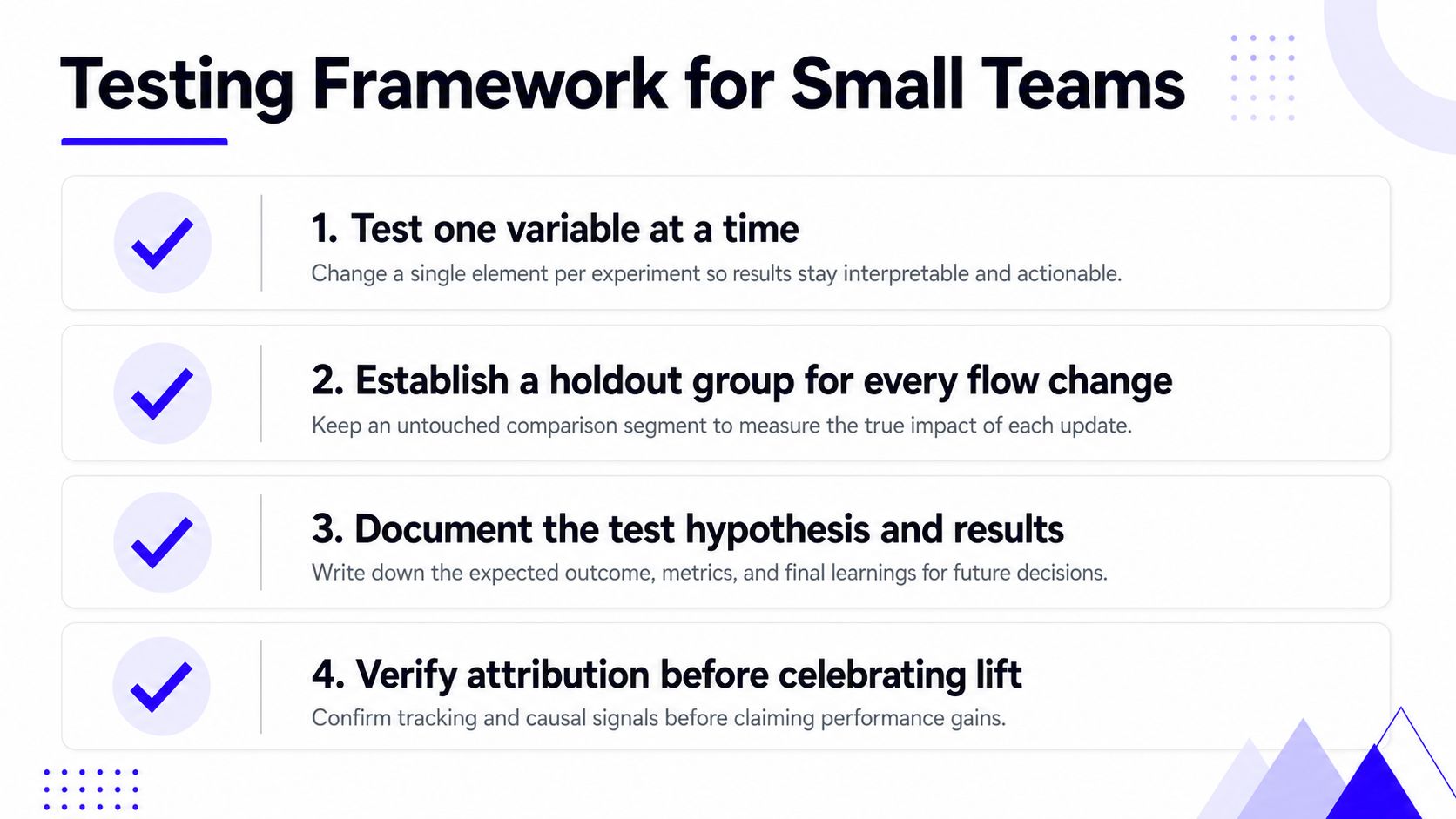
Small teams usually don't fail because they test too little. They fail because they test too much at once, then can't tell what moved the result. If you change send time, subject line, creative, and incentive in the same sprint, the dashboard turns into a confession booth.
Keep the test design narrow
One variable at a time is still the cleanest rule. If you're testing timing, don't also rewrite the creative. If you're testing incentive type, don't move the channel mix at the same time. The point is to learn something you can use, not to make the spreadsheet look busy.
Holdout groups matter because they show what recovery would have looked like without the change. That's the only reliable way to know whether a new flow improved revenue or just shifted attribution around. A holdout can feel conservative, but it saves you from celebrating noise.
Use a cadence a small team can actually sustain
A weekly rhythm is usually enough for a lean operator. Pick one question, run one change, document it, then decide whether to roll it forward. If your cart volume is low, extend the test window instead of forcing a fast conclusion, because weak samples make strong opinions look stupid.
The backlog should be written down, not hidden in someone's head. Track the hypothesis, the change, the outcome, and the follow-up decision. That's especially important for cart recovery, where a “win” on open rate can hide a loss in margin or a drop in opt-outs.
Verify attribution before you celebrate
Teams get sloppy. They see recovered orders, assume the new subject line deserves applause, and miss the fact that the ad platform or CRM sync reclassified the conversion later. If recovery revenue is going to inform decisions, the attribution path has to be checked before the victory lap.
A clean testing process also forces better discipline around channel overlap. If email and SMS both hit the same shopper on the same day, you need to know which touch did the work or whether the sequence itself was the driver. The answer matters because it changes how you spend time, not just how you write copy.
Reporting Recovery Revenue Against Ad Spend and CRM
Recovery revenue is only useful when it sits next to acquisition cost and CRM stage, not buried in a lifecycle dashboard no one checks. That means your reporting should show recovered orders by original source, channel, and contact stage, so you can tell whether paid traffic is producing valuable carts, whether lifecycle is rescuing profitable demand, and whether some channels are creating bad-fit buyers.

Build the dashboard around decision questions
The weekly view should answer three things. Which recovery channel brought people back, which original source produced the highest-value recoveries, and which cart segments are consistently leaking money. If the dashboard can't answer those, it's just decoration.
The monthly review should be about trends, not event-chasing. Look at whether one channel is carrying the sequence, whether a specific campaign source produces more recoverable intent, and whether CRM stages line up with recovery outcomes. That's the point where recovery stops being an email metric and starts becoming a source of budget insight.
Tie the system back to spend and pipeline
If recovered revenue lives beside ad spend, you can see whether paid acquisition is feeding a healthy lifecycle or just dumping traffic into a leaky cart. If it lives beside CRM stage, you can tell whether the buyer was a one-off shopper, a warm lead, or someone who needed sales follow-up before finishing the order. That's a very different operating picture than “we recovered some revenue this month.”
A good dashboard also helps you stop arguing about credit in the abstract. The source, channel, and CRM stage tell you where the order came from and why it came back. That makes decisions sharper, especially when you're deciding whether to scale a channel, keep an incentive, or tighten the checkout flow instead of pouring more into recovery.
Run the 30-day operator checklist
In the first week, diagnose the leak and verify event capture. In the second, clean up the tracking stack and standardize UTMs. In the third, launch the sequence with holdouts and a conservative incentive policy. In the fourth, review recovered revenue against ad spend, CRM stages, and margin, then decide what gets scaled and what gets cut.
That checklist is enough for a single operator to get from “we send reminders” to “we run a recovery system.” It's also the point where abandoned cart recovery stops being a side project and starts behaving like a measurable revenue channel.
If you want a recovery system that's wired into GA4, CRM sync, and ad-platform attribution instead of a brittle two-email flow, Du Marketing can build the tracking, lifecycle, and reporting layer around it. Visit Du Marketing if you want a practitioner-led setup that connects abandoned cart recovery to real revenue, not just inbox metrics.