Integrated Marketing Campaigns: A Startup's Guide to Success

Most advice about integrated marketing campaigns is backwards. It tells startups to add channels, hire specialists, build a content calendar, then hope the pieces somehow click into place. They usually don't.
What is often called “integrated” is just parallel activity. Paid search runs on one dashboard. Social lives in another. Email goes out when someone remembers. The landing page says one thing, the ads say another, and sales improvises the rest. That isn't integration. That's coordinated-looking chaos.
Startups feel this fast because they don't have spare budget for misalignment. They can't afford three vendors, two reporting systems, and a weekly meeting where nobody owns the whole journey. The companies that get this right usually don't win because they have a bigger team. They win because they built a tighter system.
Table of Contents
Why Your Integrated Campaign Is Probably Just Expensive Noise
The Single-Operator Advantage How to Execute Without an Army
Why Your Integrated Campaign Is Probably Just Expensive Noise
The most common failure isn't weak creative. It's structural.
A startup launches Google Ads, Meta campaigns, email sequences, social posts, and a couple of blog articles. Everyone feels productive. Nothing compounds. The reason is simple. The channels weren't designed as one system. They were purchased, assigned, and measured separately.
Harvard Business Review put it bluntly: “Disparate teams with differing points of view and separate budgets and KPIs make integration impossible” in its discussion of whether a campaign is integrated (Harvard Business Review on integrated campaigns). The same source notes that companies with unified budgeting structures achieve 2.3x higher ROI than those with siloed funding.
That's the part most startup advice skips. Integration is not mostly a messaging problem. It's a budget and operating model problem.
The budget fragmentation trap
When paid media has one goal, content has another, and sales has its own pipeline target, each function optimizes for local wins.
Paid media chases cheap clicks: It can hit dashboard goals while sending low-intent traffic.
Content chases publishing volume: It can produce articles that never support campaigns or sales calls.
Email focuses on nurture in isolation: It can keep sending polished sequences that don't match current offers.
Sales writes its own narrative: It can ignore the campaign message because nobody tied marketing inputs to CRM outcomes.
The customer sees the result immediately. Ad promise, landing page pitch, follow-up email, and demo call all feel like they came from different companies.
Practical rule: If budgets, KPIs, and reporting lines are split, the campaign isn't integrated no matter how polished the creative looks.
Activity is not orchestration
A lot of agency work looks impressive in a slide deck because it multiplies outputs. More channels. More assets. More specialist owners. For an early-stage company, that often creates more handoffs than strategic value.
What works is smaller and stricter:
Common setup | What happens |
|---|---|
Multiple channel owners | Messaging drifts fast |
Separate reporting by platform | Nobody sees the full journey |
Different conversion definitions | Teams argue over “what worked” |
Shared strategy, separate execution | Launches slip and fixes come late |
An integrated campaign should feel like one motion. One offer. One narrative. One measurement model. Different channels still play different roles, but they should all push the same buyer toward the same next step.
If that sounds less glamorous than “full-funnel omnichannel acceleration,” good. Glamour doesn't fix broken handoffs.
The Orchestra Analogy What Is an Integrated Campaign
The cleanest way to explain integrated marketing campaigns is with an orchestra.
A room full of talented musicians warming up isn't music. It's noise. Each player may be excellent. The problem is that they're not following the same score at the same tempo for the same audience experience.
Marketing works the same way. Search, social, PR, email, landing pages, and sales enablement can all be strong on their own. Without a shared strategy, they compete for attention instead of reinforcing each other.

Research highlighted by the University of Western Australia, citing Gartner, found that integrated marketing campaigns executed across four or more channels outperform single- or dual-channel campaigns by 300% (Gartner finding via UWA). That gap exists because the channels aren't just adding reach. They're reinforcing memory, trust, and action.
The conductor matters more than the channel list
In practical terms, the conductor is the campaign strategy. The sheet music is the message architecture. The sections of the orchestra are the channels.
A healthy campaign usually has:
One core promise: A buyer should hear the same value proposition whether they arrive through Google Ads, LinkedIn, or email.
One defined conversion path: Channels can introduce, persuade, or close, but they should point toward a shared next step.
One asset system: Headlines, proof points, creative themes, and CTAs should adapt by channel without changing identity.
One operating cadence: Launches, optimizations, and reporting should happen on the same rhythm.
Conversely, campaigns are often built backward. Marketers start with channel tactics, then try to align them later. That's like asking the percussion section to improvise after the strings have already started the piece.
What real harmony looks like
A campaign becomes integrated when each channel has a job, not just a budget.
Channel | Best role in the system |
|---|---|
Paid search | Capture active demand |
Paid social | Create demand and retarget attention |
SEO content | Build credibility and long-term discovery |
Email and CRM | Nurture, segment, and recover missed conversions |
Landing pages | Convert campaign intent with minimal friction |
PR or earned media | Add trust and third-party validation |
A good integrated campaign doesn't make every channel say the exact same thing. It makes every channel support the same decision.
That distinction matters. Search ads can be direct. Organic social can be conversational. Email can be personal. A landing page can be conversion-first. The wording shifts. The story doesn't.
When startups understand this, channel planning gets easier. They stop asking, “Should we add another platform?” and start asking, “What role is missing from the buying journey?”
That's a much better question.
Building Your Marketing Machine The Core Components
A working campaign isn't a stack of tactics. It's a machine. Each part should feed the next one.
Most startups already have some of the pieces. The problem is that they're bolted together badly. SEO lives in a document. Paid media lives in ad platforms. Email lives in HubSpot or Klaviyo. The landing page gets built last. Tracking gets patched after launch. Then people wonder why results are uneven.
The machine works when each component produces input for another component, not just output for its own channel.
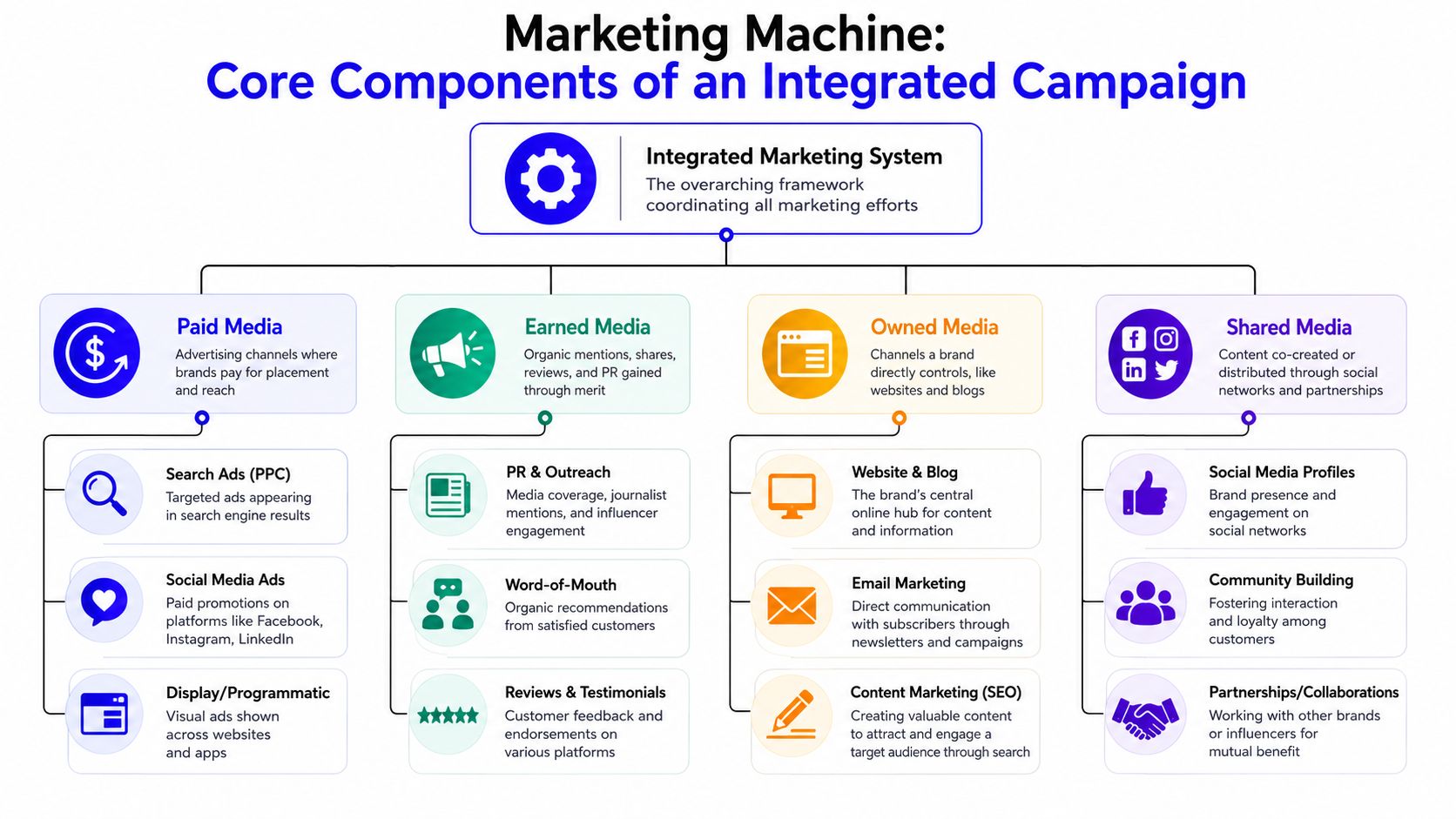
A study cited in the provided research set found that maintaining consistent messaging across channels leads to a 68% increase in audience engagement (consistent messaging and engagement). That only happens when the components share the same logic.
The gears that actually move together
Here's the basic machine I'd want in place for most startup campaigns.
Paid media: Google Ads captures active intent. Meta and LinkedIn can create demand, retarget visitors, and pressure-test positioning. Paid media shouldn't invent the message. It should amplify what the rest of the system can support.
SEO and content: Search terms tell you how buyers describe the problem. That language should shape ad copy, landing page headlines, and email hooks. Good content doesn't sit off to the side as a “brand play.” It pre-frames the offer and lowers friction before paid traffic arrives.
Email and CRM: This is where most startups leak opportunity. Traffic that doesn't convert immediately needs follow-up. Leads that do convert need segmentation, sales routing, and nurture logic. Email is not a newsletter checkbox. It's the bridge between first touch and revenue.
Landing pages: They need to match intent. Not “kind of.” Exactly. A keyword-driven campaign needs a page built for that query. A retargeting campaign needs a page that assumes prior awareness. One generic website page usually underperforms because it tries to serve everyone at once.
Tracking and attribution: Google Tag Manager, GA4, standardized UTMs, CRM fields, offline conversion flows, and server-side event handling all exist for one reason. They help you connect traffic, behavior, and outcomes without guessing.
What breaks the machine
The machine usually fails in one of these ways:
Message disconnect. SEO talks education, ads talk urgency, sales talks enterprise transformation.
Asset mismatch. The ad promises a checklist, the page pushes a demo, the email asks for a webinar signup.
No feedback loop. Search term reports never shape content. CRM objections never shape ad copy.
Tracking gaps. The form submits, but the CRM record doesn't carry campaign context forward.
A stronger way to think about components is as a chain of evidence.
Component | What it should pass forward |
|---|---|
SEO research | Buyer language and intent themes |
Paid campaigns | Qualified traffic and tested messaging |
Landing pages | Conversion data and behavior signals |
Email and CRM | Lead quality, objections, and stage movement |
Tracking stack | Shared identifiers and source context |
Operator's view: If one component can't pass clean context to the next, the campaign will feel integrated only at the surface level.
That's why startups don't need a giant department to run integrated marketing campaigns. They need a connected machine with clear ownership and fewer translation errors.
From Idea to Launch A Step-by-Step Planning Framework
Planning falls apart when teams jump from “we need pipeline” to “let's launch ads.” The work in the middle decides whether the campaign has a spine or just a deadline.
This framework is simple enough for a startup team and strict enough to stop channel chaos.
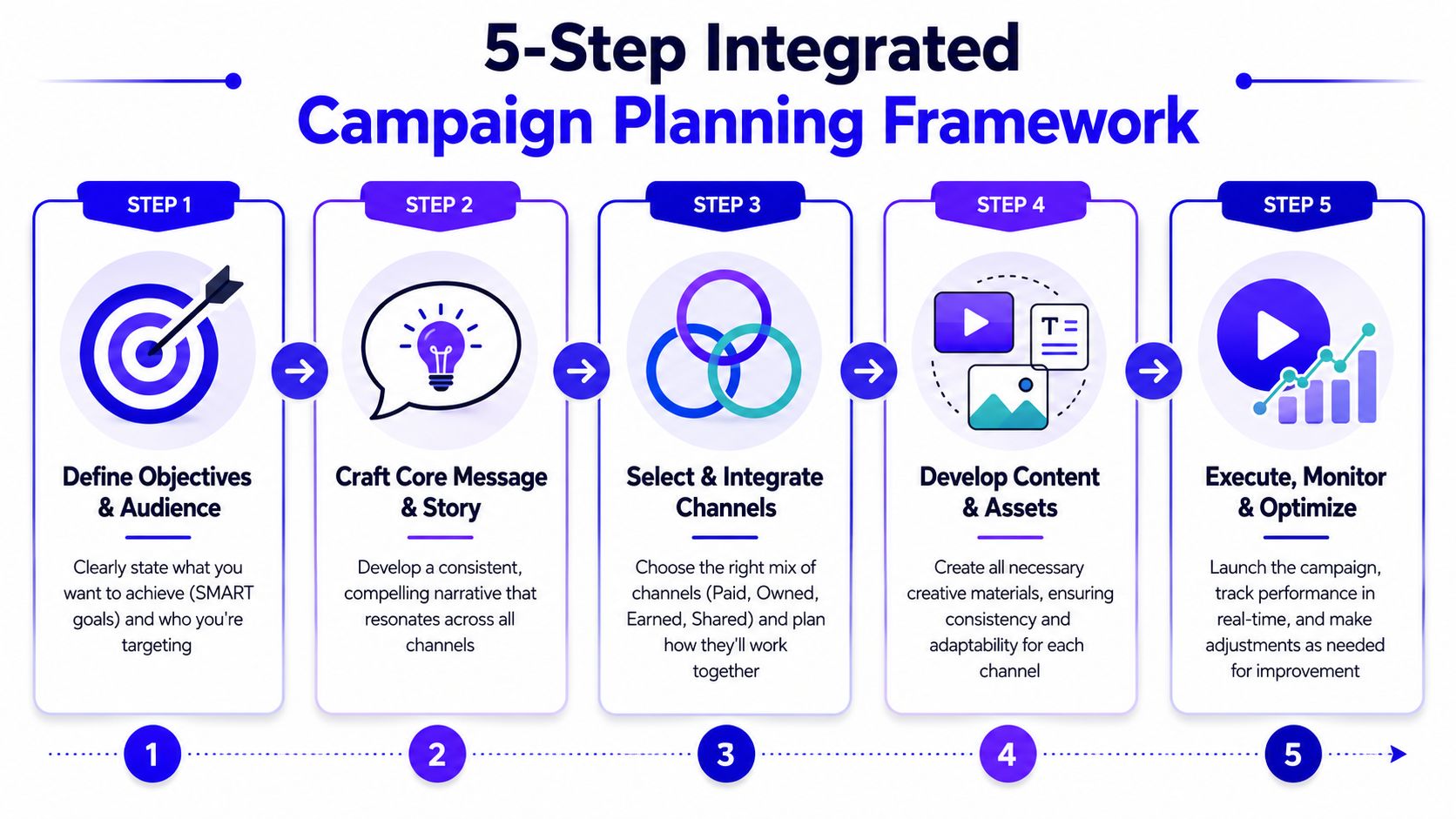
Step 1 to 3 set the campaign spine
1. Define the objective and audience
Start with one business outcome. Pipeline creation, demo bookings, trial starts, repeat purchases, or reactivation. Pick one primary objective.
Then get specific about audience. Not “B2B SaaS founders.” Think narrower. Existing category-aware buyers. Problem-aware teams using a competing tool. Cart abandoners with high-intent product views. The tighter the audience definition, the easier the channel decisions become.
2. Write the core message and offer
You need one message the whole system can repeat without sounding robotic.
Write:
the pain point
the promised outcome
the proof
the CTA
If the offer can't fit on a single page of notes, the campaign is probably too fuzzy.
3. Map channels to roles, not habits
Don't include a channel because your team “always does LinkedIn” or “should post more on Instagram.” Assign roles.
Search ads: Capture buyers already looking
Paid social: Introduce the angle, then retarget
Email: Follow up by segment and behavior
Content: Support objections and search intent
Landing page: Convert the exact promise made upstream
If you're also planning distribution around content, this guide to a content distribution strategy for startups is a useful companion because it forces channel purpose instead of random posting.
A short visual explainer can help align stakeholders before launch:
Step 4 and 5 make it measurable
4. Set up tracking before creative goes live
Disciplined teams pull ahead. Before launch, confirm:
UTM naming rules
event tracking in Google Tag Manager and GA4
CRM field mapping
form capture rules
conversion definitions
dashboard views by channel and campaign
If tracking starts after launch, reporting becomes archaeology.
5. Build an optimization cadence
Integrated campaigns need a rhythm. Daily checks for spend, delivery, and obvious breakage. Weekly optimization for creative, audience, search terms, nurture timing, and page friction. Monthly review for strategic decisions.
The important part is that all channels get reviewed together. Otherwise every channel owner declares victory with a different metric.
Here's a practical planning sheet you can copy into Notion, Google Sheets, or Airtable.
Integrated Campaign Planning Checklist
Phase | Task | Status |
|---|---|---|
Goal | Define one primary business objective | ☐ |
Audience | Document target segment and buying stage | ☐ |
Message | Finalize pain point, promise, proof, and CTA | ☐ |
Offer | Confirm campaign asset or conversion action | ☐ |
Channel mapping | Assign a role to each selected channel | ☐ |
Creative | Approve headlines, visuals, and copy variants | ☐ |
Landing page | Match page message to campaign intent | ☐ |
Tracking | Apply UTM conventions and event setup | ☐ |
CRM | Confirm source fields and lifecycle routing | ☐ |
Reporting | Build dashboard views for campaign monitoring | ☐ |
Launch | Publish assets and verify live tracking | ☐ |
Optimization | Schedule weekly cross-channel review | ☐ |
A launch plan should feel boring on paper. That's usually a good sign. Boring planning produces cleaner execution.
Making the Channels Dance Real-World Orchestration Examples
Abstract strategy sounds smart until you have to launch something on Tuesday. Here's what orchestration looks like when the channels interact.
Research from Improvado's integrated marketing communications piece notes that PR-earned media increases paid advertising click-through rates by 22% and lifts campaign ROI by up to 30%, while campaigns using identical CTAs, visual assets, and value propositions across email, social, and paid search achieve 28% higher conversion rates than fragmented setups (PR and conversion effects in integrated campaigns).
That's useful because it describes a real operating principle. Channels perform better when they validate each other.
B2B SaaS lead generation
A B2B SaaS company wants booked demos from operations leaders.
The clean version looks like this:
LinkedIn ads introduce a sharp problem statement tied to wasted manual work.
Search ads capture bottom-of-funnel queries from buyers already comparing solutions.
The landing page doesn't explain the whole category. It mirrors the ad language and offers one next step.
HubSpot handles immediate follow-up based on form type, company size, and viewed pages.
Sales sees campaign source, ad angle, and content touches inside the CRM before outreach starts.
Now add orchestration. The company lands a podcast mention, niche newsletter inclusion, or trade publication feature. That earned visibility softens resistance when the buyer later sees a paid ad. The ad no longer arrives cold.
For search-heavy teams, this matters a lot. Messaging consistency between paid search, landing pages, and follow-up sequences does more work than adding another ad group. If you run B2B acquisition, this breakdown of a B2B paid search strategy fits well with that approach.
When sales opens a record and can see the original campaign angle, follow-up gets smarter fast.
B2C e-commerce promotion
Now switch to a B2C store running a seasonal push.
A shopper sees a Meta ad built around a specific product benefit. They click to a focused landing page or collection page. They browse, add to cart, then leave.
The integrated version doesn't panic and blast discounts everywhere. It keeps the sequence coherent:
Touchpoint | Job |
|---|---|
Meta ad | Introduce the offer and creative theme |
Product page | Reinforce proof, visuals, and purchase confidence |
Abandoned cart email | Recover intent with the same product story |
Retargeting ad | Remind, not restart the message |
Post-purchase email | Extend value and trigger repeat behavior |
What doesn't work is when the retargeting ad suddenly pushes a different angle, the email swaps to another product family, and the site banner promotes an unrelated clearance sale. That breaks the rhythm.
Orchestration is basically timing plus consistency. The buyer should feel nudged forward, not reset at every touchpoint.
Proving It Works Modern Measurement and Attribution
Many can launch campaigns. Far fewer can prove what happened after the click.
That's why integrated marketing campaigns often get underfunded or misjudged. The reporting is usually stuck at channel metrics. Search reports conversions. Paid social reports view-through activity. Email reports clicks. CRM reports closed deals. Nobody can connect the path cleanly.
A 2025 industry report cited by Mural found that 68% of marketers struggle to quantify cross-channel ROI, and only 12% use unified attribution models that connect ad interactions to closed revenue (Mural on measuring integrated campaign ROI). That's the measurement gap in one line.
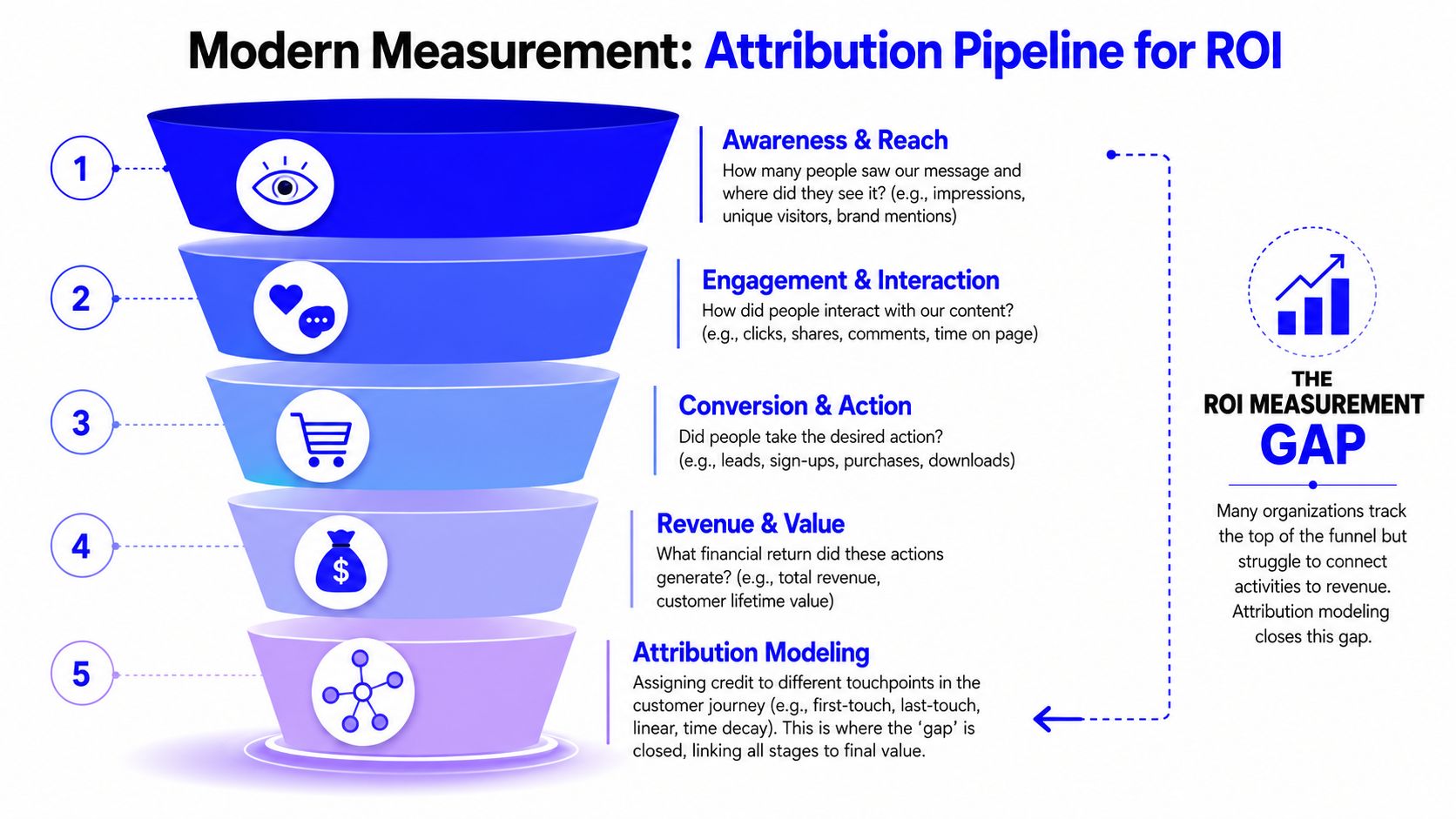
What the attribution stack needs to do
You don't need exotic tooling to start. You need a stack that carries source data from first touch through revenue events.
The core pieces are straightforward:
UTM conventions: Every campaign needs a consistent naming structure. If one team uses
paid-socialand another usespaidsocial, reporting gets dirty fast.Google Tag Manager: Event logic remains organized here instead of being scattered across platform scripts.
GA4: Useful for cross-channel behavior, pathing, and conversion event visibility.
Server-side tracking: This reduces some of the loss and mismatch that happens when browser-based tracking is incomplete.
CRM sync: This is the crucial piece. If campaign context never reaches HubSpot, Pipedrive, or Salesforce, you can't connect marketing to opportunities or revenue with confidence.
Offline conversion handling: Important when the actual business outcome happens after a form fill, call, sales meeting, or pipeline stage movement.
Here's the simple test. Can you answer these questions without stitching screenshots together in a board deck?
Which campaign created the lead?
Which message angle drove the highest-quality leads?
Which channel combination shows up most often before revenue?
Which spend should be cut, protected, or expanded?
If the answer is “sort of,” the stack isn't finished.
The reporting view founders actually need
Founders usually don't need another platform dashboard. They need a decision view.
That means reporting should combine:
Layer | What to inspect |
|---|---|
Traffic quality | Source, landing page behavior, engaged sessions |
Lead quality | Form intent, qualification rate, sales acceptance |
Pipeline movement | Stage progression by campaign and source |
Revenue connection | Closed revenue tied back to campaign metadata |
A lot of marketers stop at platform ROAS and call it attribution. That's incomplete. This is exactly why analyses built only on ad-platform reporting can mislead budget decisions. If you want a hard-nosed explanation of that problem, this piece on why your ROAS is a lie is worth reading.
The goal of attribution isn't perfect certainty. It's decision-grade visibility that survives scrutiny from finance, founders, and sales.
The startups that handle this well don't obsess over one magic model. They standardize naming, preserve source data, sync it into the CRM, and review results at the journey level. That's what lets integrated campaigns earn trust inside the business.
The Single-Operator Advantage How to Execute Without an Army
The usual assumption is that integrated marketing campaigns require a bigger team. In startups, the opposite is often true.
More people can mean more specialized skill, but it also means more handoffs, more interpretation, and more reporting drift. One freelancer runs Google Ads. Another writes content. A part-time designer handles landing pages. Someone inside the company sends emails. Nobody owns the entire path from click to CRM to revenue. That's how campaigns get slower as they get more complex.
A single-operator model solves a lot of this by design.
Why smaller can be tighter
When one practitioner runs the system end to end, a few things happen:
Strategy stays intact: The person writing the brief is also building the campaigns, reviewing search terms, shaping landing pages, and checking CRM outcomes.
Feedback loops shorten: Keyword insights can inform content fast. Sales objections can become new ad copy fast. Tracking issues get fixed before they become reporting myths.
Ownership is obvious: There's no room for “that was the other team's responsibility.”
Attribution gets cleaner: One operator is more likely to enforce naming rules, source capture, and reporting consistency across the stack.
This doesn't mean one person should do everything forever. It means startups should treat integration as an operating system first, headcount question second.
What actually scales
What scales isn't channel sprawl. What scales is a repeatable system:
one message architecture
one conversion path
one measurement model
one owner of execution quality
That's why some lean teams outperform larger vendor stacks. They don't spend half the week translating between specialists. They spend it improving the campaign.
If your current setup feels busy but blurry, the problem probably isn't effort. It's design.
If you want that kind of end-to-end setup without stitching together an agency, a freelancer, a tracking contractor, and a CRM consultant, Du Marketing is built for it. It runs paid media, SEO, content, email/CRM, landing pages, and attribution as one connected system, with direct practitioner execution and transparent reporting for startups that need clean growth, not more coordination overhead.