10 Best Marketing Audit Template Downloads for 2026

Stop Guessing, Start Growing: Your Marketing Is Overdue for an Audit
Feeling like you're pouring money into a marketing machine with a dozen blinking red lights? You're not alone. Chaotic data, fuzzy attribution, and "best guess" strategy are normal in startups, especially when one person is juggling paid ads, CRM, SEO, reporting, and whatever broke in GA4 this week.
A proper marketing audit is the reset button. It checks the whole system, from campaigns and landing pages to analytics and handoffs, so you can see what's driving pipeline, what's draining budget, and which problems are just reporting illusions. HubSpot notes that audits can reveal where 40% to 60% of budget, headcount, and time are creating measurable returns versus where they're wasted, and that even small paid media fixes can shift ROAS by 20% or more when landing page alignment or targeting is off (HubSpot's marketing audit guide).
The problem is that most templates either drown you in questions or leave you with a nice-looking document and no next move. This guide cuts past that. You'll get the best marketing audit template downloads, one startup-focused option that goes deeper than a template, practical trade-offs, examples of what each one is good at, and what to do after the audit so it doesn't die in a folder called "Q1 Strategy."
Table of Contents
3. Smart Insights RACE Digital Marketing Audit Checklist/Benchmarking
4. Smartsheet Digital Marketing Audit Report Checklist Template
1. Du Marketing B2B/SaaS Growth & Attribution Audit

A familiar startup scenario: paid search says one thing, GA4 says another, the CRM says something else, and nobody can explain why pipeline dropped after budget went up. That is the kind of mess this audit is built to fix.
Du Marketing focuses on B2B and SaaS growth systems where attribution, channel performance, and CRM operations are tangled together. Instead of handing over a downloadable worksheet, it runs a 13-step review across the full path from first click to closed revenue. That includes paid media, SEO, email, CRM, landing pages, GTM, GA4, server-side tagging, Meta CAPI, ad platform APIs, offline conversions, and CRM sync.
Why it stands out
What makes this option different is the operating model. The audit is tied to implementation, so findings can turn into tracking fixes, campaign cleanup, dashboard changes, and reporting rules without a long handoff between strategy and execution.
That matters for startup teams with limited bandwidth.
Generic audit templates are useful for coverage, but they often break down when the actual issue sits between functions. I see this a lot in SaaS. Paid campaigns generate leads, sales works them in the CRM, and marketing reports on platform conversions that never match revenue. A channel-by-channel checklist will catch symptoms. It usually will not resolve the underlying setup problem.
Practical rule: If the audit surfaces issues across attribution, CRM hygiene, and campaign structure at the same time, assign one owner to fix the system end to end.
Best fit and real trade-offs
This is a strong fit for founders, lean B2B teams, and growth leads who need to connect spend to pipeline and revenue. It is especially useful when Direct traffic is inflated, lead-source fields are unreliable, or ad platforms report conversions that sales cannot verify downstream.
There is a trade-off. This is a service, not a free template you can duplicate in five minutes. Teams that want a downloadable sheet for internal benchmarking may prefer one of the workbook-style options later in this playbook.
Large brands with multiple regions, heavy creative needs, or separate analytics and ops teams may also want broader specialist coverage. But for startups, the appeal is clear. You get an audit that does more than list findings. You get a path to fix the setup, customize the process to your stack, and turn the audit into an operating cadence instead of another unused document.
2. HubSpot A Workbook to Audit Your Client's Strategy
HubSpot's audit workbook is the one I'd hand to a team that needs a structured discovery process, especially if multiple stakeholders are involved. It feels less like a spreadsheet and more like a guided interview system for strategy, channels, messaging, analytics, and operations.
That makes it strong for agency-client audits, quarterly reviews, and messy internal situations where sales, marketing, and leadership all have different versions of reality. The workbook format is also good when you're auditing more than performance. It pulls in positioning, goals, and process.
Where it works best
HubSpot's broader audit thinking is practical. Their guidance stresses competitor benchmarking across areas like keyword rankings, messaging, and paid offers, so you're not judging your channels in a vacuum. That's useful because an internal dashboard can say "fine" while the market says "weak."
What I like most is the breadth. What I like least is also the breadth. You can end up with a lot of qualitative answers and not enough ruthless prioritization unless someone owns the final call.
Best for stakeholder interviews: Good when you need input from founders, sales, RevOps, and channel owners.
Best for quarterly discovery: Strong fit for recurring strategy reviews, not just one-time cleanups.
Weakest point: It isn't an automated scoring model, and the download is gated.
If your team works in HubSpot already, the examples feel familiar. If you need a hard-edged action sheet with owners and due dates, you'll probably want to pair this with an execution tracker.
3. Smart Insights RACE Digital Marketing Audit Checklist/Benchmarking
A common audit failure looks like this. Paid search gets reviewed in one tab, SEO in another, lifecycle email somewhere else, and nobody connects those findings to the customer journey. Smart Insights RACE audit resources help fix that by forcing the review into four stages: Reach, Act, Convert, and Engage.
That structure makes this template useful for teams that already have channel data but need a better decision model. Instead of treating every issue equally, you can sort findings by where they break the funnel. A weak landing page offer in Convert usually matters more than a minor visibility issue in Reach. In practice, that helps small teams protect time and budget.
Why RACE works in real audits
RACE is one of the better options in this list if you want both diagnosis and benchmarking. The framework gives you a way to compare performance by funnel stage, spot imbalances, and explain the problem clearly to leadership. That matters when your audit needs to do more than list issues. It needs to justify what gets fixed first.
I also like it for customization. A startup can trim the model down to a few core checks per stage, like branded search coverage in Reach, demo or signup friction in Convert, and activation email performance in Engage. A larger team can add deeper scoring criteria, ownership, and benchmarks by market or channel.
Here is the trade-off. Smart Insights is stronger as a planning system than as an instant operator worksheet. Some of the best material sits behind membership, and the format can feel more like guided methodology than a ready-to-run spreadsheet. If you want a download that your team can fill out in one meeting, this may need extra setup first.
That said, the output is often better once you do that setup. RACE pushes teams to produce findings such as "traffic is healthy, but Act-stage engagement is weak on core product pages" or "email retention is carrying revenue because first-visit conversion is underperforming." Those are useful audit conclusions because they point to action after the audit, not just observation during it.
Use this one when fragmented thinking is the problem. If your audit needs a shared framework across acquisition, conversion, and retention, RACE gives you one of the clearest structures in the group.
4. Smartsheet Digital Marketing Audit Report Checklist Template
Smartsheet's digital marketing report templates are for operators who don't want a beautiful audit. They want a working document with status, owner, due date, and notes. That sounds unglamorous because it is. It also works.
This is one of the easiest templates to operationalize. Download it in Excel, PDF, Google Sheets, or Docs, then start logging issues immediately. If your biggest failure mode is "good findings, no follow-through," Smartsheet is much better than a strategy deck.
Best use case
Use Smartsheet when the audit result needs to become a task system fast. I like it for post-audit execution sprints, especially when the issues are concrete: tracking broken, forms misfiring, low-performing pages, outdated ads, bad redirects, inconsistent UTMs.
It doesn't teach much. That's the trade-off. Smartbug argues that a strong audit needs a single source of truth protocol so teams aren't making decisions from silos and black-box reporting (Smartbug Media's marketing audit article). Smartsheet won't create that governance for you, but it gives you a place to enforce it operationally if you know what you're doing.
Big win: Owners and deadlines live next to findings.
Big limitation: It needs tailoring for PPC, SEO, CRM, and attribution checks.
Best team fit: Startups and small teams who already work from task trackers, not long-form docs.
If your team is allergic to execution detail, this template will feel blunt. That's probably a good sign.
5. ClickMinded Digital Marketing Audit Template

A common audit scenario looks like this. The team has traffic coming from six places, budget spread across too many campaigns, and a report full of metrics nobody trusts enough to use. ClickMinded works well when the job is to sort that mess into a short list of actions with a clear order.
The template is practical because it forces prioritization. Instead of treating every channel as equally important, it steers the audit toward the few areas that drive revenue or absorb budget. That makes it a strong fit for startups, small in-house teams, and consultants who need to show what to fix first, not produce a long diagnostic document.
Where this template earns its place
ClickMinded is useful for channel-level reviews that need to turn into a working plan fast. It covers the usual audit ground, then pushes you to group findings into near-term actions, medium-term fixes, and later bets. I like that structure because it matches how real teams operate. Some issues need a same-week fix. Others need design, dev, or CRM support and should not block the obvious wins.
It also keeps the scope under control. If paid search, SEO, and email produce nearly all qualified pipeline, the audit should spend its time there. Side channels can wait.
A few findings this template handles especially well:
Paid search friction: Search intent, ad copy, and landing page message are out of sync. Fix the path before adjusting bids. If that is part of your audit, this guide on how to optimize search ads is a useful follow-up.
Conversion leaks: Traffic volume looks fine, but forms, CTA placement, offer clarity, or page speed are dragging down conversion rate.
Reporting clutter: The team tracks too many numbers and still cannot answer which channels create pipeline. A tighter scorecard built around marketing metrics that actually matter in 2026) usually fixes that faster than another dashboard tab.
Budget drift: Spend keeps spreading across low-impact experiments instead of backing proven acquisition paths.
The trade-off is depth. This template is good for prioritization and action planning, but it is not the one I would use for a serious attribution audit. If the question is whether server-side tracking is broken, offline conversions are missing, or CRM lifecycle stages are corrupting paid media reporting, you will need a second layer of analysis.
Used the right way, this template does what many teams need. It turns an audit into a focused plan, gives startups a manageable way to customize the process, and makes it easier to move from findings to execution without pretending every issue deserves equal attention.
6. Demand Metric Marketing Measurement Assessment Excel
Demand Metric's marketing measurement assessment is the template I'd pull out when reporting has started to drift from reality. Teams ask for an audit after pipeline slows, CAC rises, or leadership loses confidence in the dashboard. In a lot of those cases, channel execution is only part of the problem. The bigger issue is that nobody trusts the numbers enough to make a clear call.
That is where this Excel format earns its place in the toolkit. It is built to review KPI definitions, reporting consistency, dashboard logic, and how well teams measure performance across channels. If your audit needs to answer, "Are we measuring the business correctly before we change the plan?" this template is a practical starting point.
Best used as a measurement check
I would not use this one to diagnose ad creative, landing page UX, or content gaps. I would use it to catch the issues that make every later decision weaker.
A few examples:
Sales and marketing use different lead definitions, so conversion rates look fine in one report and broken in another.
Paid search is being judged on form fills while leadership wants pipeline contribution.
Email, web, and CRM reports use different date ranges or attribution rules, so channel comparisons are misleading.
The team tracks too many KPIs and still cannot explain which numbers matter.
That last problem is common. If the audit reveals bloated scorecards and weak KPI discipline, this guide to marketing metrics that matter in 2026) is a smart follow-up.
Audit lens: If leadership asks for ROI while marketing and sales disagree on what counts as a lead, fix measurement before you touch channel strategy.
There is a trade-off. This template is strong for structure and accountability, but it will not replace a proper attribution or tracking audit. If offline conversions are missing, lifecycle stages are misconfigured, or CRM sync issues are distorting paid media results, you will need a deeper layer of analysis.
Used well, though, it does an important job. It helps teams separate performance problems from reporting problems, customize the audit around measurement maturity, and leave with a cleaner plan for what to fix first.
7. Hootsuite Social Media Audit Template
Hootsuite's template library is the fastest route to a social audit that doesn't become a side quest. If your profiles are inconsistent, bios are outdated, campaign naming is messy, and nobody knows which account is still active, Hootsuite is useful immediately.
This is not a full-funnel audit. That's the point. It does one job well: it helps you inventory profiles, review social performance, check brand consistency, and document actions.
Good for fast cleanup
I like Hootsuite when social needs housekeeping before strategy. Start with basics. Are all profiles owned? Are they branded correctly? Do links work? Are there duplicate accounts, dead formats, or old campaign assets pinned where prospects can still find them?
Use it as a component inside a broader audit, not as the whole audit. For many teams, social is important but not the highest-spend channel. A focused social sheet is useful because it keeps this work contained.
Best use: Profile inventory, consistency review, content performance check.
Not for: Paid search, lifecycle email, CRM, or attribution diagnosis.
Watch out for: Old copies floating around online. Pull the current version from Hootsuite's site.
If social is chaotic, this template brings order quickly. If your pipeline problem sits in paid and CRM, keep moving.
8. Sprout Social Social Media Audit Template
Sprout Social's social media audit template is the cleaner, more presentation-ready alternative to a rough internal social spreadsheet. It's useful when you need the same social inventory and KPI review as Hootsuite, but you also need something leadership can read without flinching.
The format feels modern and strategy-oriented. That makes it a good fit for in-house teams reporting upward or agencies packaging social findings for clients.
Why choose it over another social sheet
Choose Sprout Social when the audit output needs to support a decision, not just a cleanup. It handles profiles, KPIs, competitor observations, and content gaps in a way that naturally rolls into a strategy update.
What it doesn't do is solve the bigger marketing system. It won't help with paid search leakage, conversion tracking, CRM routing, or lead quality. That's fine. Social-specific tools should stay in their lane.
A narrow template isn't a weak template. It's weak only when a team expects it to answer a broader growth problem.
If your social presence needs a current, polished audit doc, this is a good option. If you're trying to explain why revenue reporting doesn't match platform data, skip it.
9. Notion Digital Marketing Audit Template Marketplace
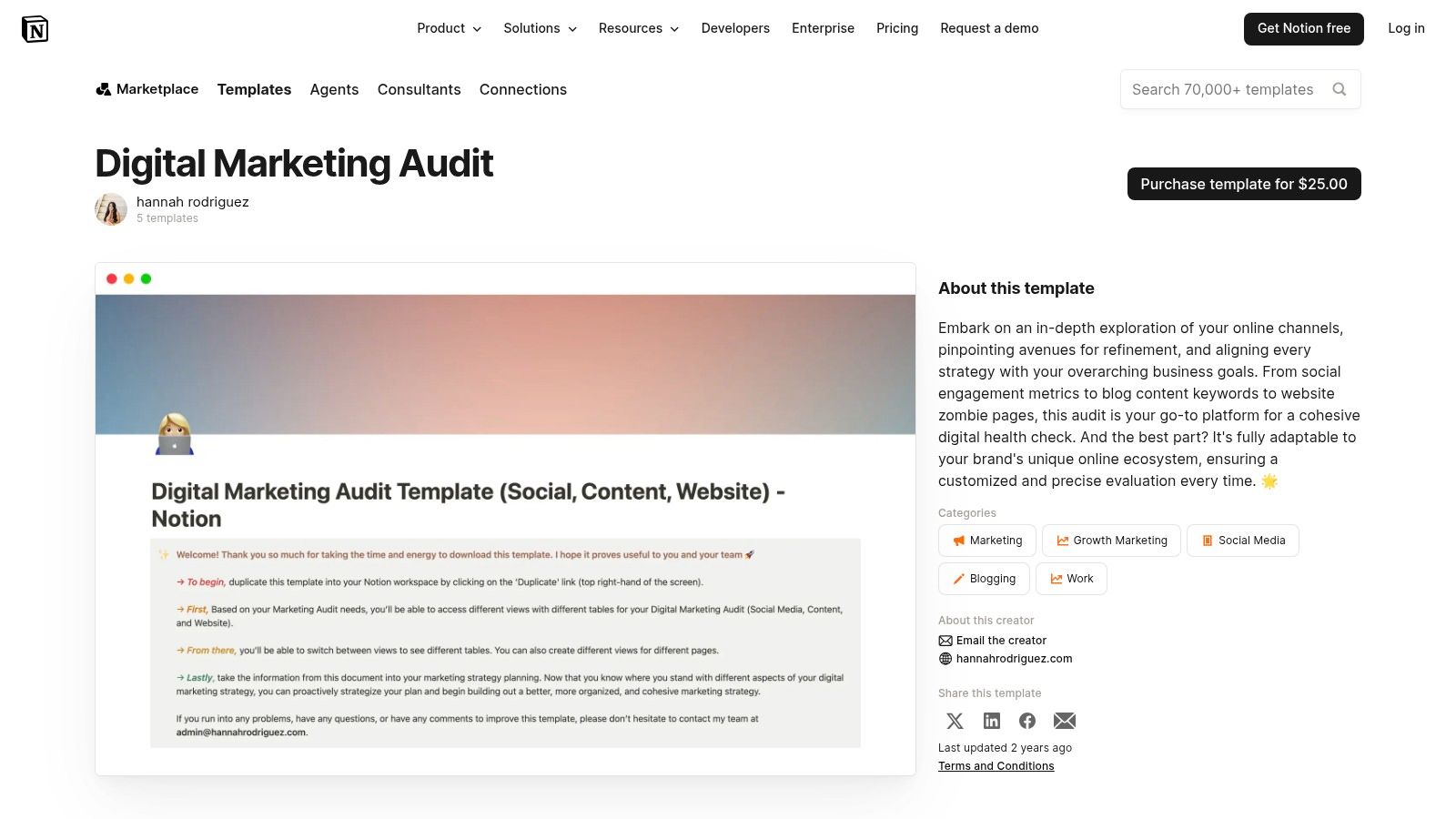
Notion's digital marketing audit templates are for teams that already live in Notion and want the audit to sit where work happens. That's a real advantage. Audits fail when the document lives in one place, screenshots in another, action items in a third, and dashboards somewhere nobody opens.
Notion shines when you want one workspace for findings, evidence, comments, owners, and linked dashboards. For startup teams, that convenience matters more than feature depth.
Why startup teams like it
This is the easiest format to adapt. You can create databases for channels, findings, severity, owner, status, evidence links, and follow-up tasks. You can also duplicate the setup every quarter and keep a running history of what's improving and what's still broken.
The catch is quality control. Marketplace templates vary a lot. Some are smart and usable. Others look pretty and collapse the moment you need weighted scoring, dependencies, or a clean executive summary.
A few practical ways to make a Notion audit template better:
Add decision fields: Include owner, deadline, impact, effort, and dependency.
Embed evidence: Drop in GA4 explorations, ad screenshots, and CRM reports directly beside the finding.
Build views: One for executives, one for channel owners, one for overdue fixes.
If your team already thinks in Notion, this can become your ongoing audit system, not just a one-off file.
10. Ready North Comprehensive Marketing Audit Template

Ready North's marketing audit template download is a strong choice when the actual problem sits outside the channel report.
That happens a lot. Paid search can look healthy while lead quality drops because sales and marketing are working from different definitions. Content can publish on schedule while pipeline stalls because nobody owns distribution, reporting, or follow-up. A template that checks team structure, systems, process, and strategic alignment helps catch those failures earlier.
What it catches that channel templates miss
I'd use this before a founder review, board prep, or a reset with department leads. It surfaces whether weak results come from execution, org design, tool sprawl, or unclear priorities.
That wider view is useful for startup teams in particular. Early-stage companies often patch together tools and reporting as they grow, then struggle to explain which channels produce revenue and which ones only produce activity. Ready North helps frame those questions at the operating level, where a lot of marketing waste starts.
It is not a tracking or attribution audit on its own. Use it as the leadership and operations layer, then pair it with a more technical review if reporting quality is in doubt.
That makes it a good fit after messy growth spurts, team changes, or a handoff from agency to in-house. If the audit shows that strategy is sound but execution is thin, a practical next step is tightening the content engine. This guide to content marketing for startups is a useful follow-on for that work.
Top 10 Marketing Audit Templates Comparison
Use the table below to pick the right audit template for the job. Some are built for channel reviews. Some are better for reporting, team process, or client delivery. The fastest way to waste time is choosing a generic template for a specific problem, then realizing halfway through that it does not cover the systems, evidence, or follow-up your team needs.
This list works best as a selection tool, not just a resource roundup. If you are auditing startup growth, you usually need more than a checklist. You need a template you can adapt, examples of the kinds of findings it surfaces, and a clear path from diagnosis to implementation.
Service / Template | Core features | Quality ★ | Value 💰 | Audience 👥 | Best use case ✨ |
|---|---|---|---|---|---|
Du Marketing B2B/SaaS Growth & Attribution Audit 🏆 | 13-step end-to-end audit + paid/SEO/CRM + GTM/GA4/Server-Side/CAPI + implementation | ★★★★★ | 💰 Flat monthly fee, ad spend/tools billed direct | 👥 Startups (B2B/SaaS), founders wanting operator access | ✨ Best for startup teams that need one audit across acquisition, attribution, CRM, and execution |
HubSpot – A Workbook to Audit Your Client's Strategy | 100+ questions, 6 templates, 30/60/90 planning | ★★★★ | 💰 Free download (email gated) | 👥 Agencies, client-facing teams, B2B | ✨ Best for agency-led audits with stakeholder interviews and structured handoff plans |
Smart Insights – RACE Digital Marketing Audit Checklist/Benchmarking | RACE funnel prompts, benchmarking, spreadsheet scoring guidance | ★★★★ | 💰 Some free content, detailed templates often require membership | 👥 Practitioners focused on funnel and benchmarking | ✨ Best for funnel-stage reviews where benchmarking matters more than technical implementation |
Smartsheet – Digital Marketing Audit Report Checklist Template | Checklist + report formats, PDF/Excel/Sheets/Docs downloads | ★★★ | 💰 Free template downloads | 👥 Ops teams, project managers, implementers | ✨ Best for teams that need owners, due dates, and task tracking after the audit |
ClickMinded – Digital Marketing Audit Template | Multi-channel checklist, scorecard, prioritization, 30/60/90 plan | ★★★★ | 💰 Gated download / paid resources | 👥 Startups & small teams seeking quick wins | ✨ Best for quick-win reviews and prioritizing obvious fixes fast |
Demand Metric – Marketing Measurement Assessment Excel | KPI readiness, measurement maturity, cross-channel assessment (Excel) | ★★★★ | 💰 Free sample, full library via membership | 👥 Analysts & teams focused on attribution/reporting | ✨ Best for measurement audits where reporting quality is the main concern |
Hootsuite – Social Media Audit Template | Social profile inventory, metrics, benchmarks, next steps | ★★★ | 💰 Free template | 👥 Social media managers, content teams | ✨ Best for cleaning up social account sprawl and checking baseline performance |
Sprout Social – Social Media Audit Template | Profile/KPI worksheets, competitor/content eval, presentation format | ★★★★ | 💰 Free (may request email) | 👥 Social teams needing modern, presentation-ready audits | ✨ Best for teams that need a cleaner social audit they can present internally |
Notion – Digital Marketing Audit Template Marketplace | Database-driven audit, centralized notes/evidence, owner fields | ★★★ | 💰 Marketplace (free/paid) | 👥 Startup teams using Notion for collaboration | ✨ Best for collaborative audits where evidence, comments, and action items need to live in one workspace |
Ready North – Marketing Audit Template | Discovery across people, process, tech, ROI & martech prompts | ★★★ | 💰 Free (form gated) | 👥 Founders, execs, org/process reviewers | ✨ Best for reviewing operating issues across team structure, tools, and decision-making |
A few trade-offs stand out.
If the goal is speed, ClickMinded and Smartsheet are easier to deploy quickly than a startup-specific growth audit. If the goal is client delivery, HubSpot gives agencies more built-in structure. If the core issue is reporting trust, Demand Metric is a better fit than a broad channel checklist. For startup operators, the strongest option is usually the one that ties findings to implementation and reflects how demand gen, tracking, CRM, and sales handoff work together in practice.
From Audit to Action Turn Your Findings Into Growth
Monday morning, the audit is finished. The spreadsheet is tidy, the gaps are obvious, and the team agrees on the problems. Friday arrives, and the campaign structure, tracking setup, lead routing, and reporting are all unchanged because nobody turned the findings into a short execution plan.
That handoff is the difference between an audit that gets filed away and one that improves pipeline.
The best templates in this list are useful for different reasons, but they all need the same final step. Adapt the template to the way the business acquires and converts demand. A startup selling a single product through paid search and demo requests needs different checks than a mature B2B team juggling branded search, paid social, lifecycle automation, offline conversions, and a sales-assisted funnel. I usually add fields for channel owner, evidence, estimated impact, implementation effort, and the system affected. That small change makes the audit easier to prioritize and much harder to ignore.
The findings also need weight. Treating every issue as urgent is how teams spend two weeks polishing low-impact work while broken attribution keeps distorting budget decisions. Tracking failures, duplicate lead creation, dead retargeting pools, form-routing issues, and CRM mapping errors usually go first because they affect revenue visibility or follow-up speed. Creative inconsistencies, older metadata, and low-value reporting requests can wait.
Common findings tend to fall into a few patterns:
Attribution hygiene is weak: Email, partner, or paid traffic is being misclassified because UTMs are inconsistent.
A proven asset was turned off: A high-intent campaign, audience, or workflow was paused and performance dropped without a clear explanation.
Platform reporting overstates reality: Ad platforms show conversion volume that does not line up with CRM opportunities or closed revenue.
The journey breaks after the click: The landing page offer, form, or CTA does not match the ad promise.
Operations are slowing conversion: Leads are being captured, but scoring, routing, or follow-up delays reduce downstream performance.
For startup teams, there is usually one priority above the rest. Check whether measurement is reliable enough to support channel decisions. If GA4 events are inconsistent, GTM is incomplete, CRM sync is patchy, or offline conversions are missing, the audit should not end with a channel recommendation deck. It should start with fixing the measurement stack. Otherwise, budget allocation becomes a cleaner version of guesswork.
This is also where generic templates often fall short. They produce long lists. Lean teams need sequence, not volume.
A practical post-audit plan looks like this:
Write the top five issues in plain language.
Assign one owner to each issue.
Set the first deadline around the next action, not the final result.
Define the success check. Use a concrete validation step such as “lead source now passes correctly into CRM” or “offline conversions are visible in the ad account.”
Review the result after the fix goes live. Then decide whether to scale the change, revise it, or drop it.
Real progress usually comes from a few fixes done in the right order. Clean up tracking. Restore wasted demand capture. Fix routing. Then revisit channel mix, creative, and reporting.
That is why this article is more than a list of downloads. The useful template is the one you can adapt to your funnel, use to document evidence, translate into a ranked action plan, and revisit in the next operating cycle. If you want the audit to change growth, build the next step into the template before you start.