Organic Growth Strategy: A Startup's Blueprint for 2026

You've probably got some version of this running right now.
A few blog posts are live. Search Console is collecting impressions. Somebody set up Meta ads at some point. Leads drip into HubSpot or Pipedrive, but source data looks suspect. One contact says “organic,” another says “direct,” a third clearly came from a paid campaign but somehow shows up as “website.” You're busy producing activity, but you can't cleanly say what's driving pipeline.
That's where most startup advice falls apart. It assumes you have a data team, a RevOps person, a content lead, and time for elegant planning. Most early teams have one operator wearing all four hats. An effective organic growth strategy for that reality has to be lean, measurable, and boring enough to survive real workloads.
The good news is that sustainable growth doesn't require a giant team. It requires one connected system. SEO, content, CRM, and attribution need to behave like parts of the same engine, not separate side projects.
Table of Contents
Why Your Growth Hacks Are Failing
Most growth hacks fail for one simple reason. They aren't attached to a system.
A founder publishes SEO content, runs a few paid experiments, sends a newsletter, and tweaks landing pages in random bursts. Every tactic sounds reasonable on its own. Together, they create noise, duplicated effort, and source data nobody trusts.

Tactics don't fail because they're bad
SEO isn't the problem. Email isn't the problem. Paid retargeting isn't the problem.
The problem is isolation. When a blog post has no clear target query, no internal links, no CRM capture path, and no follow-up sequence, it becomes a publishing ritual. When paid traffic lands on pages that don't match search intent, acquisition gets blamed for a conversion problem. When CRM stages are messy, good channels look weak because revenue never gets tied back to first touch.
Practical rule: If a channel can't be tracked from visit to qualified lead, it's not a growth lever yet. It's an activity.
That's why “more content” rarely fixes a flat pipeline. It usually creates a larger pile of unmeasured work.
What an actual growth engine looks like
The better model is an engine built on internal compounding. One content system supports search visibility. That visibility feeds landing pages and lead capture. The CRM records progression and revenue. The data tells you which themes and acquisition paths deserve more effort.
That approach holds up better over time. Firms achieving strong organic growth attain a 6.6% higher shareholder return over ten years compared to companies that depend on inorganic strategies, and businesses emphasizing organic growth observe an average sales growth rate of 7.2% annually, according to this summary of Bain and McKinsey findings.
What works in practice is usually less glamorous than startup Twitter makes it sound:
Connected channels: SEO, content, email, and CRM share the same funnel logic.
Clear ownership: One person owns naming conventions, tracking quality, and reporting hygiene.
Repeatable operating cadence: Publish, distribute, capture, nurture, review, then repeat.
Revenue feedback: Closed-won deals influence future topic selection.
What doesn't work is chasing novelty every week.
A lot of startups don't need another channel. They need one channel family that talks to itself.
Build Your Growth Engine Before You Hit the Gas
Before you chase rankings, build the measurement layer. Otherwise you're just creating future arguments about attribution.
For small teams, the simplest version of a working stack is enough. Use Google Tag Manager, GA4, your ad platform pixels, server-side event support where possible, and a CRM that can hold source fields without getting mangled by every import and workflow.

Start with naming discipline
Messy tracking usually starts with lazy naming.
If one campaign uses utm_source=linkedin, another uses LinkedIn, and a third uses paid-social, reporting becomes fiction. Standardize a small UTM taxonomy before you launch anything else. Keep it painfully boring and document it in one shared sheet.
A basic convention should define:
Source for platform or publisher
Medium for channel type
Campaign for initiative name
Content for creative or asset variant
Term for paid keyword or audience note when needed
Failure to standardize UTM conventions and implement server-side tracking such as Meta CAPI and GA4 causes 40-60% of attribution data loss and can misallocate up to 30% of marketing budgets toward underperforming channels, according to this detailed breakdown of organic growth operating discipline.
Wire the stack once
Single-operator teams get into trouble when they keep “sort of” setting up analytics.
Do it once, properly. In Google Tag Manager, define your core conversion events. In GA4, make sure those events map to meaningful actions such as form submission, booked demo, trial start, or qualified lead trigger. For paid platforms, pass back the cleanest event data you can support. If Meta is in the mix, server-side event forwarding matters because browser-only tracking gets brittle fast.
Set up the boring plumbing before content production ramps. The best blog post in the world can't save a broken source field.
A practical sequence looks like this:
First: Install GTM and confirm pageview coverage across the site.
Next: Define event triggers for key actions, then QA them in preview and live mode.
Then: Configure GA4 conversions and align naming with the CRM.
After that: Add platform-side tracking and server-side support where feasible.
Finally: Test a full journey from click to form to CRM record.
Make the CRM the finish line
The website is not the end of attribution. The CRM is.
If leads enter HubSpot or Pipedrive without original source, latest source, campaign detail, and lifecycle movement, you'll never know which topics or channels produce revenue instead of just form fills. Map form fields, hidden fields, and sync logic carefully. Protect the original source values from being overwritten by later automations.
Use a short audit checklist every time you launch a new page or campaign:
Check hidden fields: Make sure UTMs pass into forms.
Check lifecycle rules: Don't let automation relabel contacts in ways that erase acquisition context.
Check offline conversion flow: If sales qualifies leads later, send that signal back where possible.
Check handoffs: Confirm the lead owner sees source data inside the CRM record without digging.
That's the point where an organic growth strategy becomes audit-ready instead of vibes-driven.
Pinpoint Where Your Future Customers Are Hiding
Startups waste a lot of time targeting categories they haven't earned yet.
If your product serves a narrow use case, broad “industry” keywords are usually a trap. They're vague, expensive in time, and full of visitors who aren't close to buying. A leaner move is to find the exact problems your best-fit customers are already trying to solve.
Niche beats broad when resources are thin
A niche-first approach isn't small thinking. It's an efficiency play.
Data from Hinge Marketing's 2023 study shows that 82% of the fastest-growing firms succeed by focusing on a well-defined niche first, and those firms achieve 3x higher organic growth rates than firms pursuing broad innovation, as summarized in Hinge Marketing's executive summary.
That lines up with what usually works for lean teams. You don't need to dominate an entire category. You need to become unusually useful for one slice of it.
A good niche is specific enough that your homepage copy, article topics, and CRM segmentation all sound like they came from the same brain.
Find language in the wild
Skip the fantasy persona workshop. Pull language from places where users describe pain in their own words.
Useful sources include:
Support tickets: Look for repeated blockers, setup confusion, and objections.
Sales call notes: Pull phrases prospects use when they compare options.
Reddit and Quora threads: Pay attention to how people phrase symptoms, not just solutions.
Competitor reviews: G2, Capterra, and app marketplace reviews often reveal unmet expectations.
Internal search logs: If your site has search, those queries are gold.
Turn that raw language into a simple Jobs-to-be-Done map. Not academic. Just practical.
User phrase | Job behind it | Content angle |
|---|---|---|
“How do I track this properly?” | Reduce reporting uncertainty | Attribution setup guide |
“We have traffic but weak conversion” | Improve lead capture efficiency | Landing page and funnel article |
“Our CRM data is messy” | Restore source clarity | CRM field governance checklist |
Once you've got the phrases, pair them with distribution. The content itself won't move if nobody sees it. A lean promotion plan matters just as much as keyword selection, especially if you're building authority from scratch. A practical content distribution strategy for startups proves its value.
Broad keywords make teams feel ambitious. Specific customer language makes content useful.
Create a Content Blueprint That Actually Works
Random article lists don't become growth systems. They become editorial debt.
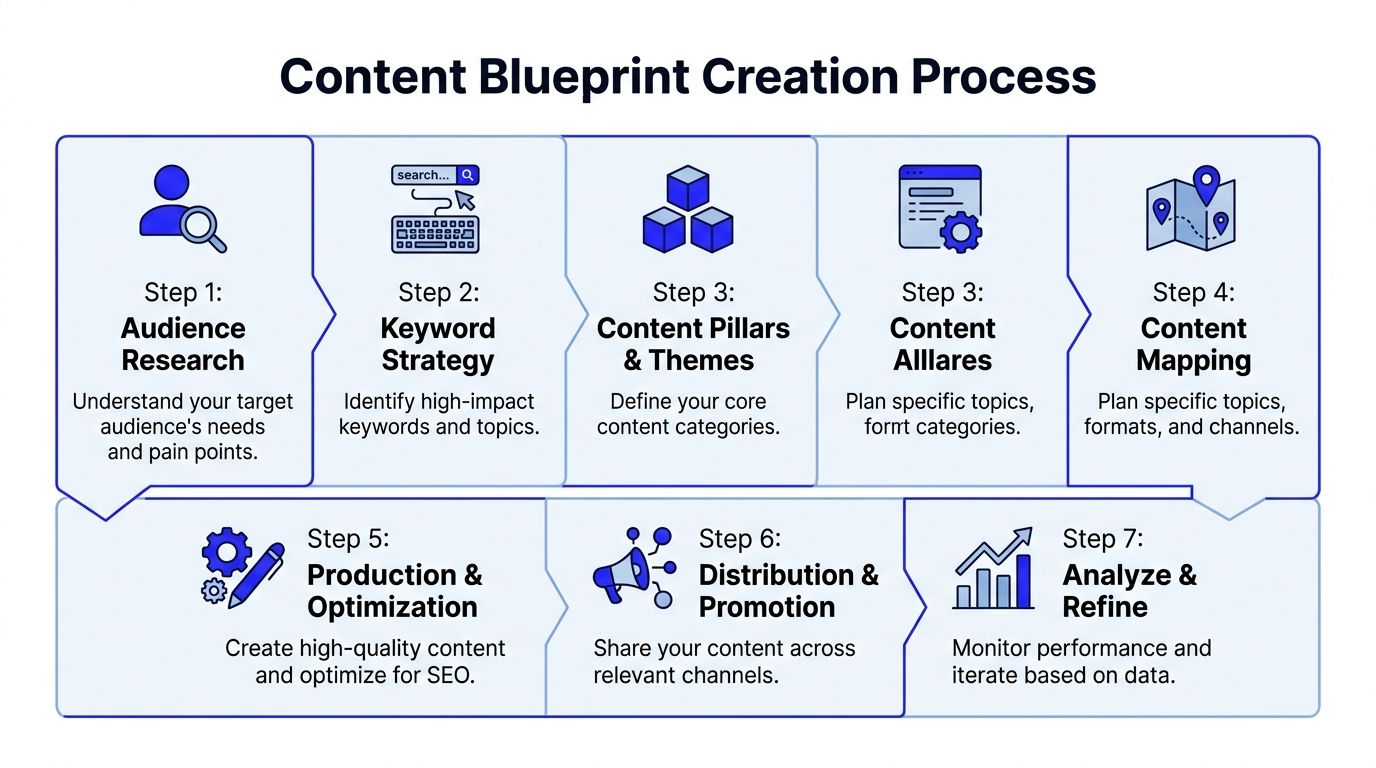
A useful content blueprint connects search intent, conversion paths, and nurture logic before the draft is written. Every piece needs a job. Some attract problem-aware visitors. Some help comparison-stage buyers. Some convert existing interest into demos, trials, or replies.
Build around pillars and clusters
The easiest blueprint to manage is still the pillar-and-cluster model.
Pick a core commercial topic that matters to the business. That becomes the pillar page. Then support it with narrower cluster articles that answer adjacent questions, objections, workflows, and tool-specific problems. Internal links should move both ways. The cluster supports discoverability, and the pillar consolidates relevance.
A simple startup structure might look like this:
Pillar page: Organic growth strategy for early-stage SaaS
Cluster article: How to set up GA4 and GTM for lead attribution
Cluster article: UTM naming conventions for small marketing teams
Cluster article: How to connect SEO content to HubSpot lifecycle stages
Cluster article: When server-side tracking matters for startup attribution
This beats publishing five unrelated posts because readers and search engines both get a clear thematic map.
Attach every asset to a funnel job
Content planning gets sharper when you assign each asset one primary job.
Use this simple content job map:
Content type | Primary job | CTA style |
|---|---|---|
Pillar page | Capture broad problem-aware demand | Demo, consultation, or newsletter |
Cluster post | Rank for specific intent | Related article, template, or tool |
Comparison page | Help buyers evaluate options | Contact sales or start trial |
Email nurture | Move leads from interest to action | Book call, reply, or revisit key page |
Then add one product-led hook where it fits. Templates, checklists, calculators, or short audits work well because they create a natural exchange for an email address without feeling forced.
If you want a stronger process for planning and maintaining this system, a startup-specific content marketing framework helps keep production tied to business goals instead of “publish because calendar.”
A workable blueprint usually includes these operating rules:
One main keyword target per page
One clear conversion action
One internal path to a deeper commercial page
One follow-up email sequence tied to the topic
One owner responsible for updating it later
The hidden win is editorial restraint. You publish fewer pieces, but each one has a defined role in revenue progression.
From Data to Decisions a Simple Prioritization Framework
Once tracking starts working, a new problem appears. You'll have too many decent ideas.
Refresh old posts. Build a free tool. Publish a niche landing page. Add sales enablement content. Fix form friction. Launch comparison pages. None of these are obviously wrong. The issue is choosing what earns time first.
Use RICE without pretending to be precise
RICE works well for organic growth because it forces trade-offs. Reach asks how many users or accounts might touch the change. Impact asks how strongly it could influence pipeline. Confidence keeps guesses honest. Effort stops low-value complexity from eating the roadmap.
According to Hinge Marketing, 65% of early-stage SaaS startups cite incomplete attribution as their primary barrier to scaling organic growth because they can't connect SEO, content, and paid channels into one view. That's the exact operational mess this framework helps reduce when your measurement layer is finally credible.
Don't over-engineer the scoring. Use directional estimates and compare options side by side. The value comes from consistency, not mathematical theater.
If attribution is weak, every roadmap discussion turns political. If attribution is usable, weak ideas lose arguments quickly.
A practical way to estimate each factor:
Reach: Use recent impressions, sessions, or lead volume from the relevant page group or topic.
Impact: Score from 1 to 3 based on likely effect on qualified pipeline, not vanity traffic.
Confidence: Lower this when data is sparse or implementation depends on several teams.
Effort: Use person-months, even if the number is rough.
A stronger dashboard also helps. If your current reporting mixes noise with a few useful numbers, this breakdown of marketing metrics that actually matter) is a useful reality check.
Sample RICE Prioritization for Organic Growth Ideas
Initiative | Reach (Users/Mo) | Impact (1-3) | Confidence (0-100%) | Effort (Person-Months) | RICE Score |
|---|---|---|---|---|---|
Refresh existing high-intent blog posts | 800 | 3 | 80% | 0.5 | 3840 |
Build CRM source field cleanup workflow | 200 | 3 | 70% | 0.5 | 840 |
Launch new broad thought leadership series | 1200 | 1 | 40% | 1.5 | 320 |
Create comparison landing page for one niche use case | 300 | 3 | 75% | 0.5 | 1350 |
Add downloadable template tied to pillar page | 500 | 2 | 85% | 0.5 | 1700 |
The exact scores don't matter much. The ranking does.
In most startups, this process pushes high-intent optimization above shiny net-new publishing. It also gives one operator a clean way to defend focus when everyone has ideas and nobody wants to kill any of them.
Your First 90-Day Organic Growth Sprint
The first ninety days shouldn't try to prove every channel. They should prove that your system can capture signal and turn it into a repeatable loop.
That means building infrastructure first, shipping a small set of focused assets second, and reviewing what happened before the next sprint starts.
A simple roadmap helps keep the work from sprawling.
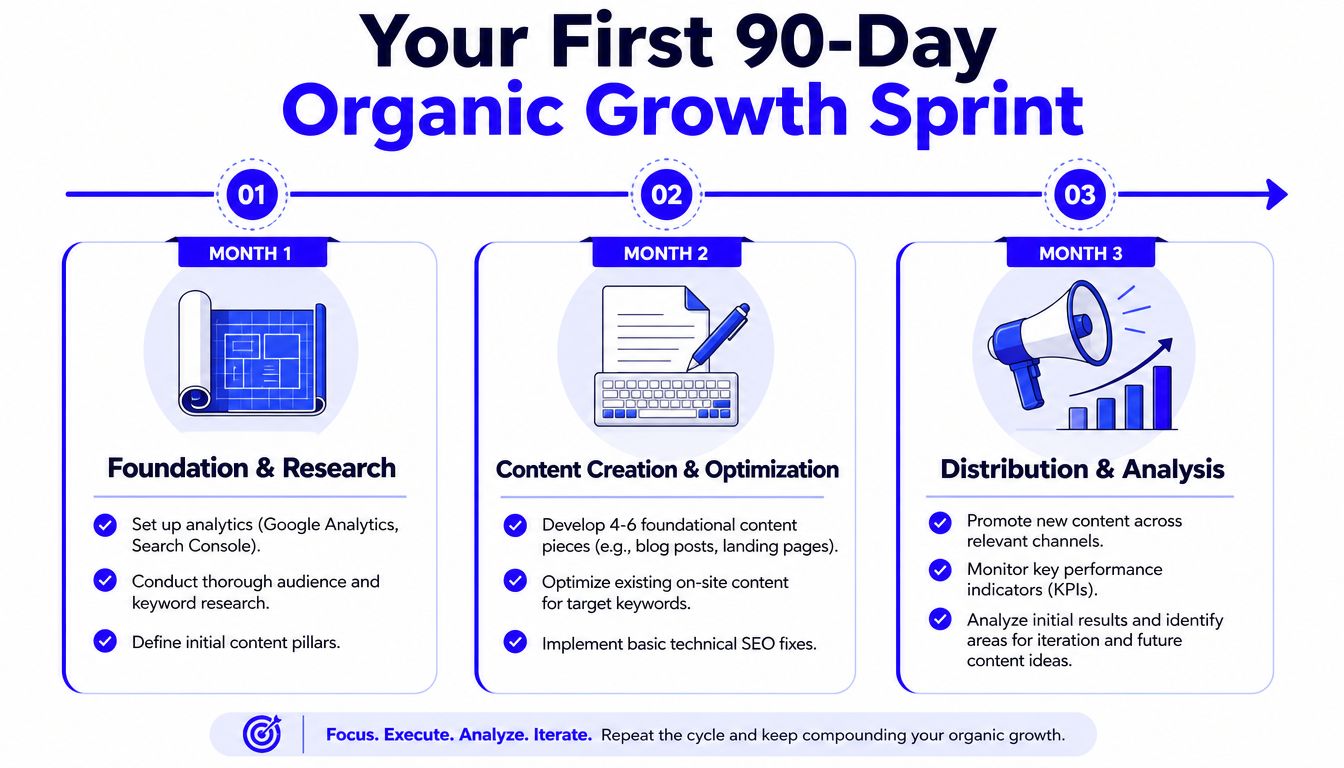
Days 1 to 30 foundation
The first month is setup and truth-finding.
Install or clean up GTM, GA4, Search Console, CRM source fields, form capture logic, and conversion definitions. At the same time, collect customer language from support, calls, reviews, and communities. By the end of this phase, you should have a documented UTM standard, a short list of topic pillars, and confidence that leads won't vanish into “direct.”
Key outputs for this phase:
Tracking map: Events, conversions, source fields, and CRM handoff logic
Topic map: A small set of niche themes tied to real buyer pain
Page audit: Existing content worth refreshing, merging, or redirecting
Mid-sprint, it helps to review the operating rhythm visually before work expands further:
Days 31 to 60 activation
Month two is for publishing assets with a clear funnel role.
Create one pillar page and a tight cluster around it. Add one conversion path that matches intent. That might be a downloadable checklist, a short diagnostic form, or a demo request with cleaner context fields. Then build the simplest possible nurture sequence in HubSpot or Pipedrive. Keep it short, useful, and tied to the problem the visitor already showed interest in.
The biggest mistake here is overproduction. Don't try to launch a media company. Launch a system you can maintain.
Days 61 to 90 iteration
The third month is where discipline matters.
Review what happened. Which pages attracted qualified visits. Which CTAs got ignored. Which sources entered the CRM cleanly. Which pages assisted opportunities even if they didn't create last-click conversions. Then run one prioritization cycle and choose the next batch of improvements.
A solid review meeting should answer:
What created qualified demand
Where attribution broke
Which topics deserve deeper coverage
Which workflows slowed follow-up
What gets cut from the next sprint
If you do this well, your organic growth strategy stops being a content calendar and starts behaving like an operating system. That's the difference between “we're doing marketing” and “we know how growth works here.”
If you want that kind of system without hiring separate freelancers for ads, SEO, CRM, and tracking, Du Marketing helps startups build and run one connected growth engine. The work spans paid acquisition, SEO, content, lifecycle, landing pages, GTM, GA4, server-side tracking, CRM sync, and reporting, all under a single operator model designed for teams that need execution without coordination drag.