Paid Search Consultants: How to Hire the Right One

Most advice about paid search consultants is backwards. Founders obsess over polished case studies, platform badges, and clever ad copy, then wonder why revenue attribution stays messy and budgets keep leaking. The person you want is not the one who can make the interface look busy. It's the one who can prove which clicks turned into closed business, and who can tell you what to stop funding.
Paid search is no longer a side quest. Market estimates put global PPC and paid search spend at $306 billion in 2026, with one projection growing from $218 billion in 2022 to $320 billion by 2030 at a 12.3% CAGR. In the U.S., search-ad spend has been estimated at $97.5 billion in 2023 and later at $124.59 billion in another forecast, which is exactly why the consultant's real job has shifted from basic bidding to measurement, attribution, and budget discipline. When paid search visitors are reported to be 50% more likely to purchase than organic visitors, and one industry estimate says businesses can earn $28 in income for every $1 spent on Google Ads (Digital Applied), sloppy tracking becomes expensive fast.
Table of Contents
Why Most Paid Search Consultant Hires Fail
The most common hiring mistake is treating a paid search consultant like a freelance designer. Founders look at logos, interface screenshots, and a polished story about “scaling campaigns,” then hire the person who sounds best in a pitch. That filter is weak because paid search has moved far beyond bid tweaks and keyword lists. Google Ads automation is taking over more of the tactical work, and by 2026, Performance Max campaigns were estimated to account for 41% of all Google Ads spend, up from 18% in 2023.
The core job is measurement, not button pushing
A strong consultant starts by asking what is tracked, what is missing, and what counts as a real conversion. If they jump straight to “we'll improve CTR,” they are optimizing the interface, not the business. The better operators focus on structure, measurement, and iterative testing, and benchmark data from PPC platforms shows why channel context matters, Google Ads search averages around 6.11% CTR and 7.04% CVR, while LinkedIn Ads averages 0.65% CTR and 2.35% CVR (Vidi Corp).
Practical rule: if a consultant does not talk about CRM sync, offline conversions, or attribution quality in the first conversation, they are selling campaign management, not growth.
That distinction matters because the channel is huge, the auctions are expensive, and attribution mistakes are costly. Search and organic together account for 80% of all trackable website visits, split as 53% organic and 27% paid, so paid search is one of the biggest levers in the acquisition mix. The consultant who understands that will talk about decision-grade data, not pretty charts.
The best hires also connect media work to revenue operations. If they cannot explain how click data becomes closed-won reporting, they are not ready for serious spend. The broader operating model behind that approach is laid out in Du Marketing's performance marketing strategy overview).
Interview Questions That Reveal Real Expertise
A good interview for paid search consultants should feel like a live diagnostic, not a storytelling contest. Skip “what's your biggest win?” That question invites rehearsed trophies and dodges the hard stuff. Instead, force the candidate to explain how they think when tracking breaks, traffic costs differ, and budget pressure is real.
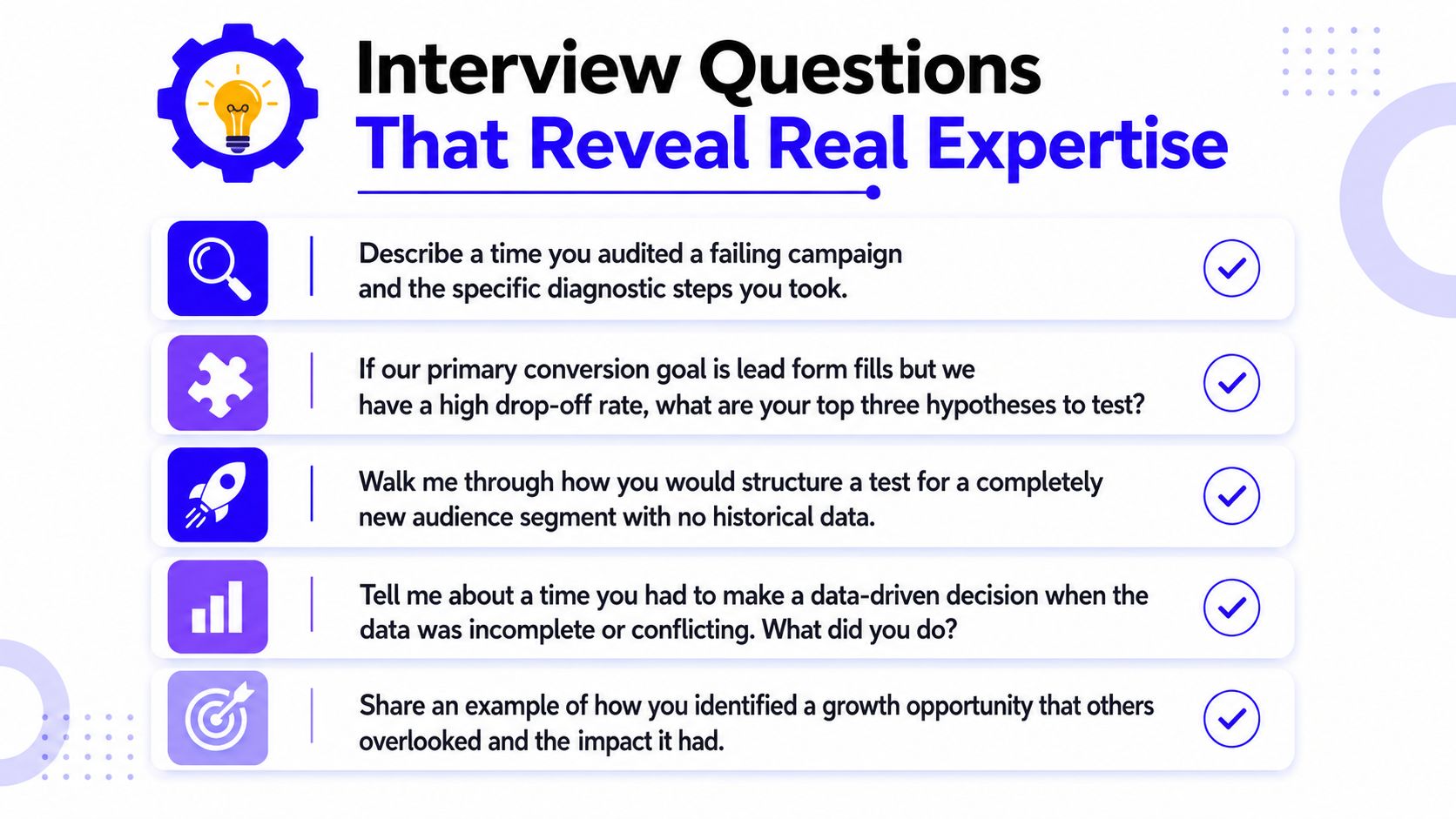
Ask questions that expose their working model
Start with conversion tracking. Ask, “What do you do when platform-reported conversions don't match the CRM?” A strong answer will mention audit steps, event definitions, CRM field mapping, deduplication, and offline conversion imports. A weak answer will blame the platform and move on. That's not a consultant, that's a shrug with billing software.
Then ask about query control. “How do you build and maintain negative keyword lists?” Good operators will describe search term reviews, match type cleanup, and systematic exclusions tied to intent. Weak operators say they “check it regularly,” which usually means they don't. The goal isn't to hear jargon. It's to see whether they're disciplined about account hygiene.
If they can't explain how they'd stop bad searches from eating budget, they don't understand search economics.
Use scenario questions for incrementality too. “If budgets are tight, how would you test whether paid search is adding net-new demand?” A real answer will reference controlled experiments, audience segmentation, and a clear definition of success before launch. A fake answer will say “we'll look at ROAS.” ROAS is useful, but it's not the same thing as proving lift.
Make them compare channels out loud
Ask them to compare Google Search, Microsoft Ads, Meta, and LinkedIn in practical terms. Recent benchmark data shows average CPCs around $4.22 for Google Search, $1.72 for Meta, $5.26 for LinkedIn, and $1.54 for Microsoft Ads (The Sarah Stemen). The right consultant won't pretend those channels behave the same. They'll explain how intent, funnel stage, and qualification standards change the math.
That's also where you'll catch lazy generalists. If their advice sounds identical across platforms, they're not making decisions from first principles. They're reading a checklist.
One more thing. If you want process discipline, ask them to walk through a recent campaign audit from first diagnostics to recommendation. You'll get a much better read from that than from a polished success story. For a deeper look at tactical search cleanup, see Du Marketing's guidance on search ad optimization.
The Technical Onboarding Checklist
Before anyone touches budgets, the measurement stack has to be clean. If a consultant skips that and rushes into campaign buildout, you're paying for motion, not progress. That shortcut is expensive because weak setup, not weak demand, is often what makes paid search look broken, and industry guidance notes that fewer than 25% of PPC ads produce conversions (Vidi Corp).
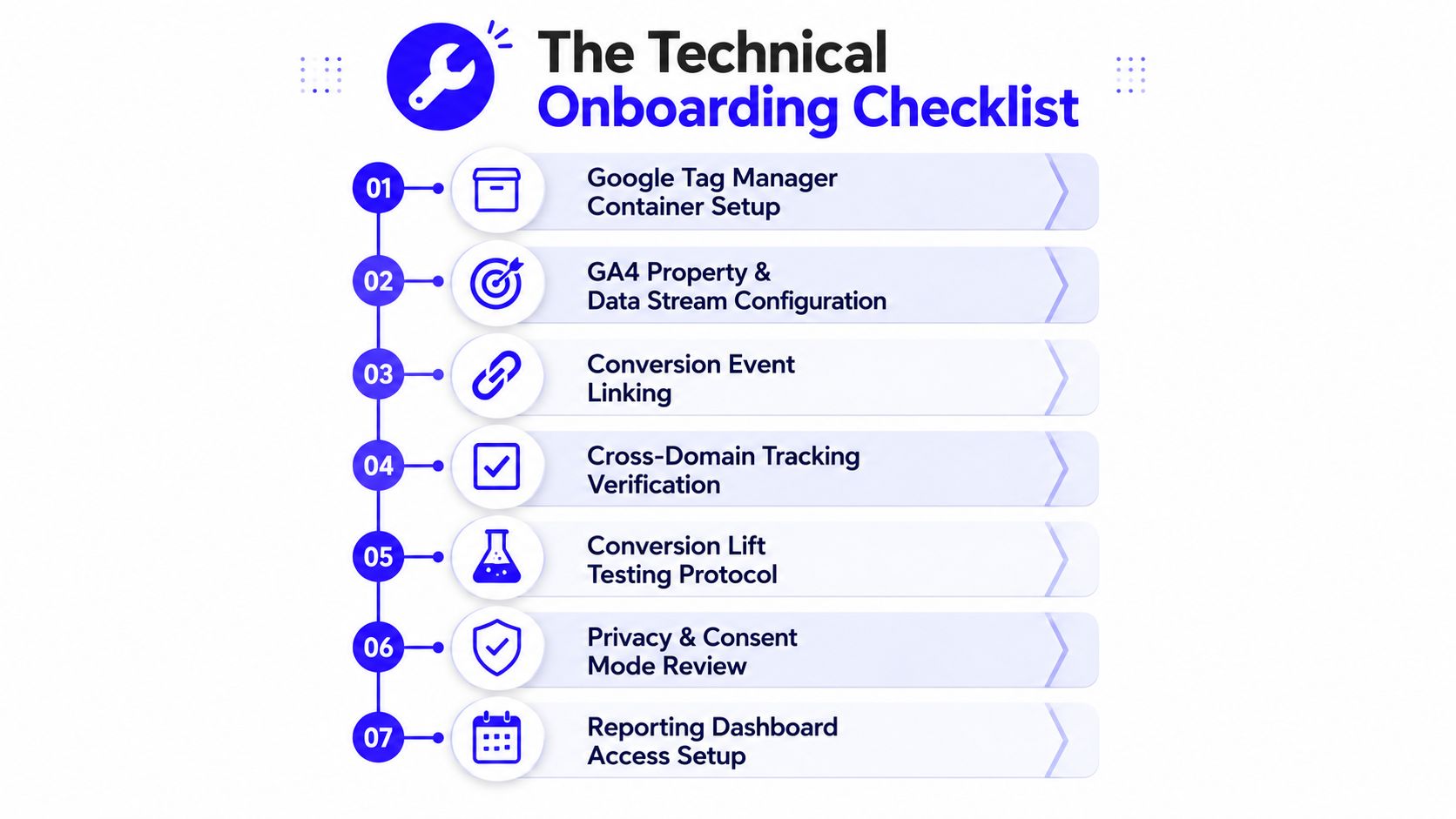
Build the stack in the right order
Start with Google Tag Manager and make sure the container is installed once, cleanly, and with ownership documented. Then configure GA4 so the property, data stream, and conversion events reflect the business outcome you care about. If the consultant can't tell you which events are primary and which are supporting signals, they're already behind.
Next, standardize UTMs and validate that every ad click can be tied back to source, medium, campaign, and creative. After that, connect the CRM. For startup teams, that often means HubSpot or Pipedrive, but the specific tool matters less than whether leads, opportunities, and closed-won records are syncing cleanly. If the pipeline can't be traced from click to revenue, reporting becomes theater.
Non-negotiable: every tracking decision should answer one question, “Can we trust this number enough to spend money against it?”
Don't ignore consent, offline data, and QA
Consent mode matters because privacy changes can break your ability to observe the full path from click to conversion. A consultant who ignores that is building on sand. The same goes for offline conversion uploads. If sales happen in calls, demos, or contracts, platform data alone won't tell the whole story.
You also need QA on automations. If Zapier pushes the wrong lead status, or if an imported conversion fires twice, your “performance improvement” is fake. That's why you should insist on testing before scaling. A technically serious consultant will check event firing, deduplication, dashboard access, cross-domain behavior, and reporting permissions in a fixed sequence, not as an afterthought.
For a more detailed view on event instrumentation, Du Marketing's GTM event-tracking guide is the kind of reference that shows how operational this work really is.
Pricing Models and What They Really Mean
Consultant pricing is where incentives show up in plain English. The model matters more than the pitch. A bad structure can make a smart operator behave like a mercenary, while a good one can keep everyone aligned on outcomes.
Pricing Model | How It Works | Best For | Key Risk |
|---|---|---|---|
Percentage of spend | Fee rises with ad budget | Large, stable accounts | Incentivizes budget growth over efficiency |
Flat monthly retainer | Fixed fee for defined scope | Startups that want predictability | Scope creep if deliverables are vague |
Hourly billing | You pay for time logged | Short diagnostics or one-off support | Punishes speed and good systems |
Performance-based fee | Compensation tied to outcomes | Clear, well-tracked funnels | Attribution disputes and argument over credit |
Pick the incentive that matches your stage
For early-stage teams, I prefer a flat monthly retainer with clear deliverables. It's easier to budget, easier to evaluate, and it doesn't encourage the consultant to max out spend just to raise their fee. Percentage-of-spend models can be defensible for very large accounts, but they create a nasty habit of linking the consultant's upside to your budget size, not your margin quality.
Hourly billing looks fair until you realize it rewards slowness. Good operators get penalized for being efficient, and mediocre ones get paid for over-explaining things you didn't need. Performance fees sound clean in a deck, then turn into debates about attribution, lead quality, and which team owns revenue credit.
The best pricing model is the one that makes bad behavior expensive.
You should also ask how ad spend and tool costs are handled. If the consultant marks up media or third-party software, the economics get murky fast. Transparent billing is better. You want direct charges, clear scope, and a simple contract that says what's included, what isn't, and how changes are approved.
If the proposal doesn't spell out deliverables and reporting cadence, walk away. A cheap consultant with vague scope can cost more than an expensive one with clean boundaries.
KPIs and Reporting That Drive Decisions
Most paid search reports are junk because they confuse activity with progress. Impressions, clicks, and CTR are useful as supporting signals, but they do not tell you whether the business is growing. Strong reporting starts with the measurement stack and ends with decisions about budget, landing pages, and lead quality.
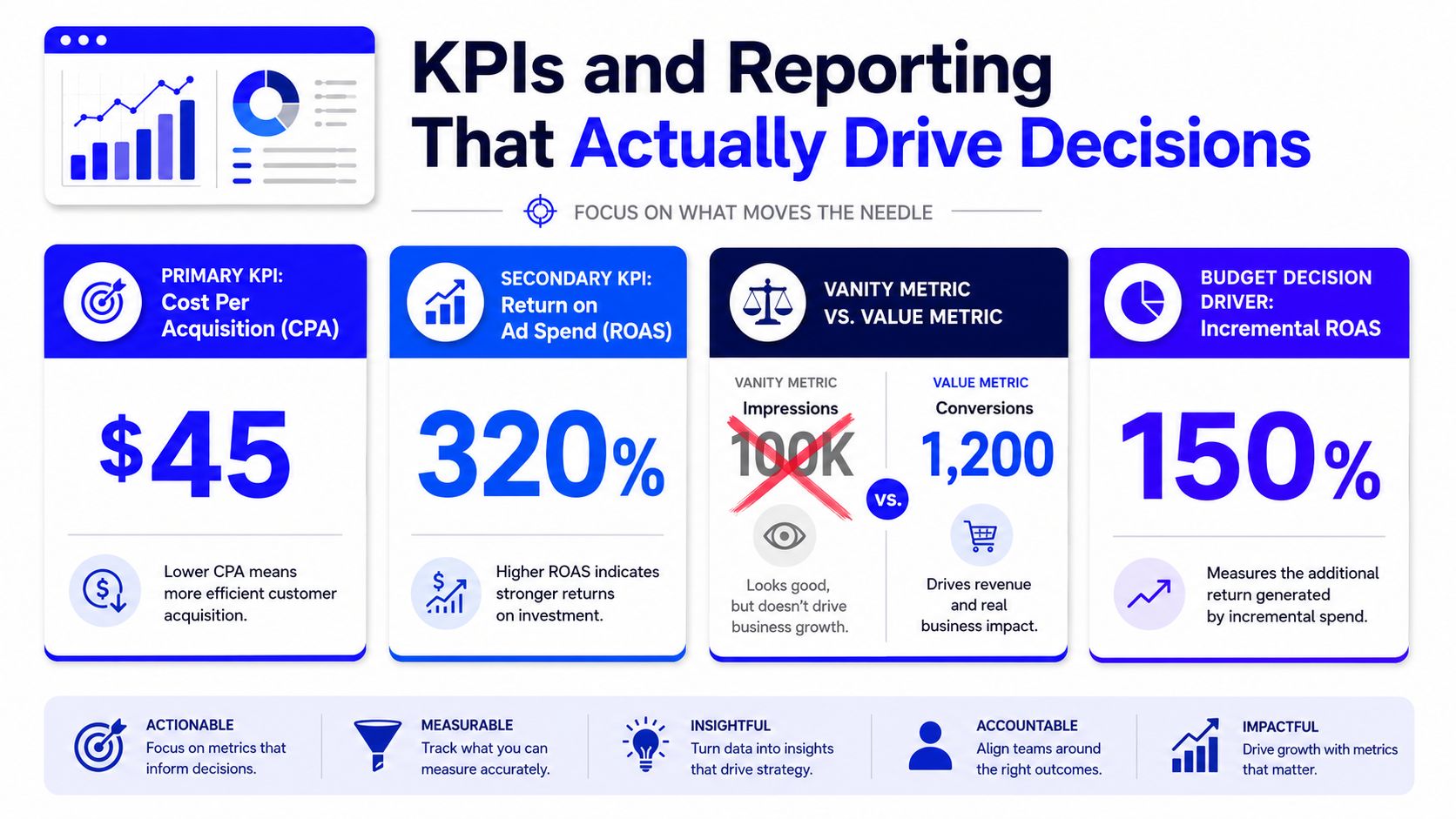
Ask for reporting that ties to revenue
A real dashboard should show cost per qualified lead, pipeline velocity, and revenue attribution by campaign. If your consultant sends a static PDF with top-line clicks and a few cheerful charts, they are avoiding the hard questions. A live dashboard is better because it shows performance in context and forces the trade-offs into the open without another meeting to interpret the basics.
The monthly review should have a simple structure. What changed, why it changed, what was tested, and what gets adjusted next. That conversation has to connect channel data to sales outcomes, not just traffic trends. If the CRM says one thing and the ad platform says another, the consultant should explain the gap clearly instead of smoothing it over.
Benchmarks still matter, but only as context. Use broad market references as a sanity check, then compare them against your own funnel and sales process. If an account is far off pace, the consultant should say whether the issue is targeting, creative, landing pages, or lead quality. That diagnosis matters more than a polished chart.
Give them time to learn the account
The first few weeks of an engagement should focus on collecting clean conversion data and stabilizing measurement, not forcing dramatic changes. Impatient founders blow up this stage all the time. They panic when the dashboard looks quiet, then approve random tweaks that make the data even worse.
Decision rule: if the consultant cannot explain what they learned from the last test, do not approve the next one.
A good report also separates vanity from value. If impressions rise but qualified leads fall, the report should say so plainly. If a landing page lifts conversion quality, that matters more than a traffic spike. Reporting only earns its keep when it changes the next budget decision.
Structuring Short-Term and Long-Term Engagements
Do not lock into a long contract before you know whether the consultant can fix your measurement and revenue flow. Early-stage teams need flexibility, not a year of inertia. The cleanest setup is a phased engagement that forces proof before commitment.
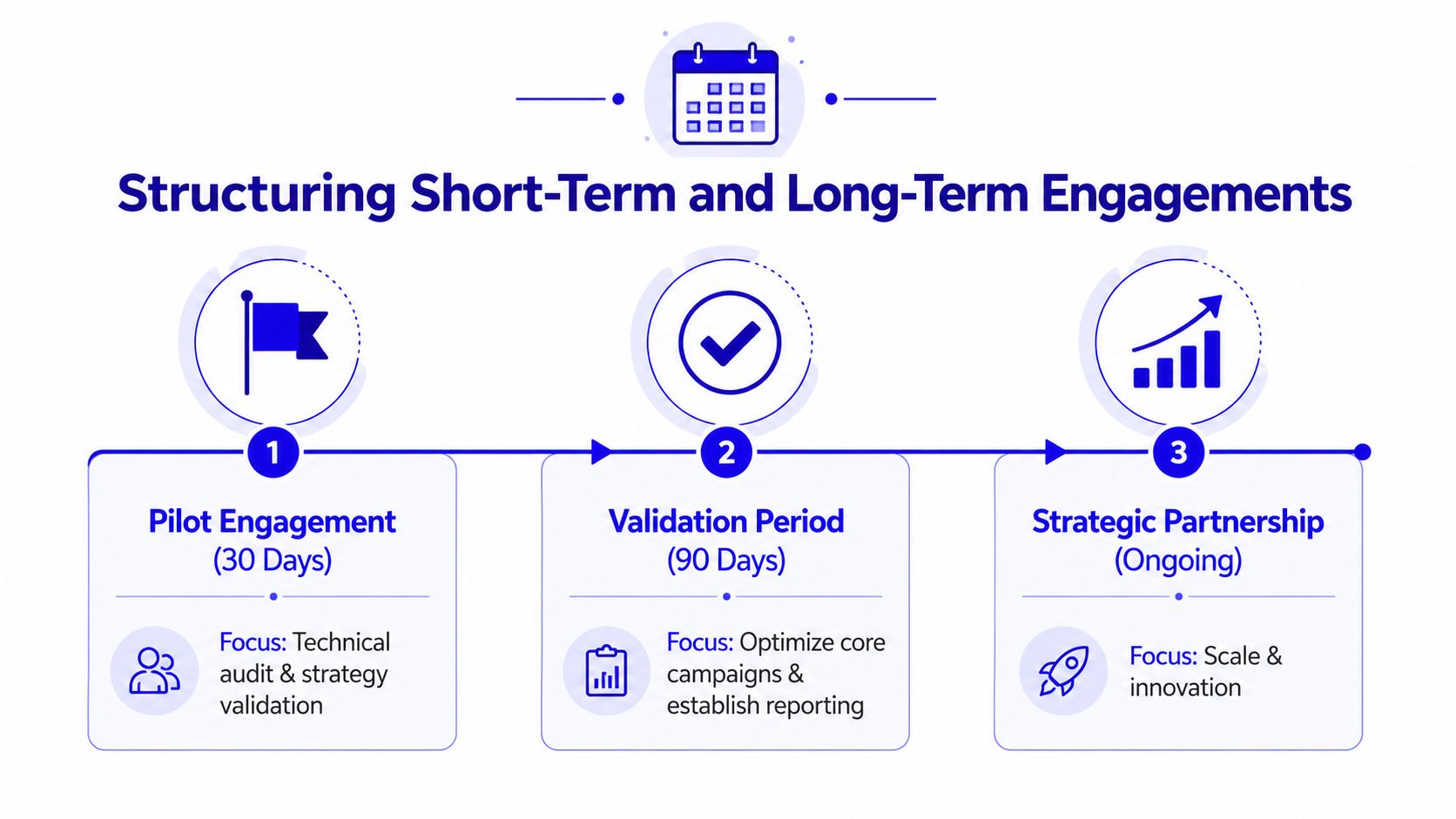
Start with a short audit, not a marriage
A first phase should be a paid audit and measurement repair sprint. The deliverable is diagnosis, not vague optimism. You want a clean read on tracking, account structure, landing page alignment, and the biggest leak in the system.
If that goes well, move into a 90-day pilot with specific go or no-go criteria. That's long enough to see whether the consultant can work inside your actual constraints, but short enough that you're not stuck subsidizing bad habits. For most startups, month-to-month terms are smarter than annual commitments because your goals, budget, and internal resources will change anyway.
The third phase is only for consultants who've proven they can own outcomes. By then, they should be contributing to scaling, experimentation, and knowledge transfer, not just running tasks. If they can't document the system well enough for an internal hire to inherit it later, you're buying dependency, not advantage.
If a consultant can't make themselves replaceable, they probably haven't built a real operating process.
The cleanest transition to in-house happens when reporting, tracking, and campaign logic are all documented. Then the handoff becomes a transfer of judgment, not a scramble to decode a private system. That's how you avoid paying forever for someone else's shortcuts.
If you want a paid search consultant who thinks like an operator, not a dashboard decorator, talk to Du Marketing. The work starts with measurement, attribution, and clean reporting, then moves into paid media, lifecycle, and landing page execution as one system. If you're tired of paying for busywork and want a partner who can connect ad spend to closed revenue, visit them and start there.