10 Social Media Growth Hacks for Real Results in 2026

Forget the usual advice about social media growth hacks that boils down to post more, hope harder, and celebrate vanity metrics. Followers matter only if they move someone into a pipeline, a checkout flow, or a CRM stage you can measure. The core game in 2026 is building a social system that creates demand, captures intent, and ties every useful click back to revenue.
That matters because social isn't a side channel anymore. By 2023, there were around 5 billion social media users worldwide, including over 1 billion in China, over 860 million in India, and 308 million social networking users in the United States, while the United States was still the largest social media advertising market at $72.3 billion (Statista). If you're trying to grow a SaaS product, a B2B service, or an e-commerce brand, attention gets concentrated there, and bad attribution can waste real budget fast.
The best tactics aren't random tricks. They're systems that combine content, distribution, tracking, and follow-up so social traffic doesn't disappear into the void. When you wire these moves into GA4, CRM workflows, UTM conventions, and server-side tracking, you stop guessing which post “worked” and start seeing which post produced qualified demand.
Table of Contents
6. Micro-Influencer and Creator Partnerships with Performance-Based Commissions
7. Behavioral Email and SMS Sequences Triggered by Web Activity
8. Competitive Positioning and Keyword-Targeted Content Marketing
10. Retargeting and Sequential Messaging Across Paid Channels
1. Viral Loops and Referral Mechanics
A referral loop is only a hack if you can see the loop close. Otherwise, it's just a nice “invite a friend” button that collects dust. The strongest version of this tactic builds sharing into the product or offer at moments of natural intent, like signup, payment, milestone completion, or a successful delivery.
Dropbox is the classic reminder that referral mechanics can work when the incentive fits the user action. PayPal's early sign-up bonus and Uber's ride credits also show the same principle in different categories, but the lesson isn't “copy the reward.” The lesson is to make the invitation obvious, make the benefit mutual, and make the attribution clean.
Practical rule: If a referral can't be tied to a source in GA4 and the CRM, it's not really a growth loop, it's a blind spot.
How to make referrals measurable
Start with UTM-tagged referral links and channel-specific landing pages so every invite has a source. Then push that data into your CRM, where you can segment referrers, referees, and reward claims by lifecycle stage. If the referral flow touches a checkout page, connect it to offline conversion uploads so downstream revenue doesn't get lost in a browser session.
A few things matter more than flashy reward amounts:
Put the CTA where intent is highest. Signup confirmation, post-purchase pages, and “you just achieved something” moments work better than a random footer link.
Reward both sides. That reduces friction because the invite feels like a shared win, not a sales pitch.
Automate fulfillment. Zapier and CRM workflows keep the reward process from becoming manual ops work.
Review the loop weekly. If referral traffic shows up but doesn't convert, the incentive or landing page is probably mismatched.
The trade-off is simple. Referral programs can create high-quality acquisition, but they also attract opportunistic sharing if the offer is too broad. The fix is to tie the incentive to product usage, not just signups, so the people sharing actually understand the value. For landing-page mechanics that support this kind of flow, a focused conversion framework like Du Marketing's landing page optimization guide is the kind of asset that keeps the loop from leaking.
2. Cohort-Based Content and Community Engagement
The best cohort content feels like a recurring appointment, not an occasional post. That's why time-bound series, live Q&As, webinars, and discussion threads tend to outperform one-off announcements when the goal is both visibility and retention. They train the audience to return, and they give you repeated chances to capture emails, track attendance, and score engagement in the CRM.
This works especially well when the content maps directly to customer pain points. A product tutorial series, a weekly founder AMA, or a use-case walkthrough can all become social assets, email assets, and sales-enablement assets at the same time. The same clip can live on TikTok, Instagram, LinkedIn, YouTube, and inside a nurture sequence, which is how content starts behaving like infrastructure instead of one-off creative.
The point isn't just “community.” It's structured engagement that you can attribute. If someone joins a webinar from a social post, clicks a UTM-tagged CTA, and later becomes a demo request, that journey belongs in your reporting stack, not in a vague “brand awareness” bucket.
Make the series do real work
Anchor each series to one concrete business objective. If the audience is prospects, build it around objections and evaluation questions. If it's customers, use it to drive adoption, expansion, and advocacy.
Consistency matters more than spectacle. Repeated formats create predictable behavior, and predictable behavior is easier to measure.
A strong operating pattern looks like this:
Use a fixed cadence. Same day, same time, same format whenever possible.
Repurpose aggressively. One live session should produce clips, carousel posts, email highlights, and a blog recap.
Tag participants by intent. Someone who asks a pricing question is not the same as someone who just lurked.
Score engagement in the CRM. Comments, shares, watch time, and attendance should all affect lifecycle segmentation.
Track which topics convert. Popular doesn't always mean profitable.
The trade-off is that community content can get noisy if it's disconnected from the product. If every live session turns into generic motivation, you'll collect views without moving buyers. Keep the subject matter close to the thing people pay for.
3. Strategic Partnership and Cross-Promotion Networks
Partnerships are one of the cleanest social media growth hacks because you're borrowing trust instead of buying attention from scratch. Co-marketing works when two brands, creators, or platforms already speak to adjacent audiences and can create something useful together, whether that's a live session, a guest post, a bundle, or a platform takeover.
Slack's ecosystem growth, Shopify's early partner motions, and the way creator tools often cross-promote each other all point to the same principle. If the audiences overlap and the offers don't compete, both sides can win without inflating spend. The core trick is attribution, because partnerships look great until you realize half the traffic was never tracked correctly.
Keep the partnership test small first
Start with a low-friction asset, not a full-blown launch. A LinkedIn takeover, a co-branded webinar, or a single newsletter mention tells you whether the audience responds before you commit to a deeper arrangement.
Use a partner-specific landing page for every collaboration, then isolate traffic in GA4 and your CRM. That gives you a read on clicks, signups, and downstream conversion quality, not just reach. A partner can generate plenty of impressions and still send you the wrong audience.
Practical rule: A partnership is only worth scaling when the traffic converts better than your baseline, not when the post looks popular.
A useful workflow is straightforward:
Pick non-competing partners. Aim for audience overlap without product overlap.
Agree on the KPI upfront. Impressions, clicks, leads, or booked calls, not all four by accident.
Use distinct UTMs and links. Every channel needs its own fingerprint.
Review the numbers on a schedule. A 30-day review window is long enough to see signal without letting the experiment drift.
Sync partner leads into CRM segments. That makes follow-up and lifecycle messaging easier.
The downside is coordination overhead. If a partner needs three approval rounds for a simple post, the channel gets slow fast. Keep the first collaboration small enough that both teams can execute without drama.
4. Account-Based Marketing with Personalized Landing Pages
ABM turns social from a broad distribution game into a precision instrument. Instead of trying to impress everyone, you build campaigns for a defined account list, then coordinate ads, email, and landing pages around the specific industries, use cases, or company sizes that matter most. For B2B, that usually means fewer wasted clicks and a better chance of reaching an actual buying committee.
The landing page is where a lot of ABM either wins or dies. A generic page after a hyper-targeted ad wastes the whole setup, because the buyer sees the mismatch immediately. A personalized page, matched audience, and CRM follow-up sequence create a much cleaner path from awareness to pipeline.
Use your target account list to drive the structure. If you're targeting a vertical, write one page per vertical. If the buying trigger is a specific use case, build the page around that pain point and keep the proof adjacent to it. Then wire the traffic into GA4 with first-click, last-click, and time-decay views so you can see which touchpoints helped move the deal.
The page itself matters enough that the internal architecture should be treated like a conversion project, not a design project. A focused page with tight messaging beats a generic page with a prettier hero shot, and the right sequencing beats more ad impressions.
Measure at the account level
ABM reporting should look beyond form fills. Track the percentage of target accounts engaged, average days to first conversion, and the difference in deal behavior versus non-ABM traffic. If a campaign creates activity but no sales motion, the page message or audience list is off.
A clean operating model usually includes:
Firmographic and intent-based account lists.
Three to five page variants by industry or use case.
Matched audiences across LinkedIn and Google.
CRM tags for every account touched by the program.
Triggered email workflows for repeat visits and high-intent actions.
The trade-off is scale. ABM is excellent for high-value deals, but it's not the right first play if you need broad top-of-funnel volume. It works best when you already know which accounts matter and can support them with enough content and sales follow-up.
5. Algorithm-Optimized Short-Form Video Repurposing
Short-form video is where attention gets compressed hardest, which is exactly why it remains one of the most effective social media growth hacks. The 2026 guidance around short-form content is clear, optimize the first 3 seconds with a hook, text-on-screen intro, or pattern interrupt, then iterate based on what the analytics show (The Inkorporated). That's not a creative guess, it's an operating rule.
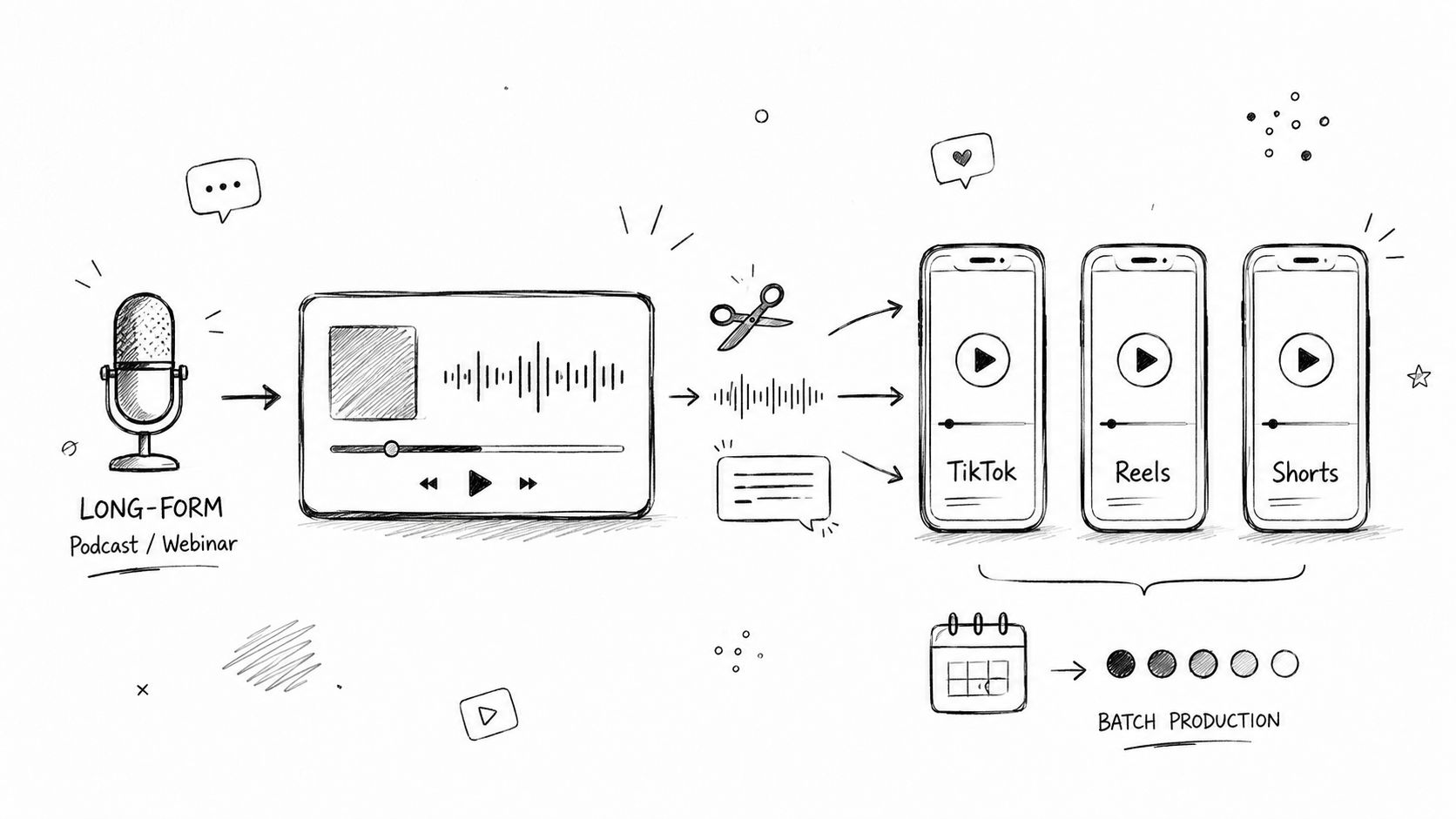
The smartest version of this tactic starts with long-form source material. Webinars, podcasts, tutorials, and customer interviews can all become a batch of short clips, each with its own hook, CTA, and distribution path. One recording day can feed multiple platforms if you're willing to cut for platform-native behavior instead of just resizing the same video everywhere.
Treat every clip like a test
The best teams don't ask, “Did the video go viral?” They ask which hook, caption opening, or thumbnail variant earned the highest-quality traffic. That's where GA4, platform analytics, and retargeting audiences come in. If a clip produces views but no site visits, the CTA is weak. If it produces visits but no conversions, the landing page or offer is off.
A useful production system looks like this:
Start from one long-form asset. A webinar or podcast is enough.
Create multiple variants. Different openings, captions, and CTAs.
Keep one variable at a time. That makes learning possible.
Use platform-native formats. TikTok, Reels, and Shorts all reward different habits.
Retarget viewers. Put the audience into email capture or paid follow-up flows.
The trade-off is volume versus quality. Batching makes publishing easier, but lazy repurposing creates sameness and fatigue. If every clip feels like the same talking head with different subtitles, performance will flatten. The content needs to be edited for the platform, not just exported to it.
6. Micro-Influencer and Creator Partnerships with Performance-Based Commissions
Micro-influencers are useful because they usually feel more like peers than billboards. Performance-based commissions make the channel even better, since the creator gets paid for outcomes, not just exposure. That alignment matters when you care about revenue, not just impressions.
The difference between a good creator partnership and a wasteful one is usually the brief and the tracking. If the creator gets a script that sounds like everyone else's ad, the audience tunes out. If they get room to speak in their own voice, while you still keep the offer and attribution tight, you get something closer to genuine recommendation.
Use a creator database, vet audience fit carefully, and assign unique links or promo codes to every partner. That lets you compare clickthrough, lead quality, and downstream conversion in your CRM. If you're only tracking likes, you're measuring applause, not contribution.
The practical numbers and deal structures vary by category, but the operating principle stays the same. Start small, watch the lead quality, and keep only the creators that drive outcomes you can defend in a budget meeting. If the partnership doesn't hold up in ROAS or CAC terms, it's entertainment, not acquisition.
For a deeper operational view of how creator and affiliate programs should be structured, Du Marketing's affiliate program management guidance fits neatly into this workflow.
What usually works
Niche creators over celebrity reach. Audience fit usually wins.
Performance-based terms. Commission, CPC, or CPL keeps incentives aligned.
Creative freedom. Over-scripted content tends to underperform.
Separate tracking per creator. One link per person, no exceptions.
A clear review window. Keep the best partners, cut the rest.
The downside is management. A creator program can become messy if every influencer has a custom process, custom terms, and no shared reporting. Standardize the infrastructure early or the program will cost more than it returns.
7. Behavioral Email and SMS Sequences Triggered by Web Activity
Social gets the attention, but email and SMS often close the loop. That's why behavior-triggered messaging is one of the most underrated social media growth hacks for teams that care about full-funnel ROI. If someone clicks from social to your site, browses a pricing page, abandons a cart, or downloads a resource, the follow-up should feel immediate and relevant.
GA4 events and CRM automation become essential. A single social click can trigger a distinct path depending on what the visitor does next. Someone who visits a pricing page needs a very different sequence from someone who only read a blog post, and the email copy should reflect that difference instead of blasting everyone with the same nurture track.
Timing matters, but relevance matters more. A short sequence that responds to a real action beats a long campaign that treats every lead the same. In practice, these workflows are strongest when they're tied to clear conversion moments, like signup, first use, upgrade intent, churn risk, or cart abandonment.
Build workflows around behavior, not hunches
Start by mapping the moments that matter in your funnel. Then connect those moments to sequences in HubSpot, Pipedrive, or your preferred automation stack. The point is to make social traffic measurable after the click, not just before it.
The best trigger is the one the user already gave you.
A useful setup includes:
High-intent GA4 events. Pricing visits, demo requests, competitor mentions, and cart steps.
Progressive profiling. Ask less at first, then enrich over time.
Conditional branches. If they take action, skip irrelevant follow-up.
Channel-specific SMS rules. Keep SMS for urgent moments only.
Weekly performance review. Open, click, and unsubscribe trends should all influence the sequence.
The trade-off is fatigue. Over-automating the journey can make your brand feel pushy, especially if the same person gets hit by social retargeting, email, and SMS at once. Set frequency rules and make unsubscribe preferences easy to manage.
8. Competitive Positioning and Keyword-Targeted Content Marketing
Organic social gets stronger when it's reinforced by search. Keyword-targeted content gives your social posts a home base, a discovery engine, and a way to capture intent that doesn't disappear after the feed scrolls away. That's especially useful when your category is competitive and buyers are actively comparing options.
The useful move here is not to publish random SEO articles. It's to map competitor keywords, search intent gaps, and category-defining topics, then build content that answers the exact questions buyers are already asking. If your competitors rank for comparison queries, use comparison content. If they dominate how-to searches, build a deeper, more useful version of the same format.
Social and search should work as a pair. Social creates distribution and discussion. Search captures the people who come back later to research the thing they saw. When you connect the two with internal links, UTM tracking, and consistent messaging, you get a much stronger path from curiosity to conversion.
Write for intent, not just keywords
The structure of the page should match the searcher's state of mind. A comparison page should help someone evaluate alternatives. A pricing page should remove friction. A use-case article should connect the problem to the product without sounding like a brochure.
Track which topics generate qualified traffic, not just visits. Refresh the pages that keep showing up, build internal links from related assets, and keep the content aligned with what sales hears on calls. That's how the content stack stops drifting away from the market.
The trade-off is speed. SEO takes patience, and social teams sometimes want instant feedback. But the combo is powerful because social can feed search demand while search compounds over time. You're not choosing one channel, you're creating a loop.
9. Community-Led Growth and Self-Serve Support Networks
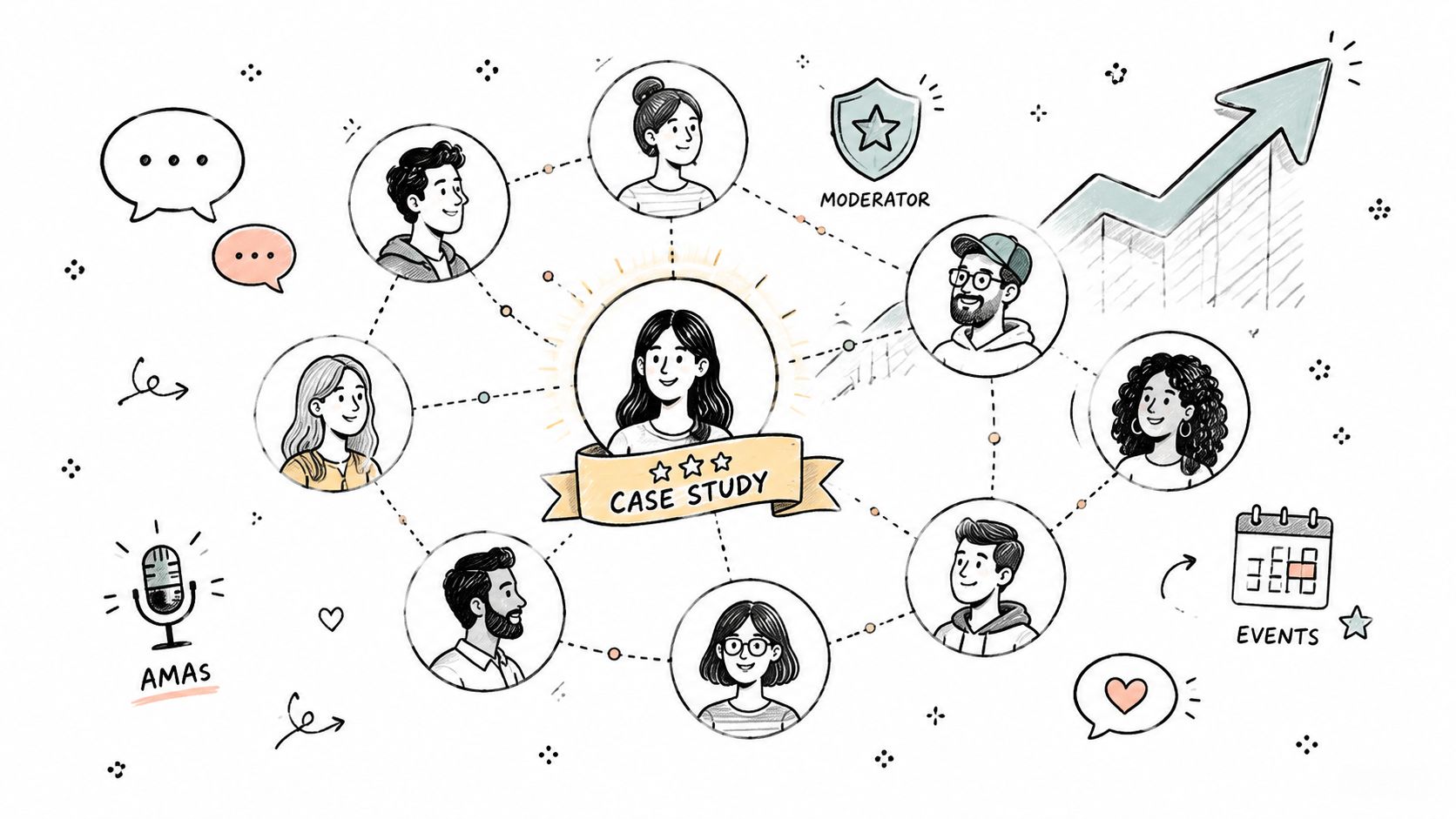
Community-led growth works when users start solving problems for each other. That can happen in a Slack group, a Discord server, a forum, or a branded community platform, but the mechanics are the same. Members share use cases, answer questions, and create enough useful chatter that the brand becomes part of the workflow instead of just another vendor.
The first job is to define the culture. If the room is full of self-promotion and random links, people leave. If the room has clear channels for intros, wins, help, and feedback, the community feels useful immediately. Founder participation matters early because members take their tone from how the company behaves.
This is also a support strategy. When users answer each other's questions, your support burden drops and product adoption improves. The social growth angle comes from visibility, because useful communities often create their own word-of-mouth loop as members invite peers who have the same problem.
Build for participation, not lurking
A community that looks busy but doesn't produce member-sourced signups isn't doing much for growth. You need structured participation, not passive membership.
The strongest operating habits are:
Launch with a core cohort. Start with power users or champions.
Host recurring events. AMAs, feature demos, and case-study sessions keep the room active.
Tag members in the CRM. Community members should be nurtured differently.
Spotlight member wins. Recognition creates more participation.
Watch health signals. Active membership and peer-to-peer support tell you whether the space is alive.
The trade-off is moderation. Communities need actual stewardship, not a set-it-and-forget-it setup. If nobody maintains the rules or responds to low-quality posts, the group loses credibility fast.
10. Retargeting and Sequential Messaging Across Paid Channels
Retargeting is where a lot of social demand gets recovered. Someone saw your content, clicked, browsed, and left. Sequential messaging gives you a second chance, then a third, without pretending every visitor is ready to buy on day one. When the audience is segmented by intent and the messaging escalates logically, paid social becomes a follow-up system instead of a blunt reminder.
The technical side matters. Meta CAPI, server-side GTM, and clean audience segments help you keep attribution usable after privacy changes and browser restrictions. Then GA4 and the CRM can show you not just who saw an ad, but who moved from awareness to consideration to decision.
The best retargeting flows don't repeat the same creative forever. They start with brand recall, move into proof, and end with a direct offer. That progression gives the buyer enough context to come back without feeling stalked.
If the same person sees the same ad too often, you're not nurturing demand, you're teaching them to ignore you.
Sequence the message with intent
A practical flow usually looks like this:
First ad. Reinforce the brand or topic they already engaged with.
Second ad. Add proof, a testimonial, or a case study.
Third ad. Make the offer direct, such as a demo, trial, or purchase.
Exclusions. Remove recent converters and existing customers.
Frequency control. Keep the cadence sane so fatigue doesn't erase trust.
The trade-off is spend efficiency. Retargeting can burn budget if your audience pools are too small, too broad, or too stale. Keep the segments tight, refresh the creative, and use CRM sync so paid and lifecycle teams don't work against each other.
Top 10 Social Media Growth Hacks Comparison
Strategy | Implementation Complexity 🔄 | Resource Requirements ⚡ | Expected Outcomes 📊⭐ | Ideal Use Cases & Key Tips 💡 |
|---|---|---|---|---|
Viral Loops and Referral Mechanics | Medium, product hooks, tracking & CRM integration | Low–Medium, engineering + incentive budget that scales with growth | ⭐⭐⭐ Compounding referrals; lower CAC over time; variable viral coefficient | Products with PMF and active users; embed CTAs at friction points; track with UTMs |
Cohort-Based Content & Community Engagement | Medium, recurring scheduling, moderation, production cadence | Medium, hosts, content creators, community managers, time investment | ⭐⭐ Sustained engagement; improved retention and organic visibility | Thought leadership, onboarding cohorts, retention; repurpose content across platforms |
Strategic Partnership & Cross-Promotion Networks | Medium, partner vetting, agreements, tracking | Low–Medium, outreach, co-production; shared costs reduce spend | ⭐⭐⭐ Access to pre-warmed audiences; credibility transfer; outcome depends on partner quality | Enter new segments/geographies; start with low-friction tests and UTM-tagged landing pages |
ABM with Personalized Landing Pages | High, account research, personalization, multi-touch orchestration | High, paid channels, landing page development, CRM/account owners | ⭐⭐⭐ Higher conversion rates and deal sizes; predictable pipeline; longer ROI lag | Enterprise B2B and high-value accounts; create 3–5 page variants and track account engagement |
Algorithm-Optimized Short-Form Video Repurposing | Medium, editing pipelines and platform optimization | Medium, video tools/editors, trend monitoring, consistent output | ⭐⭐⭐ High awareness & viral potential; weaker direct attribution | Top-of-funnel brand growth; batch repurposing from long-form; UTM bio links and retarget viewers |
Micro-Influencer & Creator Partnerships (Performance-Based) | Medium, creator vetting, contracts, many relationships | Medium, outreach tools, tracking, commission budget | ⭐⭐ Authentic endorsements; measurable ROAS if tracked; scaleable across creators | Niche DTC or SaaS verticals; use unique UTM/promo codes and start with 2–3 tests |
Behavioral Email & SMS Sequences Triggered by Web Activity | Medium, event tracking and workflow logic | Low–Medium, CRM automation tools, copy & setup time | ⭐⭐⭐ High engagement and conversion; excellent ROI when timely and relevant | Cart recovery, onboarding, upgrade nudges; map journeys and A/B test subject lines |
Competitive Positioning & Keyword-Targeted Content Marketing | Medium–High, SEO strategy, pillar content, link building | Medium, writers, SEO tools, outreach for backlinks | ⭐⭐⭐ Long-term compounding organic traffic; high-intent leads; slow payoff | Organic discovery and category authority; prioritize pillar pages and refresh top posts |
Community-Led Growth & Self-Serve Support Networks | Medium, culture building, moderation, event programming | Medium, community manager(s), platform costs, events | ⭐⭐ Strong retention, advocacy, reduced support costs; slow to scale | SaaS and creator products with engaged users; launch with a core cohort and measure MAU |
Retargeting & Sequential Messaging Across Paid Channels | Medium, pixel/CAPI setup and sequential creative flows | Medium–High, ad spend, creative production, tracking infrastructure | ⭐⭐⭐ High ROI from intent capture; recovers lost conversions; risk of fatigue | E‑commerce and high‑traffic sites; use frequency caps, segment by intent, sync audiences to CRM |
From Hacks to System Building Your Growth Flywheel
These aren't standalone tricks, they're pieces of one operating system. The social media growth hacks are the ones that connect top-of-funnel attention to middle-funnel intent and then to bottom-funnel revenue. If a tactic can't be tracked through GA4, mirrored in the CRM, or tied to downstream conversion quality, it's probably not a growth system yet.
The strongest mix is usually a combination of content, distribution, and follow-up. Short-form video feeds retargeting. Community activity feeds referral loops. Partnerships feed ABM. Behavioral email and SMS turn a social click into an actual sales motion. Once those pieces are connected, every post has more than one job, and every channel can be judged by what it contributes to the funnel.
Consistency beats randomness, too. Buffer's 2026 creator analysis found that creators who posted in 20 or more weeks out of a 26-week window saw about 450% more engagement per post than creators who posted in only four weeks or fewer (Buffer). That doesn't mean you need to chase output for its own sake. It means social growth tends to reward repeatable systems, steady testing, and distribution discipline more than one-off stunts.
That's the mindset shift. Stop asking which hack is cleverest and start asking which one compounds across the stack. A single viral post can be exciting, but a loop that keeps generating tracked traffic, qualified leads, and repeat revenue is worth a lot more.
If you're deciding where to start, pick one or two tactics that match your business model and traffic quality requirements. Then set up the tracking before you scale the volume. That's how you turn social media from a popularity contest into a measurable acquisition channel.
If you want a practical setup that connects paid media, SEO, content, email, and tracking into one system, visit Du Marketing. Du Marketing builds growth programs with GA4, GTM, CRM sync, landing pages, and live reporting so social traffic can be measured all the way to revenue.