What Is the Purpose of an Acquisition Strategy: Your 2026

An acquisition strategy exists to turn growth into a repeatable system rather than a pile of ad hoc tactics. It defines the target audience, selects the right channels, and sets measurement rules so every dollar can be tied to downstream revenue and retention.
You know the feeling if you've lived through early startup marketing. One week it's Google Ads, the next it's a LinkedIn post, then a newsletter goes out late because everyone's busy, and somehow the team still can't answer the simplest question, which effort brought in customers?
Table of Contents
Introduction From Marketing Chaos to Strategic Growth
A lot of startup marketing starts like a rescue mission. Founders throw money at paid ads, publish a few posts, send a sporadic newsletter, and hope one channel finally catches fire. The work feels busy, but the results stay fuzzy because there is no governing logic behind the spend.
A practical acquisition strategy gives that spend a job. It acts like a roadmap for finding, convincing, and converting the right customers, while also spelling out what the team should buy, build, or test first. The value is not theory, it is decision-making you can defend when budget is tight and every channel is competing for attention.
The strongest founders do not need more tactics. They need a system that tells them which tactic deserves focus before money gets scattered across too many bets. An acquisition strategy does that by forcing clarity on audience, channel, and measurement before the campaign stack gets messy. It turns random acts of marketing into a process you can run, review, and improve with intent.
Practical rule: if you cannot explain why a channel fits your audience and how success will be measured, it is a tactic, not a strategy.
What an Acquisition Strategy Really Is and Isn't
An acquisition strategy is not a content calendar, a paid media checklist, or a wish list of channels. It is the decision-making framework that tells you what to buy, build, or launch, why that choice fits the business, and how to prove the decision paid off. In procurement and program management, the same idea shows up as a top-level governance document that sets the acquisition approach, assumptions, resource constraints, risk posture, and lifecycle scope before execution starts.
For startup growth, that definition is useful because it keeps the focus on revenue, not activity. The crucial question is not, “Should we run ads?” The key question is, “Which audience, offer, and channel give us the cleanest path to revenue without wasting spend on the wrong people?” That is the difference between a plan that creates order and a pile of tactics that only creates motion.
The governance piece matters because strategy is meant to reduce ambiguity before money is committed. Federal acquisition guidance has long treated planning as a control mechanism, not a slogan, and that same discipline helps startups avoid making expensive choices too early. When you define the rules before launch, you give the team a way to compare options instead of chasing whatever looks active that week. HHS acquisition strategy memorandum
Strategy chooses the few moves that can scale
A real strategy also filters out busywork that looks productive but does not move the business. McKinsey's work on successful acquisitions points to several value-creating rationales, including getting skills or technologies faster or cheaper than building them internally, creating market access, removing excess capacity, and improving target performance. For growth teams, the lesson is the same, do not chase more channels just to look busy. Choose the few paths that can scale efficiently and support the business objective. McKinsey on the six types of successful acquisitions
That is why a real acquisition strategy works like a roadmap, not a list of tactics. A roadmap tells you where you are going, what route you are taking, and what you will do if the road changes. A tactic just gets the car moving.
The Three Core Components of a Modern Acquisition Strategy
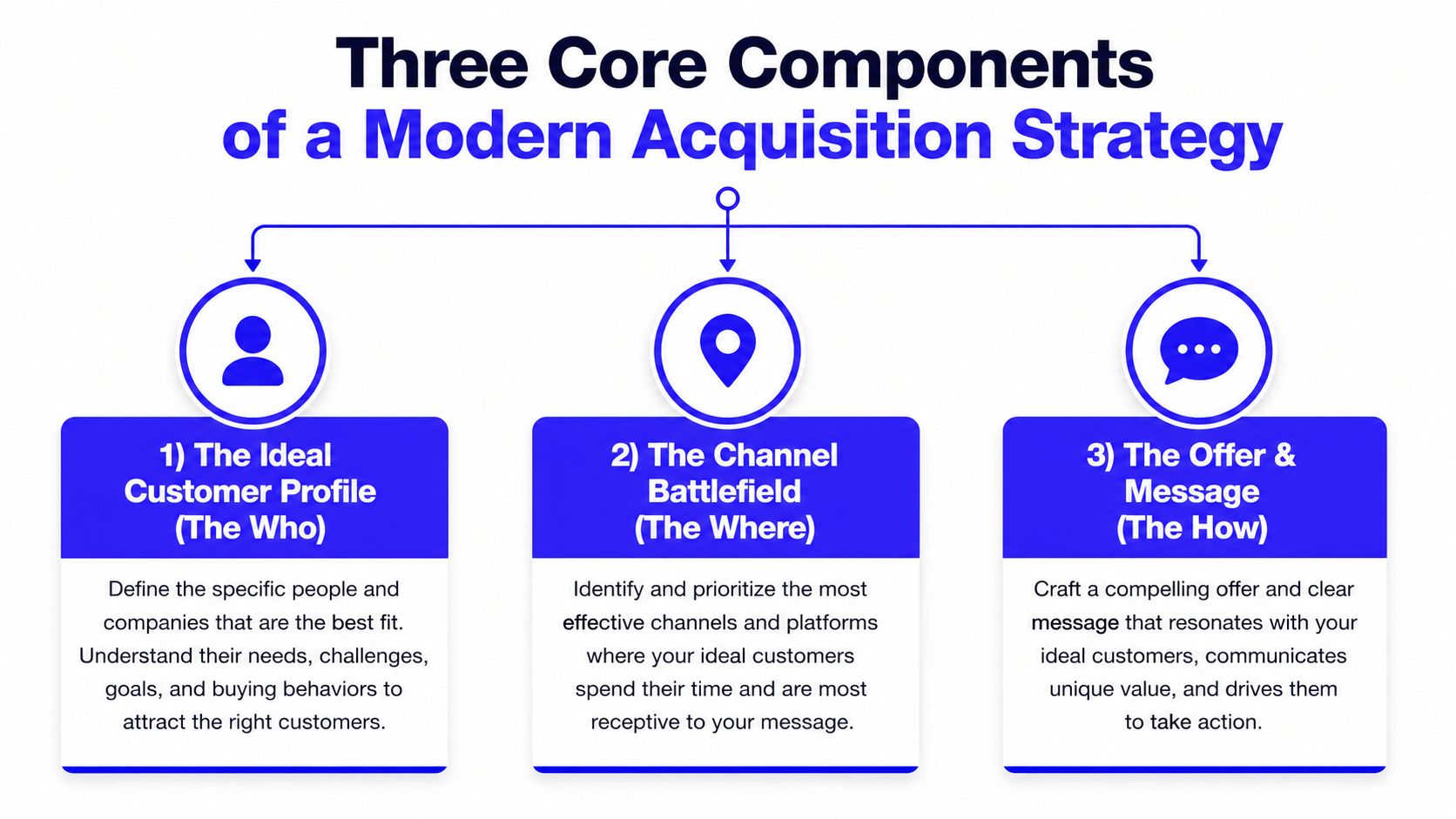
A modern acquisition strategy comes down to three connected choices, who you want, where you will reach them, and how you will know the effort is paying off. If any one of those is fuzzy, spend starts leaking into channels, audiences, or messages that do not support revenue. The discipline here is the same one used in formal acquisition planning, where the approach, assumptions, constraints, and risks are set before execution begins.
The who
The Ideal Customer Profile is the filter that keeps you from paying for attention that will never turn into customers. A startup selling to operations teams should not plan around consumer habits, and a product with a long sales cycle should not be judged like a quick checkout flow. The audience definition shapes the rest of the system, including the message, the creative, and the conversion action you choose to optimize.
This choice also forces trade-offs. A tighter profile usually means less volume but better fit, while a broader profile may look bigger on paper and waste more budget in practice. For founders, that is usually the first useful constraint, because it tells the team which prospects are worth chasing and which ones will only make the dashboard look busy.
The where
Channel choice is where strategy becomes real. The best channel is not the one the team likes to post in, it is the one your audience already pays attention to and uses while looking for a solution.
If people search with intent, search-based acquisition deserves serious attention. If they discover options through professional networks, referrals, communities, or social proof, those paths may do more work. The right channel is the one that matches buying behavior, not internal convenience.
The how
Measurement is what separates a strategy from a story. A useful acquisition plan defines what counts as a lead, what counts as a qualified opportunity, and what should happen after the first conversion, so the team can connect assumptions to evidence instead of opinion.
That also means the team has to decide what success looks like before the campaign runs. If you do not know which signals matter, you can spend money on activity that feels strong and still learn nothing about revenue. A strategy without measurement is just a bet with better branding.
Connecting Your Strategy to Real Business Goals
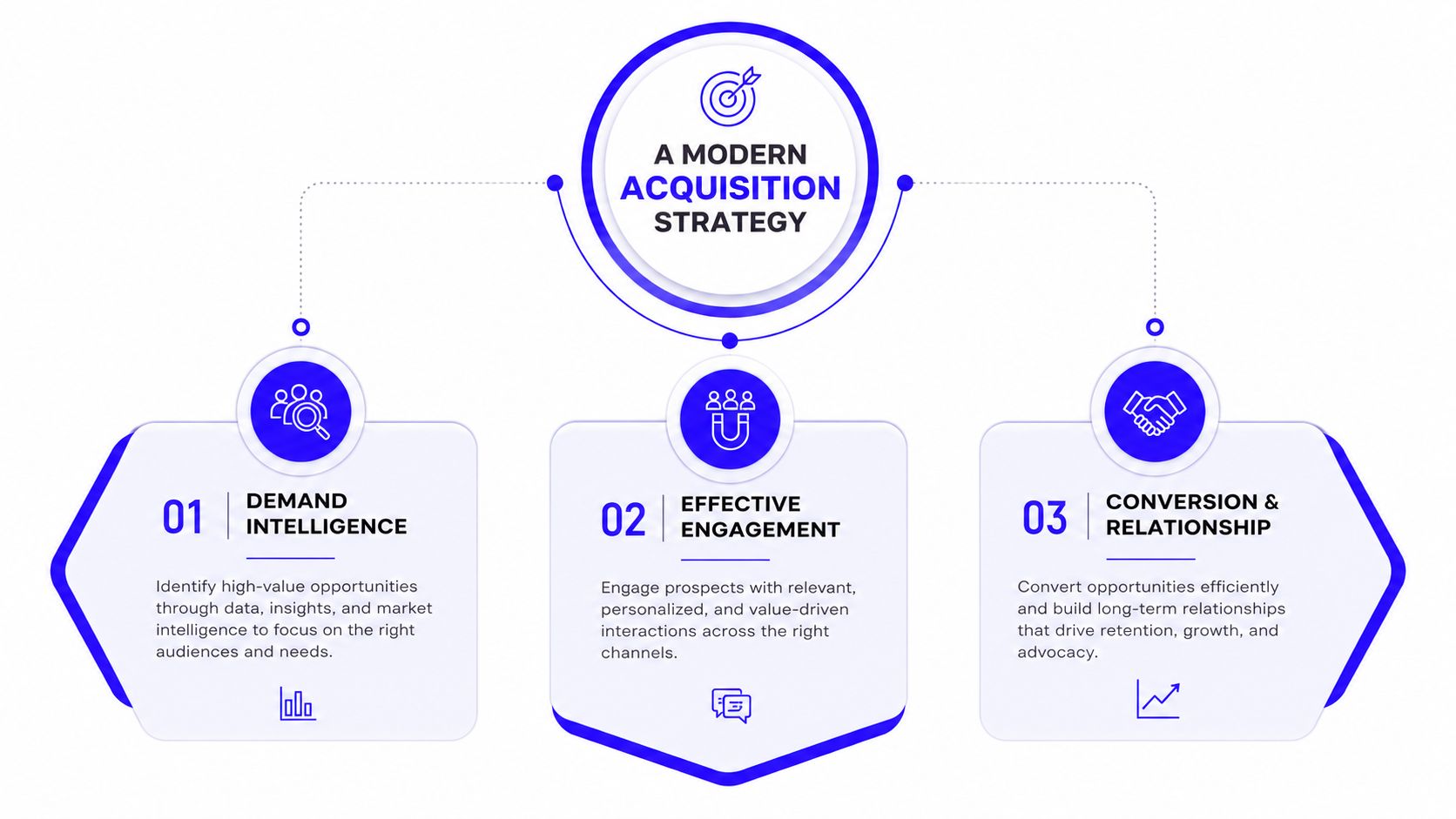
An acquisition strategy only matters if it points toward revenue, retention, and durable value creation. Otherwise, you're measuring activity instead of progress. That's the trap founders fall into when they celebrate clicks, impressions, and social reach without asking whether any of it improved the business.
The useful test is brutally practical. Can you connect a campaign to an actual customer, a real opportunity, and eventual revenue? If not, you can't tell whether the channel works or whether you just got lucky. That's why proper tracking and attribution aren't an afterthought, they're part of the strategy itself.
The business case for this discipline shows up in how acquirers think about value creation. McKinsey's framework on successful acquisitions emphasizes rationales such as gaining market access, building skills faster, and improving target performance, all of which depend on choosing a path that creates durable returns rather than isolated wins. Startup acquisition strategy works the same way. It should help you identify which channels compound and which ones merely consume cash. McKinsey on the six types of successful acquisitions
A good operating question is this, which growth path gives you the clearest line from spend to retention? That usually means you need clean source tracking, sensible conversion definitions, and enough CRM hygiene to avoid false conclusions. If your attribution is messy, your strategy will reward the loudest channel, not the most profitable one.
For a deeper look at how acquisition connects to demand creation in B2B, see B2B lead generation.
Profit beats vanity
The point is not to eliminate softer metrics. It's to keep them in their place. Clicks can tell you that a message got attention, but they can't tell you whether the customer was worth acquiring. Profit-oriented acquisition strategy puts those metrics in sequence, first attention, then conversion, then customer value, then repeatable return.
Strong attribution turns marketing from a debate into a decision system. When you can trace outcomes back to source, you can stop funding channels on instinct.
Acquisition Strategies in Action Channel Examples
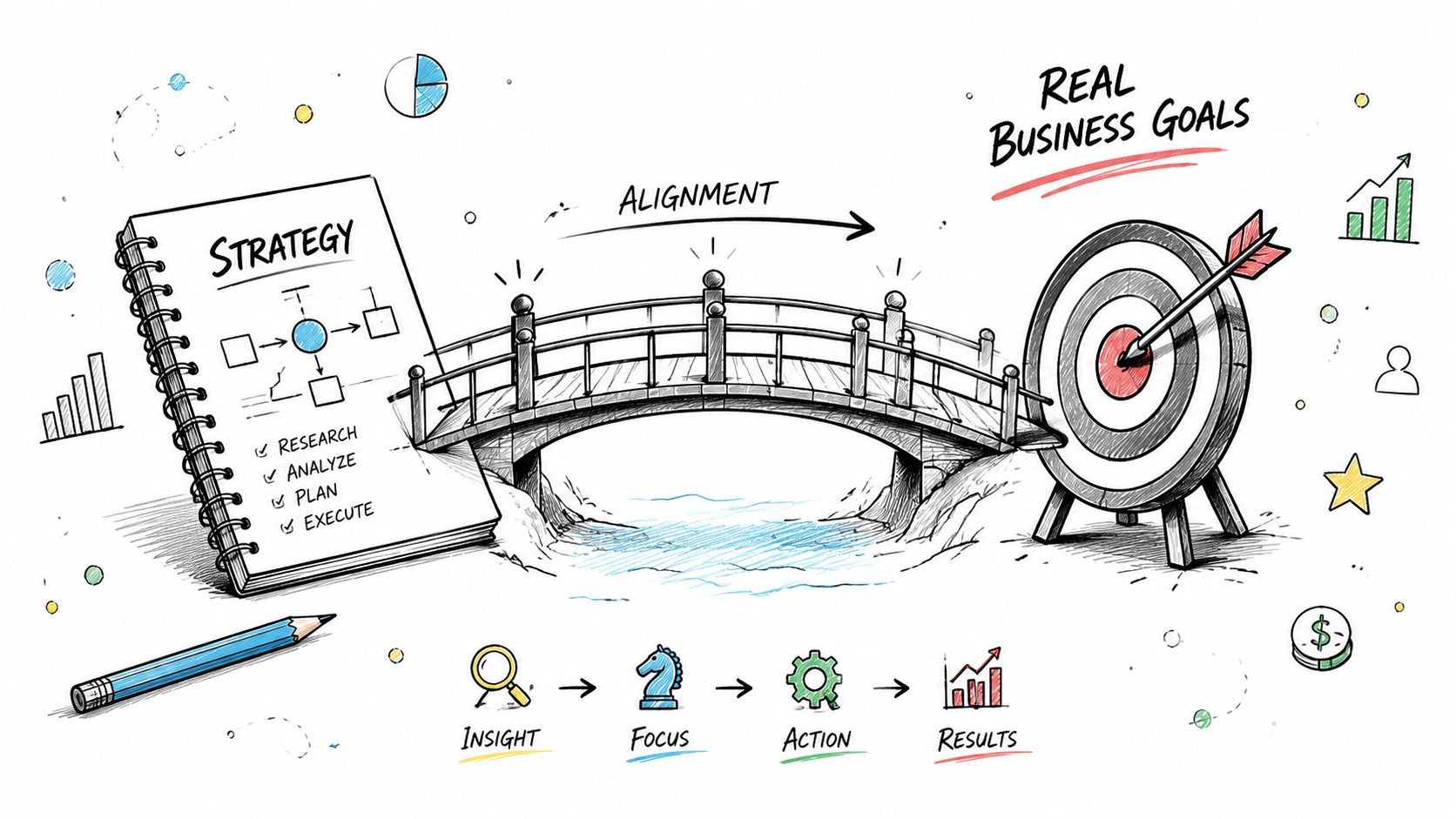
A strong strategy changes how each channel behaves. Paid media stops being a slot machine, SEO stops being a pile of disconnected articles, and email stops being a generic blast with nice formatting. The channel is just the delivery system, the strategy decides whether it deserves budget at all.
Paid Acquisition
Strategic paid acquisition starts with audience fit and economics, not with “let's boost a post.” A founder selling a niche B2B product might test one tightly defined audience, one message, and one conversion event before scaling. That approach keeps spend tied to learning, because every campaign answers a question about who responds and why.
Tactical paid acquisition does the opposite. It chases reach, likes, or low-effort clicks and calls it momentum. The problem isn't that paid media is bad, it's that undisciplined paid media can make you feel active while hiding weak targeting or weak offers.
For practical media planning discipline, see media strategy.
SEO and Content
SEO strategy works when content is mapped to intent. Instead of writing random posts because the publishing calendar is empty, a team builds topic clusters around the questions buyers ask before they convert. That way, content is doing acquisition work, not just occupying a blog.
A tactical SEO approach chases whatever keyword sounds relevant. A strategic one prioritizes commercial intent, internal linking, and conversion paths. The difference shows up in whether the content helps a reader move toward a demo, a signup, or a quote request.
Email and CRM
Email strategy is about sequence and segmentation, not volume. A startup with a CRM can create different nurture paths for leads who requested a demo, downloaded a guide, or abandoned a signup. Each path should reflect what the person already told you about their intent.
A “batch and blast” newsletter treats every contact the same, which usually means the message is too generic to move anyone. Strategic email respects timing, lifecycle stage, and next step. It supports the acquisition system by turning early interest into qualified pipeline instead of one-off opens.
Measuring Success Key KPIs for Your Acquisition Strategy
If you can't measure it, you can't manage it, and if you can't manage it, you can't scale it with confidence. The purpose of measurement is not to decorate a dashboard, it's to let you compare channels, spot risk, and make trade-offs under budget constraints. That's why a good acquisition strategy tracks both leading signals and business outcomes. For a practical dashboard lens, see the metrics that actually matter in 2026).
KPI | What It Measures | Why It Matters for Your Strategy |
|---|---|---|
Cost per Click | The cost of getting a click from a channel | Useful for judging traffic efficiency, but only as an early signal |
Conversion Rate | The share of visitors or leads who complete the next step | Shows whether the offer, page, or workflow is persuasive |
Customer Acquisition Cost | What it costs to acquire a customer | Tells you whether the channel can support the business model |
Lead-to-Customer Rate | How many leads become customers | Reveals the quality of traffic and the strength of follow-up |
Time to Conversion | How long it takes someone to become a customer | Helps you understand sales-cycle friction and cash-flow pressure |
Retention Signal | Whether acquired customers stay and continue engaging | Shows whether acquisition is producing durable value |
Read the numbers in context
A strong metric can still mislead you if you read it in isolation. Low click costs are great until you discover the traffic never converts. Fast conversion is nice until you realize those customers churn because the fit was wrong. The right question is always whether the number helps you choose a better next move.
That's the job of KPIs in an acquisition strategy, to support tradeoff decisions. If one channel is cheap but low quality, and another is slower but produces better customers, the strategy should make that trade visible. A founder who sees the full picture can spend with more confidence and less regret.
Your First Steps to Building an Acquisition Blueprint
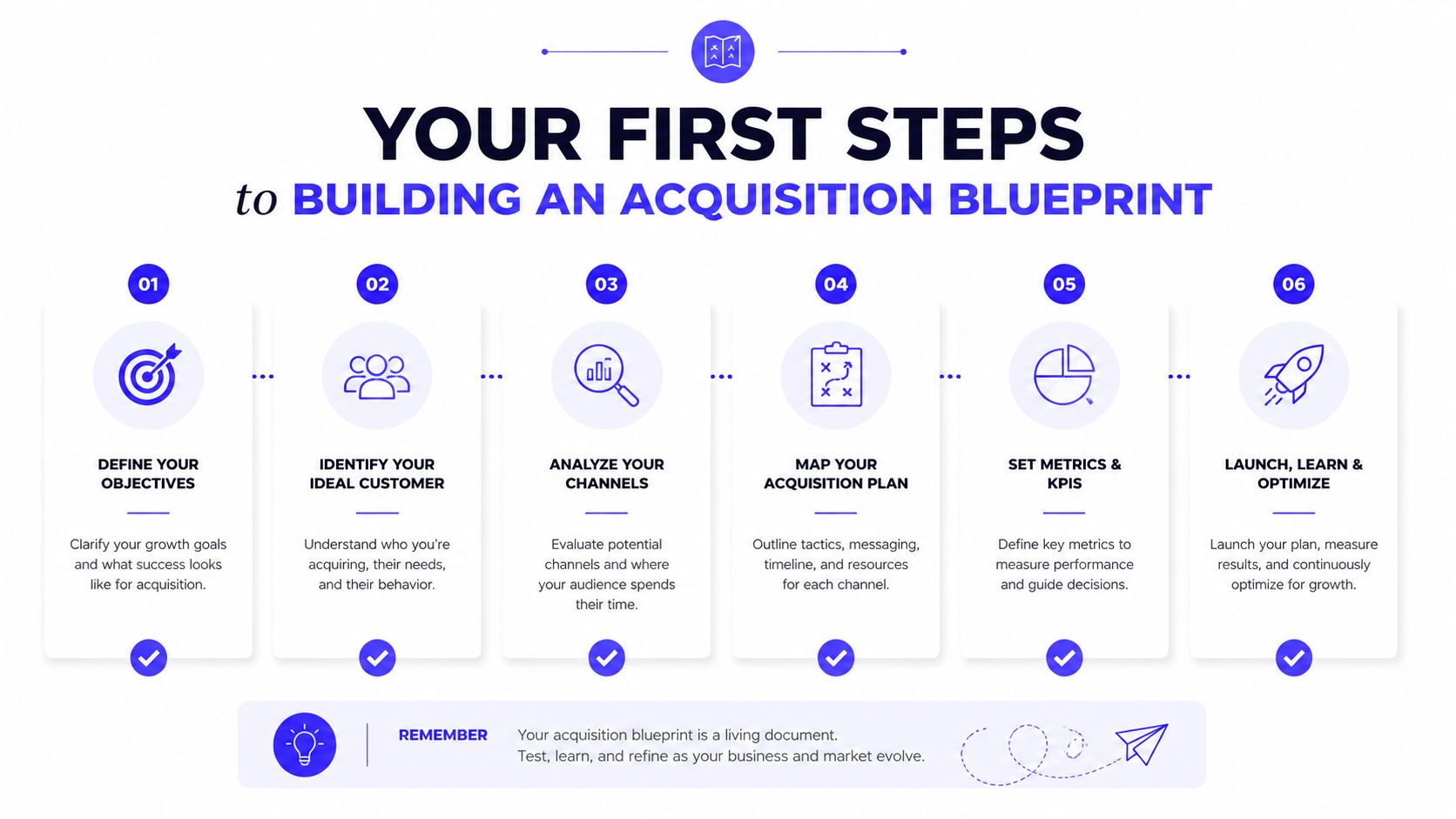
Start small. A V1 acquisition blueprint does not need to cover every channel, every persona, or every possible conversion path. It needs to de-risk your spend and prove that growth is being created on purpose.
The simplest version
Write one Ideal Customer Profile page. Keep it tight, with role, pain point, buying trigger, and the reason they would care now.
Pick one primary acquisition channel. Choose the channel most likely to reach your audience efficiently, then focus on learning before expanding.
Define one conversion event. Decide what counts as success, such as a demo request, trial signup, or qualified inquiry.
Set up basic tracking. Make sure you can see where the lead came from and what happened after the click.
Review results on a fixed schedule. Compare cost, conversion, and downstream quality before increasing spend.
Only add another channel when the first one is understood. That keeps the system from turning back into chaos.
This is the same logic that protects buyers from overpaying in acquisition-heavy deals. When assumptions are loose, people buy optimism. When the blueprint is tight, they buy evidence.
A simple blueprint is not small thinking. It's how you avoid funding the wrong thing for too long.
If you want help turning scattered marketing into a system you can trust, Du Marketing builds acquisition, lifecycle, and analytics into one operating model for startups. The work is practical, hands-on, and designed to connect spend to revenue without the usual handoff chaos.