What Is B2B Lead Generation: A Complete Guide for 2026

You've got the spreadsheet, the CRM, the ad account, and maybe a half-working email sequence. Leads are coming in, but sales keeps calling them junk, the founder keeps asking for pipeline, and nobody can tell which channel deserves more budget. That's usually the moment people ask what is B2B lead generation, but the problem isn't the definition. It's that the business doesn't have a system.
B2B lead generation is the operating system that turns attention into sales-ready conversations. In practice, it's the connected mix of channels, data, qualification rules, and follow-up that identifies the right companies, attracts them, and moves them into a state where sales can work them properly. The modern version is multi-channel by default, with email used by 87%–88% of businesses for lead generation, social media by 78%, and cold calling by 37%, while LinkedIn is used by 97% of B2B marketers who use social for lead generation (2025 B2B lead generation report).
Table of Contents
A Startup Without a Lead Generation System
The founder opens three tabs before lunch. One shows LinkedIn ads, one shows form fills in the CRM, and one shows an email tool with a decent open rate and almost no replies. Sales says the leads are weak. Marketing says the landing page converts. The founder just wants to know why there's still no pipeline.
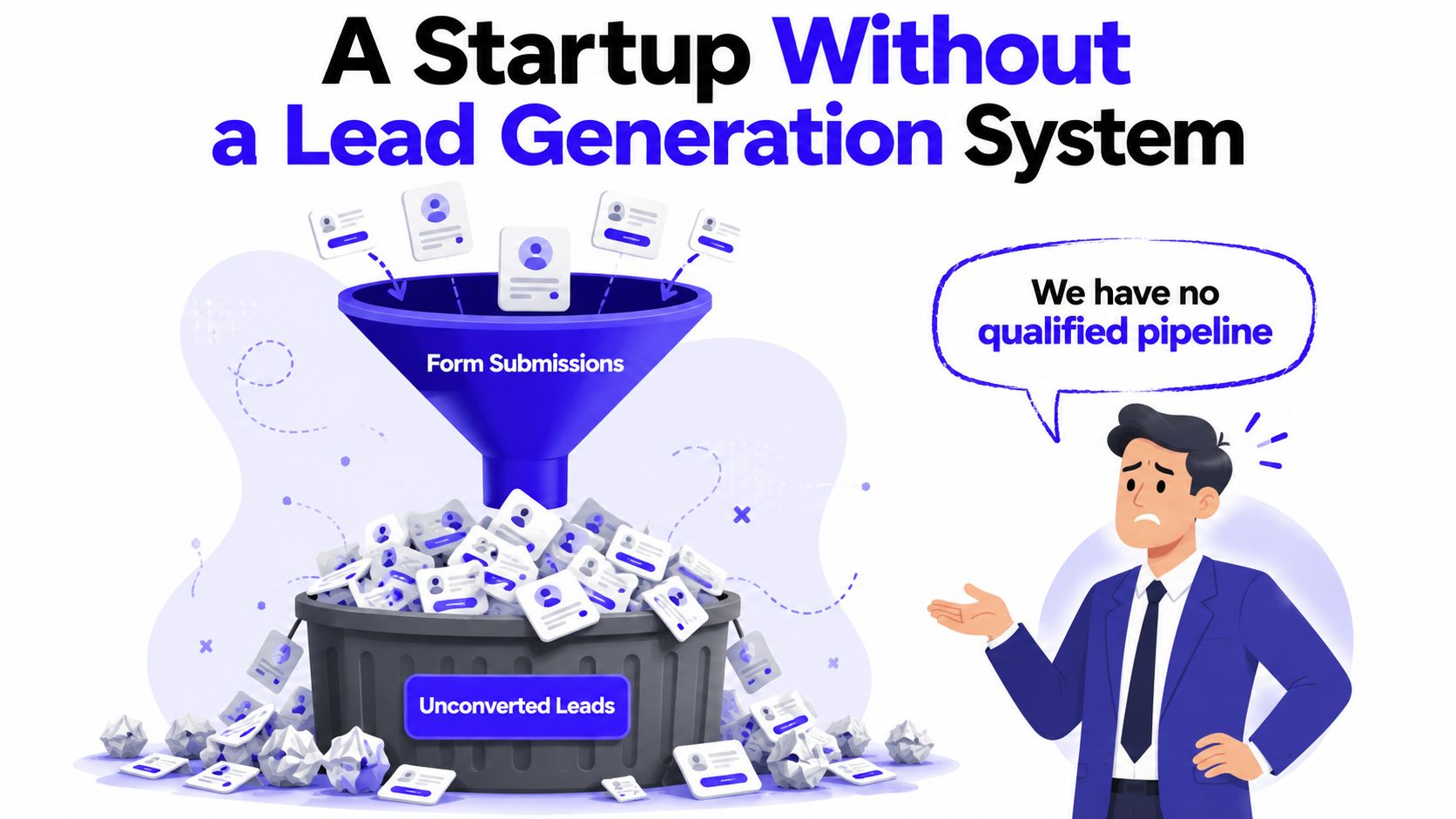
That mess is exactly why the textbook answer to what is B2B lead generation falls short. Lead generation isn't a form, a campaign, or a list of names. It is the connected process that turns strangers into sales-qualified leads, with qualification and nurturing built into the motion rather than bolted on after the fact, as framed in this operational definition and multi-channel framing.
A startup with no system usually has activity, not a revenue motion. Someone is running ads, someone else is sending follow-up emails, and a third person is exporting CSVs into a CRM, but nobody owns the handoff between steps. The useful definition is operational, not academic. B2B lead generation is the machine that identifies the right accounts, attracts them through the right channel mix, and converts them into a state sales can work.
The same pattern shows up in the channel mix. Email, social, cold calling, and LinkedIn all show up in real programs, but their value depends on whether they feed the same qualification rules and CRM stages, not on whether a team can cite a channel benchmark. A startup that only collects contacts does not have lead generation. It has contact collection.
Practical rule: if sales can't tell you where a lead came from, what it did next, and why it was routed, you don't have a system yet.
One useful way to audit the setup is simple. If the ad platform, email tool, and CRM each tell a different story, the business is running disconnected tactics. If the marketing path and sales path share the same definitions, the same lifecycle stages, and the same source data, it starts to behave like a revenue system rather than a pile of campaigns. For a startup that needs outside help building that operating cadence, this kind of fragmentation is often the signal to revisit the internal model and decide whether a fractional CMO for startups makes sense.
The Lead Generation Funnel From Demand to SQL
A clean funnel starts before the form fill. In B2B, buyers often begin by searching, scrolling, comparing, and trying to understand the problem before they ask for a demo. That is why a workable system separates demand creation, demand capture, and nurture instead of treating every lead as if it entered through the same path.
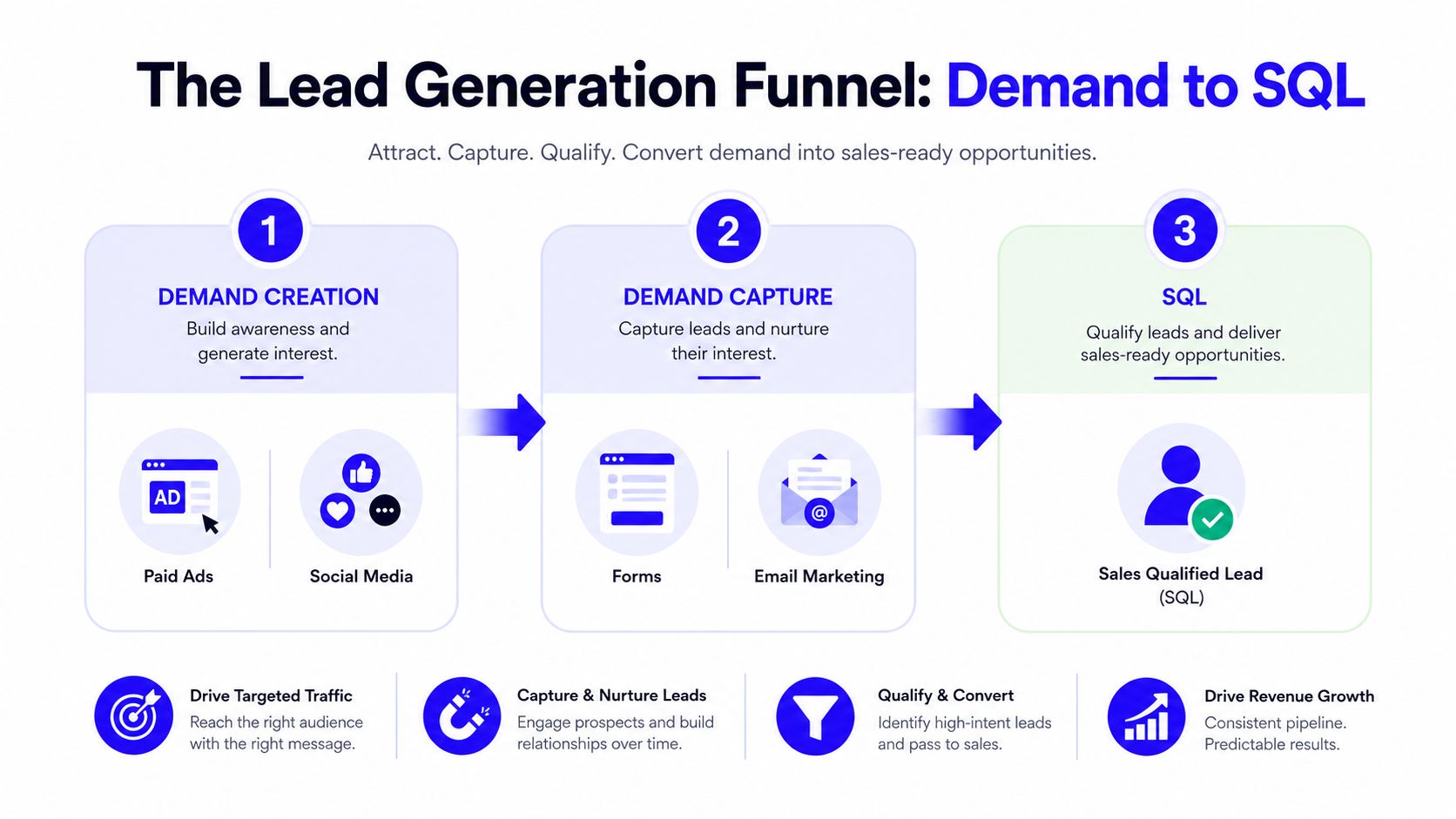
Demand creation
Demand creation is the part many founders underinvest in because it rarely converts right away. It includes content, ads, social posts, and educational pages that shape future intent before a buyer is ready to raise a hand. If a SaaS startup launches a new analytics feature, a prospect might first encounter it through search or a social post that explains the problem it solves.
Awareness-stage SEO and content do their real work here. They keep the company visible while the buyer is still defining the category, not just comparing vendors. Teams often separate this from broader qualification work, which is why the distinction between lead capture and pipeline creation matters in newer playbooks, especially once you start mapping how leads become MQLs before they ever reach sales. For a closer look at that handoff, see understanding marketing qualified leads.
This stage should be measured by whether it moves the right audience toward the next step, not by attention alone. Visibility without movement looks good in a dashboard and does little for pipeline. If the content attracts the wrong people, the funnel gets noisier, not stronger.
Demand capture
Demand capture is where the buyer shows intent. The prospect lands on a page with a clear offer, fills out a form, books a demo, or engages with a page that already matches what they were looking for. This is the high-intent layer, so landing pages, direct calls to action, and fast routing matter more than clever branding.
The weak point is usually the handoff. If the page asks for too much information, or if the lead sits too long before it reaches the right owner, conversion drops fast. The capture stage should stay tight, visible, and easy to measure because it is the point where marketing stops generating interest and starts creating a sales conversation. Teams often separate this from broader qualification work, which is why the distinction between lead capture and pipeline creation matters in newer playbooks (pipeline system framing).
Nurture
Nurture is the bridge between interest and readiness. Email automation, lifecycle segmentation, and CRM workflows keep the lead warm until the timing matches the buying stage. That is not a polite follow-up sequence. It is the mechanism that turns a non-ready inquiry into a future opportunity.
A lead that isn't ready today still has value if your CRM knows how to re-engage it later.
Definitions that stop at lead collection fall apart here. A real funnel has a measurable handoff at every stage, plus an owner for each one. Without that, leads disappear between search, form fill, nurture, and sales, and the team only notices when pipeline dries up.
The Six Core Channels and Where Each One Fits
A mature B2B lead generation setup usually touches six channels, even if the startup doesn't run them all at once. The mistake isn't using too many channels. The mistake is launching them without a clear intent match, an owner, or a feedback loop. Channel count alone doesn't create pipeline, operating cadence does.
Paid ads and SEO
Paid ads are the fastest way to capture existing intent or create very targeted reach around a defined offer. They're useful when the team needs controlled tests, clear audience targeting, and quick feedback on messaging. For startups, paid is usually the most visible channel, which is why many teams start with a small pilot and only scale once the measurement layer is trustworthy.
SEO works differently. It compounds around discovery and discovery-plus-intent, especially when buyers are actively researching a category or solving a problem. The strongest use case is matching high-intent search with a page that answers the query cleanly, then routes the reader into a next step.
Content and email plus CRM
Content is the trust layer. It gives buyers a reason to keep paying attention before they're ready to talk. Good content doesn't try to sell everything at once. It makes the company easier to evaluate.
Email and CRM are the conversion layer. Once someone has engaged, the job shifts to segmentation, lifecycle automation, and lead scoring. The critical point for startups is whether they build a usable funnel or create a mess of one-size-fits-all nurture.
Events and outbound
Events are for relationship density. They work best when the offer benefits from live conversation, peer context, or high-trust relationship building. They're slower than paid, but often stronger for account penetration.
Outbound is for precision prospecting. It's useful when the team knows exactly who it wants to reach and can't wait for demand to surface on its own. The challenge is simple, though. Outbound that isn't matched to buyer stage becomes spam. Outbound that's well timed can accelerate qualification quickly.
Channel | Best Fit | Startup Reality |
|---|---|---|
Paid ads | Fast capture and testing | Best when measurement is solid |
SEO | Ongoing discovery | Slow to start, strong over time |
Content | Trust and education | Needs consistency more than volume |
Email plus CRM | Nurture and conversion | Useless without clean data |
Events | Relationships | Stronger for focused accounts |
Outbound | Direct prospecting | Works only with clear targeting |
The channel mix in the market reflects this portfolio approach. Independent roundups place email, paid social, paid search, and SEO among the most commonly used lead channels, which is another sign that modern programs rarely rely on a single motion (lead channel mix). If you're validating LinkedIn specifically, it's worth separating organic prospecting from paid campaigns. A useful breakdown of the paid side is in this LinkedIn advertising guide for B2B.
Operator's note: don't stack all six channels in month one. Pick the channel that matches your buyer's current stage, then prove that you can measure and repeat it.
Metrics and Attribution That Make the System Honest
A channel can look healthy and still be hurting pipeline. That is why top-of-funnel numbers do not get the final say. The metrics that matter tie spend to qualified opportunities, not just clicks to forms. If a lead cannot be traced through the CRM, the dashboard is decoration.
The metrics that matter
The first number early-stage startups usually watch is cost per lead, but CPL only matters if the lead is viable. A cheap lead that never reaches sales is still expensive. The next number worth watching is the MQL-to-SQL rate, because it shows whether marketing is sending sales something worth touching.
After that comes pipeline velocity, which shows how quickly qualified leads move toward opportunity and revenue. Strong programs also watch lead-to-opportunity and revenue by source, because that is where scaling decisions get real. Salesforce notes that reliable lead scoring depends on clearly defined criteria, regular score updates, and a CRM that tracks activity history so teams can see which touches create sales-ready leads (Salesforce lead generation guide).
Practical rule: scale the channel that produces qualified pipeline at an acceptable cost, not the channel that makes the dashboard look busy.
The attribution stack you need
Start with standardized UTMs. If every campaign uses a different naming convention, reporting gets fuzzy fast. Then connect tracking through Google Tag Manager and GA4 so form fills, clicks, and key page actions are recorded consistently.
The next layer is CRM sync. The CRM has to know where the lead came from, what it did, and whether sales accepted it. Lifecycle automation and lead scoring turn that raw activity into something usable instead of theatrical. For paid channels, server-side events and conversion uploads close the loop so ad platforms can optimize toward downstream actions rather than superficial engagement.
Attribution is not a reporting add-on. It is the evidence layer that shows whether the system is producing economically viable pipeline. Without it, the team ends up spending money on what looks busy instead of what converts.
A 30-Day Implementation Checklist and Sample Workflow
A startup doesn't need a six-month transformation to get the basics right. It needs a clean month of setup, testing, and repair. The goal isn't perfection. The goal is to make sure every lead can be traced, scored, routed, and reviewed without guesswork.
Week-by-week rollout
Week | Focus Area | Key Deliverable |
|---|---|---|
Week 1 | Tracking conventions | UTM naming rules, campaign taxonomy, source fields |
Week 2 | Analytics setup | GTM container, GA4 events, form and CTA tracking |
Week 3 | CRM design | Lifecycle stages, required fields, lead source mapping |
Week 4 | Scoring and routing | Lead scoring rules, handoff logic, sales notifications |
The sequence matters. If you build scoring before source tracking, the score has no context. If you build CRM fields before agreeing on naming, the data gets messy immediately. The first pass should be boring and standardized, because inconsistent labels are what break reporting later.
A simple working workflow
A LinkedIn ad click lands on a page with one offer and one conversion path. The form submits into the CRM with source, campaign, and lifecycle fields already mapped. A scoring rule increases priority when the lead matches the ideal customer profile and shows a high-intent action.
At that point, the lead gets routed. If it qualifies, sales gets the alert and follows up. If it doesn't, it enters a nurture sequence instead of being ignored. That's the difference between capture and conversion, and it's why the workflow needs to live in the CRM, not in someone's inbox.
Offline conversion uploads matter because they let ad platforms learn from actual downstream outcomes, not just clicks. That feedback loop is what turns spend into a managed system instead of a guessing game. Once the loop works, every new campaign becomes easier to evaluate because the data has a memory.
Common Mistakes That Break B2B Lead Generation
Most weak programs don't fail because the market is impossible. They fail because the internal setup is sloppy. The warning signs are usually obvious if you're willing to look at the right reports.
Vanity numbers and broken reporting
The biggest trap is celebrating MQL volume while ignoring how many of those leads ever reach closed-won. If marketing keeps reporting more top-of-funnel names while sales keeps rejecting them, the problem isn't lead volume. It's qualification. The right diagnostic question is whether the team can rebuild the funnel from CRM data alone without leaning on a separate dashboard.
Another common issue is attribution that can't survive contact with the CRM. If the channel report says one thing and the opportunity report says another, the team is making budget decisions on bad evidence. That's dangerous because it rewards channels that are easy to measure, not channels that create real pipeline.
Channel sprawl and lazy nurture
A startup can also break itself by trying to run too many motions at once. Paid, SEO, outbound, events, and nurture all need owners, or they turn into a pile of half-finished tasks. Channel sprawl creates the illusion of progress while every channel starves for attention.
Nurture is another place teams get sloppy. Sending the same sequence to the entire list ignores intent and lifecycle stage. Leads who have already booked a demo should not get the same content as contacts who only downloaded a guide.
If the same email goes to everyone, the CRM isn't doing lifecycle marketing. It's doing mass mailing with extra steps.
The last mistake is scaling spend before the measurement layer is trustworthy. That's how startups burn through budget while they're still arguing over source definitions. Fix the plumbing first, then scale the channels that can survive attribution scrutiny.
Working With an Integrated Growth Partner and Next Steps
At some point, the question stops being “can we do this?” and becomes “who should own the system?” If one person is juggling paid, SEO, email, CRM, and attribution, the bottleneck will show up fast. That's usually when startups start looking for an integrated growth partner instead of another isolated specialist.
The right signal isn't just workload, though. It's maturity. If the team already has enough channel complexity that each motion affects the others, the work needs one operating cadence. Paid spend should not be scaled until tracking is clean, CRM feedback is reliable, and the same person or team can see the whole path from click to opportunity.
A useful evaluation framework is straightforward. Ask whether the partner owns strategy and execution together, whether they can ship UTMs, GTM, CRM, and ads as one system, and whether they report on pipeline rather than impressions. If they can't connect the data to revenue, they're not managing lead generation. They're managing activity.
Start with a short audit. Check source consistency, lifecycle definitions, lead scoring, routing logic, and how often sales feedback reaches marketing. If those pieces are already messy, the next best move is usually not more campaigns. It's a tighter operating model.
If you're at the point where the channels exist but the system doesn't, reach out to Du Marketing. A short audit can show where your tracking breaks, which channel deserves budget, and what needs to be fixed before you scale.