Fractional CMO for Startups: A Founder's How-To Guide

You're probably in one of two modes right now. Either marketing has become the founder's second full-time job, which means you're bouncing between pricing pages, ad accounts, CRM fields, and freelancer briefs. Or you've already hired help, but SEO, paid media, content, email, and analytics now operate like five separate companies that happen to invoice you every month.
That's the moment when founders start looking for a fractional CMO for startups. The mistake is assuming the job is “get senior strategy.” Strategy is the easy part to buy. The hard part is finding someone who can turn a messy startup marketing setup into an operating system that produces pipeline, shows where revenue came from, and doesn't require you to referee every handoff.
The two questions that matter most are rarely the first ones founders ask. Will this person execute, or just delegate? And will they own attribution all the way to revenue, or stop at traffic and leads? If you get those wrong, you won't hire a growth partner. You'll hire an expensive narrator for your existing chaos.
Table of Contents
The Startup Marketing Litmus Test
Monday morning. The founder is reviewing ad copy, the sales lead is questioning lead quality, and a freelancer is waiting on feedback for a landing page that should have shipped last week. GA4 is installed, but nobody trusts what it says. Revenue is coming in, yet no one can explain which message, channel, or offer drove it.
That is usually the moment a startup starts talking about senior marketing help.
The key question is not whether marketing feels busy. The question is whether anyone owns the system from message to pipeline to revenue, and whether that person will do the work required to fix it.
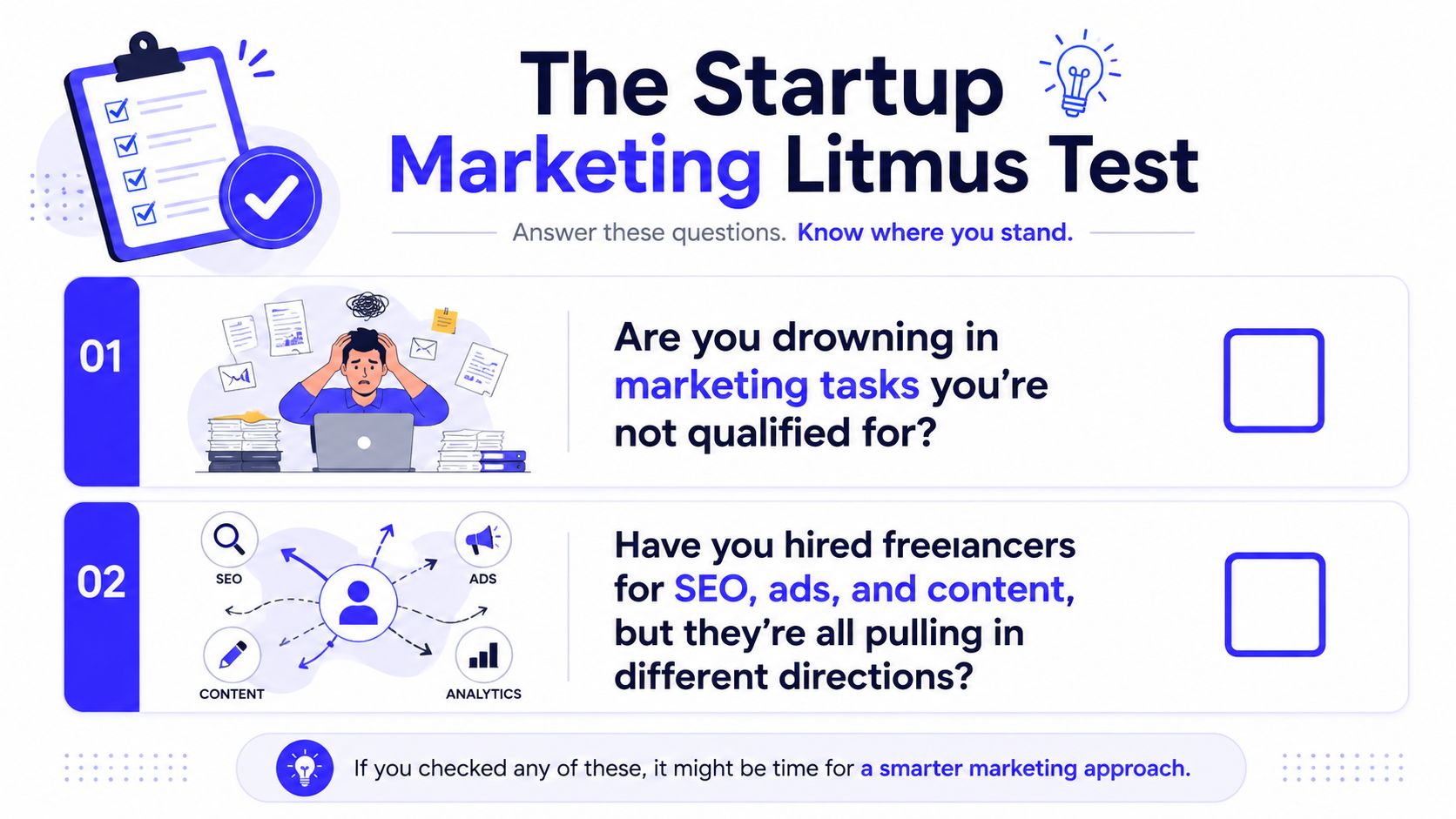
Five signs the current setup has run out of road
A startup usually needs a fractional CMO for startups when the same operational failures keep showing up across channels, reporting, and team handoffs.
The founder is still the integrator: Agencies, freelancers, and internal hires all depend on the founder to set priorities and resolve conflicts. Messaging, spend, offer strategy, funnel stages, and sales feedback never come together under one owner.
Marketing activity is fragmented: SEO targets one problem set, paid campaigns target another, and sales hears objections that never make it back into the site, email flows, or ad creative.
Reporting exists but nobody can use it: The dashboard has charts, but nobody can answer which campaigns create qualified pipeline, which ones create noise, and where attribution breaks between first touch and closed revenue.
Budget calls are reactive: Spend rises or falls based on stress, not evidence. In practice, that usually means no one has cleaned up tracking, channel accountability, or conversion definitions.
Execution dies between strategy and launch: Good plans sit in docs and project boards because the person leading marketing is advising from the side instead of carrying key work through build, QA, launch, and review.
A simple test helps here. If marketing slows down every time the founder steps out of the loop, the business does not have marketing leadership. It has scattered contributors.
That is also where many startups make the wrong hire. They bring in a part-time strategist who can diagnose problems, run a workshop, and hand work off. What they needed was a hands-on operator who would fix attribution, tighten the funnel, brief the landing page, review the CRM stages, and launch the first campaigns personally. Founders should use a structured startup marketing audit template before hiring, because it shows whether the gap is strategic guidance, execution ownership, or both.
When a fractional CMO is the wrong hire
A fractional CMO is not a rescue plan for a company that is still changing its customer, offer, and sales motion every month.
The model tends to work best once there is a real product, a defined buyer, and enough commercial signal to improve. It tends to disappoint when the startup is still guessing at basics, has too little budget to test and learn, or expects a part-time leader to fix a broken product. Strategic Pete makes a similar point in his breakdown of where fractional CMO engagements fit and where they fail: https://strategicpete.com/blog/fractional-cmo-for-startups-scalable-growth/
In practice, the cutoff is simple. If the business still needs founder-led customer research, sharper packaging, or sales process repair, do that first. A fractional CMO can build a growth engine. They cannot manufacture fit that is not there.
The litmus test is less about title and more about readiness. If the startup needs someone to own revenue attribution end to end, make channel decisions tied to pipeline, and execute the first layer of work instead of just delegating it, the role can pay for itself fast. If the company only wants advice, it should expect advice-level results.
Defining Scope and Budget Without Guesswork
Most hiring mistakes happen before a candidate ever joins. The founder says they need “strategy,” the marketer says they provide “leadership,” and three weeks later everyone learns those words meant completely different things.
Scope needs nouns and verbs. Who builds the dashboard? Who fixes GTM and GA4? Who manages the LinkedIn Ads account? Who briefs the landing page? Who joins sales calls? If those aren't written down, the startup buys ambiguity.
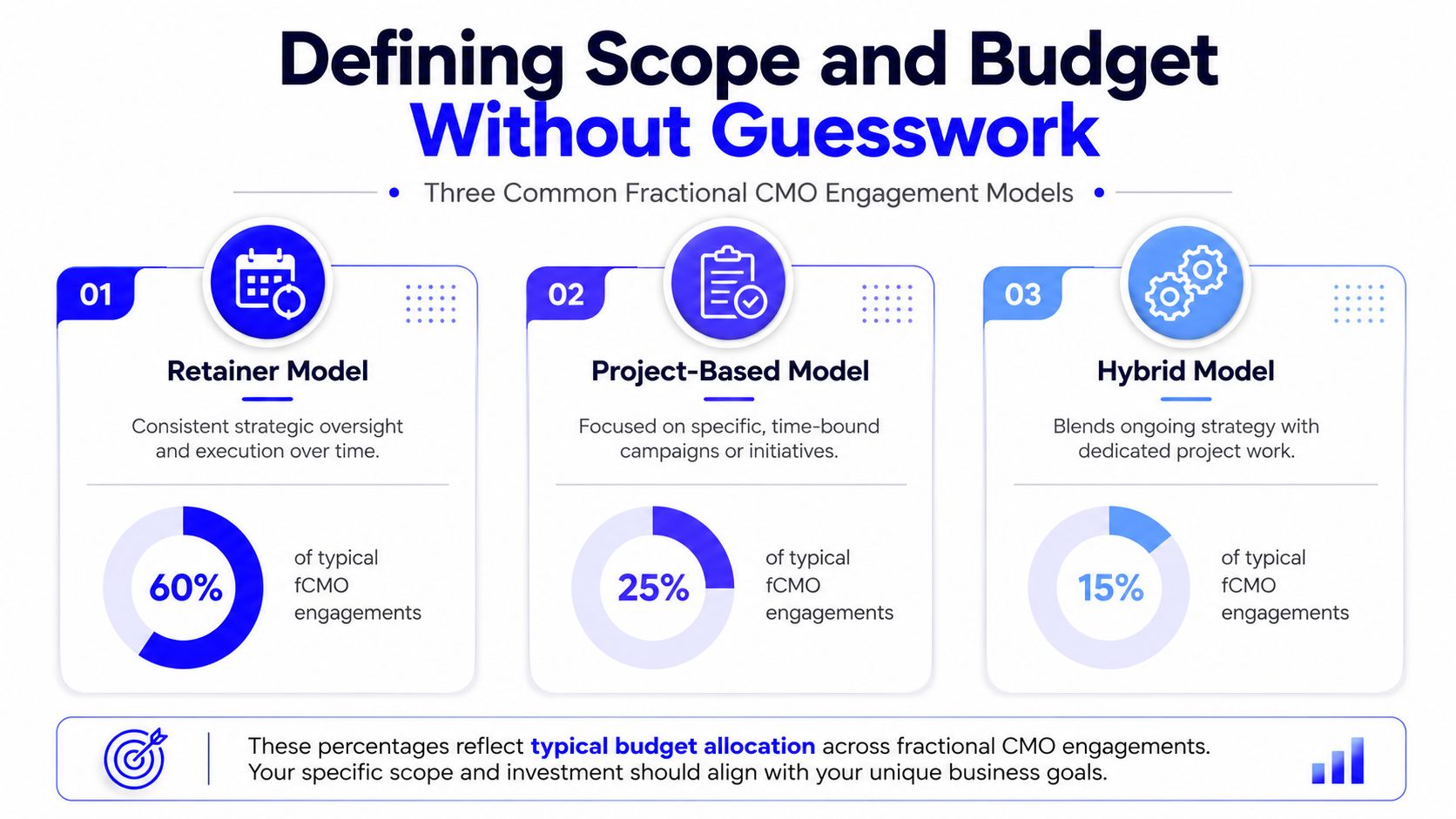
Three engagement models that look similar but aren't
Here's the practical difference between the common models.
Model | What it usually means in practice | Best fit | Main risk |
|---|---|---|---|
Strategist | Reviews positioning, channel choices, and planning cadence | Founder needs direction and team coaching | Nothing gets shipped without other operators |
Strategist-manager | Sets priorities and manages vendors or internal specialists | Startup already has channel resources | Founder still inherits execution quality if oversight is weak |
Player-coach | Owns strategy and personally builds or fixes the first critical pieces | Startup needs speed, clarity, and implementation | Scope can sprawl if boundaries aren't explicit |
The third model is the one most startups need first. Early-stage companies don't benefit much from a pure ivory-tower CMO. They need someone who can open HubSpot, inspect lifecycle stages, audit GTM triggers, rewrite the offer hierarchy, and launch the first campaigns without waiting for a committee.
That doesn't mean the fractional CMO should do everything forever. It means they should be willing to do the first hard yards themselves so the system starts clean.
What a real scope of work should include
Pricing only makes sense after scope is concrete. According to GTM 80/20's salary benchmarks for startup fractional CMOs, fractional CMOs for startups typically cost $5,000 to $15,000 per month. The same source states that early-stage startups often pay $3,000 to $8,000 for 10 to 15 hours weekly, which represents a 50 to 70% savings compared with a full-time CMO whose total compensation usually ranges from $160,000 to over $300,000.
Those benchmarks are useful, but the more important question is what you're buying.
A serious scope usually includes items like:
Measurement infrastructure: GA4, Google Tag Manager, standardized UTMs, CRM source mapping, and channel naming conventions
Revenue reporting: A dashboard that ties spend, leads, opportunities, and closed revenue into one view
Messaging work: Positioning adjustments, core homepage narrative, offer packaging, and sales enablement feedback loops
Channel ownership: Direct management of the first priority channels, or clear accountability for the people running them
Operating cadence: Weekly growth review, monthly planning, and decision logs tied to budget changes
If you need help structuring the audit piece before you define the role, a marketing audit template for startup teams can help turn “we need marketing help” into a list of actual problems.
The fastest way to overpay is to buy senior words with junior deliverables hidden underneath.
A good scope also distinguishes between ownership and support. “Oversee paid media” is soft language. “Manage a monthly paid media budget, approve creative, review search terms, and make weekly budget reallocation decisions” is real language.
When the scope is sharp, the budget conversation gets easier. You stop comparing titles and start comparing outcomes.
How to Hire Your Marketing Co-Pilot
Resume theater is a bad hiring method for startup marketing. Big logos look reassuring, but they don't tell you whether the person can function inside your mess.
A startup doesn't need a ceremonial executive. It needs a co-pilot who can manage low headcount, uneven data, impatient stakeholders, and a sales team that may already distrust marketing. That's a very different job from running a polished department with layers of support.
The execution gap you need to screen for
This is the trap most founders fall into. They hire someone who speaks beautifully about brand, segmentation, and growth loops, then discover that every meaningful task gets delegated to freelancers the founder has never met.
According to O-CMO's analysis of startup fractional CMO hiring, 68% of startups fail due to poor execution rather than strategy. The same source highlights an emerging shift toward hybrid fractional leaders who combine strategy with direct execution, including work like building landing pages or setting up GA4.
That statistic matches what founders feel on the ground. Most startups are not starving for frameworks. They're starving for someone who can turn a plan into a functioning system without creating five more dependencies.
Use that fact as your hiring filter. Ask whether the person can directly execute the first high-impact tasks. Not forever, but first. That first phase matters because it determines quality standards, reporting logic, and channel sequencing.
Interview questions that expose real operators
Don't ask, “How would you grow us?” Every polished marketer has a nice answer to that.
Ask questions that force operational detail:
Walk me through the first things you'd audit in our GA4, CRM, and ad accounts.
Which pieces would you personally fix in the first month versus assign to others?
Describe the last landing page you built or rewrote yourself, and why.
How do you connect paid spend to opportunities and closed revenue when the CRM is messy?
If sales says the leads are weak but CPL looks healthy, what do you check first?
Tell me about a time you cut a channel, not because it looked bad on-platform, but because downstream quality was poor.
You're listening for specifics. HubSpot properties. GTM triggers. Offline conversions. CRM stage hygiene. Page structure. Offer testing. If the answers stay abstract, the candidate likely lives upstream from execution.
Ask for the last thing they actually touched with their own hands. The answer is often more useful than their strategy philosophy.
Reference checks should also focus on behavior, not charisma. Did this person move fast? Did they challenge bad assumptions? Did they leave behind a system the team could keep running? Were they comfortable owning uncomfortable truths in the data?
Contract structure matters too. Early startup engagements work best when expectations are clear and the relationship stays flexible. Month-to-month terms, explicit deliverables, access requirements, and ownership boundaries tend to create healthier partnerships than vague long retainers based on trust alone.
The Critical First 90 Days of Integration
A founder hires a fractional CMO because growth has stalled, paid spend feels noisy, and nobody trusts the numbers. Ninety days later, one of two things is true. You either have a working marketing system with clearer attribution, tighter execution, and a few channels starting to produce qualified pipeline, or you have more meetings and a nicer roadmap.
The difference usually comes down to two questions. Did the fractional CMO personally get into the work, or did they stay at the delegation layer? Did they take ownership of revenue attribution end to end, or stop at traffic and lead volume?
The visual below shows the shape of that ramp.
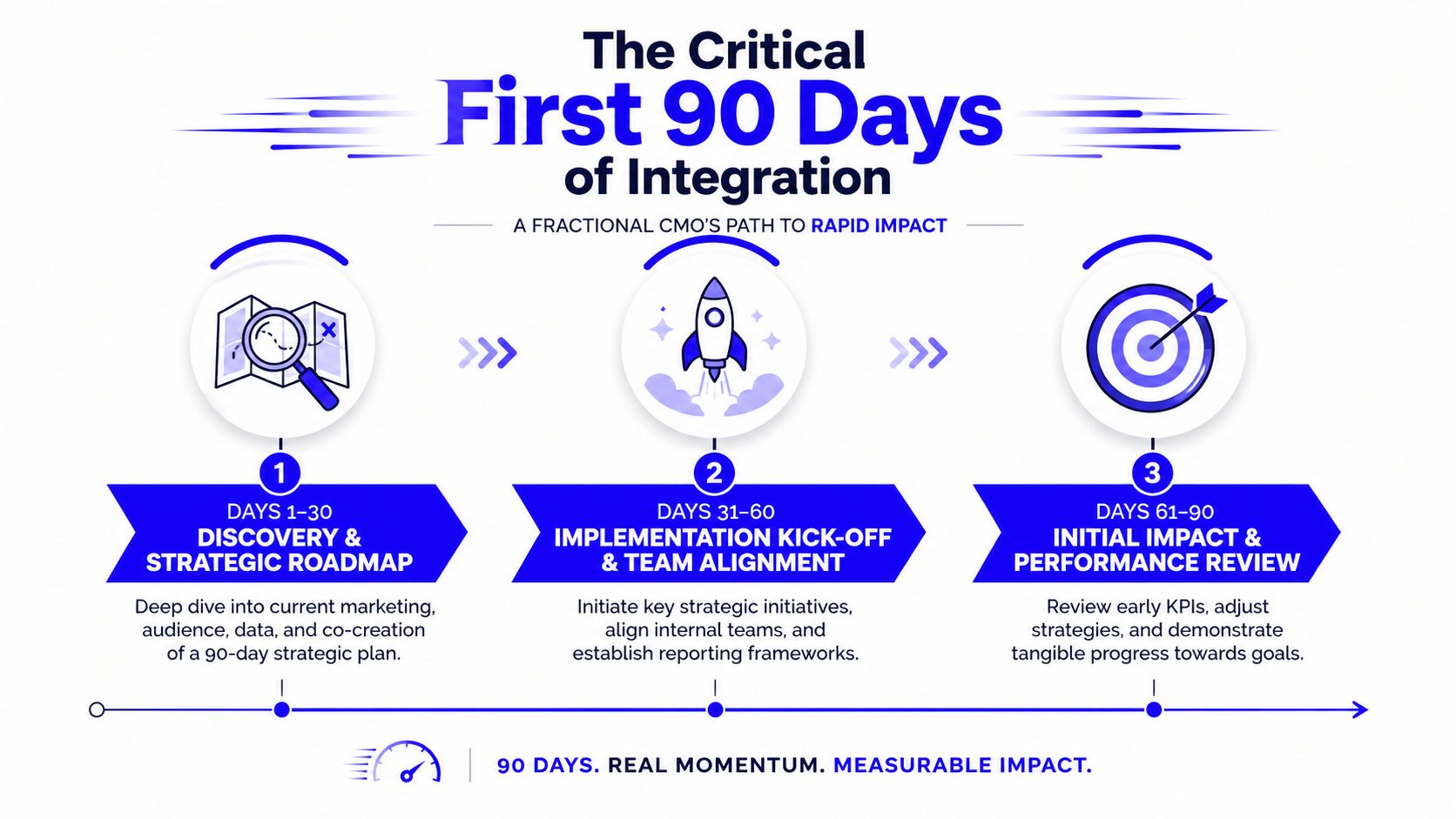
Days 1 to 30 diagnostic before motion
The first month sets the operating standard. A good fractional CMO gets access fast, reviews the systems that matter, and produces a written diagnosis with clear priorities. If that work turns into a broad brand workshop or a long strategy deck, the engagement is already drifting.
Month one should answer a few hard questions with evidence:
What is trackable today, and what is missing
Where leads drop between first touch, qualification, and pipeline creation
Which campaigns produce sales conversations, not just form fills
What the sales team keeps hearing that the website and ads still ignore
What should be fixed now by the CMO directly, and what can wait or be delegated
This is hands-on work. I expect to see the fractional CMO inside GA4, ad accounts, CRM records, call notes, landing pages, and calendar conversion paths. In early-stage startups, the first win is often basic but high impact: fixing source tracking, cleaning lifecycle stages, or rewriting the one page every paid campaign points to.
Sales input matters early, but only if it gets turned into process. If lead definitions, routing rules, and follow-up expectations are still fuzzy, marketing and sales alignment for growth teams becomes an execution problem, not a communication problem.
A strong output at the end of month one looks like a ranked plan. Fix attribution first. Repair CRM stage hygiene second. Rework the demo page and core offer next. Resume channel expansion only after the path from click to opportunity is measurable.
Here's a useful outside explainer on how startup marketing leaders think about the onboarding window:
Days 31 to 60 build the measurement spine
Days 31 to 60 are where good intentions either become infrastructure or disappear into backlog. This phase should produce cleaner data, simpler campaign structure, and assets that are ready to convert traffic into qualified demand.
The work is usually concrete:
Repairing conversion tracking: form fills, booked meetings, qualified opportunities, offline conversions, and revenue events
Standardizing campaign inputs: UTMs, naming rules, source mapping, and CRM field usage
Fixing the money pages: homepage sections, demo pages, paid landing pages, and follow-up flows
Setting a reporting routine: one source of truth, weekly inspection, and clear ownership for anomalies
Trade-offs matter here. A hands-on fractional CMO does not try to rebuild the entire marketing stack at once. They pick the few fixes that make spend easier to judge and pipeline easier to trace. Sometimes that means delaying a channel launch for two weeks so offline conversions are mapped correctly. That is usually the right call. More campaigns on top of broken measurement just create faster confusion.
This is also the phase where you can tell whether the person is an operator or just a coordinator. If every meaningful change is waiting on someone else, progress slows. If they can write the landing page, clean the CRM logic, adjust campaign architecture, and brief specialists only where needed, the startup gets momentum instead of dependency.
Days 61 to 90 prove repeatability
By the third month, the goal is not more activity. The goal is a repeatable path to pipeline you can inspect and improve.
At this stage, the conversation changes. Which audience, offer, and channel combinations create qualified opportunities? Where does paid traffic outperform outbound? Which pages improve meeting rates? Which campaigns look efficient in-platform but produce weak deals or no revenue at all?
A good 90-day integration should leave behind a few things the company can keep using:
A baseline attribution model the team trusts enough to make budget decisions
A small set of channels with early proof of downstream quality
Clear weekly reporting tied to opportunities and revenue, not just lead counts
Documented priorities for the next quarter, based on conversion and pipeline evidence
If those pieces are missing, the startup is still guessing.
The warning signs are easy to spot. Reporting still relies on screenshots from ad platforms. Sales disputes lead quality, and nobody can trace the disagreement to stages or source data. Channel shifts happen because of opinion, not because someone measured conversion to pipeline and closed revenue. In that case, the fractional CMO may have added activity, but they did not install a growth engine.
KPIs That Matter and Reporting That Informs
Founders don't need prettier dashboards. They need reporting that changes decisions.
A lot of startup marketing reporting still centers on metrics that are easy to collect and easy to present: sessions, impressions, MQLs, form fills, cost per lead. Those numbers can be useful diagnostics, but they're terrible substitutes for business truth. They don't tell you whether budget is flowing into revenue or into activity that looks busy.
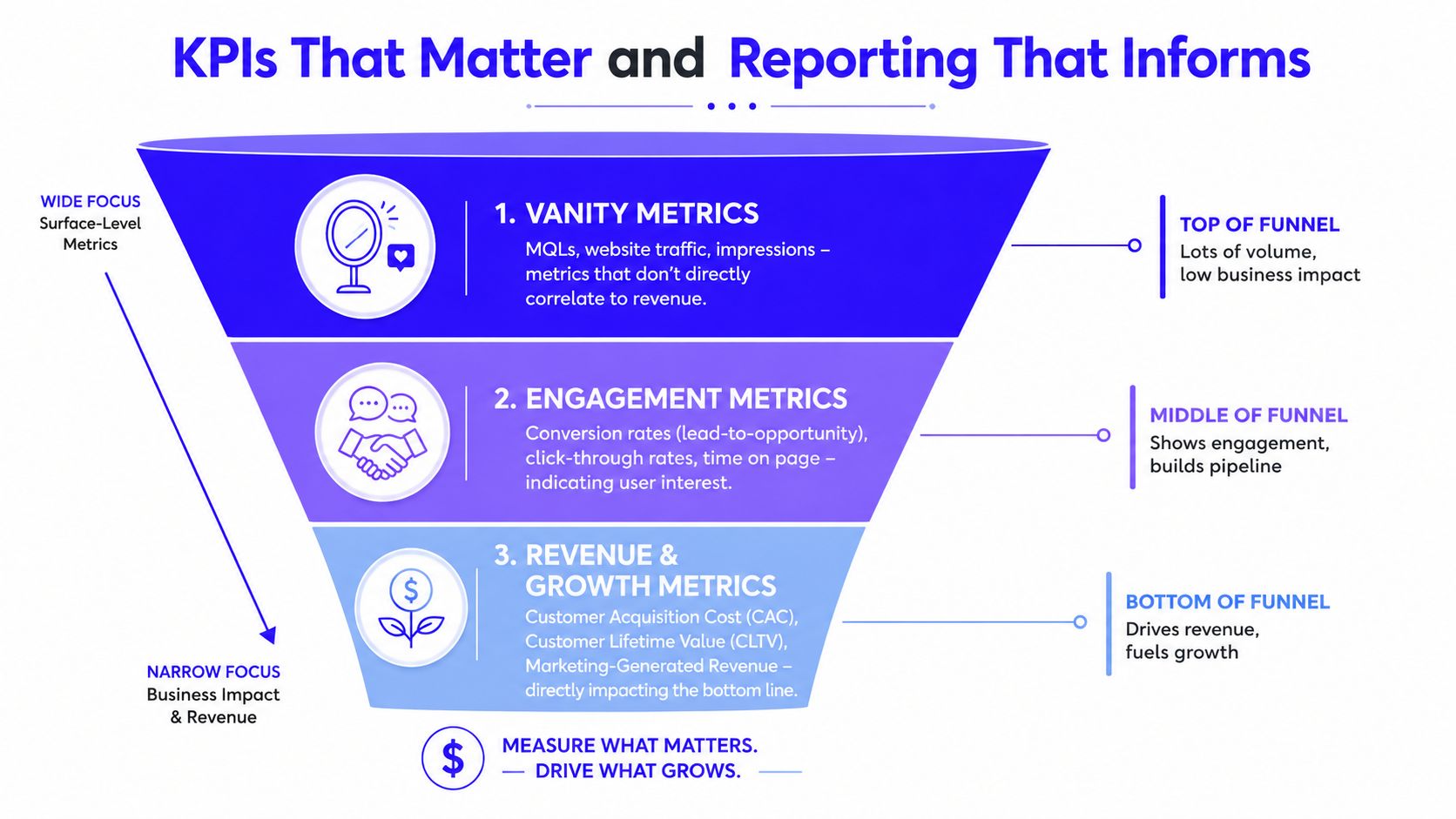
Stop reporting on activity and start reporting on causality
The most dangerous sentence in startup marketing is, “We're getting leads, so the channel is working.”
Maybe. Maybe not.
According to Stranded's analysis of attribution and startup marketing decisions, 74% of B2B startups misallocate budget due to broken attribution. The same source argues that a fractional CMO's primary value lies in installing decision-grade data, including infrastructure like server-side tracking and CRM sync, so teams can connect spend directly to revenue.
That's the difference between reporting and measurement. Reporting shows what happened in platforms. Measurement shows what happened in the business.
A founder should be able to ask questions like these and get defensible answers:
Which paid channels create qualified pipeline, not just leads
Which campaigns influence closed revenue
Where lead quality falls apart between form fill and opportunity
Whether organic content creates opportunities directly or mostly assists branded demand
Whether retargeting is harvesting existing demand or adding incremental value
If your current marketing lead can't own those questions end to end, they don't own the growth engine.
What decision-grade reporting actually includes
Good reporting is less glamorous than often assumed. It's mostly disciplined plumbing and naming hygiene.
A useful stack often includes:
Layer | What it should do | Why it matters |
|---|---|---|
Tracking layer | Capture first-touch and key conversion events with clean UTM logic | Prevents source confusion |
CRM layer | Preserve lead source, lifecycle stage, opportunity status, and revenue outcomes | Connects marketing to sales reality |
Dashboard layer | Show spend, conversions, opportunities, and revenue together | Makes budget decisions faster |
QA process | Regularly check breakage across forms, events, syncs, and campaign tags | Stops silent data decay |
If you're building this internally, a practical overview of marketing reporting automation for startup teams can help map the moving parts.
The dashboard itself should stay lean. I'd rather see one page that clearly connects channel spend to pipeline and revenue than ten pages of attractive clutter. Once attribution becomes credible, budget conversations get calmer. You don't have to defend marketing with adjectives. You can defend it with evidence.
Broken attribution doesn't just create messy reports. It pushes real money into the wrong channels.
That's why a hands-on fractional CMO matters. They shouldn't just request reports from others. They should know how the data gets collected, where it fails, and what needs to be rebuilt before the company scales spend.
Is a Fractional CMO Your Growth Catalyst
A strong fractional CMO for startups doesn't act like a part-time mascot for the marketing team. They function more like an installed operating layer. Strategy, execution standards, measurement, prioritization, and commercial accountability all start running through one brain instead of being scattered across freelancers, founders, and dashboards nobody trusts.
The right hire changes the operating rhythm
The biggest shift isn't just better campaigns. It's better decisions.
Founders stop spending their week translating between channel specialists. Sales starts getting tighter feedback loops on lead quality and messaging. Budget moves for a reason. Landing pages, CRM stages, attribution, and creative testing start behaving like one system rather than a pile of disconnected tasks.
That's why the two hiring questions matter so much. If the person only delegates, the startup keeps paying the coordination tax. If they only report top-of-funnel metrics, the startup still can't tell what's driving revenue. You need someone who will personally get the first engine running, then build the team and process around it.
A bad hire gives you strategy theater. A good one leaves behind a machine the company can keep using.
If your startup has already outgrown DIY marketing, but a full-time executive still feels too early or too risky, this model can be the right middle ground. Not because it's cheaper in the abstract, but because it lets you buy senior judgment where it counts most: channel focus, execution quality, attribution integrity, and speed.
If you want that kind of hands-on help, Du Marketing is built for startups that need one operator to connect paid media, SEO, content, CRM, landing pages, and attribution into a single growth system. The work is practical, audit-ready, and month-to-month, which makes it a good fit for founders replacing fragmented freelancers or agencies with one accountable partner.