Growth Hacking for Instagram: A Startup Playbook

Most Instagram growth advice is still stuck in a 2019 mindset. It tells you to post more, chase trending audio, stack hashtags, and pray that the algorithm feels generous. That playbook is weak now, because Instagram's distribution is bigger, noisier, and far less forgiving, so growth hacking for Instagram only works when you treat the platform like an acquisition system, not a popularity contest.
Instagram reached 3 billion monthly active users by September 2025, while one 2026 summary cites average post reach at only 3.5% of a brand's followers, down from 10% to 15% in 2020, which means follower count alone is a poor growth engine now, and format choice matters more than vanity metrics do (Outfame on Instagram growth statistics). Reels sit at the center of that shift, with reporting that they drive 36% more reach than carousels and 125% more reach than single-image posts, alongside massive consumption at the platform level, including over 200 billion Reels plays per day across Meta platforms (Outfame on Instagram growth statistics).
Table of Contents
Why Growth Hacking for Instagram Looks Different in 2026
Posting more is not a strategy. Trending audio is not a strategy. Hashtag piles are definitely not a strategy. On a platform where organic distribution is thin and paid amplification is normal, the only thing that matters is whether your system can create repeatable attention, then prove that attention turned into action.
The engagement slide makes that obvious. A Buffer-referenced benchmark put median Instagram engagement at 2.94% in January 2024, then 0.61% by January 2025, which shows how quickly attention has diluted as usage scaled (HeyTrendy on Instagram growth hacks). That same shift is why modern performance language now leans on reach, impressions, saves, shares, profile visits, ER by reach, CPM, CPV, and CPA, not follower totals and likes alone (HeyTrendy on Instagram growth hacks).
Practical rule: if a tactic can't be tied to profile visits, link clicks, signups, or purchases, it's entertainment, not growth.

That's why follower-count hacking has become a trap for startups. A bigger audience that doesn't click, save, share, or convert just gives you a more expensive dashboard. If the account can't reliably produce downstream behavior, the growth effort is cosmetic.
The smarter frame is simple. Build a system that uses profile searchability, Reels distribution, controlled paid amplification, and clean attribution as one loop, then evaluate the loop on business outcomes. That's the difference between creating an Instagram account and building an Instagram acquisition channel. For a related perspective on why organic-only thinking breaks down, this overview of organic growth strategy fits the same reality.
Building a Profile That Actually Converts Visitors
Your Instagram profile is a landing page. Treating it like a bio is how teams waste warm traffic. The goal is to make a profile visitor understand who you help, what you do, and why they should trust you before they scroll away.
Make searchability do some of the work
The username and display name need niche keywords, not cleverness. If someone searches for a category, a service, or a problem, your profile should be legible to both humans and search. The bio then has one job, which is to remove ambiguity fast.
A clean bio structure usually looks like this, who you help, what you do, proof or credibility, and a single call-to-action. A link-in-bio tool can route traffic to one landing page, one lead magnet, or one offer, but it shouldn't become a junk drawer. Highlights and pinned posts should function like navigation, not decoration.
A profile visitor decides fast whether the account feels relevant. If the feed, the bio, and the pinned posts don't agree with each other, the visitor leaves.
The biggest mistake is mismatch. If your bio says one thing and the last 30 posts tell a different story, the account weakens conversion from profile visit to follow and from follow to click. A quick audit is brutal but useful, rewrite the bio promise, then scan the last 30 posts and ask whether they support that promise consistently.
For teams that want a cleaner conversion surface, landing page conversion optimization is the right mental model, because the profile has the same job as any other landing page, clarify value, reduce friction, and make the next click obvious.
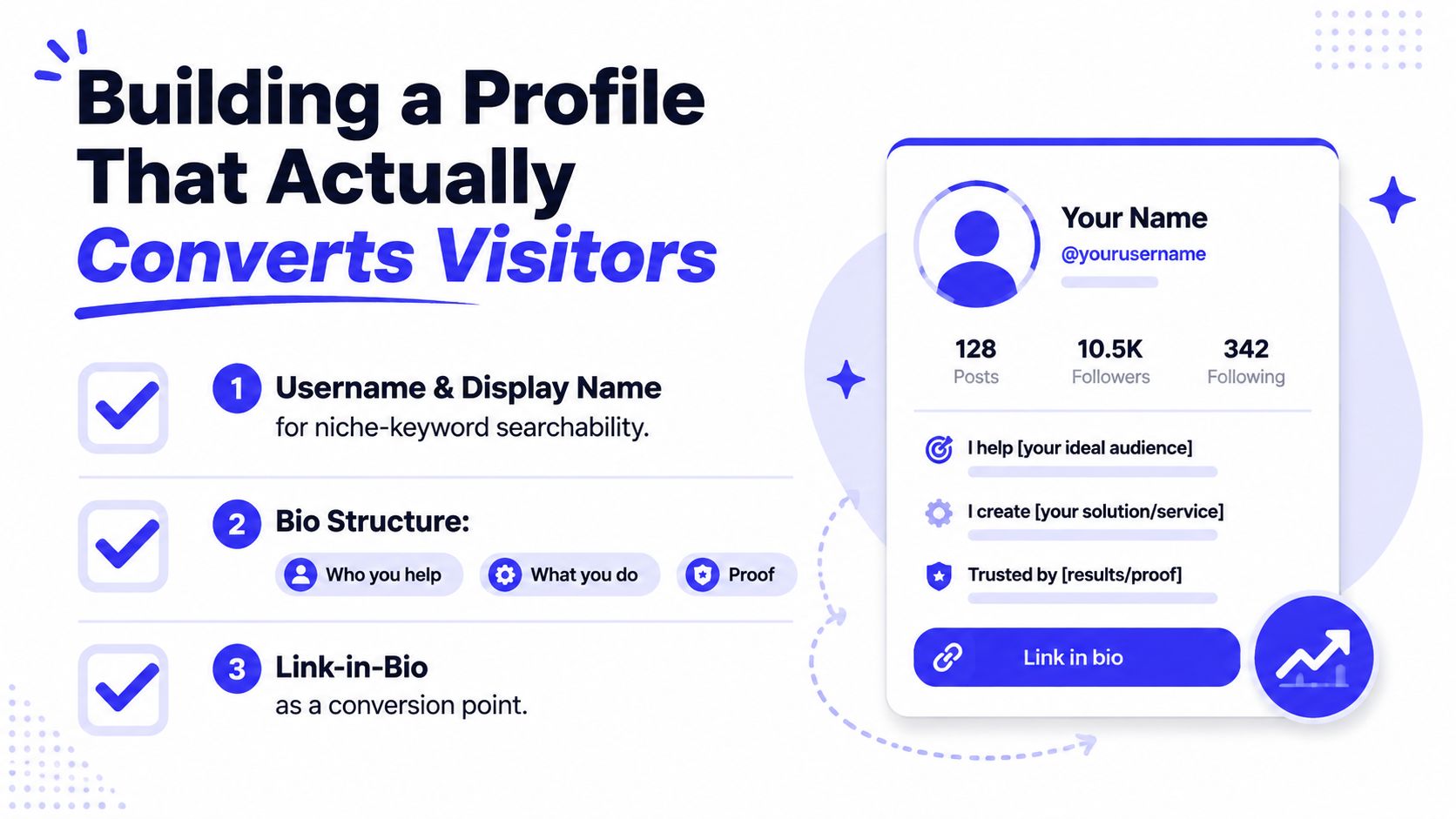
What a conversion-ready profile looks like
A good setup usually has three visible layers working together.
Username and display name: readable, searchable, and tied to the niche.
Bio: direct value proposition, then trust signal, then CTA.
Pinned posts and Highlights: proof, onboarding, and fast answers.
That's enough to turn visits into meaningful next steps. Anything extra is usually ego dressing.
Designing a Reels-First Content Engine
Reels are the closest thing Instagram still has to reliable top-of-funnel reach. The point isn't that other formats never work, it's that the platform now rewards distributed video far more consistently than static posting, and the signal is strong enough to build around. One data-backed guide says the most effective Reel length is 60 to 90 seconds, and another recommends tracking retention instead of guessing creative length (Sked Social on Instagram growth hacking strategies).
Build around retention, not applause
Likes are cheap. Comments can be cheap too. What matters more is whether the content keeps attention, gets sent, gets saved, and pulls people deeper into the account. Recent guidance aimed at marketers emphasizes sends per reach and early retention, while also arguing that hashtags don't improve visibility in the way people still assume (YouTube guide on Instagram growth signals).
That changes the production brief. Hooks need to arrive fast, the visual premise needs to make sense without sound, and the first few seconds should earn the rest of the runtime. A weak opening forces the algorithm to spend energy on the wrong people.
A workable weekly cadence is straightforward:
3 to 5 Reels per week for discovery.
Daily Stories for continuity and trust.
Highlights for recurring objections, onboarding, and proof.
The specific topics matter less than the pattern. One pillar should educate, one should show process, one should show proof, and one should show personality or point of view. If every Reel is a polished promo, the audience learns to ignore it. If every Reel is random entertainment, the account never becomes legible.
What to review every Monday
Use the same scorecard every week. Check retention, saves, shares, profile visits, and which format pulled the strongest response. Then cut the weak pillar, not the whole calendar. The point of the weekly review is to keep the content engine honest.
For a broader framework on distributing content without guessing, content distribution strategy is the right companion idea, because Reels only matter when the rest of the system helps them travel.
Running Repeatable Organic and Paid Experiments
Growth hacking works when the loop is documented. It fails when the operator confuses hustle with a testing discipline. The best Instagram teams I've seen don't run “campaigns” in the loose social media sense, they run hypotheses, log outcomes, and kill weak tactics without sentimentality.
Use one hypothesis log for everything
Organic and paid should live in the same experiment sheet. If a Reel angle gets traction organically, it can be boosted. If a paid creative wins first in ads, it can be adapted into the content calendar. The point is not channel purity, it's repeatability.
A useful weekly template is simple:
Hypothesis. Example, a problem-first hook will earn more profile visits than a feature-first hook.
Variable. Hook, format, CTA, audience, or offer.
Success metric. Profile visits, saves, shares, CPM, CPA, or signups.
Decision rule. Keep, cut, or iterate based on the result.
The target-account engagement loop still has a place, but it needs guardrails. One guide recommends 500 users per 3 days, while another advises no more than 100 follows at a time to reduce spam flags (Medium growth hacking guide). The tactic works when it's manual enough to stay credible and focused enough to hit a relevant audience cluster.
Do the targeting manually, or do it not at all. Broad automation usually produces noisy attention, weak intent, and avoidable platform risk.
Organic moves that still earn their keep
Collab posts can borrow trust from adjacent creators. Broadcast channels can keep warm followers in the loop. Automated DM funnels can route opt-ins into a faster response path, but only if the entry point is relevant and the message doesn't feel like spam. The common denominator is qualification, because low-intent reach looks impressive and converts like junk.
Paid amplification belongs inside the same loop. Boost winners, test creative iterations, and seed audiences from engagement clusters, profile visitors, or site visitors. That's how the channel stops being “social content” and becomes a machine for finding pockets of demand.
Choosing the Right Ad Formats and Creative Angles
Paid Instagram works best when the format matches the job. Reels ads are for discovery, Stories ads are for direct response, Explore is for broad interest capture, and profile-engagement campaigns are for warming people who have already raised a hand. If the format and the objective don't match, the ad feels forced.
Match the format to the stage
Reels ads should feel native in the first three seconds. UGC-style hooks, direct problem framing, and a fast visual payoff do better than glossy brand theater because the user is already in motion. Stories ads should be tighter, often single-offer and single-step, because the placement is a swipe environment and the user won't babysit your pitch.
Explore is less about interruption and more about relevance. The creative needs to look like it belongs in the feed of someone already browsing related topics. Profile-engagement campaigns are more useful for retargeting than for cold acquisition, because the visitor has already shown interest and needs one more nudge.
Format | Funnel Stage | Best Creative | Primary Objective | Key Metric |
|---|---|---|---|---|
Reels ads | Top of funnel | Native video, strong first 3 seconds, UGC-style hook | Discovery and attention | CPM |
Stories ads | Mid to lower funnel | Single offer, single CTA, clear next step | Direct response | CPA |
Explore ads | Top to mid funnel | Contextually relevant creative, category fit | Broad interest capture | Reach quality |
Profile-engagement campaigns | Mid funnel | Proof, testimonials, retargeting angles | Warm audience conversion | Profile visits |
The creative angle should follow the audience state. Cold viewers need a sharp problem, warm visitors need proof, and near-buyers need clarity. That's also where server-side capture starts to matter, because without reliable tracking you can't tell which format moved people forward.
Wiring Up Attribution So Instagram Revenue Is Provable
Instagram stops being a vanity channel once every click, signup, and deal can be traced back to a post, Story, or ad. Without attribution, teams end up arguing over what “worked.” With it, you can see whether a Reel started a lead, whether a Story ad pushed a signup, and whether a profile visit turned into pipeline.
Build the stack in layers
Start with a consistent UTM convention for every Instagram link. Keep source, medium, campaign, content, and placement stable so the reporting stays readable later. Then map events in GTM and GA4 for link clicks, form starts, content views, and the micro-conversions that show progress before purchase.
Meta Conversions API, or CAPI, matters because browser signals and iOS tracking loss can distort client-side reporting. Server-side capture gives the ad platform a steadier event stream, which makes attribution less fragile when browser data drops out. Pair that with CRM sync in HubSpot or Pipedrive so opt-ins, opportunities, and closed revenue sit next to the marketing inputs that created them.
A practical one-page checklist looks like this:
UTM naming: keep source, medium, campaign, content, and placement consistent.
GA4 events: track link click, form start, signup, purchase, and other meaningful milestones.
Meta CAPI: capture events server-side for more durable reporting.
CRM sync: carry lead source and campaign data into the pipeline.
Offline conversion uploads: feed closed deals and revenue back into the ad system.
Consent controls: keep measurement aligned with consent requirements and browser settings.
That stack is what turns Instagram from “brand awareness” into accountable acquisition. When the numbers show up in the CRM, the discussion shifts from vibes to spend allocation.
The 90-Day Instagram Growth Test Plan
The first two weeks are about repair and instrumentation. Rebuild the profile, baseline the current metrics, wire the measurement stack, and publish the first Reels so you have something real to measure. If the profile doesn't convert and the data doesn't flow, everything later is guesswork.
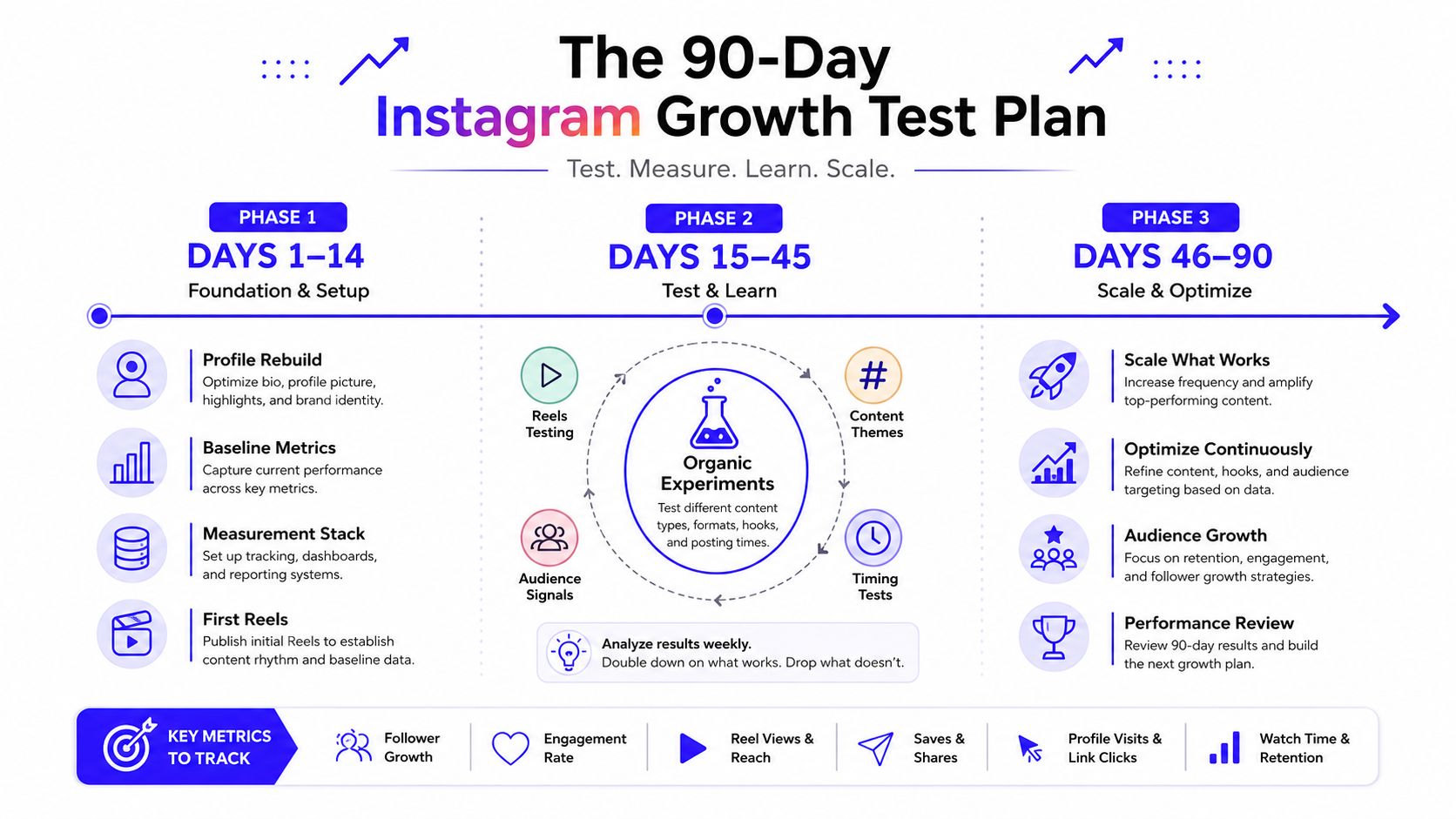
Days 15 to 45
Run organic experiments and the first paid Reels ads. Test hooks, formats, posting times, and one paid audience seed at a time. Watch profile visit rate, hook retention, saves per reach, and CPM, then keep only the combinations that prove they can earn attention and move people deeper.
Days 46 to 90
Scale winners, add retargeting flows, and tighten the CRM handoff. Now the key question is CPA and pipeline from Instagram, not just engagement. If hook retention is weak, fix the opening. If CPM rises sharply, change creative and audience. If attribution gaps appear, audit the UTM setup and server-side events before spending more.
The cutoff rule is simple. Keep what produces measurable downstream movement, cut what only looks active, and don't confuse exposure with growth.
If you want this built as a real acquisition system, not just a prettier Instagram presence, Du Marketing can help with the tracking, paid media, content, and CRM wiring that make the channel measurable. Visit Du Marketing if you want an Instagram growth plan that connects creative decisions to actual pipeline, not just likes and follower counts.