How to Write Ad Copy That Actually Converts in 2026

Most advice on how to write ad copy starts in the wrong place. It starts with the hook.
That sounds smart until you pay for traffic, get the click, and watch the visitor bounce because the page can't cash the check the ad just wrote. The ad wasn't the fundamental failure. The handoff was.
If you want ad copy that converts, build it backwards. Start with the landing page, the offer, and the next step you're asking a stranger to take. Then write the ad as the bridge between intent and conversion. That's the difference between copy that wins compliments and copy that produces pipeline.
Table of Contents
The Unspoken Reason Your Great Ad Copy Fails
A lot of ad copy advice treats the ad like a self-contained object. Write a stronger headline. Add urgency. Use a sharper CTA. Those things matter, but they're often solving the wrong problem.
The bigger issue is post-click friction. Research cited by AskNeedle says 73% of ad failures stem from post-click friction, not the copy itself, and that writing the offer and CTA first, then building the bridge copy upward, has reduced bounce rates by up to 40% in early-stage SaaS tests in its analysis of this approach (AskNeedle on writing ad copy).
That finding lines up with what happens in real accounts. Teams write a strong, high-intent ad. Then they send people to a page with soft language, weak proof, a vague form, or an offer that asks for too much too early. The campaign gets blamed. The landing page was the leak.
Why headline-first copy breaks so often
Headline-first writing pushes you toward cleverness. It rewards punchy lines that grab attention before you've decided what promise the page can support.
That's how you end up with ads that say things like:
Too much intent: “Book Your Demo Today”
Too little support: a landing page that only explains the category
Too much specificity in the ad: “Cut reporting time”
Too little proof on the page: no workflow screenshots, no product flow, no trust signals
Too much urgency: “Start Now”
Too much friction after click: a long form, unclear next step, or missing pricing context
Practical rule: If the page can't defend the promise in the first few seconds, the ad is overpromising.
The bottom-up framework
Bottom-up copywriting is simpler than it sounds.
You start by locking down three things on the destination page: the offer, the action, and the trust level. Then you write ad copy that prepares the click for exactly that experience. No surprise. No bait. No hype inflation.
That means the CTA usually comes first, not last. If the page asks users to book a demo, your ad should warm them to booking a demo. If the page offers a checklist, the ad should sell the value of the checklist, not the entire company story.
Good ad copy doesn't just get attention. It creates message continuity from keyword or scroll, to ad, to page, to conversion event.
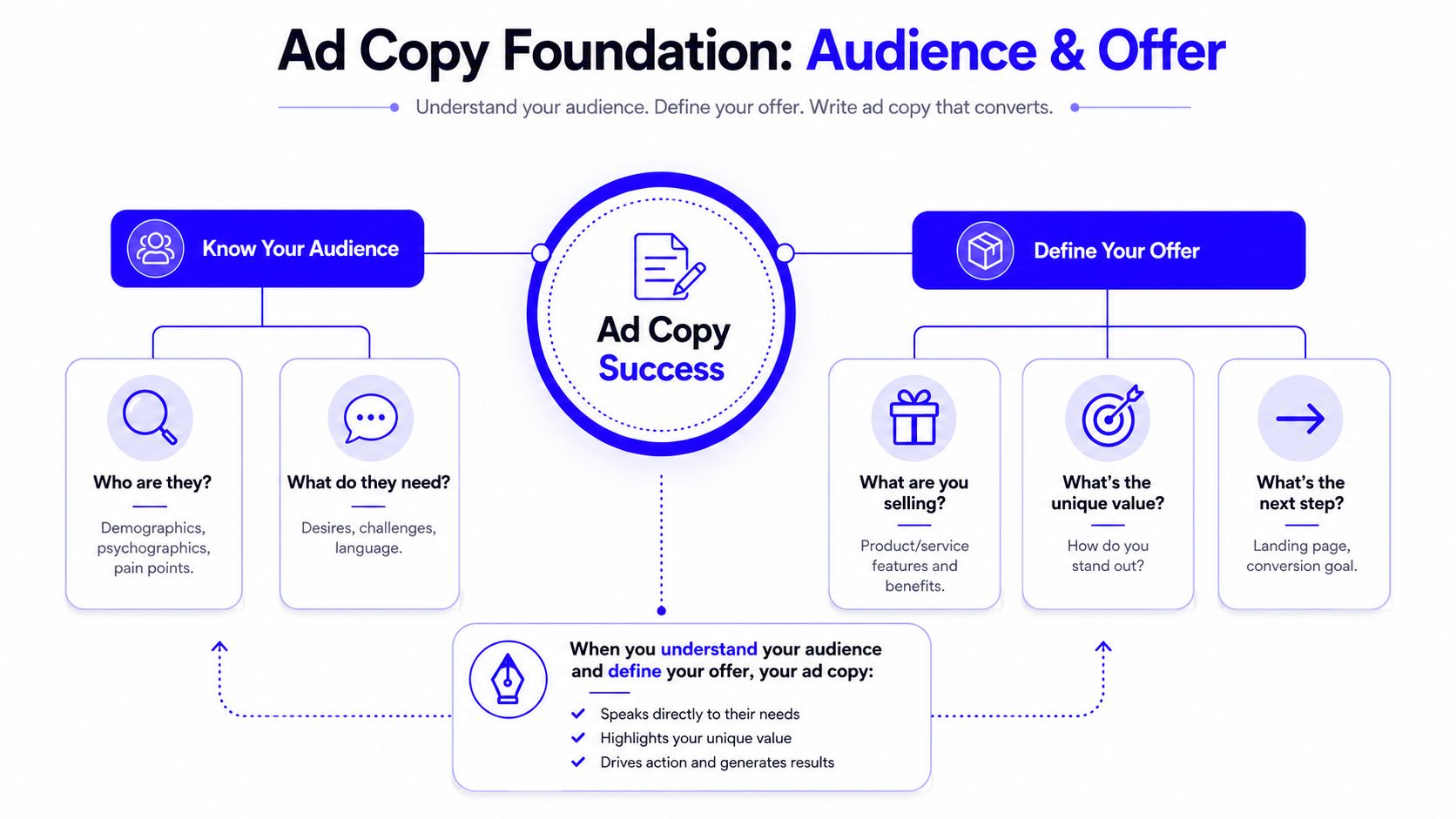
Start with the Destination Your Audience and Offer
Before writing headlines, get brutally clear on where the click lands and why someone should care. Most founders skip this because it feels slower than drafting copy. It's faster than paying for confused traffic.
Your ad has one job. It must make a promise the landing page can immediately fulfill.
Audit the page before you touch the ad
Open the landing page and answer these questions in plain English.
What is the offer?
Is this a demo, free trial, consultation, downloadable asset, product purchase, or signup?What action are you asking for?
Book. Buy. Start. Download. Apply. The action needs to be singular.How much trust does the page earn?
A cold traffic page needs more clarity and objection handling than a branded search page.What proof exists on the page?
Screenshots, testimonials, product detail, FAQ, pricing explanation, integrations, guarantees, and form context all change what the ad can safely claim.What objections are still unresolved?
If the page doesn't answer “Is this for a company like mine?” or “What happens after I submit?”, the ad should lower pressure, not raise it.
A weak page forces the ad to be more conservative. A strong page gives you room to be more direct.
If your page asks for commitment before it earns trust, your ad should not act like the sale is already done.
Build a message blueprint from buyer pain
Forget broad demographics for a minute. “B2B marketer,” “operations lead,” and “founder” aren't useful copy inputs on their own. What matters is the problem they want gone and the outcome they want next.
Use a simple message blueprint with five inputs:
Pain: What's frustrating right now?
Trigger: Why are they looking today?
Desired outcome: What would “better” look like?
Risk: What are they afraid will go wrong?
Language: What words do they already use in sales calls, reviews, support tickets, or CRM notes?
Here's what that looks like in practice.
Input | Weak version | Useful version |
|---|---|---|
Pain | Need more leads | Sales team is chasing low-intent demo requests |
Trigger | Wants growth | Paid CAC is rising and leadership wants efficiency |
Desired outcome | Better marketing | More qualified pipeline from existing spend |
Risk | Doesn't want failure | Doesn't want to add tools or create reporting chaos |
Language | Professional tone | “Qualified pipeline,” “attribution,” “handoff,” “wasted spend” |
That last line matters. Strong copy often sounds obvious because it uses the buyer's own vocabulary, not the brand's internal slogans.
Match the promise to the page's conversion readiness
Not every page can support the same intensity of pitch.
If the landing page is thin, your ad should promise education, clarity, or a low-friction next step. If the page is robust and trust-heavy, you can push harder on direct response.
Use this quick filter:
Low-trust page: lead with problem recognition and a softer CTA
Mid-trust page: lead with the offer and one concrete benefit
High-trust page: lead with outcome, proof, and a direct CTA
When people ask how to write ad copy, they usually want headline formulas. The better answer is this: first decide what level of promise your page can support. That gives you the raw material for everything that follows.
Crafting the Core Components Headline Body and CTA
Once the destination is clear, writing gets easier. You're not trying to be original. You're trying to be precise.
The structure is simple. Start with the CTA and offer. Then write the body copy that removes friction. Then write the headline that qualifies the click.
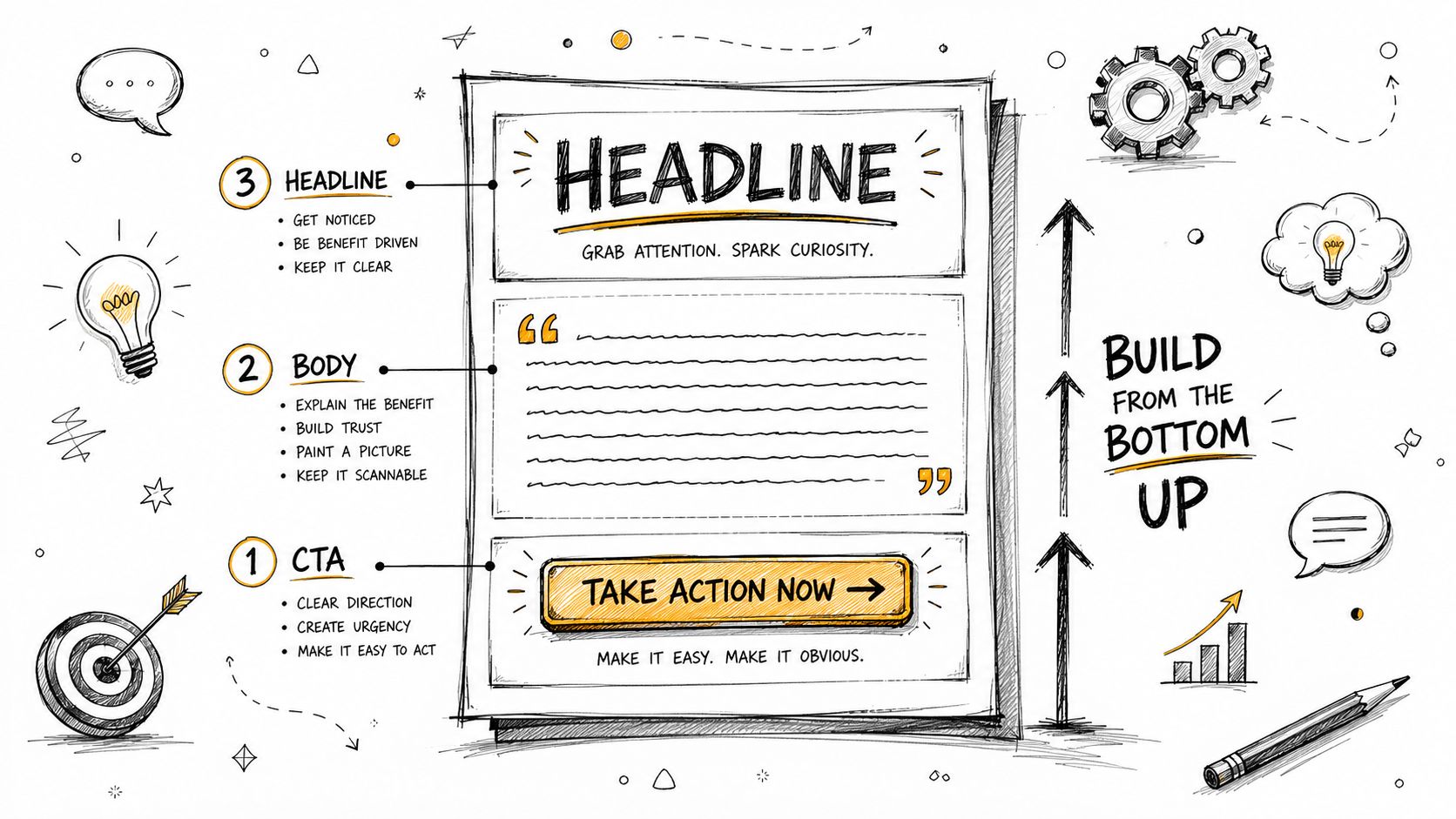
Write the CTA first
Most weak CTAs fail because they ask for the wrong next step.
If the landing page offers a guide, “Book a demo” is the wrong CTA. If the page is a product page with clear pricing and buying intent, “Learn more” is often too soft. The CTA should feel like the natural continuation of the click.
A few examples:
For a lead magnet page: Download the checklist
For a demo page: Book your demo
For a free trial page: Start your trial
For a consultation page: Get a personalized plan
For an ecommerce product page: Shop the collection
Notice what's missing. Generic verbs like “Submit” and “Click here.” They don't carry meaning and they don't reduce uncertainty.
A good CTA answers the user's hidden question: What happens next?
Build body copy that earns the click
Body copy exists to close the gap between attention and action. It should connect the audience problem to the offer without trying to explain the entire business.
In practice, that usually means covering four things:
Problem recognition: Show that you understand the situation.
Mechanism: Explain what the offer does or helps someone do.
Specificity: Give the brain something concrete to trust.
Transition: Lead naturally into the CTA.
Specificity matters more than often recognized. WordStream's analysis says ad copy with specific numbers or statistics in headlines can see up to 38% higher click-through rates than vague claims, with examples like “save 3 hours” or “9 out of 10 customers” outperforming abstract wording (WordStream on PPC ad copywriting).
That doesn't mean invent numbers. It means use real, supportable specifics when you have them. If you don't, stay qualitative.
Here's the difference.
Approach | Weak copy | Better copy |
|---|---|---|
Vague benefit | Work smarter with better reporting | See campaign performance in one dashboard |
Empty claim | The best platform for growing teams | Built for teams that need cleaner handoffs |
Generic urgency | Don't miss out | Start with a guided walkthrough |
Unsupported proof | Trusted by everyone | Used by teams managing complex approval flows |
Good body copy lowers anxiety. Bad body copy raises curiosity but leaves the hard questions for the page to clean up.
Use headlines to qualify not just attract
Most ad writing commonly goes astray. Teams want the headline to be the loudest line in the ad. What it should really be is the clearest line.
Your headline does two jobs:
Get the right person to notice.
Filter out the wrong person before they waste your budget.
That often means a useful headline beats a clever one.
Examples of stronger headline directions:
Pain-led: Struggling with messy lead handoffs?
Outcome-led: Get cleaner pipeline visibility
Offer-led: Book a reporting audit
Audience-led: For SaaS teams running paid acquisition
Time or effort-led: Save time on weekly reporting
If you have legitimate specifics, use them. Numbers pull attention because they feel concrete. But they only help if the landing page immediately supports them.
A simple build order for headlines:
Start with the page promise.
Compress it to one clear outcome or offer.
Add audience or context if needed.
Remove anything cute.
After you've drafted a few versions, watch this for a solid visual breakdown of what headline, body, and CTA are each supposed to do in a real ad workflow.
A quick bottom-up formula
If you want a working draft fast, use this sequence:
CTA: What do you want them to do?
Offer: What do they get when they do it?
Bridge: Why should they care right now?
Headline: Who is this for and what value is on the table?
That's how to write ad copy without getting trapped in headline brainstorming for two hours and ending up with something your landing page can't support.
Adapting Your Message for Different Ad Platforms
A message that works on Google Search can flop on Instagram. Not because the copy is bad, but because the user mindset is different.
On Google, people are actively looking for an answer. On Meta, you're interrupting a scroll. On LinkedIn, you're stepping into a professional context where buyers expect relevance fast and nonsense even faster. The core promise can stay the same, but the packaging has to change.
Ad Copy Cheat Sheet by Platform
Platform | Audience Mindset | Headline Best Practice | Body Copy Focus | CTA Style |
|---|---|---|---|---|
Google Ads | High intent, solution-seeking | Mirror the problem or desired outcome clearly | Reinforce relevance, offer, and next step with tight language | Direct and explicit |
Meta Facebook and Instagram | Passive scrolling, low initial intent | Stop the scroll with a sharp angle tied to pain or curiosity | Short, visually supported, emotionally legible | Lower-friction and curiosity-friendly |
Professional, skeptical, context-aware | Call out the role, problem, or business scenario | Focus on business impact, operational friction, and credibility | Professional and outcome-oriented |
What changes by channel and what should stay fixed
Google Ads rewards clarity. Search traffic usually arrives with a question in mind, so your ad should feel like the answer, not a brand manifesto. In such cases, direct language triumphs. If someone searches for a solution category, mirror that intent and keep the CTA straightforward.
Meta needs more pattern interruption. Users didn't wake up hoping to see your ad between a friend's update and a dog video. Your opening line has to create instant relevance. The body copy should stay lean, and the creative has to do a lot of the heavy lifting. The best Meta copy often reads like a clear observation, not a polished pitch.
LinkedIn sits in a different lane. Buyers there are more tolerant of business language, but only if it gets to the point fast. Calling out role-specific pain tends to work better than broad inspiration. If you're selling to B2B teams, this guide to LinkedIn advertising for B2B is worth reading alongside your copy planning.
Here's what should stay fixed across all three:
The core promise: Don't invent a new value proposition for each platform.
The offer: A demo is still a demo. A guide is still a guide.
The landing page match: The click should still feel expected.
The level of pressure: If the page needs trust-building, the ad should not push too hard.
Platform-native copy wins because it respects the user's context, not because it follows a trendy tone.
One useful exercise is to write a single message three ways. Keep the same offer and landing page, then adapt only the entry angle and pacing. If one version sounds like it belongs on every platform, it probably belongs on none of them.
Test Iterate and Find Your Winners
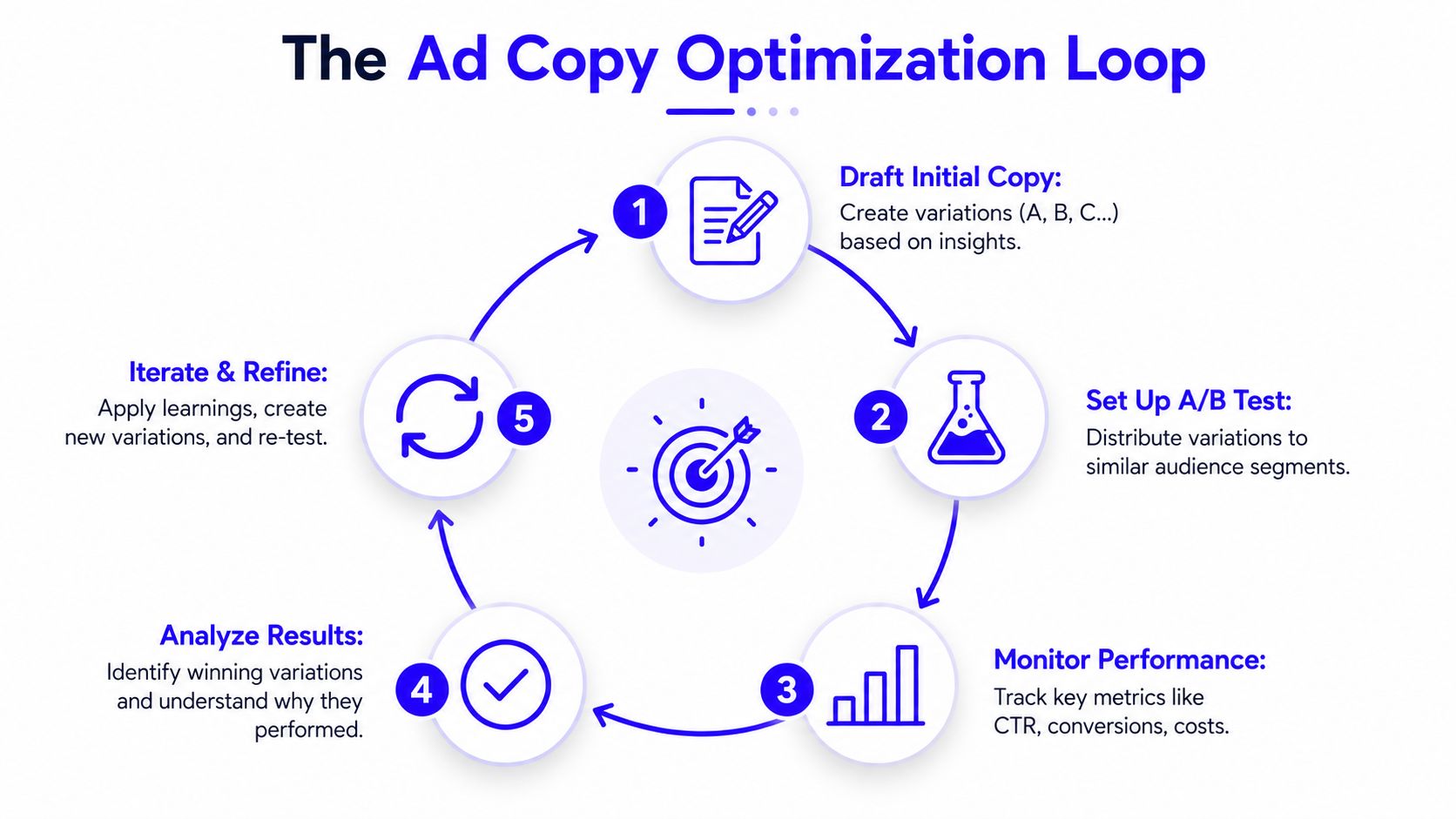
The first draft is a starting point. The money comes from iteration.
A lot of founders still treat ad copy like a one-shot creative task. Write it, launch it, hope it works. High-performing accounts don't work that way. They test methodically, keep what wins, and replace what stalls.
Disciplined A/B testing matters because small copy changes can shift the economics of the account. ClicksGeek reports that running 3 to 5 ad variations and testing until statistical significance is reached can lead to a 20 to 30% improvement in conversion rates over time (ClicksGeek on ad copywriting best practices).
What to test first
Don't test everything at once. If you change headline, body, CTA, audience, and landing page in one pass, you'll learn nothing useful.
Start with the most impactful variable first. In most accounts, that's the headline.
A practical testing order:
Headline angle
Test pain-led versus outcome-led versus offer-led.Body copy framing
Try a shorter version against one that handles objections more directly.CTA language
Compare direct action against lower-friction wording.Offer packaging
Reposition the same destination as a demo, walkthrough, audit, guide, or consultation only if the page supports it.
A related mistake is measuring success too early or using only CTR. Strong CTR with weak conversion quality is expensive entertainment. If your landing page isn't converting, the answer may sit in the handoff. This guide on landing page conversion optimization is a useful companion to copy testing because copy and page performance are joined at the hip.
How to avoid fake winners
Many teams often deceive themselves. One ad gets a good day, the dashboard looks exciting, and everyone declares a winner before the sample is trustworthy.
Silver Spider Media's testing guidance recommends isolating a single variable and collecting 50 to 100 conversions per variation, with tests running for 2 to 4 weeks to account for day-of-week swings. For impression-based CTR testing, it recommends roughly 25,000 impressions per variation with a minimum of two weeks before drawing conclusions (Silver Spider Media on ad copywriting best practices).
That sounds less glamorous than “trust your gut,” but it keeps you from reallocating budget based on noise.
A few habits keep tests clean:
Change one element at a time: Otherwise you won't know what caused the result.
Keep the landing page stable: Don't redesign the destination in the middle of a copy test.
Log the hypothesis: Write down what you thought would happen and why.
Name variants clearly: “Pain headline” and “Offer headline” beat “Version B final new.”
Judge on conversion quality: Leads that never progress aren't wins.
The point of testing isn't to prove you were right. It's to find a message the market rewards consistently.
Beyond the Click Connecting Copy to Revenue
Ad copy is not a branding side quest. It's part of your revenue system.
A click has no value on its own. Neither does a high CTR. What matters is whether the message attracts the right people, moves them through the page, and ultimately connects to qualified pipeline or sales. That requires instrumentation, not just writing skill.
At minimum, teams should use clean UTMs, GA4, ad platform conversion tracking, and CRM visibility into what happened after the form fill or purchase. Without that, you can't tell whether “better-performing” copy brought in better business. You can only tell that it got attention.
This is the shift from copywriter to growth marketer. You stop asking, “Which ad got clicked?” and start asking, “Which message produced revenue-efficient customers?” If your tracking stack is messy, your copy decisions will be messy too. This breakdown of marketing data integration shows why the backend matters as much as the words on the ad.
The practical takeaway is simple. Learn how to write ad copy from the bottom up. Start with the offer. Match the page. Reduce friction. Test the message. Track revenue, not applause.
If you want help turning ad copy, landing pages, paid media, and attribution into one working system, Du Marketing does exactly that for startups and growth-stage teams.