Startup Company Marketing Strategy: A Growth Playbook

Most startup marketing advice starts in the wrong place. It tells founders to pick a channel, write some copy, and “test” their way to growth, as if a startup company marketing strategy were a menu of tactics instead of an operating system tied to runway, tracking, and customer clarity. That approach burns time fast, because you can't optimize what you haven't instrumented, and you can't scale what you can't trust.
The better order is blunt: define who you're selling to, wire up measurement, choose experiments that fit your stage, then spend. Early marketing is less about looking clever and more about building a system that can answer basic questions, like which audience is reacting, which channel is creating demand, and whether that demand turns into revenue with enough efficiency to matter.
Table of Contents
Why Most Startup Marketing Plans Fail Before the First Campaign
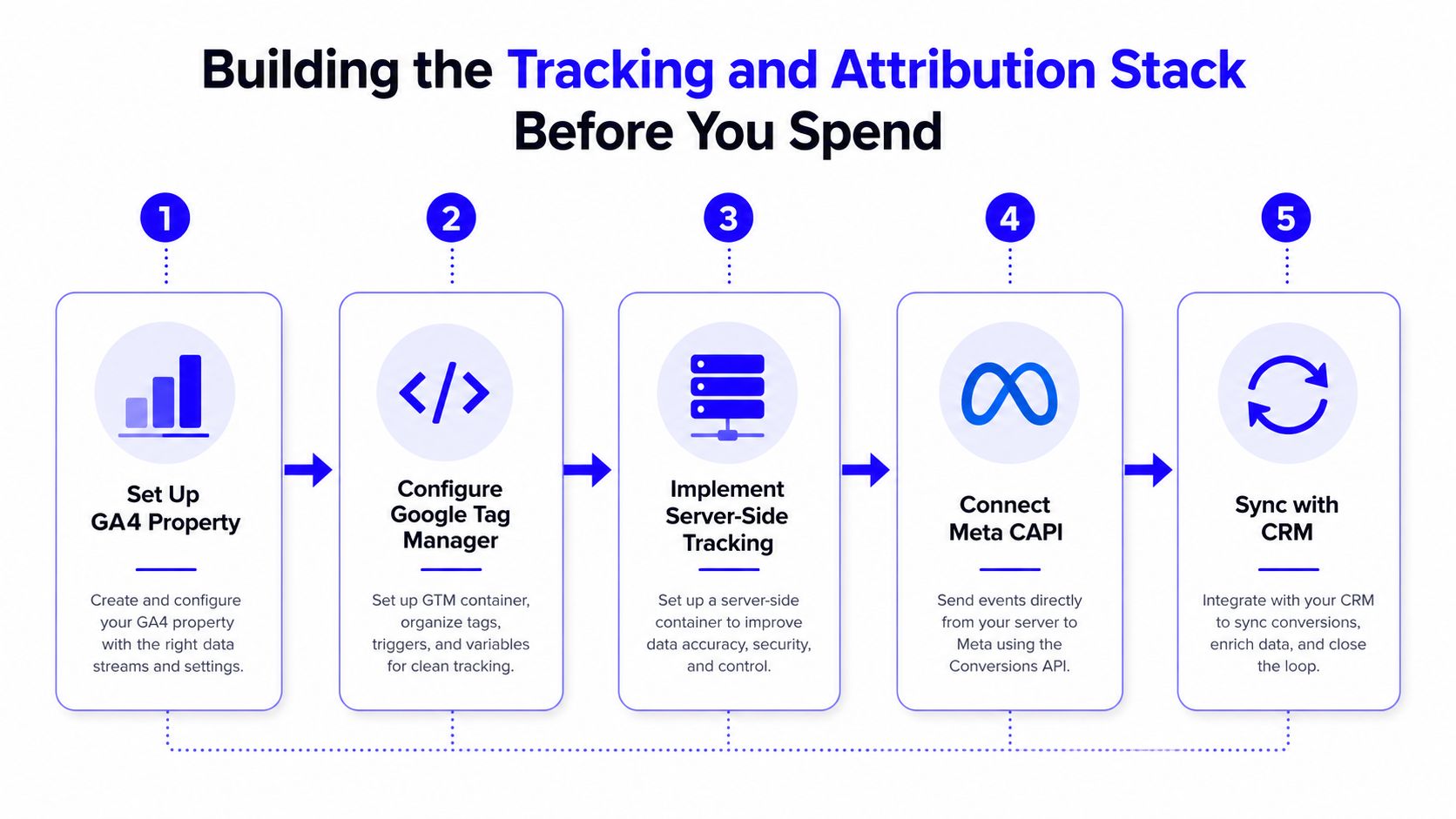
Building the Tracking and Attribution Stack Before You Spend
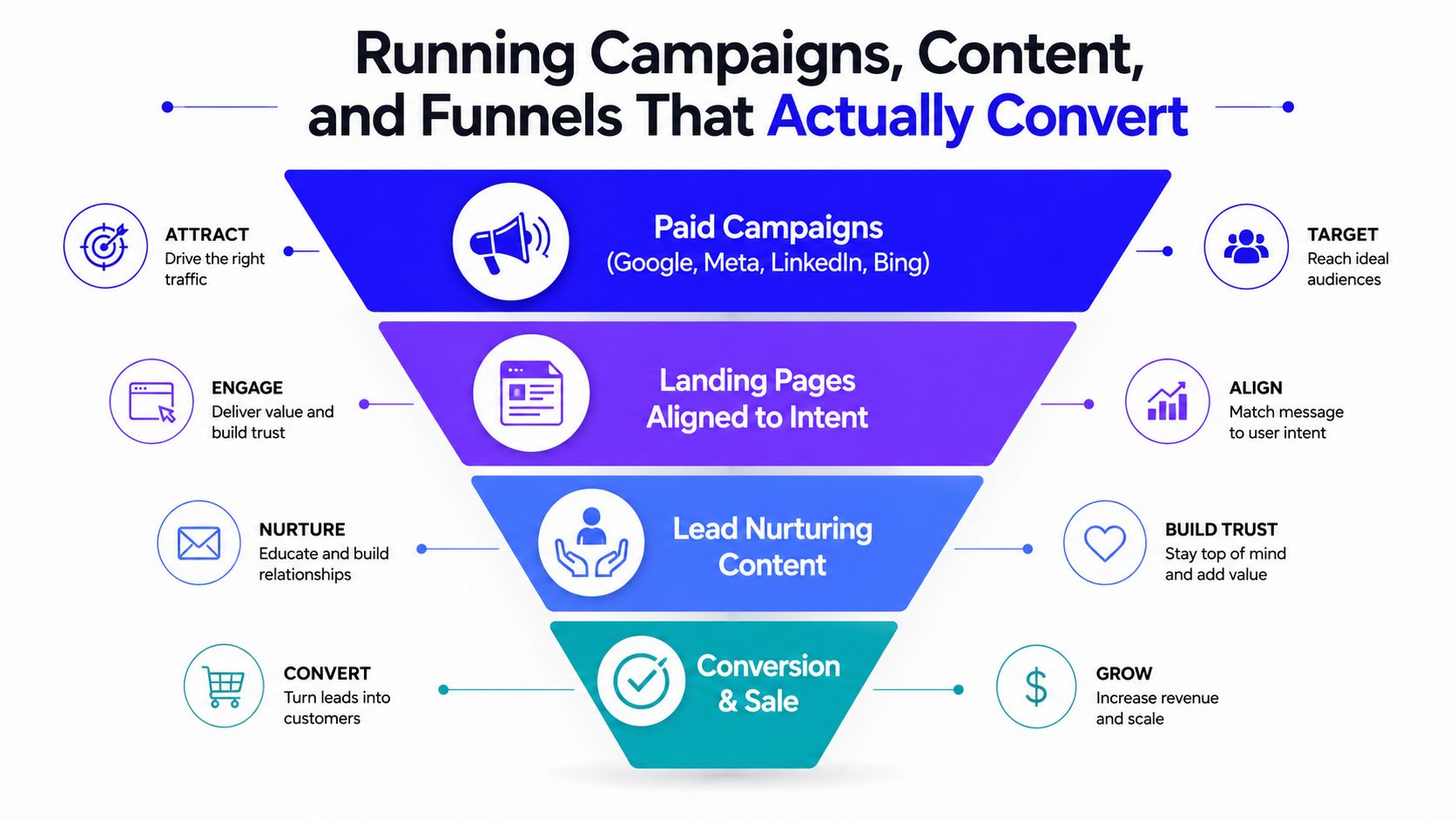
Running Campaigns, Content, and Funnels That Actually Convert
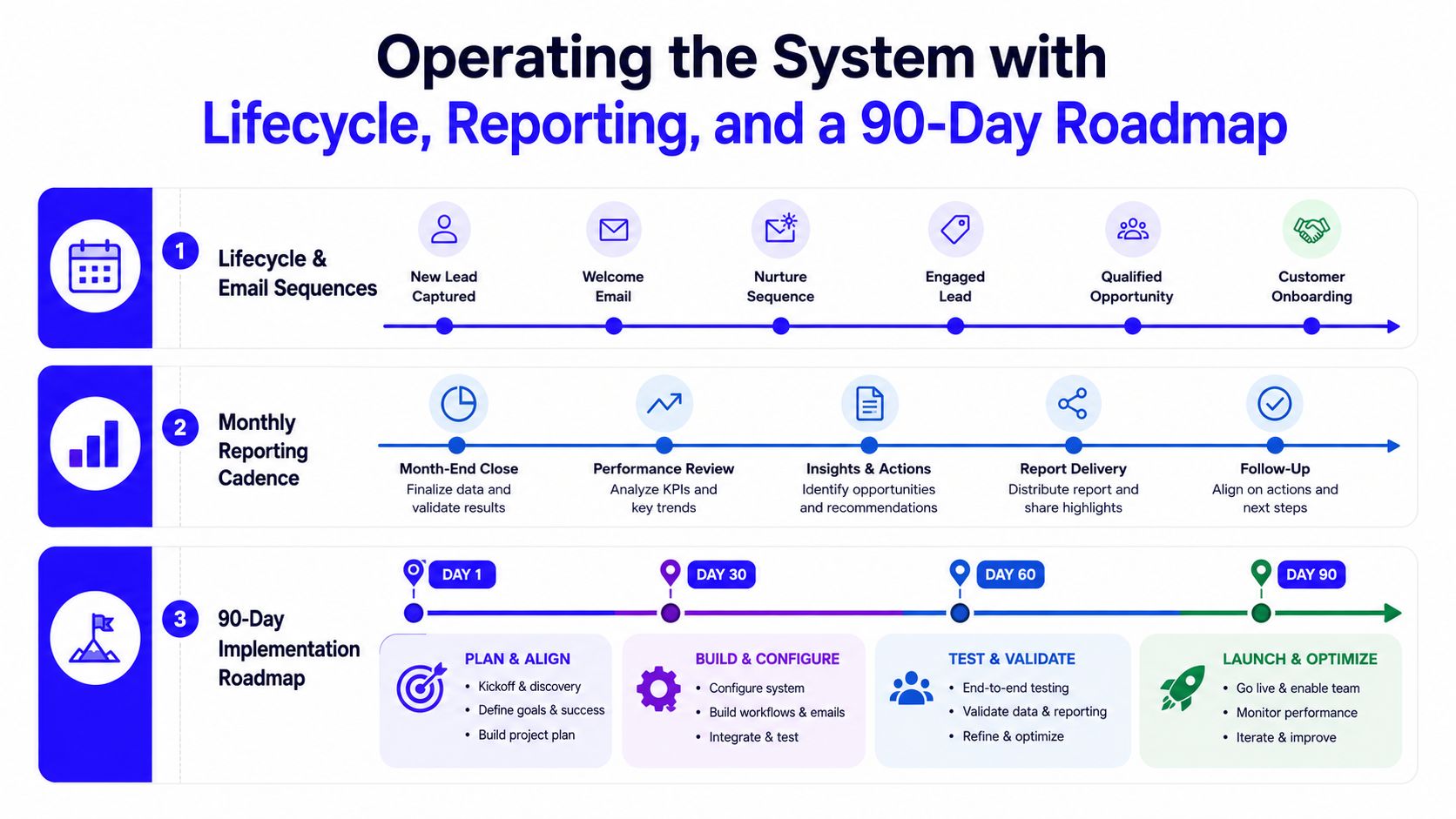
Operating the System with Lifecycle, Reporting, and a 90-Day Roadmap
Why Most Startup Marketing Plans Fail Before the First Campaign
A lot of founders start with channels because channels feel actionable. Google Ads, LinkedIn, SEO, podcasts, partnerships, email, it all sounds like motion. The problem is that motion is not the same thing as a startup company marketing strategy. Without clear positioning, tracking, and a budget tied to runway, you end up buying activity instead of building demand.
Marketing is an operating system, not a list of tactics
Budget shape changes the strategy. One benchmark source says early-stage founders should allocate about 10-20% of funding to marketing, while Series A startups often move to 25-40%, and growth-stage SaaS is often cited at 30-50% of ARR for sales and marketing combined, all from GTM8020's startup marketing budget statistics. That same source notes early-stage companies often plan around $5,000-$10,000 per month in marketing expenses, which is roughly 10% of planned annual revenue according to the same benchmark. The point isn't the exact number, it's that budget level determines whether you can afford immediate-demand channels, compounding channels, or both.
Practical rule: If you can't explain how a channel helps you learn faster or acquire customers more efficiently, it's probably decoration.
This is why layered agency setups often disappoint early. Every handoff slows feedback, and every extra vendor gives you a new version of the truth. Founders need one person, or one tightly coordinated operator, to own the full path from audience definition to reporting, because the loop is too short for fragmented ownership.
Why spend comes after instrumentation
The cleanest early move is to treat the first marketing work as measurement and clarity, not promotion. A startup that doesn't know which segment it's speaking to, what problem it solves, and how a lead becomes revenue is not ready to “scale channels.” It's ready to build the system that tells it what to scale.
That system should make it obvious when a campaign is helping. If you can't trace outcomes back to the source, you'll keep funding whatever feels active, and that usually means whatever is loudest. Startup marketing gets easier when you stop asking “What channel should we try?” and start asking “What can we measure well enough to learn from quickly?”
Auditing Your Current State and Defining the Right ICP
Before you spend a dollar, do the unglamorous audit. Inventory every channel you've touched, every landing page, every form, every email sequence, every spreadsheet someone insists is “basically CRM.” Then trace the missing links in the chain, because broken data often sits in plain sight. If the team can't tell where a lead came from, what page they saw, or whether they converted, the plan is not underperforming, it is blind.

Start with the messy inventory
A practical audit starts with five questions. What channels are active, what creative exists, what's in the CRM, where is tracking broken, and which audience are you trying to move? If you want a simple reference structure, a marketing audit template that forces the inventory into something usable can keep the work from becoming another loose document no one opens again.
You also need to understand the buying motion. The most annoying startup marketing mistake is assuming the user, the influencer, and the buyer are the same person. Sometimes they are. Often they are not. The hard part is deciding who gets first attention when they do not line up.
Decide who comes first
April Dunford's framework separates who is easiest to reach, who has the most influence on a purchase, and which audience is underserved in her startup marketing strategy guidance at April Dunford's startup marketing strategy notes. That separation matters because the first target is not always the end user and not always the economic buyer. Sometimes the fastest path is to win the person who can open the door, then earn the person who signs.
A useful decision rule is simple:
Reach first: pick the segment you can contact and learn from fastest.
Influence first: if buying is political or multi-stakeholder, target the person who shapes the decision.
Underserved first: if a niche is ignored by incumbents, the message may land faster there than in the obvious market.
If your ICP is broad enough to include everyone, it probably includes no one.
The goal is not to freeze the market into a perfect persona doc. It is to choose a segment precise enough that messaging, channel choice, and creative all get sharper. Once that is done, the budget starts making sense.
Building the Tracking and Attribution Stack Before You Spend
A startup can outgrow its ads account, but it cannot outgrow bad data. Build the tracking stack before spend begins, because attribution mistakes get more expensive once campaigns are live. If you want a decision-grade startup company marketing strategy, this technical layer protects everything that follows.
Build the stack in the right order
Start with GA4, then configure Google Tag Manager, then validate event tracking before touching budgets. If you want a practical setup guide for that middle step, use this event tracking guide for Google Tag Manager. After that, add server-side tracking, connect Meta CAPI, and sync everything back to the CRM so leads and opportunities line up with ad touchpoints. That sequence matters because each layer depends on the one before it, and weak event hygiene contaminates the rest of the stack.
Standardized UTMs are essential. If one person writes linkedin, another writes LinkedIn, and a third invents campaign names on the fly, reporting turns into archaeology. Keep naming conventions boring and consistent, because the point is traceability, not creativity.
Make the CRM the source of business truth
The fastest way to fool yourself is to look only at top-line clicks or leads. Startup guidance in the verified data stresses evaluating cost-per-acquisition, funnel conversion rates, and LTV calculated from gross margin, not revenue alone. That distinction matters. Revenue can look healthy while contribution margin is poor.
For CRM sync, keep it practical. Forms should create clean records, lifecycle stages should update automatically, and offline conversions should be uploaded when a sale closes outside the ad platform. Zapier-style automations help here, not because automation is fashionable, but because manual updates break down the moment the team gets busy.
A strong measurement layer also needs consent mode v2 where applicable, because the gap between browser behavior and platform reporting keeps widening. You will not eliminate ambiguity, but you can reduce it enough to make weekly decisions with confidence. That is the job.
Rule of thumb: if a report cannot connect a campaign to a pipeline stage, it is a dashboard, not a management tool.
One practical option for startups that want end-to-end execution is Du Marketing, which combines tracking, paid media, SEO, email, and reporting in one operator-led system. The value is continuity. One person can see where the data breaks, fix the campaign, and update the report without handing the issue across three teams.
Designing the Channel Mix and Initial Budgets by Stage
Channel mix should follow stage, not fashion. Early on, paid search and paid social are useful because they buy learning and demand fast. SEO and content move more slowly, but they compound and reduce marginal acquisition cost later, which is why a startup company marketing strategy has to balance immediate capture with long-term asset building.
Match spend to the stage you're actually in
The budget benchmarks vary by company stage, but the pattern is consistent. Early-stage founders often commit a modest share of funding to marketing, Series A teams typically increase that share as they have clearer ICP and tracking, and growth-stage SaaS companies often treat sales and marketing as a shared operating system rather than a side expense. The same benchmark source also points to early-stage monthly spend bands and a cautious starting point for performance marketing, with narrow keywords and limited geographies, from GTM8020's startup marketing budget statistics and startupscenedaily's founder marketing benchmark.
Use those benchmarks as guardrails, not instructions. If your tracking is still fragile, putting more money into acquisition just creates a larger measurement problem. If your ICP is well defined and your CRM is clean, the same budget can go further because you are buying better signal, not just more traffic.
Stage | Marketing Budget Range | Channel Emphasis |
|---|---|---|
Pre-seed / early stage | Use a narrow test budget that supports learning, usually concentrated in a few channels | Paid search, paid social, founder-led distribution, tightly scoped experiments |
Series A | Increase spend where attribution is clear and pipeline is showing repeatability | Paid acquisition plus content and lifecycle systems |
Growth-stage SaaS | Shift more weight into repeatable acquisition and retention loops | Multi-channel acquisition, content compounding, lifecycle, attribution discipline |
Spend small, learn fast, then reallocate
Small budgets should go into tightly segmented campaigns. Broad targeting turns a small test into noise, and noise gives you false confidence. If you run Google Ads with one offer, one audience, and a clean landing page, you get usable signal. If you spread that same budget across five platforms, you mostly get competing explanations for weak results.
The operating rhythm matters as much as the allocation. Review CPA, CAC, conversion rates, and lead quality weekly, then reallocate monthly based on ROI and pipeline quality. That does not mean you ignore judgment. It means you earn the right to trust your judgment by checking the numbers first.
Paid channels buy speed, organic channels buy efficiency.
For early startups, that trade-off is usually the whole game. Paid gives you learning now, content and SEO give you cheaper visits later. The strongest teams keep both active, but they do not pretend both deserve equal weight on day one.
Running Campaigns, Content, and Funnels That Actually Convert
Campaigns fail most often because the promise and the landing page don't match. A strong ad can't rescue a page that's vague, slow, or built for internal approval instead of buyer intent. The paid channel, the landing page, and the nurture sequence need to tell the same story, or the click is wasted.
Align each channel to intent
Google Ads, Meta, LinkedIn, and Bing all behave differently, but the same principle applies. Match the offer to the intent level of the audience. High-intent search deserves direct response copy. Lower-intent social often needs a clearer hook, stronger proof, and a less demanding ask.
A landing page should be built for one job only. If the traffic is coming from a specific promise, the page needs to echo that promise in the headline, show evidence quickly, and reduce the number of ways to get lost. The landing page conversion optimization guide is useful here because it keeps the work grounded in conversion, not layout preferences.
Pick SEO topics from demand, not vibes
The verified research points out a gap most startup content misses. It's easy to say “do keyword research,” but that's too broad to be useful. Frac.tl's startup marketing strategy guidance at Frac.tl's startup marketing strategy notes emphasizes competitor website analysis for keyword direction and mapping each topic to buyer-journey stage. That's a more disciplined way to choose the few content bets that might compound.
Use this filter:
Search demand: is there evidence people already want the topic?
Intent match: does the topic match what the buyer needs at that stage?
Competitive weakness: are current pages thin, outdated, or badly aligned?
Conversion path: can the page lead somewhere useful after the visit?
Content marketing takes time before it compounds, but once momentum builds, it can deliver traffic at a lower cost per visit than paid traffic, according to the verified benchmark in startup-list's startup marketing statistics. The useful takeaway is simple. Paid brings speed, content brings endurance, and funnels turn both into something measurable.
Keep the feedback loop tight. Weekly creative reviews, weekly bid adjustments, and weekly checks on whether the lead quality still matches the ICP are the difference between a learning system and an expensive habit. Startups don't need more content. They need better reasons to publish and clearer reasons to stop.
Operating the System with Lifecycle, Reporting, and a 90-Day Roadmap
Marketing doesn't stabilize when the first campaign works. It stabilizes when the team can see how acquisition, nurture, and reporting fit into one cadence. That's where lifecycle email, clean dashboards, and a realistic roadmap do the heavy lifting, because startups need a system that can survive messy weeks without losing direction.
Make lifecycle part of acquisition, not a separate project
Email sequences in HubSpot or Pipedrive should reflect behavior, not just list membership. A lead who downloaded a comparison page, a trial user who stalled at setup, and a closed-lost deal all need different follow-up. If lifecycle is generic, it's just noise with a send button.
Monthly reporting should live in a dashboard the team opens. Looker Studio works well for that because it can pull acquisition, conversion, and pipeline views into one place. The report should answer one question: what did we learn, and what changes did we make because of it?
Run the next 90 days like an experiment portfolio
A useful operating cadence is simple. Day 1, establish the tracking baseline and define the experiments. By Day 30, kill obvious losers and keep the few tests that show real signal. By Day 60, tighten messaging and budget around those winners. By Day 90, decide what graduates into maintenance mode and what gets cut.
The research from PostHog's founder marketing notes at The Stuff Nobody Tells You About Startup Marketing is blunt about the experiment mindset. It warns against spreading too thin, favors depth over breadth, and says the worst outcome is uncertainty, because “I'm not sure” leaves you funding half-working activities forever. That's the right instinct for startups, even if your stack looks more formal.
A strong roadmap also keeps the team investor-ready. The reporting should always connect spend to CAC, LTV, and ROAS, and the weekly review should be ruthless about where the signal is real versus where the data is just flattering. That's how a startup company marketing strategy becomes audit-friendly instead of anecdotal.
If a channel can't be explained in one sentence with numbers attached, it's not ready for scale.
Use the system to cut faster, not just to spend more. That discipline protects runway, sharpens the message, and makes the next round of budget feel earned instead of hopeful.
Du Marketing builds startup marketing systems that connect audience research, tracking, paid media, SEO, content, email, and reporting into one operating cadence. If you want that work handled by a single practitioner instead of three disconnected vendors, visit Du Marketing and see how the pieces fit together.