9 Twitter Growth Hacks for Startups in 2026

Tired of the same old “tweet more” advice? That's not a growth strategy, it's a content treadmill. Startups don't need prettier posting habits, they need twitter growth hacks that earn attention, move people into a CRM, and turn replies into revenue signals. The job isn't to chase vanity metrics, it's to build a distribution system that you can measure from first impression to closed deal.
The playbook has changed. A 2025 benchmark found that average weekly posting rose 8%, from 15.97 to 17.34 posts, while total impressions still fell 5% to 2,711.39 impressions per post. At the same time, engagement rose 19%, engagement rate moved from 1.32% to 1.58%, and retweets jumped 35% from 4.93 to 6.67 per post, which is a blunt reminder that quality beats volume when distribution gets harder (Metricool's X benchmark). That's why the best operators don't ask, “How often should I post?” They ask, “How do I build interactions that the platform wants to keep showing?”
For startups, that question matters because social activity has to connect to pipeline. If a reply drives a profile visit, a profile visit becomes a tracked click, and that click becomes a lead in your CRM, you've got something worth scaling. If it doesn't, you just built another expensive habit.
Table of Contents
1. Strategic Thread Architecture and Long-Form Content
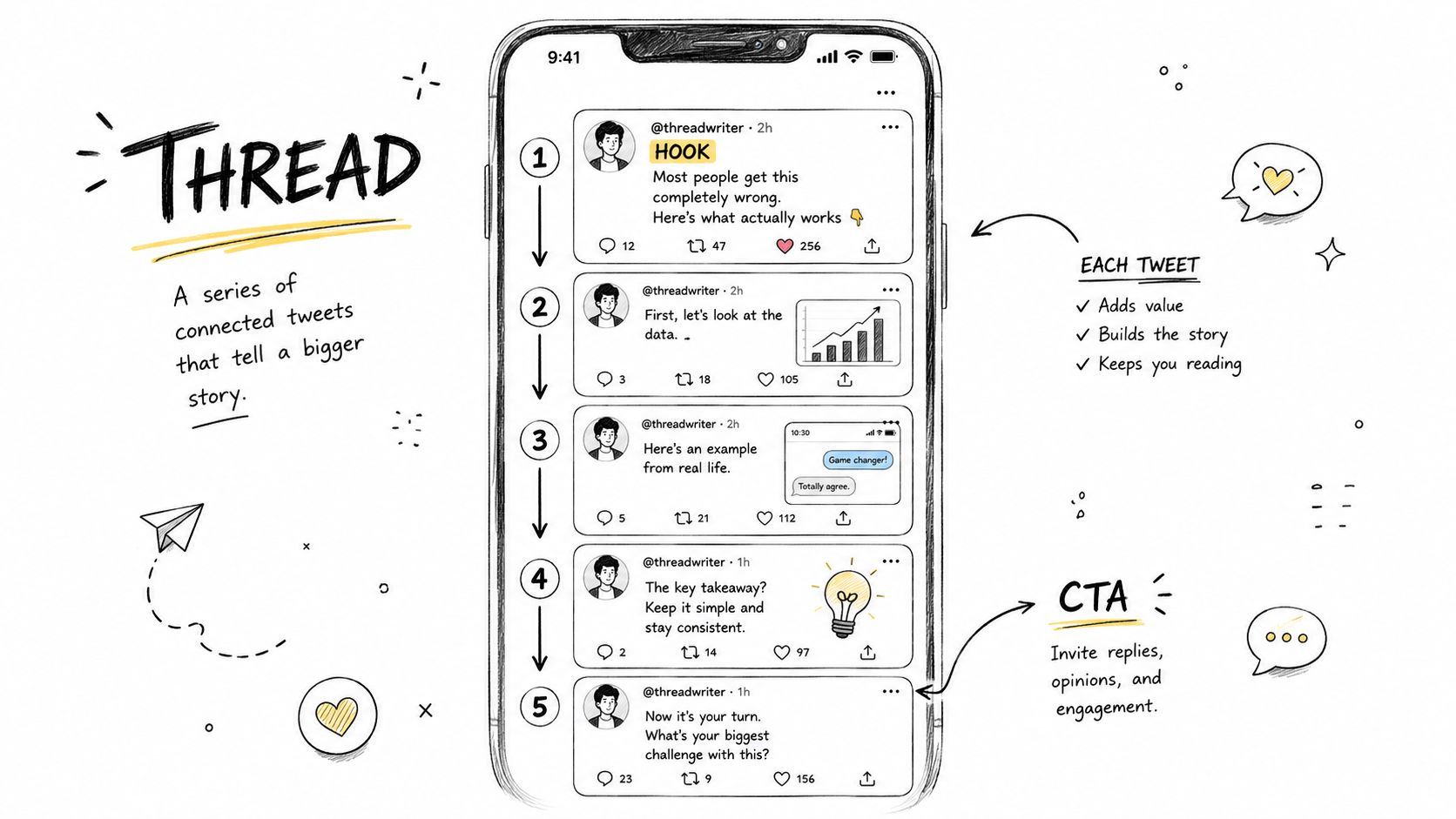
A good thread isn't a pile of tweets. It's a sequence with a hook, a payoff, and a reason to keep reading. The best startup threads work like landing pages, they open with a sharp promise, move fast into proof, and end with a next step that gives the reader somewhere to go.
That's why thread design matters more than thread length. If you're explaining a SaaS metric framework, sharing a client teardown, or documenting a campaign lesson, the first tweet has to create tension quickly. Use one surprising insight, one clear outcome, or one painful mistake, then make every later tweet earn the scroll.
Build for reuse, not just reach
A thread should do more than perform once. It should become source material for email copy, a landing page, a sales enablement asset, or a founder memo. That's the operator mindset Du Marketing uses across content and acquisition, and it's why a thread should be treated like a modular content asset, not a one-off post. If you want a broader startup content system, the thinking in Du Marketing's startup content marketing guide fits cleanly here.
Practical rule: write the thread as if your best prospect will screenshot the middle and send it to their team.
For structure, keep it simple. Lead with the outcome, show the mechanism, then give the reader a takeaway they can use today. Visuals help, especially when you're breaking up dense text with screenshots, charts, or a simple framework image. Teams that track thread performance in Looker Studio usually learn fast which topics attract founders, which ones attract marketers, and which ones bring clicks but no real intent.
2. Community Engagement and Niche Authority Building
Reply-led growth is still one of the cleanest twitter growth hacks because it puts your name in front of already-activated audiences. In 2025–2026 guidance, niche accounts under 50,000 followers were estimated to grow at 0.5%–1.5% per month on average, while stronger-performing accounts could hit 3%–5% monthly growth with strategic replies, video, and tighter niche focus (X growth hacks guidance). The practical takeaway is simple, the fastest path to attention is often not your own timeline, it's someone else's conversation.
That shift changes how you spend time. Instead of posting and waiting, spend part of the day responding to growth marketers, SaaS founders, and operators with real context, a useful counterpoint, or a question that keeps the thread alive. If you're serious about organic growth, the tactics in Du Marketing's organic growth strategy notes align well with this approach.
Treat replies like outbound, not small talk
A weak reply says “great post.” A useful reply adds a data point, a client pattern, a tool suggestion, or a sharper frame. Reply timing matters too. Published playbooks recommend replying within 10–15 minutes of a post and spending 15–30 minutes daily on targeted replies, with some niches aiming for 20–50 replies a day (X growth hacks guidance). That's not casual browsing, that's a deliberate distribution loop.
Use the same discipline in your stack. Set notifications for key creators, use advanced search to find relevant terms, and log meaningful replies in a CRM or spreadsheet so you can see which conversations produce profile visits, follows, or meetings. If a reply consistently opens doors, turn that topic into a post, then a thread, then a sales conversation.
Early replies win more often than polished ones. Speed buys visibility, substance earns trust.
3. Case Study and Retrospective Sharing With Data
Nothing beats a real retrospective when you want trust fast. Founders don't need polished brand language, they want to know what was tried, what broke, what changed, and what the outcome looked like. A clean case study turns Twitter into proof distribution, especially when you show the logic instead of pretending the result happened by luck.
The strongest format is boring in the best way. Start with the problem, state the hypothesis, describe the execution, show the result, then extract the lesson. If you're a startup operator or consultant, this format also makes it easier to connect social proof to your CRM, because every post becomes a story about a business problem and a measurable resolution. That's where reporting discipline matters, which is why Du Marketing's reporting automation workflow belongs in the background of this kind of content.
Show the real work, not the highlight reel
Good retrospectives include screenshots from GA4, Looker Studio, or a dashboard view that shows the same KPI before and after the change. Keep the visuals simple, then explain what the dashboard does and doesn't prove. If a client agreed to co-author the post, even better, because the original account gets a credibility boost and the client gets a strong asset for their own channels.
Practical rule: if you can't explain the decision that changed the outcome, the case study isn't finished yet.
The trade-off is that transparency can expose misses. That's fine. In fact, it usually makes the post stronger. People trust operators who admit what didn't work, especially when the lessons are specific enough to reuse in another startup. If the case study leads to inquiries, track that in your CRM, not just in replies, so you know whether the content generated curiosity or actual demand.
4. Daily Insights and Micro-Learning Content
Micro-learning content works because it's easy to consume and easy to remember. One short tactic, one observation, or one lesson from client work can keep an account visible without requiring a massive creative lift every day. The goal isn't to sound profound. It's to be useful often enough that founders and marketers start expecting you to show up.
Cadence matters more than cleverness. Post at the same time each day if you can, and keep a small library of ideas you can rotate through without sounding repetitive. The best micro-learning posts feel like quick field notes from someone who runs campaigns, not like recycled advice from a growth newsletter.
Build a repeatable content rhythm
A practical rhythm might look like this.
Metrics day: share one metric or reporting lesson you wish more founders understood.
Framework day: distill a client workflow into a simple mental model.
Contrarian day: challenge a common assumption, then explain why.
Question day: ask a real operational question and mine the replies for future content.
The point is to create familiarity without stagnation. If you're managing startup growth, this format is especially useful because it gives you a low-friction way to stay visible while you're busy running experiments, building reporting, or cleaning up attribution. It also creates a natural bridge into your email list, because each short post can point to a deeper resource, a lead magnet, or a sales conversation.
Keep the copy readable on mobile. Short lines, clear nouns, and one idea per post are usually enough. If the post generates engagement, capture the response patterns. The comments will tell you which topics feel urgent, which ones confuse people, and which ones are ready to become a longer thread or a service offer.
5. Contrarian Takes and Hot Takes on Industry Trends
Contrarian posts work when they challenge a lazy assumption, not when they just try to start a fight. The goal is to create useful disagreement. If your take is grounded in client work, product experience, or repeated operator-level observation, it will stand out because most accounts still hide behind consensus.
The recent shift in guidance makes this even more relevant. Growth playbooks increasingly stress reply quality and speed-to-reply over raw posting volume, with strong emphasis on early, substantive responses in the first 30 minutes rather than just more content (Graham Mann's 2026 X growth analysis). That same logic applies to contrarian posts. Don't just publish a hot take, publish a useful argument people can respond to.
Make the claim first, then earn it
A solid contrarian post says something like, “Attribution isn't the bottleneck, execution is,” then explains the operational gap behind that claim. Another strong angle is to push back on content calendar obsession and point out that distribution often matters more than volume. That aligns with what many startup teams already feel, even if they haven't named it clearly.
Use the responses as signal. When smart people disagree, ask follow-up questions, then save the best objections for future content. That turns a single post into a research loop for the business.
The best contrarian posts don't try to win the internet. They try to sharpen the operator's point of view.
This is also one of the easiest formats to route into CRM later. If a post attracts a wave of founder comments about the same growth problem, that's a sales clue. Log the pattern, tag the common issue, and use it to shape your next service page, audit offer, or nurture sequence.
6. Behind-the-Scenes and Operational Transparency
Operational transparency works because it feels expensive to fake. When you share how the business runs, people can tell whether the system is real. For a single-operator consultancy like Du Marketing, that matters even more because the model depends on trust, speed, and direct execution rather than polished agency theater.
Share the boring parts. Tell people how you split time, what you look at every week, which integrations keep the pipeline clean, and where the bottlenecks are. Transparency doesn't weaken the brand when it's paired with competence, it strengthens it. The more your audience sees the operating system, the easier it is for them to imagine working with you.
Make the workflow visible
Show screenshots of live dashboards, tracking setups, onboarding checklists, and optimization notes. If you're managing paid media, SEO, email, and analytics as one system, the transparency is the point. It demonstrates that reporting isn't an afterthought, it's part of the operating cadence.
You can also talk about constraints. If you only take on a limited number of active accounts at a given support level, say so. If you prefer certain client types because the workflow is cleaner, say that too. Specificity filters out the wrong leads and speeds up the right ones.
Practical rule: operational content should answer one question, “How does this business actually work?”
The best behind-the-scenes posts often spark the best inbound leads because they reduce uncertainty. A founder can read your process and quickly decide whether your style matches their team. That shortens the sales cycle before a call ever happens, which is exactly what a good growth system should do.
7. Educational Content and Framework Sharing Originals
Original frameworks are sticky because they give people a label for a problem they already have. Instead of posting generic tips, package your method into something repeatable, memorable, and easy to reference. The strongest frameworks usually come from repeated client work, not from brainstorming.
A lot of operators waste time here. They make something complicated when the market usually wants something clear. If you've seen the same growth problem across accounts, turn that pattern into a model, a diagnostic, or a playbook. Then test it with a few clients before you launch it publicly, so you're teaching from experience rather than aspiration.
Give the framework a job
A good framework should help someone decide what to do next. It can be a diagnostic for channel fit, a playbook for CAC payback, or a simple map of how traffic becomes pipeline. Keep the naming crisp. A memorable label is easier to share than a long explanation.
Once the framework is public, break it into smaller pieces. Use one post to define the problem, another to explain the logic, and another to show how a team would apply it. If you want people to remember the framework, pair it with a worksheet, a template, or a visual asset that makes it easier to use.
The deeper win is attribution. When a framework starts showing up in conversations, it gives the business a signature point of view. That can feed webinars, email sequences, sales calls, and even onboarding. It's also a clean fit for startup buyers who want operators, not content machines.
8. Engagement Through Questions and Audience Polling
Questions are underrated because they turn content into research. A good question tells you what people are trying to solve, what language they use, and where they're stuck. That's useful for content, but it's even more useful for offers, messaging, and CRM segmentation.
Ask about a real decision, not a vague opinion. “What's your biggest CAC challenge right now?” is better than “What do you think about marketing?” because it invites a practical answer. Polls work too, as long as the options are specific enough to reveal something. If you're trying to improve your startup content, every meaningful response becomes a clue.
Turn responses into an operating asset
When people reply, don't just like the comment and move on. Ask a follow-up, thank them, and note the recurring themes. Those replies often become the raw material for your next thread, case study, or service page. They also help you understand which pains are strong enough to justify a sales conversation.
Audience questions can also shape your lead nurturing. If several founders ask about attribution, that signals a good CRM follow-up topic. If they keep asking about reporting, that tells you where the trust gap is. Social listening becomes a practical part of marketing ops when you capture those themes systematically.
Questions are not engagement theater when you actually use the answers.
The best founders don't ask for comments just to inflate a post. They ask because they want to learn faster than their competitors. That's the advantage, because the audience is effectively telling you which topics matter right now.
9. Sharing Data, Metrics, and Industry Benchmarks
Benchmark posts work because founders want context before they make decisions. They want to know what good looks like, what's normal, and what they should measure next. Data also separates serious operators from generic accounts, especially when the numbers are paired with a clear explanation of what they do and don't mean.
The catch is that benchmark content has to be handled carefully. If you're going to publish metrics, explain the source and the caveat. A useful example from the provided research is the way recent guidance is shifting toward tracking reply impressions, profile visits, follows, and clicks after reply activity, not just likes or follower counts (ReplyWisely's social media growth perspective). That's the right direction because it moves the conversation from vanity metrics to measurement quality.
Measure the right layer of the funnel
If a post gets attention but no clicks, that's not the same as growth. If clicks happen but no leads appear in CRM, that's a different problem again. Good benchmark content helps teams diagnose the gap between engagement and revenue.
You can also publish internal benchmarks in a privacy-safe way. Anonymized client patterns, recurring ranges, or stage-based comparisons help prospects understand whether they're behind, on track, or just measuring the wrong thing. That kind of content performs especially well for startups because it connects directly to planning, budgeting, and sales forecasting.
The strongest version of this hack isn't “look at these numbers.” It's “here's how to interpret the numbers so your team stops making bad decisions.” That's where Twitter stops being a content channel and starts becoming a business intelligence channel.
9-Point Twitter Growth Hacks Comparison
Approach | 🔄 Complexity | ⚡ Resources & Speed | ⭐ Expected quality | 📊 Expected outcomes | 💡 Ideal use cases / Tips |
|---|---|---|---|---|---|
Strategic Thread Architecture & Long-Form Content | High, research, narrative design, visuals required | High time per unit; slower cadence; design assets needed | ⭐⭐⭐⭐, demonstrates deep expertise | Increased engagement, shares, profile visits; repurposable long-form assets | Lead with a strong hook; 1–2 visuals per 3–4 tweets; repurpose into blog/email |
Community Engagement & Niche Authority Building | Moderate, ongoing strategic replies and listening | High ongoing time (daily 1–2 hrs); low production cost | ⭐⭐⭐, builds relational credibility | Strong referrals, organic mentions, consistent profile traffic | Reply to 5–10 relevant tweets/day; add genuine value; turn on notifications |
Case Study & Retrospective Sharing (With Data) | High, requires data, permissions, clear storytelling | High effort and time; may need anonymization and dashboards | ⭐⭐⭐⭐, high trust & proof when done well | Evergreen leads, credibility, strong social proof, inbound interest | Structure: Problem→Hypothesis→Execution→Results; include 3–5 KPIs & visuals |
Daily Insights & Micro-Learning Content | Low–Moderate, simple creation but needs consistency | Low time per post; high frequency; fast output | ⭐⭐, consistent value but shallower depth | Habit-forming engagement, steady follower growth, frequent touchpoints | Post same times daily; rotate pillars; keep bites short and actionable |
Contrarian Takes & Hot Takes on Industry Trends | Moderate, requires evidence-backed stance and tone control | Moderate prep; can be timely; risk management needed | ⭐⭐⭐, memorable POV when substantiated | Spike engagement, quote-retweets, broadened reach, media interest | Lead with claim, back with data/experience, invite discourse respectfully |
Behind-the-Scenes & Operational Transparency | Moderate, curation vs. oversharing balancing act | Moderate resources (screenshots, retrospectives); recurring cadence | ⭐⭐⭐, builds trust and relatability | Increased trust, clearer client expectations, stronger operator positioning | Share time allocation and workflows; avoid revealing exploitable details |
Educational Content & Framework Sharing (Originals) | High, original thinking, testing, and clear visuals required | High development time; validation with clients advised | ⭐⭐⭐⭐, strong IP and thought-leadership signal | Signature lead magnets, workshops, speaking invites, long-term traffic | Test with 2–3 clients, create visual + worksheet, name the framework clearly |
Engagement Through Questions & Audience Polling | Low, easy to produce but needs active follow-up | Low effort to post; moderate time to monitor/respond | ⭐⭐, good for two-way dialogue and insights | Direct market research, higher immediate engagement, user-generated content | Use 2–3 option polls, ask follow-ups, log results for content planning |
Sharing Data, Metrics, & Industry Benchmarks | High, data sourcing, validation, and clear methodology needed | High resources for aggregation and visualization; periodic updates | ⭐⭐⭐⭐, positions as data-first authority | Recurring referral traffic, sales collateral, analyst/investor interest | Cite methodology, segment benchmarks, publish updates quarterly |
Integrate, Measure, and Grow
The best twitter growth hacks are useless if you can't connect them to business outcomes. A reply that wins a profile visit is nice, but a tracked visit that becomes a lead, a meeting, and revenue is what matters. That's the Du Marketing mindset, use social activity as the front end of a measurable growth system, not as a standalone vanity machine.
Start with one tactic, not nine. If your team is thin, pick the one that matches your current bottleneck. If you need reach, build a stronger thread system. If you need trust, publish retrospectives and operational proof. If you need demand capture, use replies and questions to expose live pain points, then route those signals into email, CRM, and content planning.
The discipline is in the handoff. Tag every meaningful X-driven visit with clean UTMs, sync it into your CRM, and check whether those clicks become opportunities or purchases. If you don't instrument the path, you'll never know whether the account is growing attention or just collecting likes. That's the difference between a social media habit and an acquisition channel.
The 2026 pattern is clear. More posting doesn't guarantee more distribution, but better interactions often do. Reply quality, proof-based content, and measurement discipline are what turn a noisy platform into a repeatable pipeline source. If you run a startup, that's the standard.
If you want a hands-on system for turning Twitter activity into trackable growth, Du Marketing can help you build the content, attribution, and CRM workflows around it. Visit Du Marketing to see how a single-operator growth setup connects social, tracking, and pipeline without the usual agency overhead.