What Is Organic Growth in Business? Your 2026 Guide

You've got a runway problem, not a logo problem.
The product is real, the team is scrappy, and the early customers are paying attention. But every growth decision feels like a fork in the road. Do you pour money into paid channels, chase a partnership, hire another freelancer, or keep publishing content and hope it compounds? That pressure is exactly where organic growth stops being a buzzword and starts becoming a management system.
Organic growth in business means expanding from the inside out, through the company's own operations rather than through acquisitions or other outside deals. Finance references define it as revenue growth from the current business footprint, and they recommend comparing year-over-year periods because monthly numbers can get noisy and seasonal Umbrex on organic revenue growth rate. In practical terms, that means your pricing, product, retention, conversion, and execution matter more than what you can buy.
Tending a garden, organic growth involves planting, watering, pruning, and improving the soil you already own. Inorganic growth is buying produce from somewhere else and calling it a harvest.
Table of Contents
So What Is Organic Growth in Business Anyway?
A founder usually feels this concept before they can define it. Sales are coming in, but not predictably. The board wants “efficient growth.” Investors want a story that doesn't rely on one-off wins. Meanwhile, the team is asking whether the next move should be more ads, better content, a stronger onboarding flow, or a product change.
Organic growth is the answer when you want the business to grow because the business itself is getting better. Simon-Kucher defines it as internally generated expansion through existing operations, including marketing, product innovation, pricing, customer retention, and process efficiency rather than mergers or acquisitions Simon-Kucher on organic growth. That's the cleanest way to think about it.
Build the machine you already own
A startup doesn't need a giant budget to pursue organic growth, but it does need discipline. The upside comes from improvements that stack, such as better conversion, stronger average order value, higher retention, or broader market penetration using the assets already in place. Those gains look modest in isolation, then suddenly they start compounding.
Practical rule: if the growth disappears the moment you stop paying for it, you probably bought momentum, not organic momentum.
That distinction matters because organic growth is not just “free traffic.” It's a business model choice. KPMG's Organic Growth Barometer 2017 shows that major companies were already benchmarking organic growth as a formal performance lens by the mid-2010s, which tells you this isn't a trend piece concept, it's an executive-level metric KPMG Organic Growth Barometer 2017.
So the simplest definition is also the most useful one. Organic growth is revenue expansion earned through your own engine, not through deal activity. If you want a durable company, that engine has to be real.
Organic vs Inorganic Growth The Ultimate Showdown
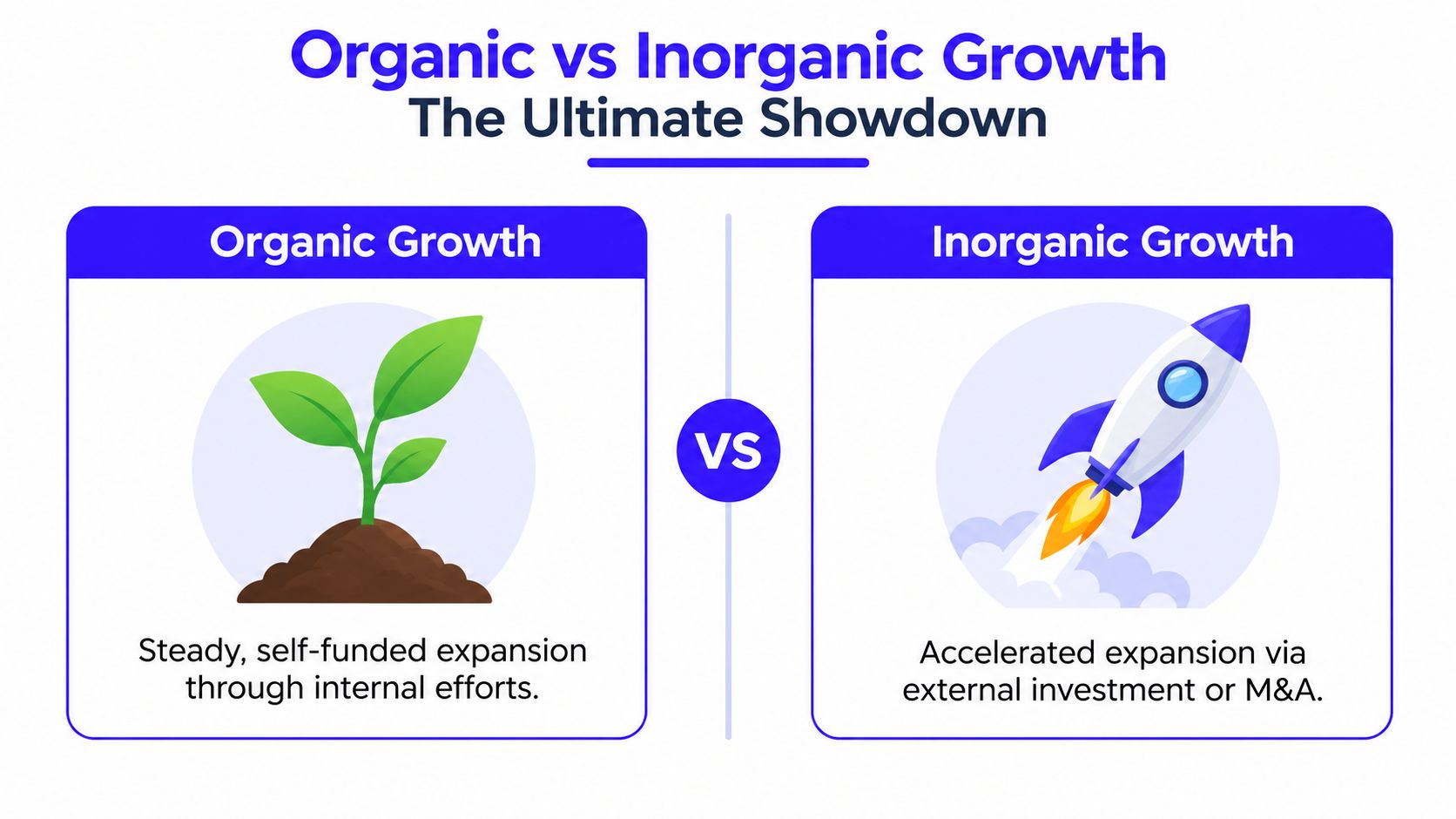
The cleanest way to frame the trade-off is build it versus buy it. Organic growth means expanding through the business you already have. Inorganic growth means adding growth from outside, usually through mergers, acquisitions, or other external transactions. Accounting guidance draws that line clearly by separating internally generated sales from acquired revenue when measuring organic growth AccountingTools on organic growth.
Speed, control, and what founders usually miss
Inorganic growth can move fast on paper. It may add customers, revenue, or capability quickly, which is why it looks attractive when a founder feels behind. Speed is not the same thing as control, and it is rarely the same thing as integration quality. Once you buy growth, you also buy systems, people, incentives, and cleanup work.
Organic growth takes longer to show up, but it gives you more operating control. You can tune the pricing page, sharpen messaging, improve onboarding, and reduce churn without negotiating with another company's structure. That matters in startups, where focus is already scarce.
A founder's real choice is usually not between good and bad growth. It is between growth that compounds inside the business and growth that depends on external transactions.
The strategic trade-offs that really matter
Organic growth is generally more controlled and sustainable because it comes from internal capabilities such as sales, marketing, product development, customer retention, and operational efficiency KPMG Organic Growth Barometer 2017. That does not make inorganic growth bad. It means the two methods solve different problems.
If you need a capability fast, buying can make sense. If you need a business model that is repeatable, measurable, and easier to compound, organic growth is usually the cleaner answer. For early-stage founders, the better path is often to use inorganic moves sparingly and keep the core growth engine internal. That way, the company does not depend on purchases to stay interesting.
The Four Engines of Organic Growth
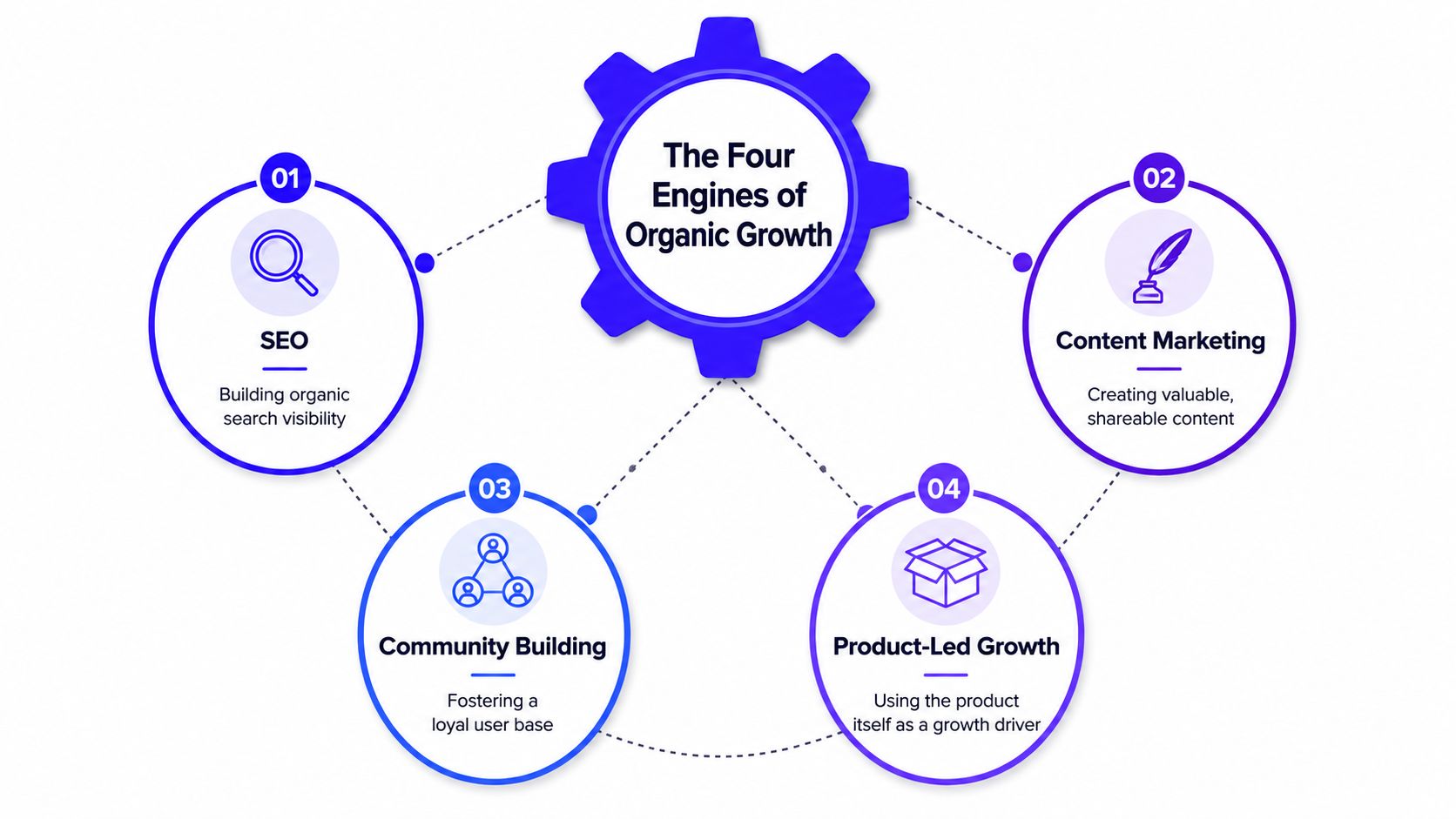
Organic growth works best when it behaves like a system, not a stunt. The four engines below don't replace each other. They reinforce each other when the message, offer, and measurement are aligned.
SEO and content that pull demand instead of shouting for it
SEO captures intent. Content gives that intent somewhere useful to land. Together, they create the most durable version of non-paid demand because they meet people while they're already looking for a solution. That's why a startup should think in topics, not random blog posts.
A good low-budget move is to build one page or post around a real customer question, then connect it to a practical next step. If you need a model for how content operations can support startup growth, this guide on content marketing for startups is a useful reference point for shaping ideas into pipeline.
Email and CRM that turn interest into repeat business
Most startups leak value after the first click. Email and CRM plug that hole. A basic lifecycle sequence, tagged properly inside your CRM, lets you follow up when attention is highest instead of waiting for a rep to remember the lead exists.
The simplest tactic is a short welcome flow tied to a single conversion goal. Don't overbuild it. Get the segmentation right, keep the message specific, and make sure every reply and click has a home in the CRM.
Product-led growth that makes the product do the selling
Product-led growth works when the product itself creates activation, retention, or referrals. That could mean a free trial, a freemium path, a fast setup experience, or a feature that spreads naturally across a team. The product becomes part of the acquisition motion instead of sitting behind it.
A founder can start by removing one extra step from signup or onboarding. If users can reach value sooner, the product stops acting like a brochure and starts acting like a salesperson.
Community building that gives your brand a memory
Community is the least mechanical engine and often the hardest to fake. It shows up when users help each other, share feedback, and feel like they're part of something useful. That creates trust no ad can buy.
Start small. One recurring customer group, one focused Slack channel, one founder-led roundtable, or one weekly office hour can be enough to create the early signals of belonging. Organic growth gets stronger when people talk about the business without being prompted.
Measuring Your Momentum Key Organic Growth Metrics
The clean financial version of organic growth is simple: compare the current period's organic revenue to the previous period's organic revenue, then express the difference as a percentage. That formula is commonly written as (\frac{\text{Current Period Organic Revenue} - \text{Previous Period Organic Revenue}}{\text{Previous Period Organic Revenue}} \times 100%), and the comparison should be year-over-year because monthly data can be noisy and seasonal Umbrex on organic revenue growth rate.
Revenue tells the story, but the funnel explains it
That top-line metric matters because it tells you whether the core business is expanding. But founders don't manage revenue directly, they manage the mechanics behind it. That's where conversion rates, churn, retention, and customer acquisition cost come in. These are the operating levers that show whether growth is healthy or just loud.
A useful way to think about it is this. Revenue is the scoreboard. The funnel is the tape review.
If you can't trace a revenue change back to a channel, campaign, or product behavior, you don't have an insight problem. You have an attribution problem.
Attribution has to be boring on purpose
Organic growth gets misread all the time because tracking is messy. A lead might discover you through search, return through email, convert after a demo, and get logged in the CRM by a rep. Without a single source of truth, each team tells a different story about what happened.
That's why attribution isn't a vanity exercise. It's how you separate internal growth from external noise. If your data stack can't show where revenue came from, then your organic growth rate may be technically correct but operationally useless.
What to watch in the day-to-day
At a startup level, the useful question is not “Did traffic go up?” It's “Did the right traffic show up, convert, and stay?” That means pairing financial measurement with the practical indicators that show whether the growth engine is working. Clean tracking, consistent definitions, and a disciplined CRM matter more than a fancy dashboard.
Organic growth becomes credible when the reporting trail is clean enough that you'd be comfortable showing it to an investor or board member without a long speech to explain the gaps. That's the standard.
Learning from the Masters Organic Growth Case Studies
HubSpot made a career out of turning search intent into compounding demand. The pattern was never “publish random blogs.” It was SEO plus content, organized around the questions buyers were already asking. That's the difference between content as output and content as an acquisition system.
Slack's rise is a stronger product-led story. The product gave teams a reason to invite more teammates, which turned usage into internal distribution. That's organic growth at work, because the product itself helped create the next layer of adoption.
Different companies, same operating logic
The common thread is not the industry. It's the discipline. HubSpot used content and search to capture demand. Slack used the product to create expansion. Both turned a single motion into a repeatable engine.
The best organic growth stories usually look obvious after the fact. They weren't obvious while the company was doing the work, because the compounding took time.
There's also a deeper lesson here for founders. None of these companies relied on one channel forever. They aligned multiple engines so the business could keep growing even when one lever slowed down. That's the part many teams miss when they chase a single tactic and call it strategy.
Organic growth looks glamorous only in hindsight. In real time, it looks like steady execution, a lot of measurement, and a refusal to confuse momentum with luck.
Your First 90 Days An Organic Growth Roadmap for Startups
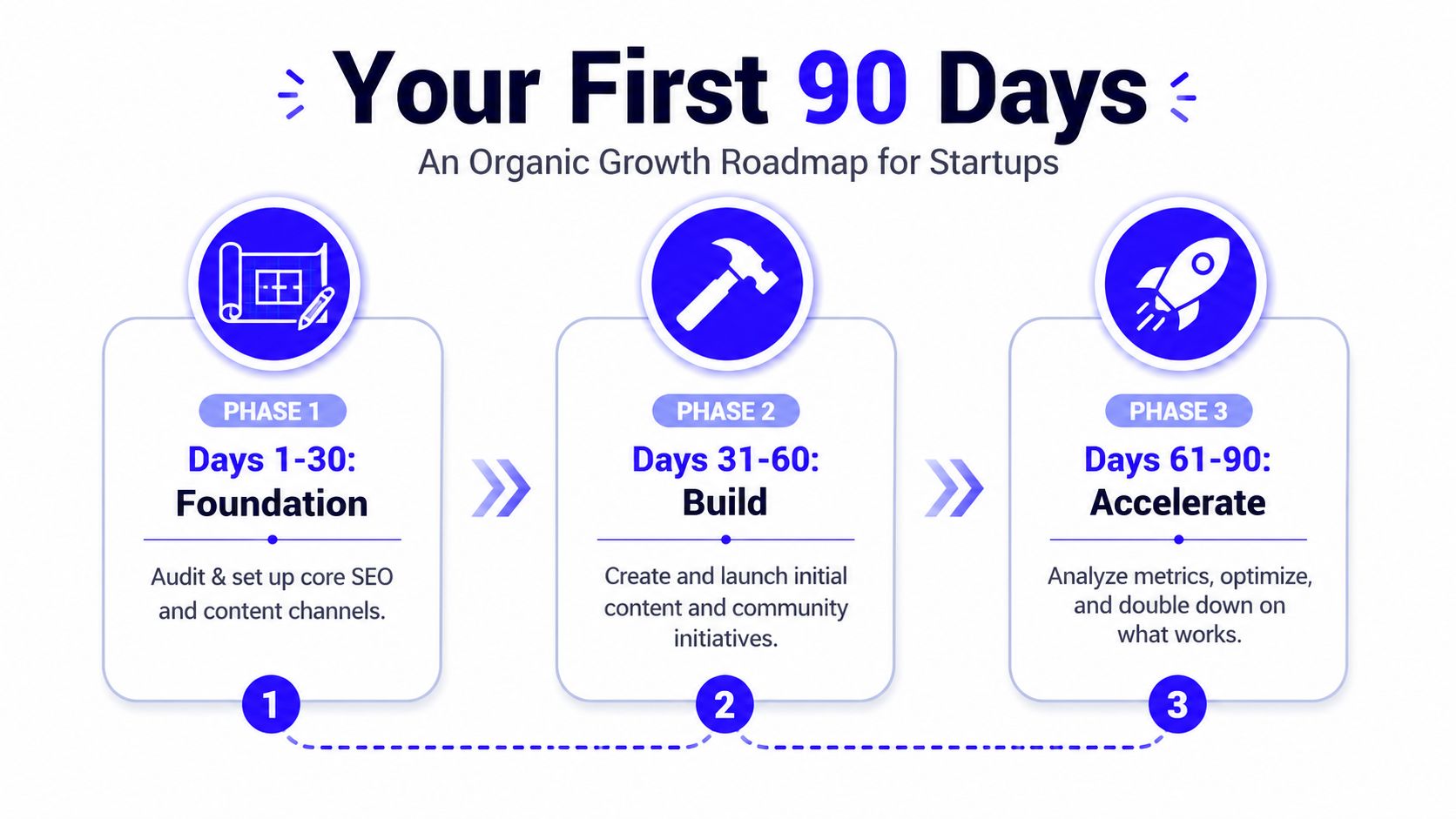
A startup doesn't need to fix everything at once. It needs a sequence that makes the next move easier than the last one. That's what the first 90 days should do.
Days 1 to 30 Foundation
Start with tracking, customer research, and a realistic channel audit. If the data is dirty, every later decision gets distorted. Build the basic reporting path first, then define the core questions your buyers ask before you write more content or launch more campaigns.
A smart first move is keyword and customer interview work, then map that to a small set of pages, offers, or onboarding steps. If you need a practical research process, this guide on how to perform keyword research is a solid reference point.
Days 31 to 60 Build
This is when the first assets go live. Ship the initial content, improve the highest-intent pages, and launch a simple community or email loop that keeps the audience warm. Don't spread effort across too many channels yet.
Focus on one message, one primary acquisition path, and one follow-up flow. That's enough to tell you what the market responds to before you scale the moving parts.
Days 61 to 90 Accelerate
Now the data should start telling you what deserves more attention. Double down on the pages, posts, and lifecycle steps that are helping people convert or return. Cut the pieces that are consuming time without moving the business.
Use the early signal to sharpen the offer, not just the content. If the funnel is healthy, this is when organic growth starts feeling less like experimentation and more like a repeatable operating rhythm.
When to Call in a Growth Partner
Some founders can run the whole organic growth motion themselves for a while. Most can't do it cleanly once tracking, SEO, lifecycle, and channel execution start overlapping. That's where fragmentation shows up fast, especially when freelancers, agencies, and internal teams all own different pieces of the puzzle.
A strong signal that you need help is when your reporting can't answer basic questions with confidence. Another one is when the business is moving, but no one can say exactly which lever is responsible. If that sounds familiar, the issue isn't effort. It's coordination.
Look for one system, not four disconnected vendors
The strongest model is a partner who can connect strategy, implementation, and measurement in one cadence. That matters because organic growth depends on continuity. If the person planning the work never touches the tracking, and the person touching the tracking never sees the revenue outcome, the loop breaks.
A fractional leadership model can help too, especially when the startup needs senior judgment without hiring a full-time executive. This overview of a fractional CMO for startups is worth reading if you're weighing that option.
If your team is losing time to handoffs, arguing over attribution, or making decisions from incomplete data, bring in a partner who can own the system end to end. Organic growth is easier to scale when one operator can see the whole machine, not just one moving part.
Du Marketing helps startups turn organic growth into a working operating system, with SEO, content, email, tracking, and reporting built to move together. If you want cleaner attribution, tighter execution, and a plan that compounds, visit Du Marketing and see how that setup can fit your growth stage.